- Team Extension
- Content Management Systems (CMS)
- Application Lifecycle Management (ALM)
- Mendix Development Services with HYS Enterprise
- Transport Management Software (TMS)
- Microservices Migration
- IT Security Services
- IT Infrastructure Support
- Web and Mobile Application Maintenance
- Functional Software Testing
- Manual Software Testing
- Digital Banking
- Custom Contact Center Software
- Application Re-Engineering
You might also like
Top IT Outsourcing Companies: Complete Guide to Choosing the Right Provider
What Is IT Outsourcing?
IT outsourcing is a method that is often used among companies that don’t want or don’t need to hire an internal software development team, so they decide to delegate this part of the work to an external team. Initially, this practice was seen as a way just to reduce operational costs, but with time, it has evolved and matured into significant growth capabilities, particularly for businesses that cannot keep up with the rapid pace of AI and cybersecurity advancements.
Types of IT Outsourcing Models
1. Onshore outsourcing.
This model is also known as domestic outsourcing because you hire a team from your own country. It might be your best choice if compliance with local regulations and data sovereignty are the top priorities [4].
| Pros | Cons |
| You operate within your timezone. | You are competing for the same expensive local talent pool that you were trying to avoid by outsourcing. |
| You speak the same language with your team. | |
| It’s easier for team members to attend company on-site events or important strategic meetings. |
2. Nearshore outsourcing.
Nearshoring is when you delegate your IT tasks to the IT software outsourcing companies from the neighbouring countries or within the same time zone. It would be easier to explain with an example: a company from Austria outsources to Poland or Ukraine, or a US firm to Mexico or Canada [5].
| Pros | Cons |
| Significant cost savings (often 30–50% less than onshore) thanks to the ability to choose cheaper countries. | Potentially slightly higher costs than offshore. |
| Keeping the ability to communicate in real time during the workday. | Some minor cultural differences. |
3. Offshore outsourcing.
Offshoring is about hiring an expert team from another geographical region or even continent, like UK companies that hire talent from India or the Philippines.
| Pros | Cons |
| Lowest possible hourly rates and access to massive talent pools. | Significant time zone gaps. |
| Communication lag where a simple question takes a full day to get an answer. |
Read More: Software Development Outsourcing Companies in the Netherlands: A Complete Guide
Benefits of IT Outsourcing Services
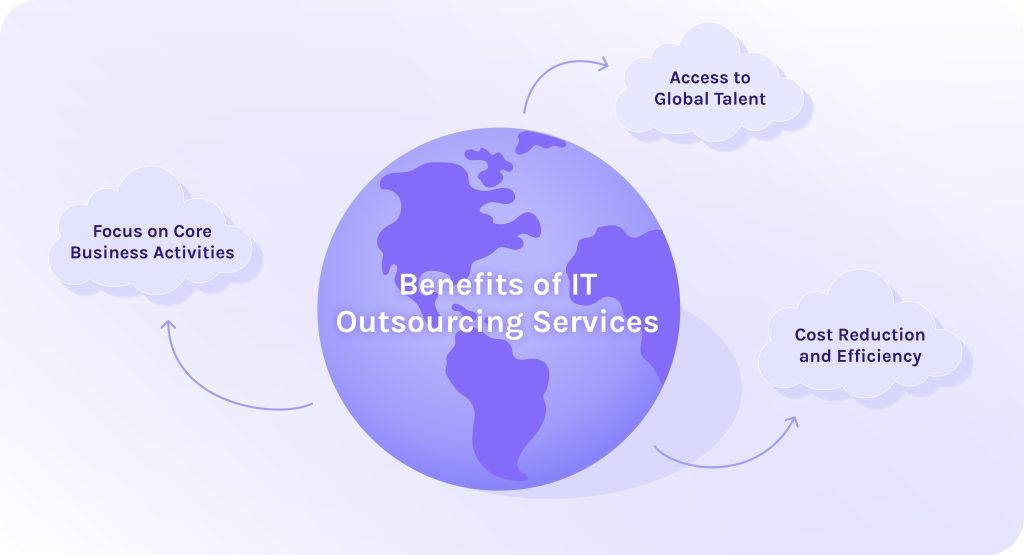
Above, we were talking a lot about the definition and outsourcing in IT companies themselves. Finally, it’s time to discuss what exactly drives companies to outsource the development of their products and services to external vendors.
1. Cost Reduction and Efficiency.
Partnership with IT outsourcing companies allows you to eliminate the massive overhead of full-time salaries, benefits, office space, and specialized hardware. You pay only for the resources you use, providing better cash flow management. According to Salesso insights:
- Recruitment process outsourcing (RPO) leads to a 25-50% reduction in cost-per-hire [6].
- Companies that outsource their software development to cost-efficient regions typically see a 25% to 40% reduction in expenses, with 60% of organizations achieving savings of 30% or more within their first year of partnership [6].
2. Access to Global Talent.
A global IT services market in 2026 faces significant challenges connected to hiring highly-experienced professionals in any industry you can think of. It is an interesting paradox: technology is everywhere, but specialized expertise is limited. At the same time, each unfilled position costs companies approximately $500 per day. Now imagine that it takes months to hire a needed specialist, and how many investments companies lose.
Outsourcing, in turn, helps companies to hire talent abroad and extend overall hiring capabilities. According to the stats, hiring time lowers up to 30-55%, from 44-100 days to 24-67 days, when companies delegate this process to outsourcing service providers [3].
3. Focus on Core Business Activities.
Every hour your leadership team spends managing server migrations or debugging legacy code is an hour not spent on customer acquisition or product strategy. In this case, collaborating with IT outsourcing companies allows your C-level executives and senior engineers to focus on strategic activities that directly drive revenue and market share [7].
Read More: Top 8 Software Development Companies in Poland 2026: Rankings & Reviews
How We Selected the Best IT Outsourcing Companies
To be as objective as possible, we evaluated each outsourcing service provider below through these primary aspects:
- How many years a company has been present in a market – we selected outsourcing IT companies with more than 10 years of experience, because by now they have gained significant expertise and recognition from the international community.
- What industries a company serves – when you know specific domains the company has experience in, you can understand if it is familiar with specific regulations or exact technologies of the needed industry [9].
- What technologies are they using – we checked IT outsourcing companies’ tech stack to ensure they don’t just follow trends but possess real, deep expertise in core modern pillars like agentic AI or cloud native technologies.
- What services they provide – we analyzed IT outsourcing services of each company to identify whether they offer end-to-end support or specialize in niche areas.
- Where their offices are located – we looked for IT outsourcing companies with offices in the CEE (Central and Eastern Europe) region to evaluate their ability to provide nearshore and offshore collaboration with the necessary time zone and cultural alignment.
Read More: Top 10 AI Software Development Companies (2026 Guide)
Top IT Outsourcing Companies
In this article, we concentrated on the Central and Eastern European region. You may ask, “Why exactly in this region?” In this case, statistics is self-explanatory:
- According to recent market forecasts, the European IT outsourcing sector is on track to reach a staggering $282 billion by 2030, maintaining a steady annual growth rate of roughly 7.4% [14].
- The CEE region has 2.2+ million tech specialists [15].
- Key IT outsourcing companies are located in Poland, Ukraine, and Romania [16].
Best IT Outsourcing Companies in Central and Eastern Europe
1. HYS Enterprise
HYS Enterprise is one of the leading IT outsourcing companies in the CEE region with its offices in Ukraine and Poland. Headquartered in Amsterdam, Netherlands, it has been delivering quality software development outsourcing services for over 15 years and, over the years, has gathered a team of over 200+ qualified professionals with experience within a diverse set of industries and domains.
The company is recognized globally as a trustworthy and reliable partner, being featured in prestigious lists such as the Peak Value fastest-growing IT company among Dutch enterprises.
What industries does this company serve?
Among our clients, we work with industry leaders across a wide range of sectors, to be more precise we have experience in telecommunications, finance & banking, logistics, and energy [10].
What technologies do they use?
Our specialists have significant experience building advanced software technologies like:
- Agentic AI.
- AI agent orchestration.
- Machine learning.
- Generative AI.
- Cloud computing.
- AI-augmented software, etc.
What services does it provide?
- IT consulting.
- Custom software development.
- Software modernization.
- Enterprise applications.
- Digital transformation.
- Quality assurance.
- Cloud migration.
- AI software development.
Where is the main office located?
Amsterdam, Netherlands. Additional offices are located in Odesa (Ukraine) and Bydgoszcz (Poland) [10].
Among big companies, HYS Enterprise had collaborations with Dutch media company FCCE, transportation company FiLogic, and Swishfund.
The IT environment moves fast, and technologies never stand still. Thus, our team is always ready to implement your ideas into life. Reach out today to discover how our experience may help your business succeed.
2. Netguru
With a rating of 4.8/5 on Clutch, Netguru is considered to be one of the most widely known IT outsourcing companies in the Central and Eastern Europe. It was founded in 2008, and since then, its team has expanded to around 900+ members scattered around the globe [12].
What industries does this company serve?
- Finance and banking.
- Healthcare.
- Education.
- Proptech.
What services does it provide?
- Almost any type of software development.
- Product and strategy design.
- AI and data science.
- Cloud migration.
- Quality assurance.
- Product management.
Where is the main office located?
Head office in Poznań, Poland. Additional offices are located in Poland as well, exactly in Warsaw, Kraków, Wrocław, Gdańsk, Białystok.
3. SoftServe
One of the largest global IT outsourcing firms with deep Ukrainian roots. It was founded in 1993, and since then, remains one of the greatest market outsourcing leaders with a strong presence in many countries and regions all over the world [11].
What industries does this company serve?
- Financial services.
- Healthcare.
- Retail.
- High tech.
- Energy.
- Manufacturing.
What services does it provide?
- AI and machine learning.
- Cloud migration and modernization.
- Internet of Things.
- Cybersecurity.
- Custom software development.
Where is the main office located?
Headquarters in Austin, USA. Other offices are located in almost every Ukrainian city, in the USA, with a strong presence in the CEE region and Latin America.
4. N-iX
N-iX is another member of our list of the best IT outsourcing companies, which also stems from Ukraine. It was founded in 2002 and was then called Novellix. It distinguishes itself by focusing on the measurability of AI—specifically, how AI tools impact codebase quality and engineering velocity before scaling them across an enterprise [13].
What industries does this company serve?
- Finance.
- Retail.
- Healthcare.
- Telecom.
- Manufacturing.
- Energy.
- Logistics.
- Game Dev.
- Agritech.
- Automotive.
What services does it provide?
- Software engineering.
- Embedded and IoT.
- Business workflow automation.
- Data and analytics.
- Cloud solutions.
- Digital transformation.
Where is the main office located?
Headquarters in Lviv, Ukraine. Also has offices in Poland, the USA, Malta, and Sweden.
5. Sigma Software
Interestingly, lots of IT outsourcing companies on our list originated in Ukraine, and Sigma Software isn’t an exception. It is also one of the best companies that provides outsourcing services to help you with digital transformation and innovations in many industries.
What industries does this company serve?
- Logistics.
- Manufacturing.
- Healthcare.
- Finance.
- Automotive.
- Adtech.
- Defense.
- Aviation.
What services does it provide?
- Software development.
- Enhancing customer experience.
- Software modernization.
- AI software development.
- Cybersecurity.
Where is the main office located?
Headquarters in Kyiv and Kharkiv, Ukraine. Additional offices in many European countries, in Latin and North America, and the Middle East.
6. EPAM Systems
This organization is also one of the best IT outsourcing companies with global presence in CEE, the USA, and Latin America. In 2026, EPAM was recognized as Google Cloud Partner of the Year for proven deep Google Cloud and AI expertise [8].
What industries does this company serve?
- Software development.
- Healthcare.
- Industrial.
- Financial.
- Telecom.
- Education.
What services does it provide?
- Software engineering.
- Strategy development.
- Digital transformation.
- AI software development.
- Cloud computing.
- Cybersecurity.
Where is the main office located?
Headquartered in Newtown, Pennsylvania, USA. Additional offices are scattered around the world in such countries as the USA, Ukraine, India, China, and across Europe.
7. DataArt
Founded in 1997, DataArt still remains one of the strongest market players among IT outsourcing companies with a presence in many regions around the world. Over the years of hard work and successful cases, it has won many awards, such as the Stevie Award in 2026, the Global Outsourcing 100, and others.
What industries does this company serve?
- Media.
- Finance.
- Healthcare.
- Travel.
- Retail.
- Manufacturing.
What services does it provide?
- Software engineering.
- Cloud technologies.
- AI software development.
- Cybersecurity.
- UI/UX design.
- Product strategy.
Where is the main office located?
Headquarters in New York City, USA. Additionally, has offices in Ukraine, Poland, and other European cities. As well, it has a strong market presence in Asia, the USA, and Latin America.
8. Civitta
Civitta distinguishes itself as a company that blends digital and consulting services for various clients from the Nordic to Central Asia. Compared to other companies outsourcing IT services, this one is relatively young (established in 2013), but it is already recognized as a leading independent consultancy.
What industries does this company serve?
- Telecom.
- FinTech.
- Public sector.
- Aviation.
- NGOs.
- Energy.
What services does it provide?
- Mobile app development.
- Custom software development.
- Digital transformation.
- Marketing.
- AI software development.
- Staff augmentation.
Where is the main office located?
Headquartered in Tartu, Estonia. Has additional offices around Europe and Central Asia.
9. Svitla Systems
This organization from our list of IT outsourcing companies helps both startups and Fortune 500 enterprises to succeed in their endeavors.
What industries does this company serve?
- Financial services.
- Education.
- Cybersecurity.
- Information technologies.
- Healthcare.
What services does it provide?
- Artificial intelligence and machine learning.
- Big data.
- Cybersecurity.
- Cloud solutions.
- Digital transformation.
- DevOps.
Where is the main office located?
Headquartered in Corte Madera, California, the USA. Has additional offices across Europe, the US, Latin America, and Asia.
10. Evozon
Evozon is recognized as one of the largest and most technically stable independent software houses and IT infrastructure outsourcing companies in Romania. It is based in the so-called “Silicon Valley of Romania” – Cluj-Napoca, and over the years it has built a reputation for handling complex, high-load enterprise projects.
What industries does this company serve?
- Smart cities.
- Healthcare.
- Banking.
- E-commerce.
- Mobility.
What services does it provide?
- IT consulting.
- Quality assurance.
- Data science.
- AI software development.
- Cloud solutions.
- ERP systems.
- UI/UX design.
Where is the main office located?
Headquartered in Cluj-Napoca, Romania.
Read More: What Are the Top 10 n8n Alternatives to Watch This Year
How to Choose the Right IT Outsourcing Service Provider
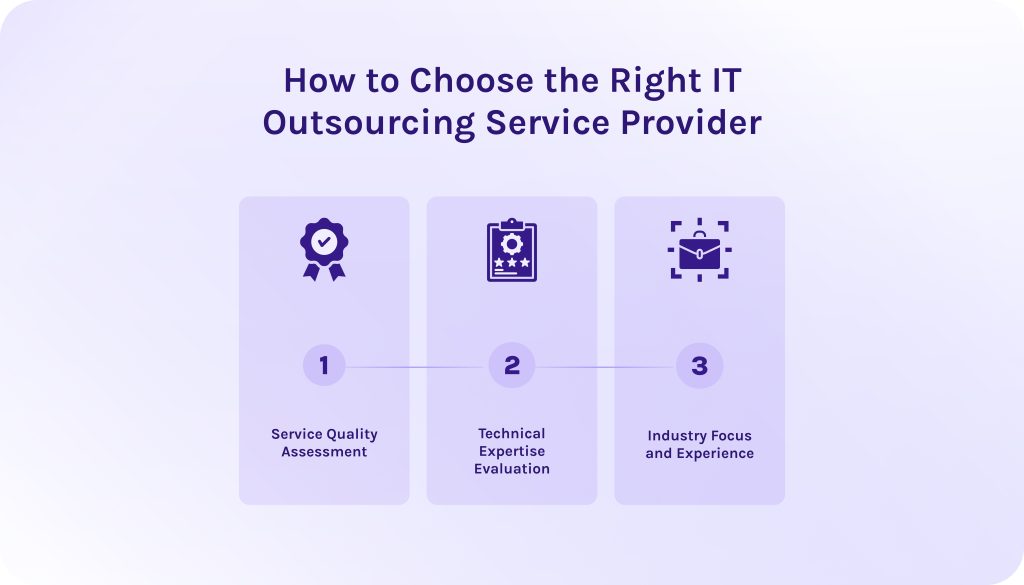
To choose an ideal partner and ensure your future success, use this three-rule framework:
1. Service Quality Assessment.
Look for outsourcing IT services companies that use advanced data analytics and track their progress in unified dashboards to ensure full visibility of ongoing processes. Ask how they handle risks and ensure they have a proactive mitigation strategy. As well, it’s extremely necessary to check reviews and feedback from clients on independent platforms to understand what is true about the company and what is not.
2. Technical Expertise Evaluation.
Ask how the global IT services vendor integrates the newest technologies like agentic AI and Copilots into their own SDLC (Software development lifecycle). A high-tier partner uses AI not just to write code, but to automate documentation, predict potential bugs before they reach production, and optimize cloud resource allocation.
Also, ask about their hands-on experience with modern cloud infrastructures (AWS, Azure, GCP) and cybersecurity.
3. Industry Focus and Experience.
Search for outsourcing service providers that have experience in your industry to ensure they are familiar with regulations and specific technical hurdles. This allows them to quickly react to changes in laws and adjust processes to them. Also, it is important to review the success cases of your potential provider and check for measurable outcomes, like reduced time-to-market or the percentage of increased ROI. This will help you to understand if their marketing matches the exact results.
Read More: Outsourcing vs Outstaffing: Key Differences and Which Model to Choose
Common Challenges in IT Outsourcing and How to Overcome Them
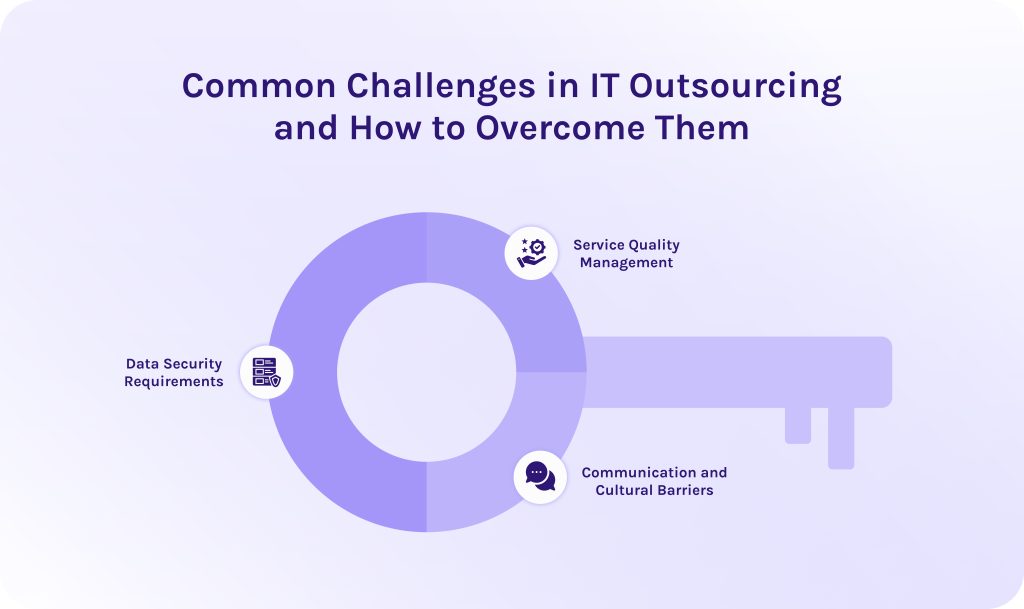
Taking into account all its advantages, we also need to talk about the challenges of IT companies outsourcing and how to tackle them hands-on.
Data Security Requirements
The challenge
If you trust your sensitive data or customer data to an external global IT services provider, it increases the possibility of data leaks and creates potential legal liabilities.
How to overcome it?
- Transition from traditional VPNs to a zero-trust model where every user and device must be continuously verified, regardless of location.
- Only partner with firms holding ISO 27001 and SOC 2 Type II certifications.
- Use “synthetic data” and encryption for development and testing so that offshore IT outsourcing companies’ teams never see real customer PII (Personally Identifiable Information).
Service Quality Management
The challenge
Discrepancies between what was promised in the sales pitch and what is actually delivered, leading to technical debt.
How to overcome it?
- Use integrated dashboards (like Jira or Azure DevOps) to monitor real-time metrics and progress.
- Implement strict “Definition of Done” (DoD) protocols from Agile project management methodology, where code cannot be merged without passing automated AI-driven testing and peer reviews.
Communication and Cultural Barriers
The challenge
The hidden cost of software outsourcing services is often the time lost to misunderstandings or mismatched business etiquette. Different interpretations of urgency, reluctance to report bad news (common in some hierarchical cultures), and time-zone lag.
How to overcome it?
- Mandate a minimum of 4 hours of workday overlap (usually achieved through nearshoring) for real-time collaboration and stand-up meetings.
- Use asynchronous tools to provide video context and written specs, reducing the chance of requirement drift.
- Conduct bi-directional workshops to align business values.
Read More: Product Portfolio Management Tools: Complete Guide to Choosing the Best Solution in 2026
Final Thoughts
In 2026, organizations decide to partner with IT outsourcing companies to save costs on the one hand, but on the other to gain a competitive advantage, delivering services faster while maintaining their high quality.
A Central and Eastern European IT hub has emerged as the premier destination for this strategic shift, offering a rare combination of deep-tier technical expertise, cultural proximity to Western markets, and a resilient workforce that has mastered the complexities of agentic AI and cloud-native engineering.
HYS Enterprise, as a part of this shift, is a global IT services provider that offers its clients a unique blend of Dutch management precision and elite Ukrainian and Polish engineering talent, ensuring that complex projects in telecom, finance, and logistics are not only delivered on time but are built on a foundation of future-proof, AI-driven architecture. Contact our experts today to learn how our expertise can help you transform your most ambitious technical challenges into a scalable reality.
FAQs
1. What is outsourcing and why do companies do it?
IT outsourcing is a strategic business process aimed at hiring an external team of specialists to handle specific management responsibilities or, for example, software development instead of managing them in-house.
2. What is the difference between onshore, nearshore, and offshore outsourcing?
The difference between these IT outsourcing models lies primarily in their geography, time zone alignment, and cost.
- Onshore – it involves hiring an IT outsourcing company located within your own country. Advantages of this model are that you can speak with the executors in the same language, they have a similar culture, and the same timezone. It is ideal for highly sensitive projects or those requiring frequent on-site visits. However, if we are talking about the pricing, this is the most expensive model, because you’re paying local market rates for labor.
- Nearshore – this involves partnering with IT outsourcing services companies in a neighboring country or a similar time zone (e.g., a Western European company outsourcing to Poland or Ukraine). It offers significant cost savings compared to onshore, but with 100% time zone overlap for Agile collaboration. Slight cultural or language differences may exist, though these are usually minimal.
- Offshore – this involves working with IT outsourcing firms in a distant geographic location, often on a different continent (e.g., a US company outsourcing to India or Vietnam). This software outsourcing services model offers the highest cost reduction, and here work continues while your local office is asleep. However, the major disadvantage here is significant time zone gaps.
3. Who are the best IT outsourcing companies?
From our perspective, in the CEE region, the best IT outsourcing companies are HYS Enterprise, Netguru, SoftServe, N-iX, Sigma Software, EPAM Systems, DataArt, Civitta, Svitla Systems, Evozon.
4. What are the most popular pricing models in outsourcing?
The most popular pricing models in outsourcing services are:
- Time and materials. You pay for the actual hours worked by the specialists and the cost of any third-party tools or licenses.
- Managed services. The outsourcing IT companies take full responsibility for a specific function for a fixed monthly fee.
- Outcome-based. You pay for specific results of your collaboration, like a 20% increase in application performance.
- Project-based (fixed). The total cost is agreed at the very beginning based on a very strict and detailed project specification.
- Monthly rate per person. You hire a team of specific specialists who work exclusively on your project for a monthly rate per person.
5. What are the key benefits of hiring IT outsourcing companies in 2026?
If we’re talking about why exactly companies tend to outsource their software development to IT project outsourcing companies, the answer lies in three core benefits described below:
- Collaboration with software outsourcing companies leads to up to 40% operational cost reduction and significant efficiency growth.
- It provides access to the global talent pool, giving companies the ability to hire narrowly focused specialists all over the world.
- Ultimately, it helps leadership to focus on their strategic tasks rather than day-to-day execution.
6. How do I evaluate an IT outsourcing firm’s technical proficiency?
To evaluate the technical expertise of your future IT outsourcing service partner:
- Assess how exactly they integrate AI into their internal software engineering process.
- Evaluate their ability to manage cloud costs.
- Present a real business problem you are facing and ask them to whiteboard a high-level architecture. Look for the ability of the global IT services vendor to handle scalability, latency, and data sovereignty.
7. What are the biggest risks of partnering with IT outsourcing companies?
While collaboration with IT services outsourcing companies offers a fast track to innovation, it also introduces specific operational and strategic risks.
- Shadow AI and data security concerns. Outsourced developers use unauthorized AI tools (like public LLMs) to process your proprietary code. If not strictly governed, your intellectual property could end up in a public training set, leading to catastrophic leaks.
- External provides handles the entire knowledge base about your system. If you decide to end the partnership, you may find that your internal team no longer understands your own infrastructure, creating a so-called vendor lock-in problem.
- Hidden operational costs. Even when you pay for what you agreed to pay, there are hidden tricks that can erode your budget, like long internal processes or moving data back to you or to a new provider.
- Cultural and communication friction. The differences in how teams define “done,” how they raise red flags, or how they interpret hierarchy.
8. What IT functions are most commonly outsourced today?
According to the Fieldfishers statistics, the most outsourced IT services are the following ones:
- IT support – 75%.
- Software application and development – 69%.
- Human resources – 44%.
- Finance and accounting – 44%.
- Facilities management – 31%.
9. When should a company not outsource its IT?
You should avoid outsourcing services if the technology is your core intellectual property that provides your primary competitive advantage. Additionally, if a project requires extremely high levels of daily, on-site physical collaboration, an internal team is usually the more effective choice.
10. How companies measure ROI from IT outsourcing?
Companies typically measure ROI from partnering with a global IT services provider through four key lenses:
- Financial impact (hard ROI). This is the most direct measurement, comparing the total cost of outsourcing against the cost of an equivalent in-house operation.
- Speed and productivity (efficiency ROI). Companies track how much faster a product reaches the market with an external partner.
- Quality and innovation (strategic ROI). Measuring how often new code deployments cause system failures. A high-quality partner reduces this rate, saving thousands in emergency fixes.
- Business growth (outcome-based ROI). Attributing a percentage of new revenue to features built by the outsourced team.
References:
- https://www.manpowergroup.com/vi/news-releases/news/global-talent-shortage-reaches-turning-point-as-ai-skills-claim-top-spot
- https://res.cloudinary.com/fieldfisher/image/upload/v1715942364/PDF-Files/Outsourcing_survey_results_oq54ms.pdf
- https://salesso.com/blog/recruitment-outsourcing-statistics/
- https://www.researchgate.net/publication/220892264_IT_Enabled_Business_Process_Onshore_Outsourcing_An_Empirical_Analysis
- https://www.researchgate.net/publication/220985036_The_Importance_of_Being_Nearest_Nearshore_Software_Outsourcing_and_Globalization_Discourse
- https://zipdo.co/outsourcing-statistics/
- https://www.researchgate.net/publication/401345104_Outsourcing_Benefits_And_Complications
- https://www.researchgate.net/publication/378255029_Case_25_EPAM_Systems_Inc
- https://www.researchgate.net/publication/280859493_Outsourcing_A_Guide_to_Selecting_the_Correct_Business_Unit_Negotiating_the_Contract_Maintaining_Control_of_the_Process
- https://www.hys-enterprise.com/about-us/
- https://www.researchgate.net/publication/380377192_MODERN_APPROACHES_TO_PERSONNEL_PROFESSIONAL_DEVELOPMENT_MANAGEMENT_IN_IT_ENTERPRISES_THE_EXPERIENCE_OF_SOFTSERVE
- https://clutch.co/profile/netguru
- https://clutch.co/profile/n-ix
- https://www.grandviewresearch.com/horizon/outlook/it-services-outsourcing-market/europe
- https://www.n-ix.com/it-outsourcing-destinations-eastern-europe-market-report/
- https://ceeoa.org/news/ceeoa-news/it-outsourcing-in-cee/
Outsourcing vs Outstaffing: Key Differences and Which Model to Choose
What Is IT Outsourcing and How Does It Work?
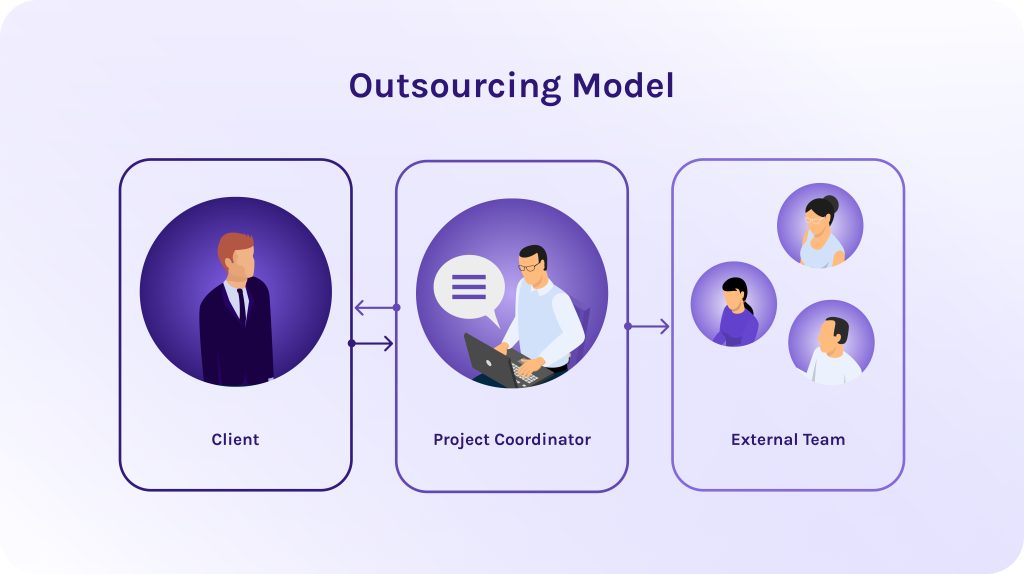
At its core, IT outsourcing is the practice of hiring an external service provider to take full responsibility for a specific IT function, project, or entire business process. Instead of managing individual workers, you are essentially buying a finished product or a managed service [3].
How does it work in practice?
Typically, outsourcing partnership workflow follows a structured algorithm designed to minimize your day-to-day involvement in the development process [4]:
- Define functional requirements and milestones. You provide the vendor with a detailed project roadmap, business goals, and technical requirements. Clearly identify specific features that your software must have, explain why you need exactly these features, how they should work, what tech stack you want to use, and, ultimately, when you want the project to be done [4].
- Selecting the vendor and scope of work. You choose a partner who estimates the cost and timeline. In this model, contracts often have fixed prices (for well-defined projects) or time and materials pricing for time and resources spent to execute the project.
- Team assembly from the vendor side. The outsourcing company selects the developers, designers, and testers from their internal bench. You generally do not interview the individual team members [5].
- Finding a perfect project manager. The vendor assigns a project manager (PM) who serves as your primary point of contact. The PM translates your goals into tasks for the developers and ensures the team hits milestones [6].
- Quality assurance and project delivery. The vendor is responsible for testing the code and ensuring the final deliverable meets the agreed-upon standards before handing it over to you [4].
Read More: Top 8 Software Development Companies in Poland 2026: Rankings & Reviews
Who is it best for?
Pretty often, global outsourcing is an ideal approach for companies that need a ready product without hiring an IT team.
- Non-technical founders who don’t have the expertise to manage a team of developers [8].
- Companies with projects that need to be done just once, like building a mobile app or migrating a database [8].
- Enterprises looking to outsource non-core functions so their internal team can focus on business strategy [8].
What Is Outstaffing in IT and How Does It Work?
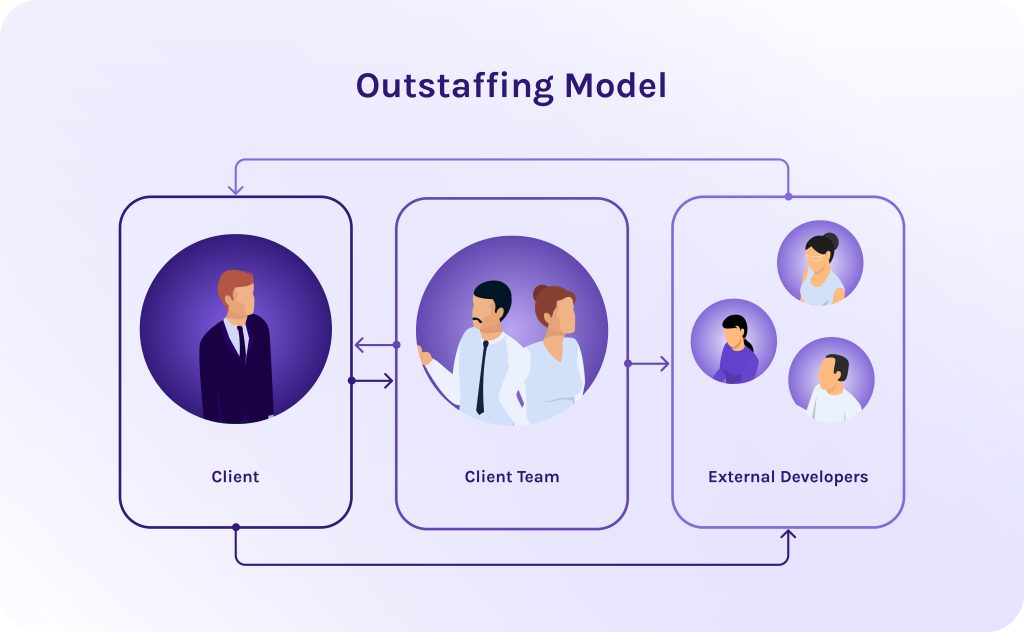
If outsourcing is like hiring a construction company to build you a house, outstaffing is like hiring a specialized crew of builders to work directly under your architect [7].
In this model, you are hiring expertise. The outstaffing provider (the vendor) acts as a specialized HR and administrative partner. They provide you with full-time, dedicated developers who work exclusively for you but officially remain on the vendor’s payroll [7].
How does it work in practice?
The outstaffing workflow is much more integrated than outsourcing:
- Hiring directly the talent that meets your requirements. You tell the vendor exactly what kind of expert you need. Then, the vendor sends you CVs, and you interview and vet them just like you would a local hire.
- Onboarding. Once you hire a specialist, they are integrated into your internal team. They get a company email, access to your internal tools, and attend your daily stand-ups.
- Direct management. You assign their daily tasks, review their code, and manage their workflow. They follow your company’s coding standards and culture.
- Vendor operations management. While you manage the work, the vendor manages the person. They handle monthly salary and bonuses, taxes and legal compliance, equipment, offices, retention, and HR support.
Read More: Software Development Outsourcing Companies in the Netherlands: A Complete Guide
Who is it best for?
Outstaffing is the perfect choice for companies that need control over processes:
- Tech-driven startups with an existing CTO who needs to scale the team fast without the overhead of local hiring [9].
- Companies with long-term projects that require deep product knowledge that shouldn’t leave when a contract ends [9].
- Businesses that need specific niche skills that are too expensive or hard to find in their local market [9].
Outsourcing vs Outstaffing: Key Differences Comparison
Now, let’s take a quick look at the main points of difference between outsourcing and outstaffing.
| Feature | IT outsourcing | IT outstaffing |
| Management | Handled by the Vendor (via their PM). | Handled by You (via your CTO/Lead). |
| Hiring process | Vendor selects the team internally. | You interview and vet each candidate. |
| Pricing model | Fixed price or time & materials. | Monthly salary + Vendor commission. |
| Best for | One-off projects;
non-tech companies. |
Long-term growth;
tech-heavy startups. |
| Responsibility | Vendor is responsible for the result. | You are responsible for the result. |
Read More: Top 10 AI Software Development Companies
Benefits and Advantages of IT Outsourcing
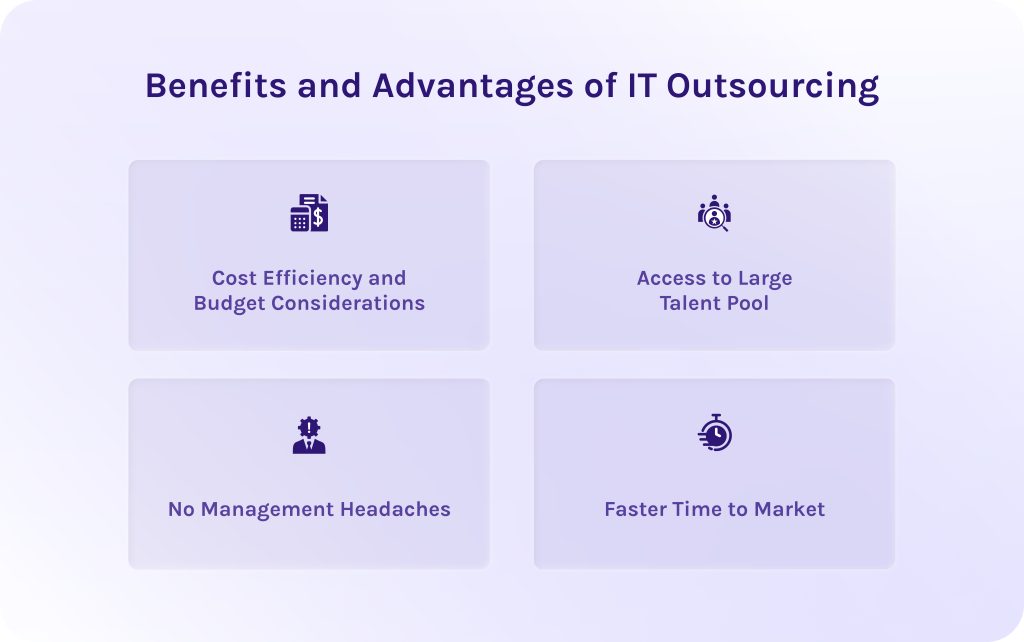
If we compare outsourcing and outstaffing of developers, we’ll see that the primary allure of outsourcing is the total delegation of responsibility. It allows you to transform IT from a complex operational burden into a streamlined service you simply consume.
The IT outsourcing market is projected to reach $856.1 billion by 2034. The market’s annual growth remains at its steady growth rate of 3.5% over the next decade. But what are the reasons that make outsourcing so popular [1]?
Here is a deeper look at the core benefits:
1. Cost Efficiency and Budget Considerations.
When selecting between outsourcing/outstaffing models, outsourcing seems to be more cost-effective. You don’t need to buy high-end workstations or pay for expensive enterprise software licenses, as well as you don’t need to think about unpredictable extra spendings. You pay only for what you agreed to pay.
2. Access to Large Talent Pool.
If you compare outsourcing/outstaffing models, you’ll see that one of the key strengths of outsourcing is the ability to avoid the problem of finding skilled talent.
According to the Qubit Labs statistics, roughly three out of four companies are currently struggling to find the skilled IT talent they need. Outsourcing software development solves this problem by bypassing local hiring shortages and giving you instant access to specialized expertise [2].
3. No Management Headaches.
This is perhaps the most significant benefit for business owners when they decide between IT outsourcing/outstaffing.
The vendor’s project manager handles all processes connected to the human element. Moreover, you don’t deal with payroll, taxes, sick leaves, or social benefits. If a developer leaves the vendor’s company, they are contractually obligated to replace them immediately without interrupting your timeline.
4. Faster Time to Market.
When speed is your primary competitive advantage, the outstaffing and outsourcing difference is that outsourcing allows you to deliver projects faster and gain a significant competitive advantage. For example, if we are talking only about the hiring process, it can often take 3–6 months, while an outsourcing vendor can often spin up a full team and start coding within 2 weeks.
Read More: Top 5 Best Project Management Methodologies for the IT Industry
Drawbacks and Disadvantages of IT Outsourcing
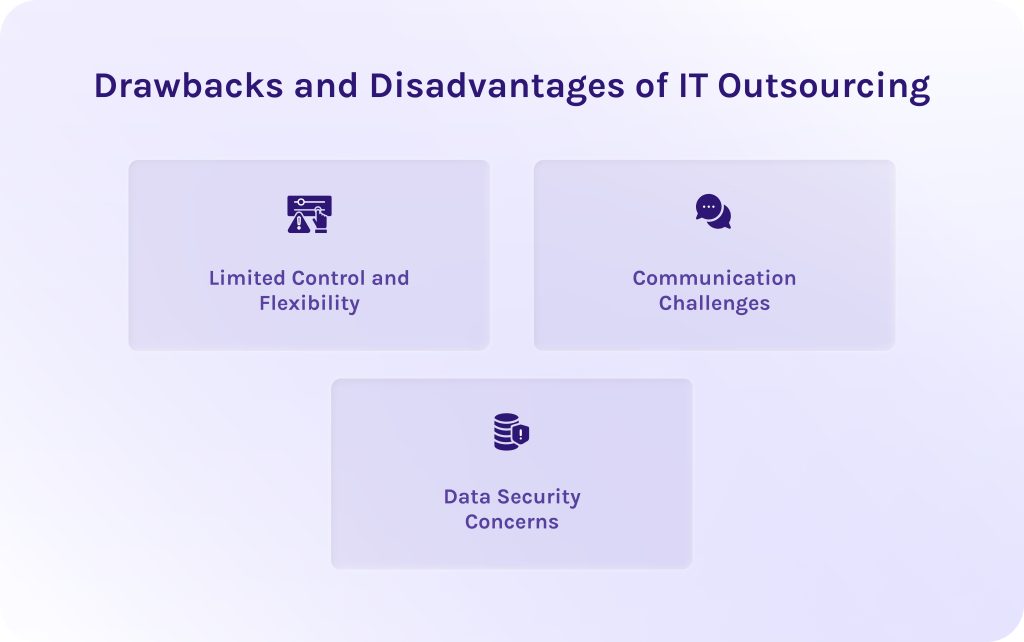
While it offers a hands-off experience, the outsourcing vs. outstaffing comparison wouldn’t be complete without looking at the potential pitfalls of total delegation. When you hand over the keys to a project, you also hand over a significant amount of influence.
1. Limited Control and Flexibility.
In the outsourcing/outstaffing difference analysis, the lack of control is often the biggest hurdle for tech-heavy companies.
You are paying for a result, not a process. This means you have little say in which specific developers are assigned to your tasks or the granular technical decisions they make daily.
Also, outsourcing software development usually relies on a pre-defined contract. If you suddenly want to pivot your strategy mid-project, it often leads to change requests – legal amendments that can result in additional fees and significant timeline delays.
2. Communication Challenges.
When comparing outstaffing/outsourcing workflows, the “middleman” dynamic in outsourcing can lead to friction.
The pitfall of outsourcing software development is that you typically communicate with a project manager rather than the person actually writing the code. This can lead to requirements being misunderstood or nuance being lost.
3. Data Security Concerns.
Handing over your proprietary data to an external entity is always a risk factor in the outsourcing outstaffing ecosystem. You should trust an entire organization’s internal security protocols. Moreover, unless your contracts are in the vendor’s jurisdiction, protecting your intellectual property can become a legal headache if a dispute arises.
Read More: Top 5 IT Outsourcing Trends
Benefits and Advantages of IT Outstaffing
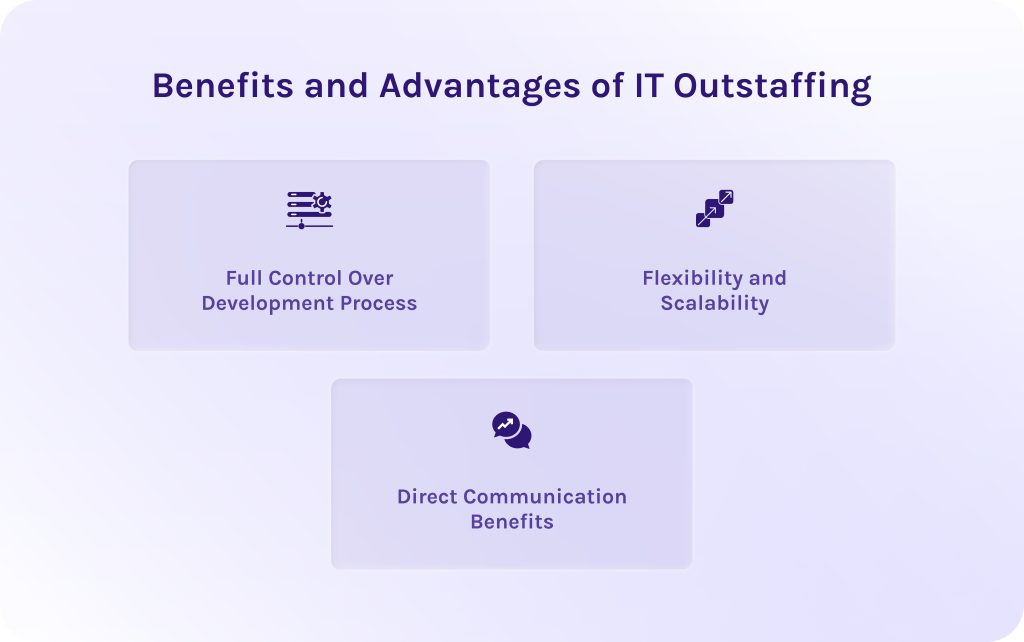
If the hands-off nature of project delegation doesn’t suit your style, the outsourcing outstaffing comparison takes a sharp turn toward the latter. For many tech-centric companies, the primary reason to choose IT outstaffing vs IT outsourcing is the desire to keep their fingers on the pulse of the code.
Here are the core benefits of the outstaffing development:
1. Full Control Over Development Process.
In the outstaffing vs outsourcing pros and cons debate, control is the ultimate advantage for outstaffing. Since the developers are integrated directly into your team, there are no hidden processes or surprise technical debt that you might find in a closed outsourcing project.
2. Flexibility and Scalability.
When weighing outstaffing outsourcing options, outstaffing wins on agility. It allows you to scale quickly on demand and adjust almost immediately to changes, unlike outsourcing, where changing the project scope often requires a legal contract amendment.
3. Direct Communication Benefits.
One of the biggest hurdles in outstaffing and outsourcing is the “middleman” problem. Outstaffing removes the project manager barrier. If a bug appears or a requirement changes, you speak directly to the developer. This eliminates the miscommunication risks that often plague the outsourcing outstaffing dynamic.
Read More: Ultimate Guide: The Best Backlog Management Tools in 2026
Drawbacks and Disadvantages of IT Outstaffing
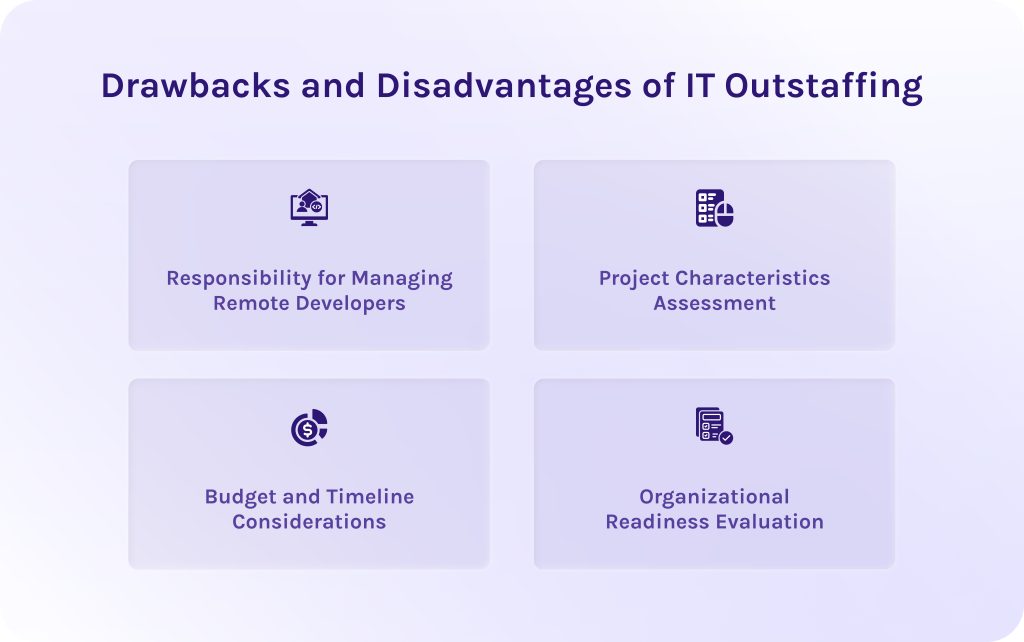
1. Responsibility for Managing Remote Developers.
Generally speaking, this is one of the most significant cons of outstaffing.
As was discussed earlier, in outsourcing, the vendor’s PM handles the team, but here you are responsible for daily tasks, performance reviews, and motivation. Thus, you must actively work to make remote developers feel like part of the team.
2. Project Characteristics Assessment.
If you choose outstaffing but don’t have a clear technical roadmap, your developers will sit idle or build the wrong thing. Another important thing here is the team’s vulnerability, because imagine if your internal lead developer leaves. What are the consequences? Most likely, you are left with a group of outstaffed specialists who have no one to give them direction [10].
3. Budget and Timeline Considerations.
In terms of budgeting, competition between outsourcing/outstaffing models obviously favours outsourcing.
While outstaffing can be more transparent, it often carries hidden management costs. Since you pay for hours/months rather than a fixed project result, an inefficient internal process can cause the project timeline (and budget) to balloon indefinitely [11].
4. Organizational Readiness Evaluation.
Before committing to an outsourcing outstaffing model, you must understand if your company is actually ready for remote collaboration.
Do you have the right tools for remote collaboration in place? And, of course, consider that if your internal team isn’t used to documenting processes or working across time zones, the outstaffing model will quickly lead to bottlenecks and frustration [11].
Read More: A Guide to the Best Risk Management Software: Top ERM Tools in 2026
When to Choose Outsourcing or Outstaffing
Navigating the outsourcing outstaffing decision comes down to how much you want to own the daily process.
When to Choose IT Outsourcing Services?
- Choose outsourcing over outstaffing when you have a standalone project with a clearly defined scope.
- Outsourcing contracts are the best fit if your company lacks an internal CTO or project manager to oversee daily development tasks and technical quality.
When to Choose IT Outstaffing Services?
- Opt for outstaffing development when you need to add specific experts to your existing team for an ongoing, evolving product.
- This is the right move if you want to manage the developers directly and integrate remote talent into your internal company culture.
Read More: Best Free ERP Software: Open Source and Free ERP Systems Compared
Why HYS Enterprise Is Your Ideal Outsourcing Choice
HYS Enterprise is a Dutch software development house that has delivered high-quality IT outsourcing services since it was founded in 2007. Over the years, HYS Enterprise experts have gained significant experience while working in highly regulated industries with complex workflows like logistics, telecommunications, fintech, e-commerce, and others.
What makes it different from the other outsourcing companies? HYS Enterprise operates on the belief that while technology is the tool, people are the core. This value manifests in two ways:
- Our focus is on understanding the business pain behind the technical requirement.
- Our culture is built on inspiring, teaching, and supporting one another, ensuring that every engineer is personally invested in your project’s success.
One of our clients said about his company’s collaboration with HYS Enterprise:
“They are proactively looking for new opportunities for us, and it feels like a real team.”
Niels Jansen, Chief Technology Officer at Swishfund.
If you’re looking for a reliable partner to build your own software solution, reach out today to our team to discuss your project requirements and discover how we can turn your ideas into reality to drive your business to success.
If you want to know more about our success cases, read them here to understand the diversity and quality of our software solutions.
Read More: Risk Scoring System to Take Full Control Over Communication Processes
Summary
Frankly speaking, when setting out to build a new product from scratch, it’s often unclear who should take ownership of development. Moreover, it’s hard to determine in advance which model is better to choose – outsourcing or outstaffing.
- Choose outsourcing if your team lacks technical expertise or you want to minimize management overhead.
- Choose outstaffing if you have strong internal technical leadership or if you plan to develop long-term projects that require deep product knowledge and direct control over the development process.
HYS Enterprise provides the Dutch reliability and elite technical talent necessary to drive your business forward. Contact our experts to see if we can build a partnership that will scale as your business grows.
FAQs
1. What is the difference between outsourcing and outstaffing?
The main difference between IT outsourcing vs IT outstaffing is management. In outsourcing, you pay a vendor for a finished project, while in outstaffing, you pay for specialized individuals who work directly under your internal management.
2. What does outstaffing mean?
Outstaffing is a remote hiring model where a vendor provides you with dedicated tech experts who become a full-time extension of your team, while the vendor handles their legal employment, taxes, and HR.
3. Is offshoring the same as outsourcing?
No, it’s not the same. Offshoring refers to where the work happens (overseas), whereas outsourcing describes how the partnership is structured (delegating a task to a third party).
4. What are the three different types of outsourcing?
There are three types of outsourcing:
- Onshore. In this model, you hire a vendor in your own country.
- Nearshore. The main difference from onshore is that you hire a vendor in a nearby country with a similar time zone.
- Offshore. Ultimately, you hire here in a distant country (usually to optimize costs).
5. What is a common disadvantage of offshoring?
The biggest challenge of offshoring is communication lag caused by significant time zone differences and potential cultural or language barriers that can slow down agile development.
6. How do you choose between outsourcing and outstaffing for your business?
- Choose outsourcing if you have a defined project and no internal tech lead.
- Choose outstaffing if you have an ongoing product and want to manage the developers yourself.
7. Is outsourcing a dying concept?
Actually, not at all. It is evolving into a strategic partnership model where companies outsource to access high-level AI and cloud expertise that is currently too difficult and expensive to hire locally.
8. Which is better for your business: IT outstaffing or outsourcing?
In fact, it depends on your internal bandwidth. If you have a CTO or lead dev to manage people, outstaffing is better. If you need a solution with zero management on your part, outsourcing is better.
9. Can software outsourcing and outstaffing completely replace in-house employees?
While possible, it is rarely recommended. The most successful firms use a hybrid model: keeping core strategy and IP in-house while using external teams for execution and rapid scaling.
10. What are the advantages of choosing Eastern Europe for software outsourcing and outstaffing?
Eastern Europe offers a powerful IT hub of high-tier technical education (STEM-focused), strong English proficiency, and a significant density of senior developers at more competitive rates than the US or UK.
References:
- https://www.imarcgroup.com/it-outsourcing-market-statistics
- https://qubit-labs.com/it-talent-gap-still-growing/
- https://www.researchgate.net/publication/230868190_Outsourcing_The_Concept
- https://www.researchgate.net/publication/253407253_The_development_of_an_outsourcing_process_model
- https://www.researchgate.net/publication/378288783_Outsourcing_business_processes_as_a_tool_for_increasing_the_efficiency_of_management_of_a_research_organization
- https://www.researchgate.net/publication/362996538_OUTSOURCING_AS_ONE_OF_THE_PROMISING_DIRECTIONS_OF_FUNCTIONING_OF_ENTERPRISES_IN_UKRAINE
- https://www.researchgate.net/publication/389186948_OUTSOURCING_AND_OUTSTAFFING_LEGAL_ASPECTS_OF_BUSINESS_PROCESS_OPTIMIZATION_IN_UKRAINE
- https://www.researchgate.net/publication/352201405_Outsourcing_Overview_and_Trends
- https://www.researchgate.net/publication/350139351_Efficiency_of_Outsourcing_and_Outstaffing_Mechanisms_Based_on_MOOCs_in_the_Market_of_Entrepreneurial_Education_Services
- https://www.researchgate.net/publication/382434702_The_essence_and_features_of_outstaffing_and_personnel_outsourcing
- https://www.researchgate.net/publication/356210307_Outsourcing_and_outstaffing_essence_and_practice_of_implementation
Top 8 Software Development Companies in Poland 2026: Rankings & Reviews
No one would argue that in today’s reality, creation of your own IT team isn’t always a wise decision. It takes a lot of time, resources, money, and, of course, experienced specialists that will suggest how to do it in the most efficient way. Often, the most reasonable solution is to hire an external team of professionals that will develop and maintain the system according to your requirements.
In this case, Poland has become one of the largest outsourcing IT hubs not only in Europe but also in the global market overall. Thus, if you’re looking for a reliable software vendor, collaboration with software development companies in Poland may be your key to success.
Best Stress Testing Software in 2026: QA and Hardware Tools Compared
No one would argue that software systems can work perfectly under normal conditions (if they are designed properly). But let’s imagine that more users than usual decided to use your platform at the same time. Will it be stable enough to handle a bigger load or larger volumes of data? If it fails, consequences will be disappointing: losses in revenue, delays, and continuous fixing. This is where stress testing software comes into play.
Stress testing software means two different things depending on who’s asking. QA and DevOps teams mean tools that push an application, API or server past its breaking point. PC builders and IT admins mean tools that push hardware until it becomes unstable. This guide covers both, kept separate, so you can jump to the lane you need.
In this article, we’ll take a closer look at stress testing tools, how they could be used in order to improve your system performance, and what is the best stress testing software for QA in 2026? Read this article to find out.
* Note that this guide does not cover portfolio or financial stress testing software