- Team Extension
- Content Management Systems (CMS)
- Application Lifecycle Management (ALM)
- Mendix Development Services with HYS Enterprise
- Transport Management Software (TMS)
- Microservices Migration
- IT Security Services
- IT Infrastructure Support
- Web and Mobile Application Maintenance
- Functional Software Testing
- Manual Software Testing
- Digital Banking
- Custom Contact Center Software
- Application Re-Engineering
You might also like
Comprehensive Guide to Risk Management Tools: Frameworks and Best Practices Reviewed
What Are Risk Management Tools and Why Are They Vital?
Before we proceed to the main section of the article, we need to understand the basics.
What are risk management tools?
Risk management tools are specialized software designed to help organizations systematically identify and mitigate potential risks before they disrupt operations. Moreover, these tools help evaluate consequences of risks and track their actual impact on your processes [2].
Tools for risk management move far beyond static spreadsheets. They gather data about your day-to-day activities, strategic plans, technical aspects of work into a single source of truth and automate risk management workflows. Furthermore, risk management platforms enable project leads and executive teams to monitor threat levels in real time and execute proactive response strategies.
Read More: Ultimate Guide: The Best Backlog Management Tools in 2026
What is an enterprise risk management platform?
At a broader level, risk management tools scale into enterprise risk management (ERM) frameworks. ERM platforms connect risk data across multiple departments, aligning:
- Governance.
- Compliance.
- Day-to-day execution.
- Strategy.
- Prioritization.
- Resource allocation.
Modern tools strengthen business resilience in several vital ways:
- They provide centralized risk registers. Risk management software replaces fragmented files with a unified database where teams can gather all data about identified hazards, risk owners, and response plans [3].
- They automate risk scoring. Risk management platforms evaluate likelihood and severity of each risk and prioritize high-impact threats using specialized criteria.
- They track regulatory compliance. Risk management software tools automatically capture audit trails and align internal controls with industry standards like ISO 27001 or SOC 2 [5].
- They provide real-time dashboards and system alerts. Automated risk management tools give leadership a portfolio-wide visibility and send instant notifications when threat thresholds are breached [4].
Ultimately, embedding risk management platforms into standard workflows turns risk management into a repeatable, data-driven discipline that protects capital and ensures business continuity.
Read More: 8 Best Strategic Portfolio Management Tools & Software in 2026
Core Principles: The Risk Management Process and Techniques
An effective risk management process replaces guesswork with a system that relies on actual, quality data. Standardizing how threats are handled helps organizations combine structured risk management techniques with modern software to maintain control over project delivery.
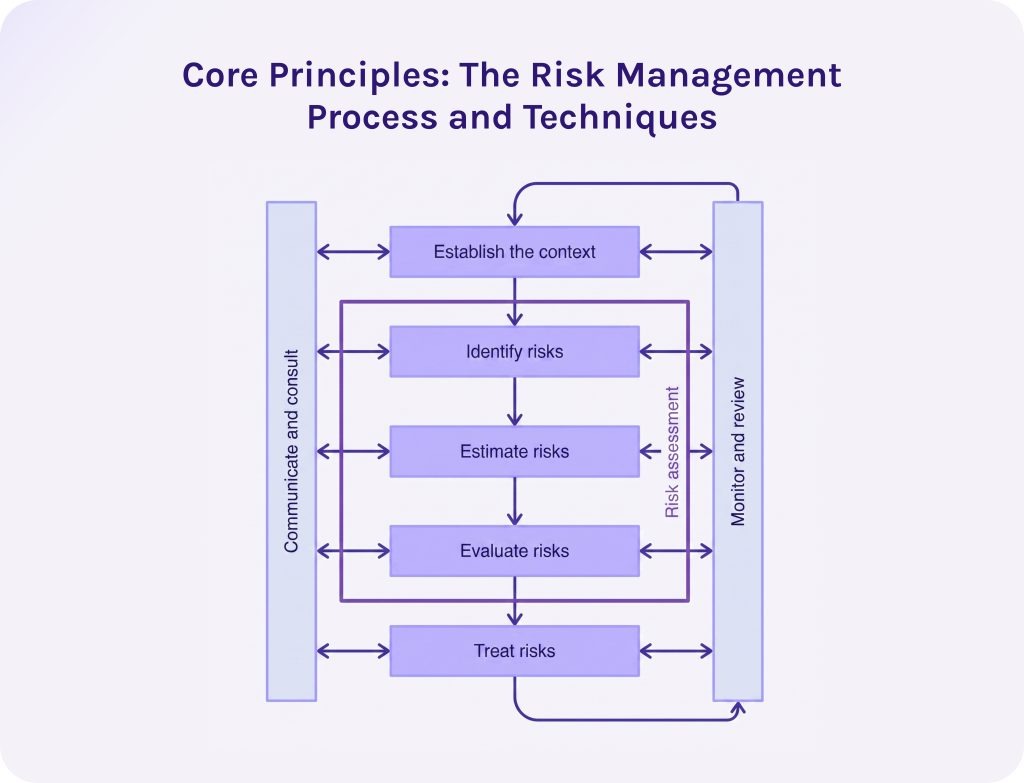
1. Risk identification and analysis (pinpoint potential risks and uncover core vulnerabilities.)
The first stage focuses on surfacing potential risks before they disrupt operations. Teams apply targeted risk management tools and techniques to collect threats and understand why they occur:
- Risk analysis. Teams map out dependencies between risks and operations and make assumptions why they actually happen to spot early warning signs.
- Root cause analysis. Then, teams use structured methods like the 5 Whys or Fishbone (Ishikawa) Diagrams to isolate the core drivers behind potential failures. It ensures that teams address actual vulnerabilities rather than work with imaginary threats [6].
2. Risk evaluation and prioritization (gauge potential impact and assign priority levels.)
Not all hazards carry equal weight. A formal risk assessment evaluates each item based on two core metrics: probability (likelihood of occurrence) and severity (financial or operational impact).
- Qualitative scoring. Categorizing items on a risk assessment matrix or probability-impact matrix (e.g., high, medium, low) to highlight critical items immediately [7].
- Quantitative risk analysis. Running numerical simulations (such as Monte Carlo analysis) to estimate precise financial cost overruns and schedule delays.
3. Response to risks and their control (mitigation strategies deployment and execution of response plans).
The final stage translates insights into exact action. Teams document these measures within a structured risk management plan, which outlines owners, triggers, and contingency budgets. Standard risk mitigation strategies include:
- Risk avoidance. Changing project scope or architecture to bypass the hazard entirely.
- Risk mitigation. Creating safeguards to reduce either the likelihood or the operational impact.
- Risk transfer. Reallocating financial liability to third parties via insurance or vendor contracts.
- Risk acceptance. Acknowledging low-impact threats and setting aside explicit contingency reserves.
Read More: Overcoming Project Portfolio Management Challenges: A Guide to Scaling Enterprise Delivery
Essential Frameworks and Tools for Risk Management
Effective risk management and governance relies on combining qualitative analysis with quantitative tools to anticipate disruptions. When you structure your evaluation around established methodologies it helps you categorize project risks and systematically plan responses.
1. Risk Register
We can consider a risk register as the master database for tracking every identified threat throughout a project’s lifecycle. Its main purpose is to become a single source of truth for every team member and stakeholder.
Key components
- Unique risk ID. A unique identifier presented as alphanumeric code and assigned to each entry for easy tracking and referencing across logs.
- Description of the hazard. It is a concise summary detailing the specific event, its potential causes, and its immediate consequences.
- Category. Classification tag (e.g., technical, financial, legal) used to group, filter, and analyze related project risks.
- Trigger conditions. Here you write specific early warning signs or events that indicate a risk is actively occurring.
- Inherent risk score. It is a rating of a threat’s potential impact and likelihood.
- Assigned risk owner. The specialist responsible for continuously monitoring project risks and executing the risk mitigation strategy.
- Action plan. The step-by-step risk mitigation strategy and contingency steps designed to handle the threat.
Core benefit
The risk register prevents project risks from falling through the cracks. It establishes clear accountability for monitoring and mitigation.
2. Risk assessment matrix.
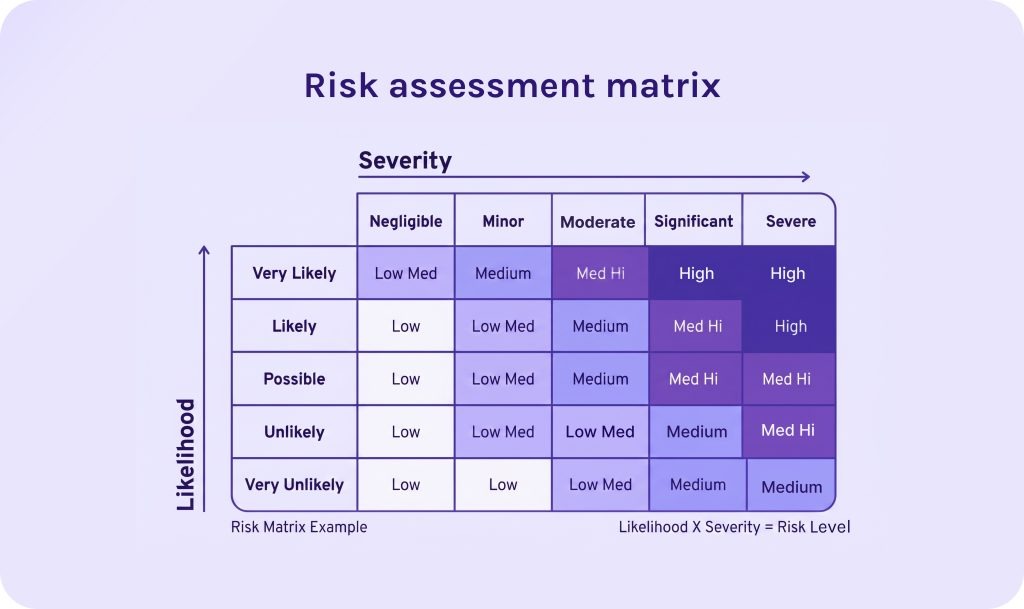
A risk assessment matrix evaluates threats by plotting two distinct variables: likelihood (the probability of occurrence) versus severity (the impact of the consequence).
Quantitative scoring
Typically uses a 3*3 or 5*5 scale where risk score = likelihood * severity
Core benefit
This risk management tool isolates high-impact, high-probability “red zone” threats that demand immediate capital and contingency planning.
3. SWOT & PESTLE analysis.
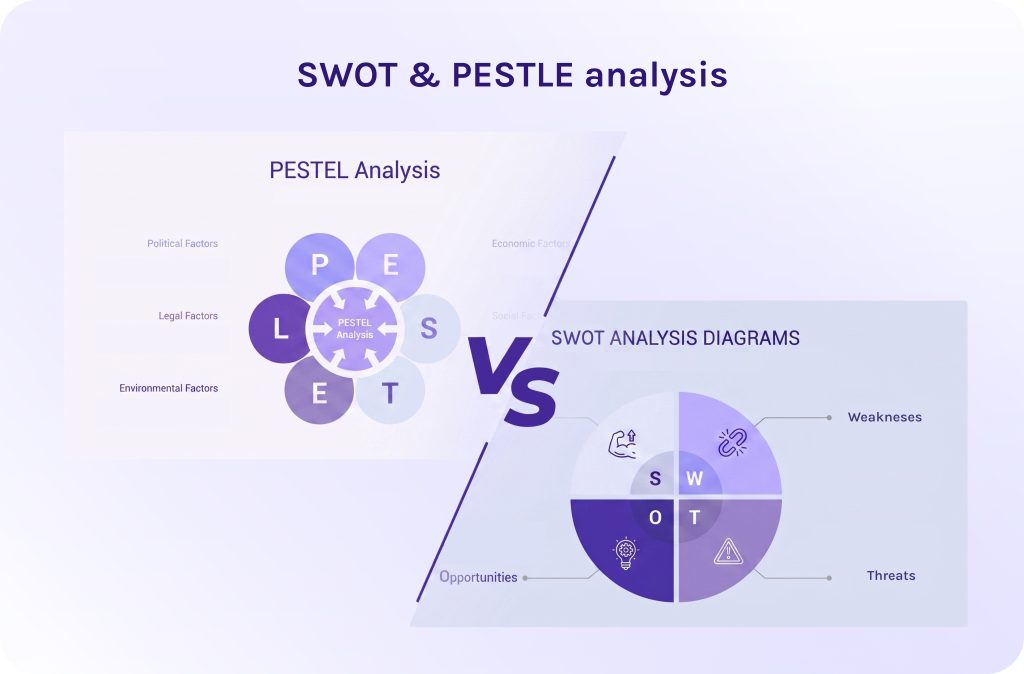
Before drilling down into itemized project logs, organizations use high-level analytical frameworks to map broader operational vulnerabilities:
SWOT analysis (strengths, weaknesses, opportunities, threats)
This framework examines internal capability gaps (weaknesses) alongside external market hazards (threats) to align strategic objectives with actual risk capacity [8].
PESTLE analysis
Analyses macro-environmental factors (political, economic, sociocultural, technological, legal, and environmental) to surface external risks before kick-off [9].
Read More: Best Scenario Planning Tools to Consider in 2026
Risk Management Tools in Project Management
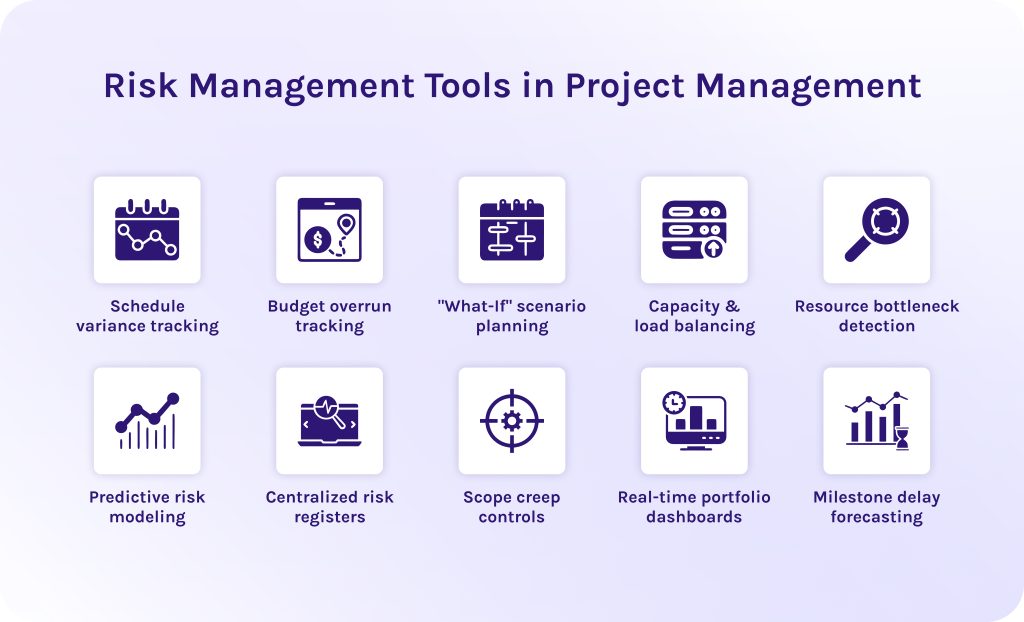
If we are talking about project delivery, project risk management tools connect high-level operational strategy and daily execution. Modern project management risk tools embedded within platforms like Epicflow or Jira continuously monitor key execution variables, like delays or capacity bottlenecks across the full project lifecycle.
Project managers utilize specialized risk management software capabilities to mitigate execution uncertainty across ten critical dimensions:
- Schedule variance tracking. Risk management tools in project management dynamically links task dependencies and critical paths to recalculate downstream impacts automatically whenever a prerequisite task slips.
- Budget overrun tracking. Automated cost-tracking features match real-time hours spent against earned value to keep financial expenditure aligned with project progress.
- “What-If” scenario planning. Advanced risk management tools for project management provide sandbox environments that allow project managers to simulate variations to model risk impacts before committing changes.
- Capacity & load balancing. Automated scheduling tools for risk management dynamically redistribute unassigned tasks across available team members to prevent burnout and smooth out demand spikes.
- Resource bottleneck detection. Real-time workload heat maps identify single-point-of-failure skill dependencies and over-allocated teams before operational stalls occur.
- Predictive risk modeling. Machine learning engines within risk management tools process historical project data to calculate the exact statistical likelihood of schedule or cost overruns on upcoming work.
- Centralized risk registers. Modern risk management software tools provide detailed logs that maintain an up-to-date repository of all identified project hazards, assigning specific owners and trigger conditions to each item.
- Scope creep controls. Project management risk tools instantly alert project leads when unplanned revisions or feature additions threaten.
- Real-time portfolio dashboards. Dynamic visual interfaces offered by modern risk management tools consolidate health metrics across multiple initiatives to give leadership immediate visibility into active threats.
- Milestone delay forecasting. Predictive algorithms within risk management tools for project management monitor project progress against baseline schedules to flag critical milestone risks weeks before deadlines are breached.
Read More: Jira Capacity Planning: The Complete Resource Planning Guide
Domain-Specific Risk Management Tools & Platforms
Organizations often deploy specialized risk management tools tailored to distinct operational domains. It helps them get exact features they need, specific integrations, and compliance frameworks required for their specific risk exposure.
1. Enterprise risk management (ERM) tools.
Enterprise risk management tools focus primarily on long-term strategy and overall organizational performance across every department, from finance and IT to legal.
Primary function
Align corporate risk management with long-term strategic goals. Enterprise risk management tools help organizations consolidate data across financial, reputational, regulatory, and market domains to guide executive decision-making [11].
Key features
- Executive risk heatmaps.
- Scenario modeling.
- Strategic goal tracking.
- Board-level reporting dashboards.
- Integrated risk management frameworks.
2. Operational risk management tools.
Operational risk management tools work perfectly on a narrower level. It utilizes a process-oriented approach focused on protecting day-to-day business execution [12].
Primary function
Operational risk management tools help companies identify and deal with threats stemming from internal process breakdowns, system failures, or even human errors [12].
Key features
- Key risk indicator (KRI) tracking.
- Automated internal control testing.
- Incident tracking logs.
- Root-cause analysis (RCA) workflows.
- Loss event databases.
3. Third-party risk management tools.
Third-party risk management (TPRM) software focuses mainly on evaluating and mitigating different types of risks introduced by external vendors. They are also called vendor risk management tools or supplier risk management tools [10].
Primary function
Top-rated supplier risk management tools centralize due diligence and continuous vendor monitoring to ensure third parties do not introduce cybersecurity vulnerabilities or compliance failures into your organization [10].
Key features
- Automated vendor security questionnaires (SIG/CAIQ).
- Continuous dark-web and credential exposure monitoring.
- Security posture ratings.
- SLA tracking.
- Audit-ready compliance reporting.
4. Supply chain risk management tools.
Supply chain risk management tools track physical logistics, material sourcing, vendor dependencies, and global events to protect manufacturing and distribution continuity [13].
Primary function
Map multi-tier supplier networks to identify operational bottlenecks and possible vulnerabilities in logistics or material shortages. It helps to optimize processes before threats cause production downtime or delivery delays [13].
Key features
- Multi-tier sub-tier mapping.
- Real-time geopolitical and weather disruption tracking.
- Predictive transport delay alerts.
- ESG sourcing monitoring.
- Automated corrective action plan (CAP) tracking.
5. Cyber risk management tools.
Cyber risk management tools designed specifically to handle digital threats to an organization’s network and cloud infrastructure. They help companies keep their sensitive data safe and sound.
Primary function
This type of risk management tools is used for continuous exposure monitoring and cyber risk quantification to protect digital infrastructure from data breaches and ransomware.
Key features
- Automated security ratings.
- Dark web intelligence feeds.
- Financial risk quantification (e.g., FAIR model simulations).
- Vulnerability scoring.
- Cloud security posture management.
6. IT risk management tools.
IT risk management tools focus on broader technology operations, mapping technological vulnerabilities to daily business processes and regulatory IT controls.
Primary function
These risk management tools ensure stability and compliance of IT infrastructure.
Key features
- IT asset inventory tracking.
- Disaster recovery planning.
- IT service management (ITSM) integration.
- Automated patch compliance monitoring.
- Control mapping (NIST, ISO 27001, CIS).
7. Integrated risk management tools.
Integrated risk management tools are unified ecosystems that break down operational siloes by combining enterprise risk, IT risk, vendor risk, and compliance into a single shared framework.
Primary function
These risk management software tools provide a comprehensive view of interconnected risks across strategic, digital, operational, and financial domains to improve cross-departmental decision-making.
Key features
- Unified risk taxonomy engines.
- Cross-functional dependency mapping.
- Centralized workflow automation.
- Integrated KRI tracking.
- Holistic executive dashboards.
8. Open-source risk management tools.
Open-source risk management tools are software solutions for risk management with publicly available source code. They offer flexible, community-maintained frameworks for organizations seeking cost-effective threat tracking without vendor lock-in or licensing fees.
Primary function
These risk and compliance management tools provide customizable frameworks for source-code auditing and alongside ability to tailor this exact software to your specific requirements.
Key features
- Open vulnerability database integration (CVEs/NVD).
- Software composition analysis (SCA).
- API-driven DevSecOps pipeline integrations.
- License compliance scanning.
- Community-maintained security patches.
9. AI tools for risk management.
AI tools for risk management leverage predictive analytics, machine learning, and natural language processing to evaluate both operational risks and governance challenges introduced by enterprise AI models.
Primary function
This software for risk management automates real-time risk scoring and runs predictive scenario simulations to identify risks early and help companies create mitigation strategies.
Key features
- Predictive due-date/cost forecasting.
- Automated “what-if” simulations.
- Shadow-AI discovery.
- Automated mapping to frameworks like the EU AI Act and NIST AI RMF.
Read More: The Next Generation of PMO Tools: How to Choose the Perfect One for You
Top 5 Risk Management Tools Comparison: Best Risk Management Tools
As we discussed earlier, spreadsheets are too error-prone for modern businesses. They are highly susceptible to manual errors and lack real-time visibility required to manage complex risks at scale. Meanwhile, modern risk management tools support business growth and flag project risks in advance. Below is a detailed analysis of leading risk management tools.
1. Epicflow
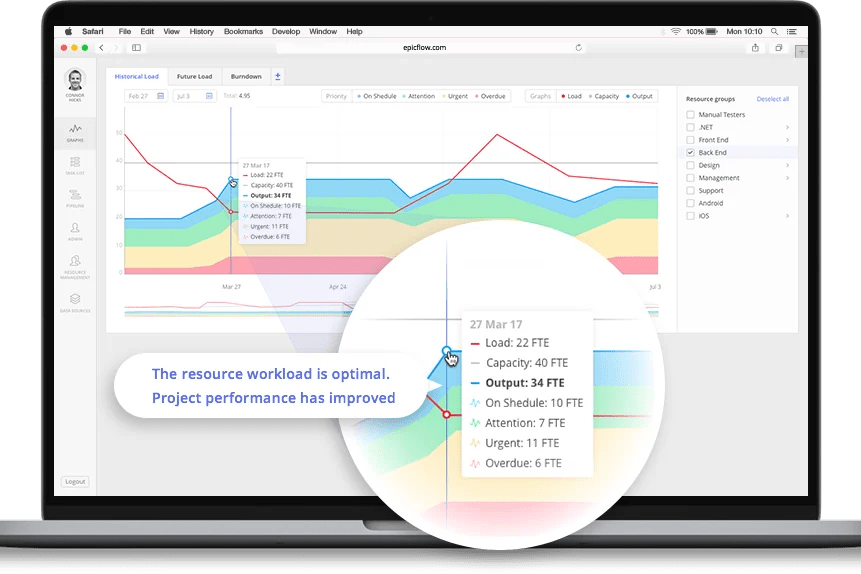
Epicflow is an AI-driven platform designed primarily to manage constrained resources across multiple projects at once, doesn’t matter 2 or 200. It has a dedicated suit of AI risk management tools built specifically to tackle capacity bottlenecks and project schedule uncertainty.
Key features
- Automated cross-project task reprioritization.
- Predictive due-date forecasting.
- Multi-variable “what-if” scenario sandboxes.
- Predictive bottleneck detection.
- Historical data analysis.
Risk management strengths
Excels at surfacing invisible operational risks, such as team burnout, skill shortages, and resource over-allocation, long before they derail milestones.
Compliance framework support
- Supports operational framework governance.
- Integrates natively with enterprise systems like Jira, MS Project, and SAP.
Target industry & Use cases
-
- Complex engineering.
- Enterprise risk management.
- IT portfolio management.
- Product development.
- Multi-project environments facing tight resource constraints.
- IT risk management.
2. MetricStream
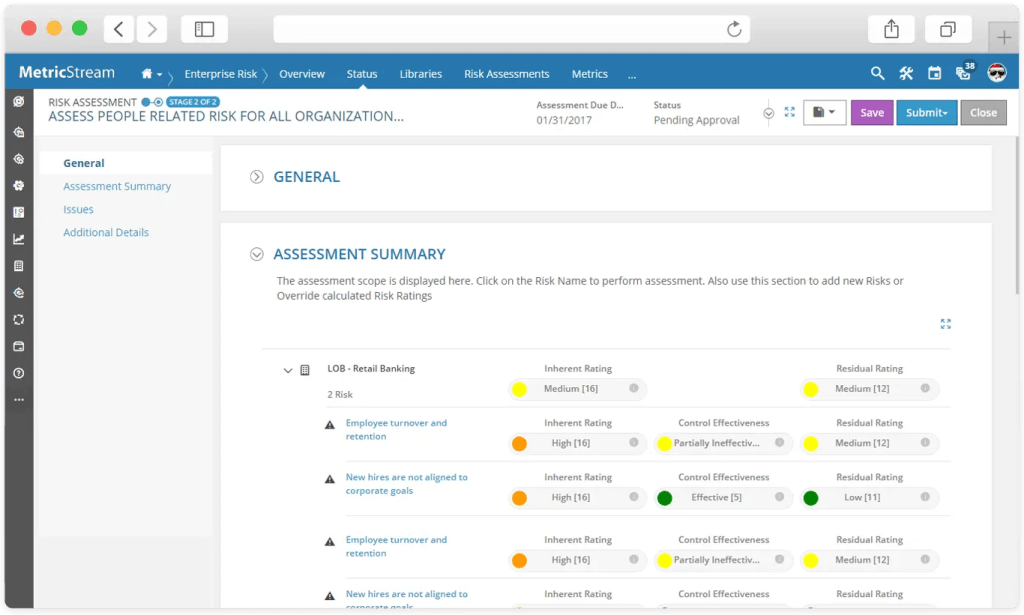
This platform stands out from the other IT risk management tools on our list because it was primarily designed for large global organizations that require deep operational, cyber, and financial risk oversight.
Key features
- Centralized risk registers.
- Risk scenario modeling.
- Automated internal controls testing.
- Enterprise policy management.
Risk management strengths
Powerful real-time heat maps and Key Risk Indicator (KRI) dashboards that roll operational unit metrics up to executive board levels.
Compliance framework support
Native mapping for ISO 27001, SOC 2, HIPAA, GDPR, Sarbanes-Oxley (SOX), and NIST.
Target industry & Use cases
- Banking.
- Financial services.
- Healthcare.
- Energy.
- Heavily regulated global enterprises.
3. Fusion Risk Management
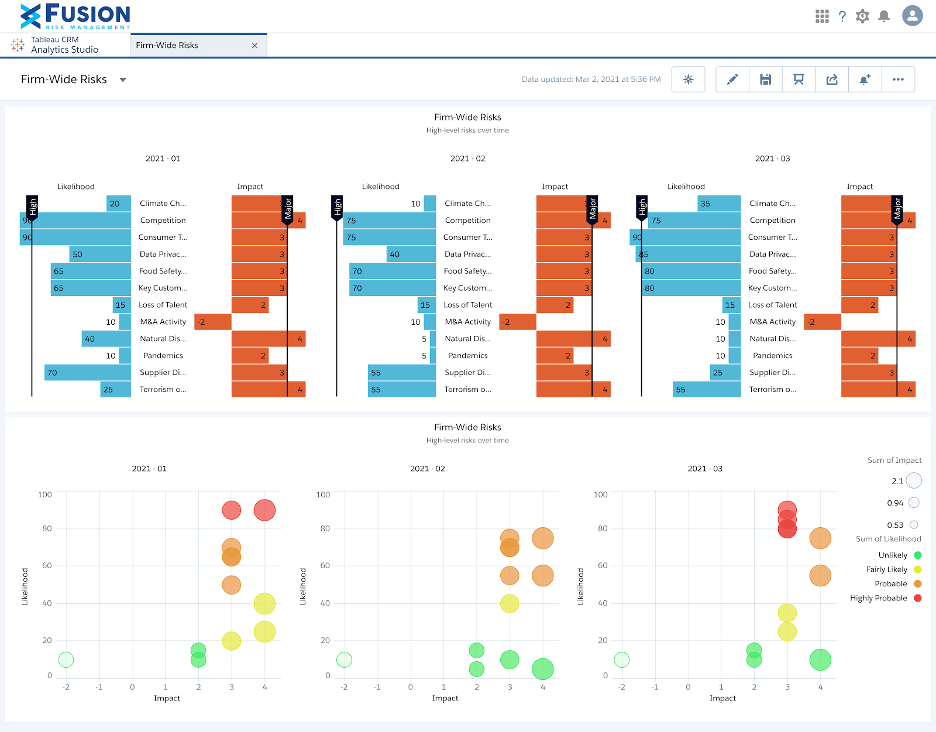
This tool from our project management risk tools list is an example of an enterprise-grade platform specifically designed to build operational resilience, map system dependencies, and ensure continuous business continuity across complex organization-wide initiatives.
Key features
- Visual dependency mapping across processes, systems, vendors, and personnel.
- Business impact analysis (BIA) workflows.
- Crisis event activation.
Risk management strengths
Links potential risks directly to operational dependencies, allowing organizations to visualize failure propagation during system outages or supply chain disruptions.
Compliance framework support
ISO 22301 (Business Continuity), DORA, FFIEC, and global financial resilience frameworks.
Target industry & Use cases
- Financial institutions.
- Critical infrastructure.
- Supply chain operations.
- Enterprise IT resilience teams.
4. Resolver
Resolver is an incident-centric risk management tool that connects threat assessment and active event response.
Key features
- Integrated incident logging.
- Case management.
- Root-cause analysis workflows.
- Automated risk scoring.
- Threat intelligence tracking.
Risk management strengths
Connects what could happen (risk register) with what actually happened (incident data) to validate whether risk assessments were accurate or overly optimistic.
Compliance framework support
ISO standards, PCI-DSS, internal audit governance, and corporate compliance checklists.
Target industry & Use cases
- Corporate physical security teams.
- Cyber risk management.
- Loss prevention.
- Enterprise incident managers.
- Healthcare risk units.
5. Riskonnect
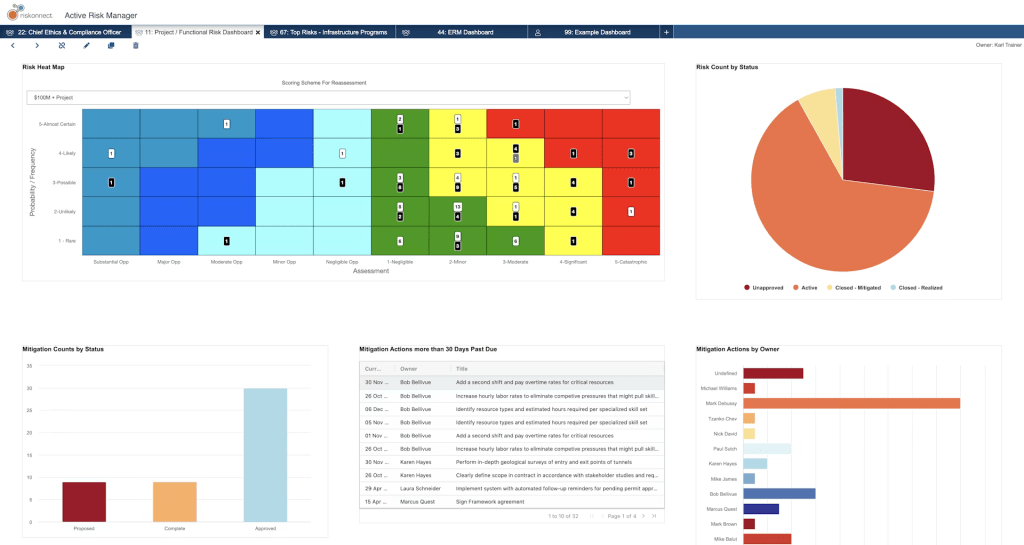
This is the last solution on our list of tools for risk management. Riskonnect is a cloud-native GRC platform that leverages machine learning to break down operational silos across risk, compliance, and audit departments.
Key features
- AI-driven risk pattern detection.
- Automated Monte Carlo impact simulations.
- Third-party risk management (TPRM).
- AI governance tracking.
Risk management strengths
Offers automated risk recommendations and continuous monitoring alerts when key risk indicators breach preset tolerance thresholds.
Compliance framework support
Regulatory mapping agent for dynamic regulatory changes, ESG standards, and corporate governance controls.
Target industry & Use cases
- Multi-national enterprise GRC teams.
- Insurance/risk pool managers.
- Supply chain oversight.
- Heavily audited industries.
Read More: The 15 Best Manufacturing Capacity Planning Tools in 2026
Summary Comparison Table: Top Risk Management Tools
| Tool | Key focus | Automation and AI | Industry fit | Deployment |
| Epicflow | Multi-project risk management | AI predictive due-date forecasting.
Automated task reprioritization. What-If multi-variable scenario modeling. Predictive risk analysis. |
Ideal for engineering, product development, IT portfolio teams, and multi-project environments. | SaaS / cloud |
| MetricStream | Enterprise GRC | AI-first connected GRC engine.
Automated internal control testing. Real-time predictive analytics & KRI alerts. |
Best for global, heavily regulated enterprises (banking, healthcare, energy, public sector). | Cloud, hybrid, on-premise |
| Fusion Risk Management | Operational resilience | Automated dependency mapping.
Dynamic business impact analysis. Scenario readiness & disaster recovery simulations. |
Designed for mid-market to enterprise financial institutions, critical infrastructure, and supply chains. | Cloud (built on Salesforce) |
| Resolver | Incident and threat response | Automated incident-to-risk linkage.
Machine-assisted root-cause analysis. Intelligent triage & threat scoring. |
Fit for corporate security, loss prevention, risk oversight teams, and healthcare systems. | SaaS / cloud |
| Riskonnect | Integrated risk management | AI-driven risk pattern detection.
Monte Carlo financial impact modeling. Automated third-party monitoring. |
Suited for large enterprises consolidating insurable risk, claims, ERM, and third-party risks oversight into one platform. | SaaS / cloud |
Read More: AI in Project Portfolio Management: 7 Key Trends & Features
How to Choose the Right Risk Management Tools
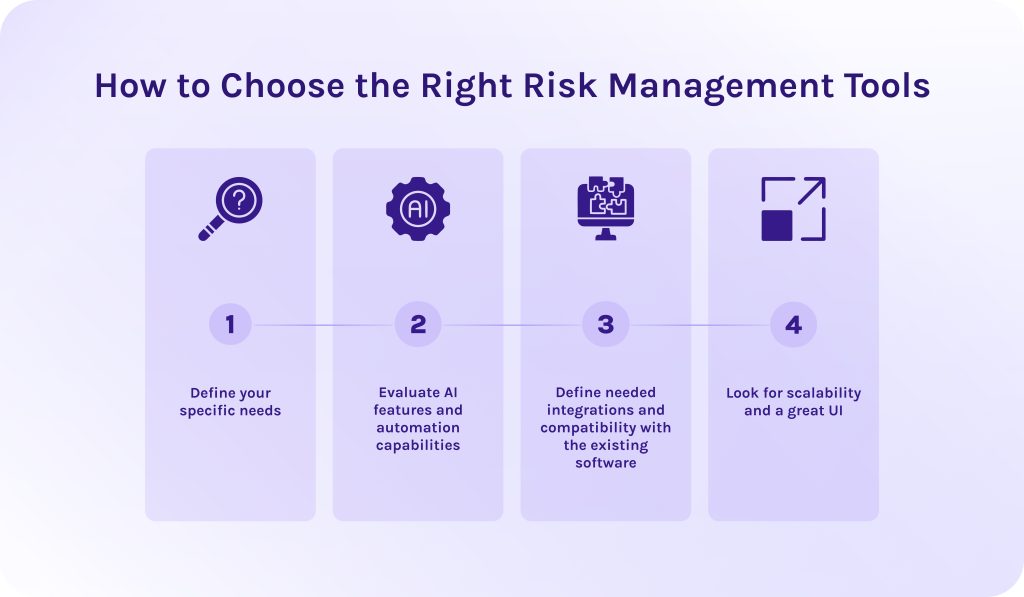
- Define your specific needs. First of all, you need to identify your main pain points to fill the efficiency gaps. Align risk management software tools requirements with your primary exposure area.
- Evaluate AI features and automation capabilities. Prioritize AI tools for risk management that offer features for workflow automation and predictive analytics to enhance your operations.
- Define needed integrations and compatibility with the existing software. Ensure the risk management software seamlessly connect with your existing tech stack so data flows automatically without manual re-entry.
- Look for scalability and a great UI. Opt for an intuitive interface with role-based dashboards that non-risk specialists can easily adopt. At the same time, risk management tools architecture should scale seamlessly as your organization grows.
Read More: 3 Essential Types of Capacity Planning Strategies and When to Use Them
Final Words
- Risk management is an essential activity which defines the company’s strategy for handling various risks. It dictates the process of risk identification, analysis, and creation of mitigation plans to address problems in a most efficient possible way.
- Risk management tools are software solutions that automate the most important parts of the risk management process: identification, assessment, mitigation plan creation, keeping risk register tidy and structured.
- Organizations with mature risk management frameworks gain the strategic agility to calculate and execute higher-risk market opportunities safely.
- Top 5 risk management tools includes Epicflow, Riskonnect, Fusion Risk Management, Resolver, and, ultimately, MetricStream.
- Despite risk management software itself, companies can use other risk management tools, for instance: risk register, risk assessment matrix, SWOT & PESTLE analysis.
Frequently Asked Questions (FAQs)
1. What are risk management tools?
Risk management tools are software applications and platforms that help organizations systematically identify potential risks and mitigate their impact. They centralize data into real-time dashboards and automated workflows, enabling teams to protect project budgets and schedules before issues arise.
2. What are 5 risk management tools?
The most popular risk management tools available on the market today are Epicflow, MetricStream, Resolver, Fusion Risk Management, Riskonnect.
3. Why are enterprise risk management tools so important?
Enterprise risk management (ERM) tools are vital because they consolidate threat data across all departments into a single system. Moreover, they automate risk scoring and compliance tracking to help organizations prevent costly project overruns and turn market uncertainty into a strategic advantage.
4. How do AI tools enhance project risk management?
Project risk management tools powered by artificial intelligence (AI) use predictive analytics and machine learning algorithms to analyze historical data and identify potential risks early. As well, they automate real-time risk scoring and scenario simulations. AI helps teams proactively resolve threats before they somehow will affect project delivery.
5. Which firms offer AI risk management tools?
6. What is a risk mitigation plan?
Risk mitigation plan is a document that outlines specific actions and resources required to reduce the probability of identified project risks. It also assigns a dedicated owner to each high-priority risk and detailing exact steps to prevent issues or contain damage if they occur.
7. How do vendor risk management tools work?
These risk management tools the evaluation of third-party suppliers. They send digitized security questionnaires and continuously monitor vendors’ security postures, financial health, and compliance credentials. Then, they compile these data streams into centralized real-time dashboards, triggering instant alerts when a vendor’s risk profile breaches defined safety thresholds.
8. Is Jira a risk management tool?
Yes, Jira can function as a risk management tool. Though it depends on how it is configured.
9. What are risk management tools and techniques?
10. What are the 5 examples of risk management?
References
- https://www.proofhub.com/articles/project-management-statistics
- https://www.researchgate.net/publication/363584438_Risk_Management_in_Software_Development_Projects_A_Systematic_Literature_Review
- https://www.researchgate.net/publication/354694992_Risk_Register_Database_to_Improve_Organizational_Resilience_and_Knowledge_Management
- https://www.researchgate.net/publication/396037094_Real-Time_Risk_Assessment_Dashboards_Using_Machine_Learning_in_Hospital_Supply_Chain_Management_Systems
- https://www.researchgate.net/publication/389097754_Navigating_Regulatory_Compliance_and_Risk_Management_How_ESG_Metrics_and_Sustainability_Reporting_Shape_Financial_Controllership_and_Governance
- https://www.researchgate.net/publication/387868490_Root_Cause_Analysis_Techniques_and_Best_Practices_-_For_Current_product_improvement_which_can_be_implemented_in_New_product_design
- https://www.researchgate.net/publication/383213866_Qualitative_Risk_Assessment
- https://www.researchgate.net/publication/319367788_SWOT_ANALYSIS_A_THEORETICAL_REVIEW
- https://www.researchgate.net/publication/394298616_How_to_Create_the_Best_PESTEL_Analysis
- https://www.researchgate.net/publication/378575253_Third_Party_Risks_and_their_Impact_to_the_Overall_Risk_Posture_how_to_Improve_it
- https://www.researchgate.net/publication/260514687_Enterprise_Risk_Management_ERM
- https://www.researchgate.net/publication/366594028_Operational_risk_management
- https://www.researchgate.net/publication/390235627_Supply_Chain_Risk_Management_Theory_and_Practice
A Guide to the Best Risk Management Software: Top ERM Tools in 2026
Risk management is a critical part of every modern business, as it helps companies face uncertainty and other challenges with maximum efficiency and even better outcomes if implemented properly. On the one hand, this process sounds terrifying and difficult (and it actually is), but on the other the usage of the right software can reduce time and costs companies lose on dealing with consequences of unmanaged risks. In addition, it makes risk management more effective and pays off a hundredfold with time. But how to choose software that will fit specifically your needs?
Read further to explore our top of the best tools for risk management. Additionally, we’ll give you some recommendations on how to evaluate them and choose the perfect one.
Top Telecom Project Management Challenges and How to Overcome Them
Managing projects as big as telecom companies was never easy, but today it has become increasingly complicated. It often means dealing with strict deadlines, high expectations, huge investments, and responsibilities. Rapid innovation, such as 5G networks and FTTH rollouts, modernizing BSS and OSS systems to satisfy customers, requires strong management skills to help companies grow securely and stably, handle enormous resources, avoid budget overruns, and deal effectively with multiple vendors simultaneously. That’s why effective project management in telecom gives a powerful advantage. Let’s dive deeper into telecom project management challenges and explore methods to overcome them.
The Power of BSS in Increasing Revenue and Customer Loyalty
Business support systems, alongside operational support systems (BSS), are inseparable components of telecom services, fundamentally shaping a brand’s profitability and market presence. However, contemporary developments challenge the traditional paradigm of network exploitation due to the emergence of new technologies and innovative solutions. The article acknowledges the necessity of monetizing the entire ecosystem and generating value beyond mere connectivity. In this context, a telecom BSS becomes a critical factor in achieving this objective, as providers must simultaneously develop innovative strategies for product diversification to enhance customer satisfaction levels.