
Key takeaways
- Strategic portfolio management is an evolved portfolio management approach that focuses on business goals and strategy rather than on day-to-day task execution.
- Strategic portfolio management tools are enterprise software solutions that are focused on the common value of all projects within the portfolio.
- If you need to choose strategic portfolio management tools for your company, look for needed integrations, features, and the tool maturity. The chosen software must address your main pain point.
- Choose ServiceNow or Planview if you need a huge enterprise ecosystem.
- Opt for Planisware or Broadcom Clarity for specialized governance.
- Select Epicflow or Triskell for advanced portfolio planning.
- For dedicated agile teams, choose Businessmap or Apptio Targetprocess (IBM).
Read More: Ultimate Guide: The Best Backlog Management Tools in 2026
Top strategic portfolio management tools: comparison table
| Tool | Best for | Standout capability | Pricing model | Free trial |
| Epicflow | Multi-project resource management. | AI portfolio optimizer and predictive algorithms. | Growth: €22.5
Enterprise: custom |
Yes |
| ServiceNow SPM | Aligning strategic portfolios directly with IT service management (ITSM). | Native integration across the ServiceNow platform. | Custom / Enterprise license. | No (Demo available) |
| Planview | Enterprise-grade strategic portfolio management (SPM). | Value stream management (VSM). | Custom enterprise subscription. | Yes (30-day trial for Projectplace / AgilePlace; Enterprise is demo-based) |
| Planisware | R&D, engineering, and capital-intensive project portfolios. | Stage-gate process automation paired with advanced financial forecasting. | Custom pricing. | No |
| Apptio Targetprocess (IBM) | Enterprise agile planning (EAP) and scaling frameworks (SAFe/LeSS) alignment. | Visualizing cross-team dependencies and OKRs. | Custom pricing. | No (Demo available) |
| Triskell | Dynamic portfolio scenario planning and flexible multi-level governance. | Real-time financial “what-if” scenario modeling. | Custom pricing. | Yes (Demo available) |
| Businessmap | Enterprise Lean/Kanban portfolio management. | Multi-level nested Kanban boards. | Tiered per-user subscription. | No (Demo available) |
| Broadcom Clarity | Large-scale enterprise PPM capital project portfolios. | Deep financial cost controls. | Subscription plans based on features. | Yes |
Read More: Overcoming Project Portfolio Management Challenges: A Guide to Scaling Enterprise Delivery
What is strategic portfolio management?
Let’s talk about the basics first.
According to the research “STRATEGIC PORTFOLIO MANAGEMENT In the Multi-project and Program Organisation,” strategic portfolio management is a type of project portfolio management where all projects and programs are viewed as a way to achieve strategic objectives. All activities must deliver measurable business benefits that bring strategic value to the organization [3].
From another research study named “Strategic Portfolio Optimization: Balancing Agile, Lean Six Sigma, and AI-Augmented Resource Allocation Models”, we discovered that traditional PPM models frequently fail to adjust properly to ever-changing business environments and complex interdependencies between projects, as they lack agility and flexibility [4]. Thus, the emergence of SP management is driven by the need for more adaptive execution.
Read More: Value Management Office (VMO): The Complete Guide to Lean Portfolio Management
What is strategic portfolio management software?
Strategic portfolio management (SPM) software is a dedicated portfolio management tool that focuses on the value each project creates for business rather than on simple task management. This software connects business strategy with corporate finances, resources, and execution outcomes into a single view.
Who uses strategic portfolio management tools?
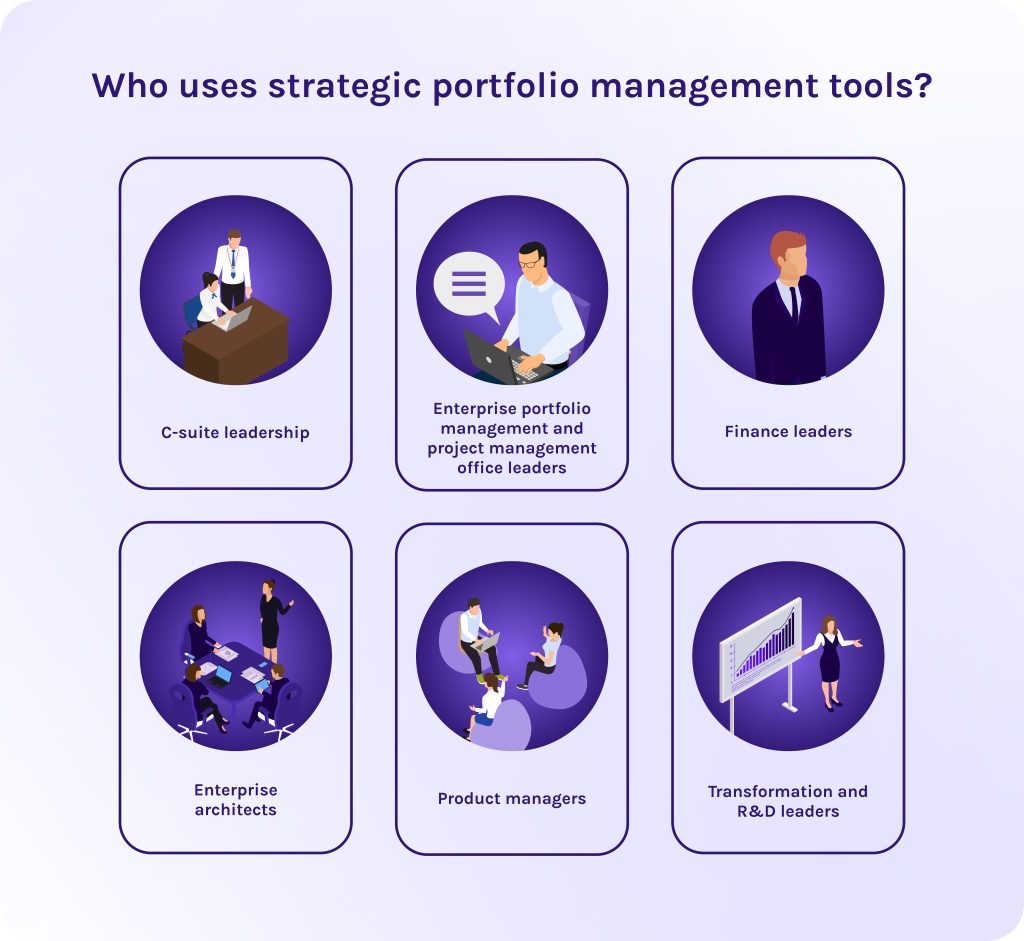
Tools for strategic portfolio management are great for various users and team members:
- C-suite leadership – C-level executives use strategic portfolio management software to align investments with corporate strategy and use real-time data to make strategic decisions.
- Enterprise portfolio management and project management office leaders – EPMO and PMO leaders use such portfolio management tools to balance workforce capacity simultaneously with maintaining governance across the entire project portfolio.
- Finance leaders – These specialists use strategic portfolio management tools to govern CapEx/OpEx allocation and monitor financial performance.
- Enterprise architects – They utilize SMP software to model cross-application dependencies and map appropriate business models.
- Product managers – Product managers and value stream leaders use SPM tools to connect product roadmaps to high-level OKRs and track value realization.
- Transformation and R&D leaders – These executives rely on portfolio management software to dynamically reallocate resources toward top-priority digital initiatives.
Read More: Microsoft Project Online Retirement 2026: Migration Guide and Alternatives
Strategic portfolio management vs project portfolio management (SPM vs PPM)
To better understand why traditional project portfolio management (PPM) falls behind, let’s take a look at the following table:
| Capability | Project portfolio management (PPM) | Strategic portfolio management (SPM) |
| Primary focus | Project execution, deliverable tracking, and operational governance. | Strategic alignment, value delivery, and business outcome realization. |
| Target audience | Project managers and PMO leaders. | Business leaders, VMOs, executives. |
| Funding model | Project-based. | Dynamic, based on activities that bring the most value. |
| Planning horizon | Annual or multi-year static planning cycles. | Continuous planning with dynamic “what-if” scenario modeling. |
| Metrics of success | On-time delivery and resource utilization rates. | Business outcomes, ROI, and revenue growth. |
| Delivery methodology | Often favors structured Waterfall or hybrid project management. | Prefers flexible, incremental approaches. |
Wanna know more about recent industry trends? Read other articles on our blog.
Read More: Best Engineering Project Management Tools: Complete Guide & Comparison
Key features of strategic portfolio management tools
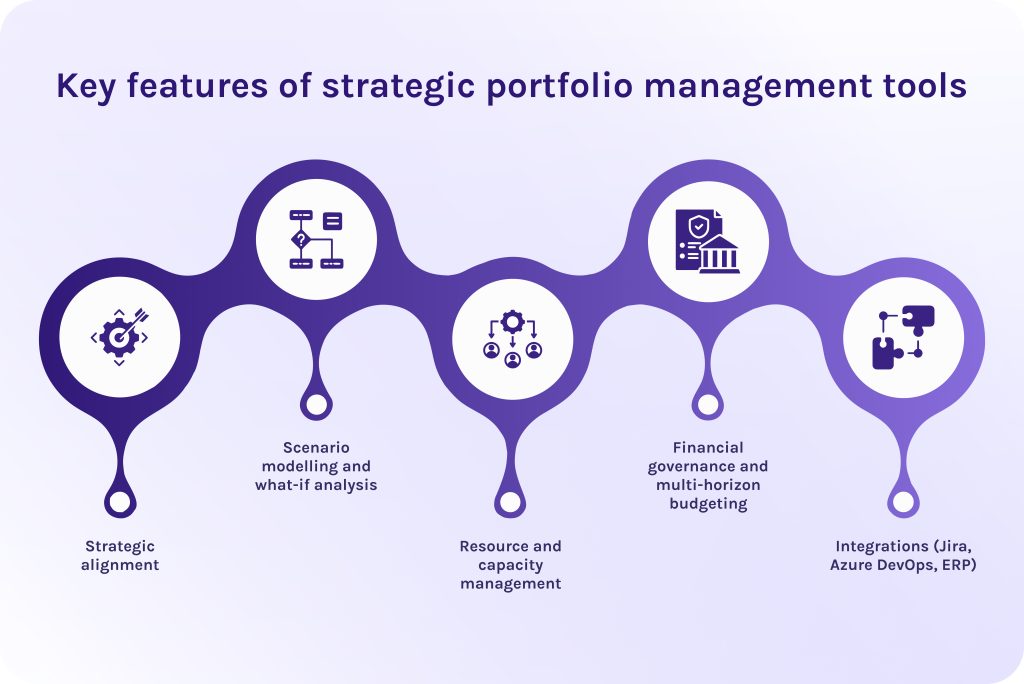
It’s important to understand what capabilities a versatile strategic portfolio management tool should have to drive business growth. Below, we’ve listed the five most required features.
1. Strategic alignment.
The first main feature you should look for in the strategic portfolio management software is its ability to align project execution with high-level strategic goals. Such tools directly link enterprise OKRs and KPIs down to value streams and project portfolios. Moreover, strategic portfolio management tools automatically score all initiatives against criteria such as strategic fit, possible risks, urgency, and return on investment (ROI) to ensure that every dollar spent works directly for you.
2. Scenario modelling and what-if analysis.
This feature in tools for strategic portfolio management lets companies simulate different business changes and immediately see possible consequences. Thanks to it, organizations can see in real time how shifting project start dates or budgets impacts delivery timelines and cross-project dependencies to quickly adjust their resources and budgets to market changes and shifting priorities.
3. Resource and capacity management.
No less important is that strategic portfolio management tools software should evaluate human and operational capacity. It helps prevent overallocation, which, according to statistics, is one of the most common reasons for project failures. Poor resource planning extends execution times by nearly 30% and blocks achievement of your strategic goals [1].
Frequently, software for strategic enterprise portfolio management have early warning systems identifying where critical specialized roles will become over-committed months in advance.
4. Financial governance and multi-horizon budgeting.
SPM tools provide continuous financial oversight. It replaces annual budgeting cycles with rolling forecasts and multi-horizon governance (McKinsey’s Horizon 1, 2, and 3 framework) [2]. It, in turn, helps track Capitalized Expenditure (development work) versus Operational Expenditure (maintenance/run work) for accounting and tax compliance.
5. Integrations (Jira, Azure DevOps, ERP).
It’s important to remember that the strategic portfolio management tools shouldn’t ruin your already existing workflows. Thus, it must support direct integration with the most popular portfolio management tools or at least allow connection through APIs.
Read More: The 15 Best Manufacturing Capacity Planning Tools in 2026
How we evaluated the strategic portfolio management tools: our scoring criteria
To be as honest as possible in this review, our team did comprehensive research based on several core metrics to evaluate each strategic portfolio management tool objectively. There are no sponsored positions in this top.
- We chose the tools that support strategic alignment. The proper SPM tools must support OKRs, KPIs, value stream mapping, and automated strategic prioritization scoring. Moreover, the top tools make it impossible for teams to work on “ghost projects” that don’t support an enterprise goal.
- The software must support scenario modeling. Modern tools for strategic portfolio management must help companies evaluate each strategic decision before finally committing.
- You should be able to plan resources and their capacity. We evaluated how well the strategic portfolio management tools balance human and operational capacity across the entire strategic portfolio. It must allocate resources according to their roles and skills and detect bottlenecks.
- It must govern finances. We looked for sophistication in tracking spending beyond basic project accounting.
- Integrations with third-party tools. We selected the SPM tools that seamlessly integrate with other execution platforms like Jira and Azure DevOps as well as with enterprise financial systems and ITSM systems like ServiceNow.
- The user experience and flexibility. We looked for portfolio management software that is easy to adopt and use for both C-suite executives and execution teams. There must be flexible reporting, an understandable, intuitive user interface with low friction in daily usage.
- It must be scalable. The strategic portfolio management tool must be scalable enough to handle growing data volumes and the number of users. We thought about it from the beginning because afterwards migrating to a new platform or rearchitecting the entire corporate ecosystem is much more expensive and time-consuming.
Read More: Stop Guessing, Start Scaling: Top 8 Capacity Planning Software [2026]
The 8 best strategic portfolio management tools in 2026
1. Epicflow – best for resource-constrained multi-project portfolios.
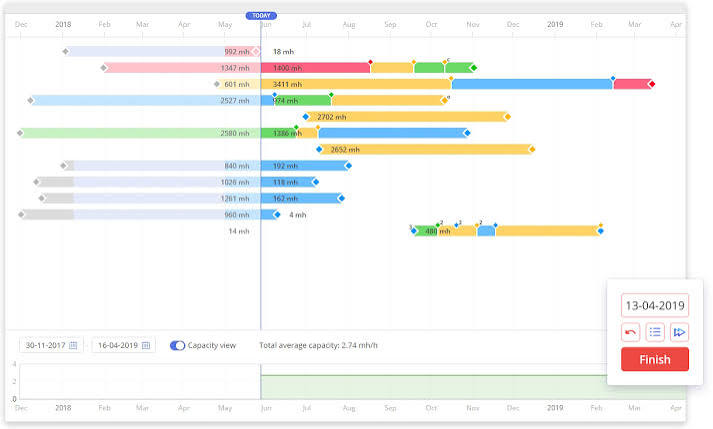
Epicflow heads our list of the best tools for strategic portfolio management. It is designed directly to help large, multi-project enterprises deliver maximum value possible from each initiative separately and from the portfolio overall. This solution is built on the Theory of Constraints (ToC), a project management philosophy whose main thought is:
“Any manageable system is limited in achieving more of its goals by a very small number of constraints (bottlenecks)” [5].
Best for:
Large enterprises that need to manage constrained resources across multiple projects at once.
Standout capability
AI portfolio optimization: It uses predictive analytics to dynamically prioritize projects within the portfolio based on strategic KPIs defined by users. Then, it automatically schedules project kickoffs to prevent future resource friction and simultaneously maximizes total portfolio output.
Key features
- Skill-based resource allocation.
- Scenario planning and “what-if” analysis.
- Epica AI project manager.
- Dynamic project and task prioritization.
- Bidirectional integration with other PM software.
- Workload balancing.
Pricing model
- Growth: €22.5
- Enterprise: custom pricing based on needed features and number of users.
Free trial
Available for the Growth plan.
Limitations
- Too dependent on quality data.
- Initial setup and onboarding are complex.
If you want to learn more about Epicflow capabilities, contact HYS Enterprise experts for a detailed consultation.
2. ServiceNow SPM – best for the ServiceNow ecosystem.
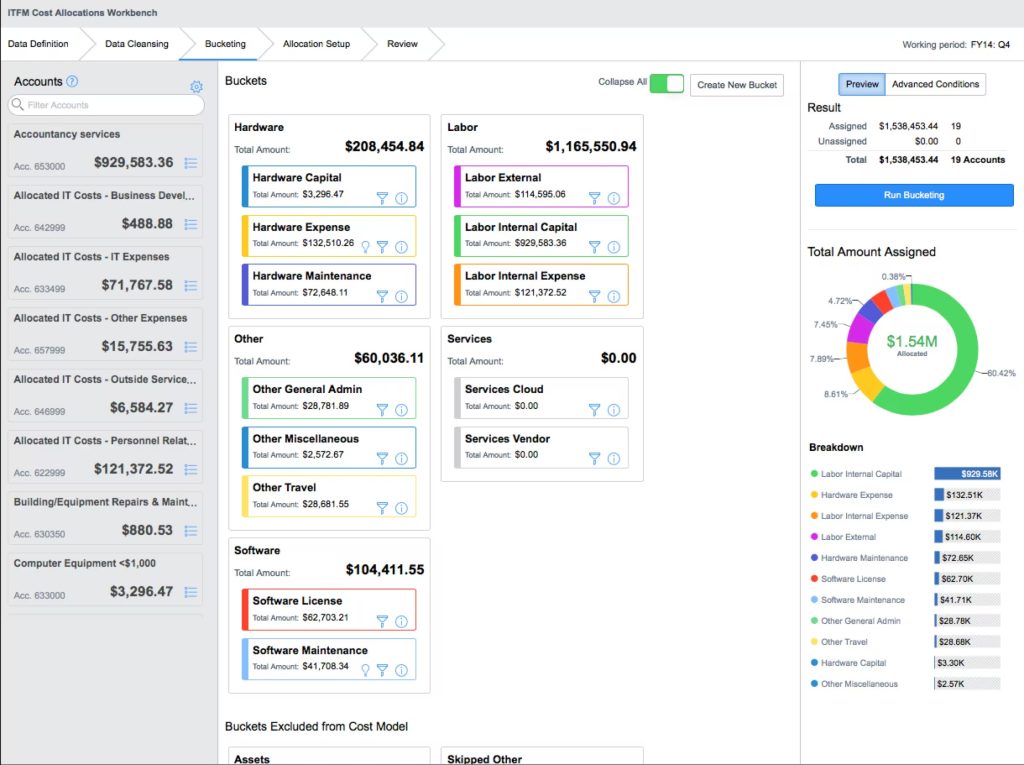
The next strategic portfolio management software on our list is ServiceNow SPM. Its main distinguishing feature is that it’s built natively on ServiceNow’s Now Platform. At its core, it connects strategic intent directly to IT operational execution. Additionally, it helps companies unify and automate the operations of different departments like HR, IT, customer support, and others.
Best for:
This solution suits large enterprises, especially those heavily invested in the ServiceNow ecosystem.
Standout capability
Native single-platform CMDB & ITSM integration: ServiceNow SPM serves as a part of a larger ServiceNow ecosystem. This gives executives direct operational line-of-sight connecting business goals and software investments down to physical infrastructure and digital applications.
Key features
- Application portfolio management (APM).
- Scenario planning.
- Value stream funding.
- AI assistant.
- Strategic planning workspace.
Pricing model
Custom/ enterprise license.
Free trial
There is no free trial, only a demo version available.
Limitations
- Highly dependent on the ServiceNow ecosystem.
- Has high implementation costs.
- Initial setup complexity is high.
- The UI can be steep to learn for non-technical users.
3. Planview – best for large-enterprise scale.
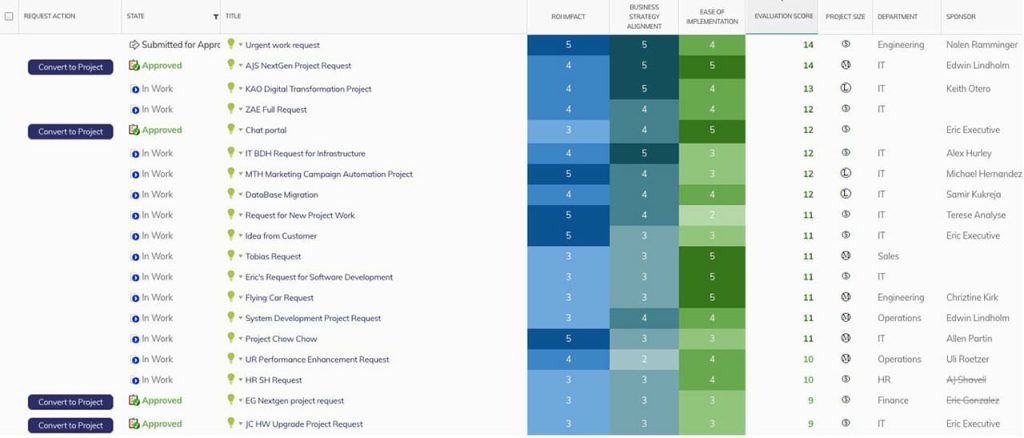
This portfolio management tool is a dedicated leader in enterprise strategy execution and portfolio governance. Specifically, its Planview Portfolios and Planview Strategic Portfolio Management software help large enterprises connect strategic goals and daily tasks. Furthermore, it significantly simplifies financial planning, resource allocation, and strategic decision-making across massive global initiatives.
Best for:
Global enterprises and large EPMOs that manage multi-billion-dollar portfolios across hybrid delivery models.
Standout capability
Connected enterprise scaling: Planview provides end-to-end visibility that links top-line executive strategy down through OKRs, portfolio funding, application architectures, and continuous Agile execution frameworks.
Key features
- Dynamic value stream funding.
- Advanced scenario modeling.
- Enterprise architecture mapping.
- Cross-platform integration with Jira, Microsoft Azure DevOps, Rally, Workfront.
- Capacity constraints analysis.
Pricing model
Custom enterprise subscription.
Free trial
The software has a free 30-day trial for Projectplace / AgilePlace. The Enterprise plan is demo-based.
Limitations
- Has a steep learning curve.
- Interface may feel complex for new users.
- Has an implementation overhead.
4. Planisware – best for R&D and stage-gate portfolios.
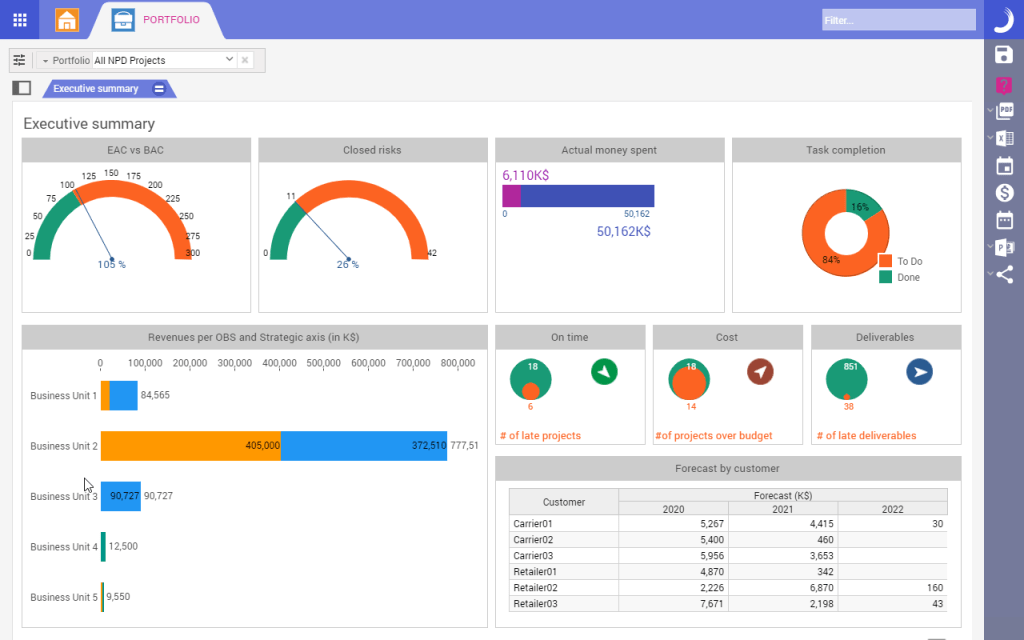
Among other strategic portfolio management tools, Planisware stands out for being engineered specifically for R&D-driven and complex engineering environments. It helps companies with complex cross-project dependencies connect corporate strategic goals with long-term resource allocation and technical risks.
Best for:
Will be a decent choice for R&D-intensive industries like life sciences, pharmaceuticals, aerospace, defense, automotive, and high-tech engineering organizations.
Standout capability
R&D pipeline optimization: Native support for strict phase-gate decision frameworks. It tracks milestone readiness, probability of technical success (PcS), NPV/financial risk models, and gated capital approvals.
Key features
- Cost and financial forecasting.
- Dynamic capacity planning.
- Agentic AI.
- Predictive analytics.
- Enterprise resource management.
Pricing model
Has custom pricing.
Free trial
Free version isn’t available for this tool.
Limitations
- Highly tuned for physical product development and engineering lifecycles.
- Less naturally aligned with pure ITSM or other solutions.
- Customization and configuration are complex.
5. Apptio Targetprocess (IBM) – best for enterprise agile planning.
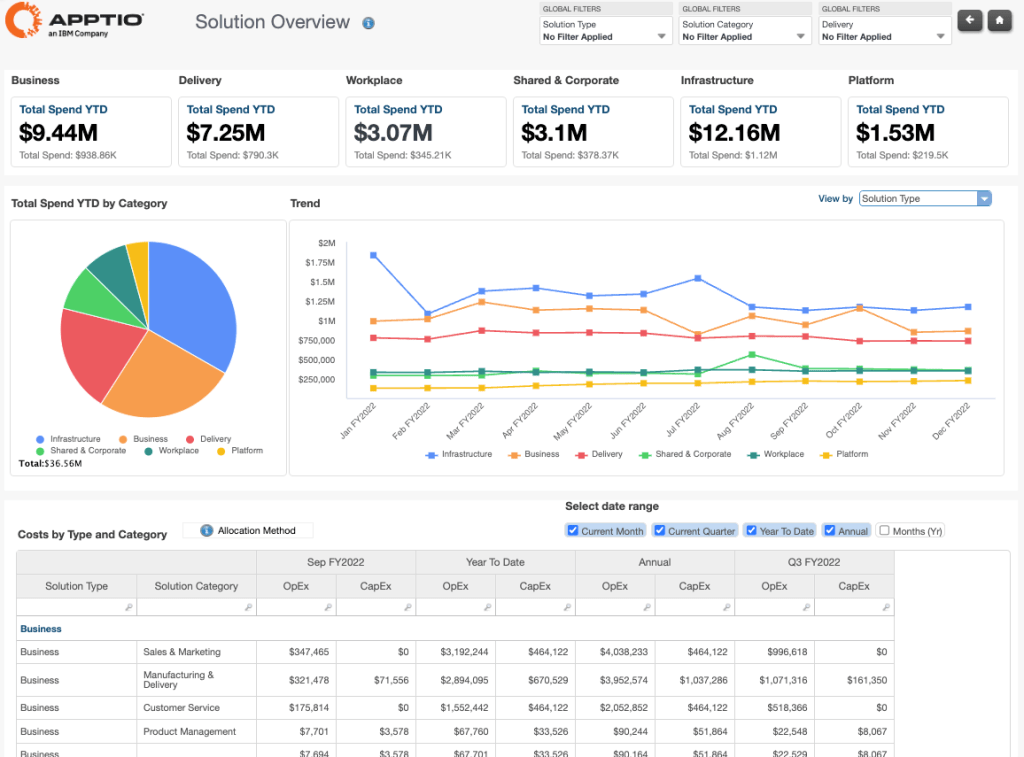
This solution from our list of top strategic portfolio management tools is designed by IBM. Apptio Targetprocess is an enterprise strategic portfolio and value stream management platform. It is designed to connect top-down corporate strategy with large-scale Agile and hybrid execution frameworks.
Best for:
Large enterprises and EPMOs undergoing Agile transformations.
Standout capability
Native scaled agile alignment with Apptio Financial Intelligence: It is a highly configurable support for SAFe, LeSS, and hybrid agile frameworks.
Key features
- Dynamic dashboards.
- Workforce and capacity planning.
- Bidirectional integrations.
- Real-time funding request workflows.
- Visualizes relationships and dependencies.
Pricing model
Has custom pricing.
Free trial
No, this tool does not provide a free trial. Instead, it has a demo available.
Limitations
- Has a high administrative complexity.
- The interface can become visually cluttered and overwhelming.
- Full ecosystem value depends on Apptio integration.
6. Triskell – best for configurable governance.
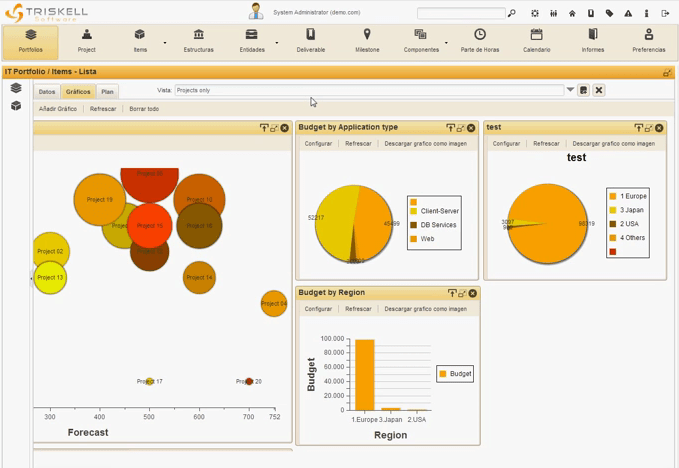
The next solution on our list of strategic portfolio management tools is Triskell. It is an enterprise SaaS platform engineered around high configurability and data modeling flexibility. It makes the portfolio management process way easier, allowing organizations to build custom portfolio structures and dynamic workflows without relying on hardcoded platform assumptions or expensive custom code.
Best for:
Mid-sized to large enterprises that require an adaptable platform to mirror complex organizational structures.
Standout capability
No-code data modeling: Triskell allows administrators to build custom entities, attributes, relationships, and governance workflows using native drag-and-drop configuration.
Key features
- Hybrid portfolio management.
- Dynamic capacity and resource forecasting.
- Interactive scenario planning.
- “What-if” modeling.
- Multi-currency management.
- Financial management.
Pricing model
Has custom pricing.
Free trial
This software for strategic portfolio management has a free trial. Moreover, it also offers a demo version.
Limitations
- It has a smaller market footprint compared to other tools.
- Has fewer AI-powered capabilities.
7. Businessmap – best for Kanban-native strategy execution.
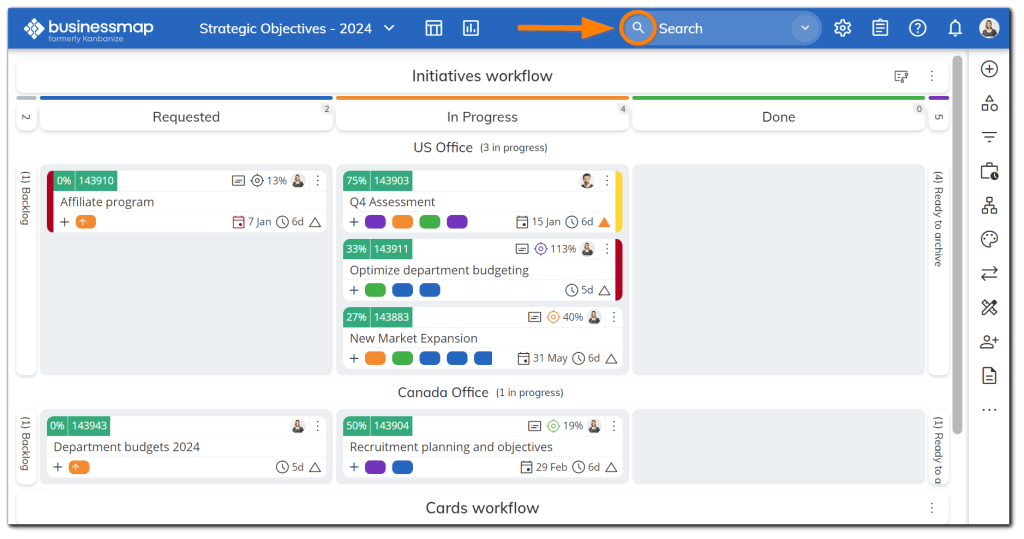
Businessmap (formerly Kanbanize) is an enterprise strategy execution and Lean portfolio management platform built on advanced Kanban principles. Among other top strategic portfolio management tools in 2026, this one is powered by multi-layered, advanced Kanban boards, which makes it a standout solution within the market.
Best for:
Lean-Agile organizations that want to visualize value streams and optimize operational throughput at the same time.
Standout capability
Multi-layered portfolio Kanban boards: This portfolio management tool supports infinite board nesting and parent-child dependencies across management layers. It pairs this with built-in Monte Carlo simulations and cumulative flow diagrams (CFD) to accurately forecast project completion dates based on historical throughput.
Key features
- Strategy-to execution mapping.
- No-code automation rules.
- Smart canvas.
- Management dashboards.
Pricing model
Tiered per-user subscription.
Free trial
This tool doesn’t offer a free trial. However, it offers a demo version.
Limitations
- Steep learning curve for non-Lean teams.
- Complex initial administration.
- Less suited for heavy financial / CapEx accounting.
8. Broadcom Clarity – best for enterprise financial governance.
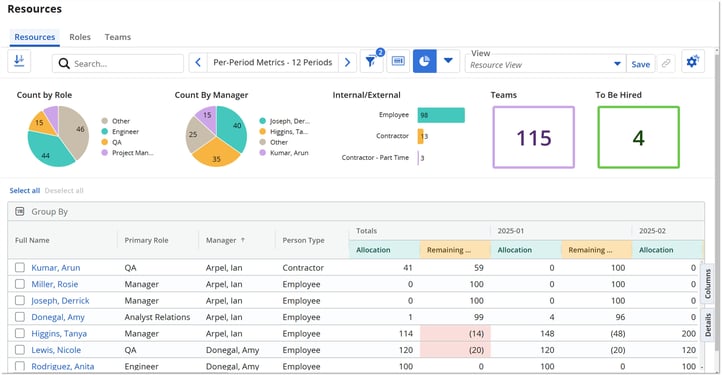
Broadcom Clarity is an enterprise-grade value stream management and strategic portfolio management software designed for large-scale financial control and capital governance. It connects high-level strategic objectives with complex financial accounting and resource capacity planning.
Best for:
Large enterprise PMOs and capital-heavy industries (financial services, telecom, public sector, healthcare) that demand rigorous financial governance.
Standout capability
Enterprise financial controls: Offers standard-setting financial management capabilities that seamlessly handle complex financial structures.
Key features
- Advanced capacity and resource management.
- AI insights and analytics.
- Integrates natively with Broadcom Rally.
- SPM financial roadmaps.
Pricing model
Subscription plans based on features.
Free trial
Has a free trial.
Limitations
- Complex initial implementation.
- This portfolio management tool can be overwhelming for low-maturity PMOs.
- The vendor’s commercial strategy prioritizes large enterprise clients.
Read more: A Guide to the Best Risk Management Software: Top ERM Tools in 2026
How to choose a strategic portfolio management tool?
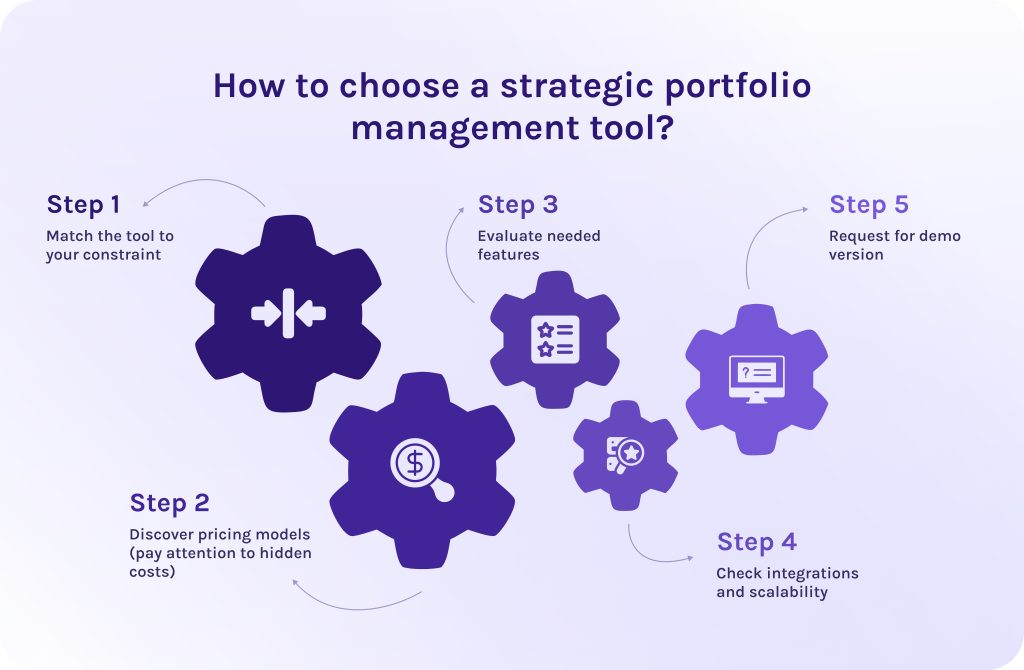
#1 Match the tool to your constraint.
Every organization has a distinct operational bottleneck. Identify your core pain point first and choose a vendor whose native architecture addresses that specific governance challenge. In this case, general solutions will be more of an overhead than a helping hand.
#2 Discover pricing models (pay attention to hidden costs).
SPM tools range from per-user SaaS subscriptions to custom enterprise-wide software agreements. Look beyond the baseline license fee and account for total cost of ownership (TCO) drivers.
#3 Evaluate needed features.
Focus on core strategic portfolio management capabilities that directly support strategic, data-driven decisions. These tools can be scenario planning, “what-if” modeling, predictive algorithms, capacity forecasting. Prioritize tools that balance robust governance with an intuitive interface your team will easily adopt.
#4 Check integrations and scalability.
A strategic PM tool must seamlessly pull data from your existing ecosystem. Ensure the software can scale both technically and structurally to support expanding portfolios and larger data volumes over time.
#5 Request for demo version.
Avoid generic sales slide decks and request a customized proof-of-concept (PoC) or sandbox environment built around your organization’s actual portfolio data. Use this trial to test how easily executives can generate real-time status insights and how smoothly project managers can input execution metrics.
Read More: Jira Capacity Planning: The Complete Resource Planning Guide
Quick summary
Let’s quickly summarize the main pieces of advice on which strategic portfolio management tools you need to choose for your organization:
- Epicflow – if shared resource overload and capacity bottlenecks across projects are your main operational bottleneck.
- ServiceNow SPM – when you rely heavily on the ServiceNow ecosystem.
- Planview – when you need a solution for global strategy execution and complex capital allocation.
- Planisware – if you operate within environments that require engineering roadmaps.
- Apptio Targetprocess (IBM) – when you’re scaling SAFe/LeSS frameworks across large IT groups.
- Triskell – if you want a flexible workspace to build custom data models.
- Businessmap – if you need multi-layered portfolio Kanban boards.
- Broadcom Clarity – if you require advanced financial controls and multi-currency accounting.
Don’t hesitate to get your best strategic project management software today and increase efficiency of your operations – contact HYS Enterprise experts.
FAQs
1. What is strategic portfolio management software?
Strategic portfolio management (SPM) software is software for large enterprises that aligns high-level business strategy with tactical project execution. It provides real-time insights into resources, finances, ongoing projects, risks, and task statuses so that every team member is on the same page and does exactly what supports enterprise-wide strategy.
2. What are SPM tools?
These are strategic portfolio management tools that provide executive leaders with a single source of truth to align business strategy and resource capacity with operational execution.
3. What does SPM stand for?
SPM stands for strategic portfolio management. It is an approach to managing huge project portfolios based on the business value of each initiative within it. This allows companies to continuously balance resources and priorities to ensure maximum return on investment (ROI).
4. What is the difference between PPM and SPM?
Project portfolio management (PPM) focuses primarily on the tactical execution of individual projects to ensure they are delivered on time, on scope, and within budget. In contrast, strategic portfolio management (SPM) operates at the executive level. It aligns overall investments, resource capacity, and dynamic funding directly with overarching business strategy and OKRs.
5. Is SPM part of ServiceNow?
Yes, SPM (strategic portfolio management) is a dedicated product suite within ServiceNow. It provides business leaders with tools to align strategic priorities and manage enterprise value streams directly on the ServiceNow platform.
6. Is Jira a PPM tool?
Standard Jira is a work management and issue tracking tool, not a true project portfolio management (PPM) tool. However, the version extended with Jira Align or Advanced Roadmaps (Jira Plans) expands Jira into enterprise-level PPM and SPM capabilities.
7. What is the best strategic portfolio management software?
There are no best tools for strategic portfolio management. Every solution serves different purposes, so you need to choose strategic portfolio management software according to your needs and pain points.
8. How much does strategic portfolio management software cost?
Strategic portfolio management (SPM) software typically costs between $20 to $150 per user per month for standard cloud plans. Enterprise-grade platforms (such as Planview, ServiceNow SPM, or Broadcom Clarity) usually operate on custom annual contracts ranging from $30,000 to well over $100,000 per year. Total costs depend heavily on user tier mix (full planners vs. view-only licenses), required modules, and implementation or integration services.
9. Is there a free strategic portfolio management tool?
Most of the tools for strategic portfolio management are justifiably expensive as they provide an extensive set of advanced features for scenario planning and wise resource allocation. However, they often offer free plans or demo versions to test and choose the best option.
10. What does a strategic portfolio manager do?
A strategic portfolio manager is a specialist who is responsible for aligning every project within the portfolio with strategic objectives. They instantly evaluate proposed initiatives to choose the most valuable ones based on strategic ROI and OKRs and allocate investments and resources accordingly. They ensure investments consistently align with high-value business outcomes.
References
- https://pmc.ncbi.nlm.nih.gov/articles/PMC2047294/
- https://www.mckinsey.com/capabilities/strategy-and-corporate-finance/our-insights/enduring-ideas-the-three-horizons-of-growth
- https://www.researchgate.net/publication/363893185_STRATEGIC_PORTFOLIO_MANAGEMENT_In_the_Multi-project_and_Program_Organisation_ISBN_9780367425036
- https://www.researchgate.net/publication/389680736_Strategic_Portfolio_Optimization_Balancing_Agile_Lean_Six_Sigma_and_AI-Augmented_Resource_Allocation_Models
- https://www.researchgate.net/publication/288872494_Theory_of_constraints_A_state-of-art_review
- https://www.researchgate.net/publication/396912200_Creating_Value_through_Agile_Portfolio_Management_and_Strategic_Alignment_in_Technology_Enterprises
- https://www.researchgate.net/publication/332144265_An_innovative_strategic_project_and_portfolio_management_decision-making_tool
- https://www.gartner.com/en/documents/7988837
- https://www.scribd.com/document/410173146/portfolio-management
- https://www.routledge.com/Strategic-Portfolio-Management-In-the-Multi-Project-and-Program-Organisation/Angliss-Harpum/p/book/9780367425036
- https://www.researchgate.net/publication/361734122_Portfolio_Management_Strategies
- https://www.researchgate.net/publication/381655522_A_REVIEW_ON_THEORY_OF_CONSTRAINTS_TOC_IN_MANUFACTURING