
What is project portfolio management?
Project portfolio management (the short form is PPM) is a strategic process of managing all a company’s projects together to choose the most important ones for the organization’s growth and achieving long-term and short-term business goals.
In traditional project management, companies manage individual projects separately. Frankly, for smaller companies it can be the best option: while you manage only a few projects, keeping your schedules aligned with resource availability is quite easy.
However, for companies managing dozens or even hundreds of projects and programs simultaneously, aligning every initiative with business goals is as necessary as breathing. As much as we’d like otherwise, resources will always be limited. In this case, portfolio management helps you prioritize the right projects and allocate resources wisely to ensure every dollar spent directly supports the company’s growth and drives revenue.
Read More: Top 7 Best Strategic Portfolio Management Tools for Your Organization
What is the role of a project portfolio manager?
Project portfolio manager is a person who is responsible for managing huge project portfolios in their organizations. They are also the first people who need to deal with portfolio management challenges and find efficient ways to solve them.
What are the core competencies of a project portfolio manager?
- These specialists must be financially literate to work with huge investments and drive ROI.
- They must have developed strategic thinking to avoid a lack of alignment and align all processes with business strategy.
- They must possess good negotiation skills to solve conflicts and avoid miscommunication.
- Ultimately, they must understand where to find accurate and relevant data and how to work with it to ensure portfolio governance.
Read More: AI in Project Portfolio Management: 7 Key Trends & Features
What are the main project portfolio management challenges and ways to overcome them?
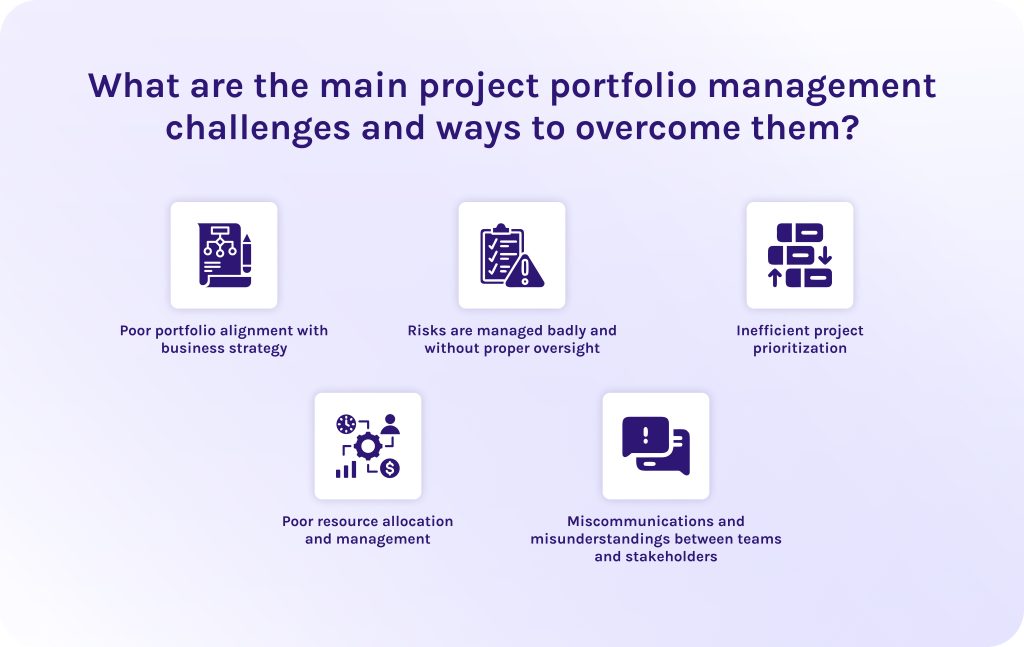
#1 Poor portfolio alignment with business strategy.
Projects are approved and executed without clearly supporting the organization’s strategic objectives. It is one of the biggest challenges of project portfolio management that significantly reduces the overall value of the portfolio.
Why does it happen?
While communicating with business leaders, you rarely can get clear selection criteria for prioritization of projects and programs. Consequently, experimental projects or cost- and time-consuming initiatives get approved even if they don’t move the strategic needle.
How to overcome this strategic portfolio management challenge?
Remember to always use scoring frameworks and models to be as objective as possible and avoid misalignment. Every project proposal must explicitly demonstrate how it contributes to key objectives.
#2 Risks are managed badly and without proper oversight.
Managers don’t identify and assess portfolio risks consistently. Bad risk management is often considered to be one of the largest portfolio management challenges with the most harmful consequences. According to Speakwise statistics, organizations with poor risk management practices lose 12% of their total project capital directly to failed initiatives and wasted resources. High performers with mature risk strategies waste 14 times less money [2].
Why does it happen?
Teams often log risks inside individual project silos. Portfolio managers then miss dependencies. Consequently, if that single point fails, the entire project portfolio collapses.
How to overcome this strategic portfolio management challenge?
Implement a centralized portfolio risk register. Focus specifically on cross-project dependencies and resource constraints, or any industry-specific risks that can affect your project portfolio.
#3 Inefficient project prioritization.
Of course, while talking about portfolio management challenges, we must mention poor prioritization of projects in the project portfolio. Companies often struggle to evaluate projects based on strategic success criteria and do so by relying on gut feeling or subjective opinions. This, after all, leads to suboptimal investment decisions.
Why does it happen?
Leadership struggles to make tough portfolio decisions. Instead, business leaders rely on subjective assumptions. Consequently, every department head fights to mark their initiative as critical, leaving execution teams confused about where to focus.
How to overcome this portfolio management challenge?
Adopt formal prioritization frameworks like WSJF (Weighted Shortest Job First) or Eisenhower’s matrix. Prioritization must be re-evaluated quarterly as market conditions change.
#4 Poor resource allocation and management.
One of the toughest challenges in portfolio management is efficient resource allocation. When all your resources are limited (they always are) and they aren’t distributed effectively across projects, it leads to bottlenecks and overbooked or underutilized capacity.
Why does it happen?
The main problem here is that project portfolios are often planned around ideal capacity. Business leaders assume 100% efficiency and zero operational interruptions. Moreover, senior specialists or team leaders are frequently double-booked across five different “top priority” projects.
How to overcome this portfolio management challenge?
Companies need to switch from project-based resource allocation to capacity-based planning. As well, plan only 70–80% of the capacity of your employees to leave room for unforeseen changes.
#5 Miscommunications and misunderstandings between teams and stakeholders.
Ineffective communication between project teams and business leaders creates misunderstandings about priorities and expectations. This lack of alignment is one of the most dangerous portfolio management challenges, which can end up in conflicts and negatively impact delivery [3].
Why does it happen?
It happens because, pretty often in companies, different departments use different tools and definitions of “done.” Executives want high-level financial and milestone summaries, while portfolio managers provide detailed task logs.
How to overcome this strategic portfolio management challenge?
You need to establish a single source of truth (a unified PPM platform or dashboard) with tailored views. Thanks to it, all information will be gathered in one place so that executives and team members will always be on the same page.
All the portfolio management issues and challenges described above are tightly connected to each other and, if you’re struggling with one of them, you’re almost certainly struggling with another one.
Read More: Jira Capacity Planning: The Complete Resource Planning Guide
How does Epicflow help to solve portfolio management challenges?
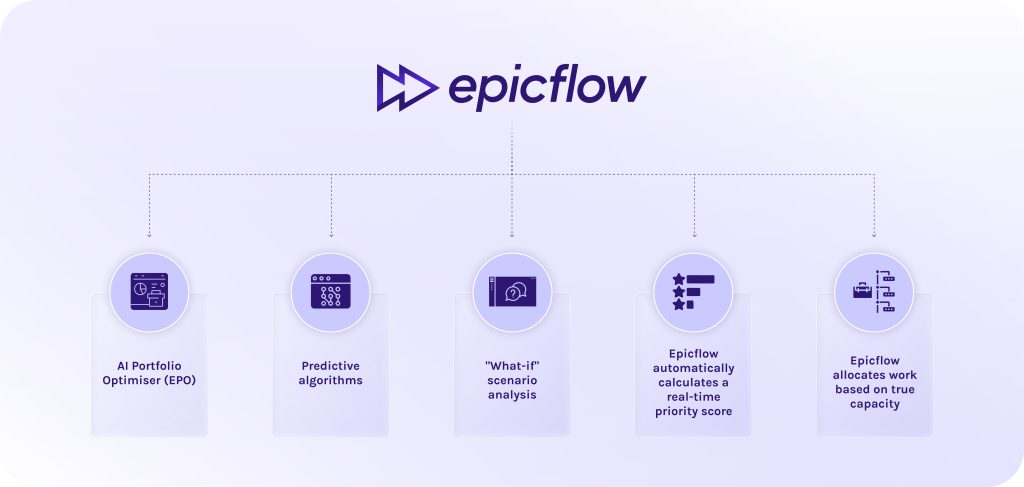
Epicflow is a dedicated portfolio management software designed directly to help enterprises manage their project portfolios properly. This platform addresses core portfolio management challenges by approaching portfolio execution through innovative algorithms and focuses on the efficient allocation of constrained resources.
- Its AI Portfolio Optimiser (EPO) models total real-world capacity against expected business value. It sequences tasks and projects to ensure your limited specialist hours yield the highest strategic return.
- Epicflow analyzes current velocity and workload trends to forecast resource bottlenecks in advance, thanks to its predictive algorithms.
- Using “what-if” scenario analysis feature managers can test hypothetical changes without any risks to see their impact across the entire portfolio.
- Epicflow automatically calculates a real-time priority score for every task based on different metrics.
- Designed specifically for multi-project environments, Epicflow allocates work based on true capacity and specific skill sets.
Don’t hesitate to see all Epicflow’s capabilities. Contact our experts today to unlock the full potential of your team.
Read More: The Next Generation of PMO Tools: How to Choose the Perfect One for You
Conclusion
In a nutshell, we found out that specialists highlight five main portfolio management challenges:
- Bad alignment between business strategy and actual project planning and execution.
- Poor communication between business leadership and execution teams.
- Weak project prioritization when everything becomes a priority.
- Bad risk management and the absence of risk registers.
- Struggling with resource allocation.
The easiest strategy to solve them is to find a robust software that will possess all the features needed for complex project planning. Epicflow is one of them. Explore more information about Epicflow capabilities on its official website.
FAQs
1. What is project portfolio management?
Project portfolio management (PPM) is a continuous, strategic process of managing an organization’s ongoing and upcoming projects. Here, companies are not limited only to managing tasks. They evaluate all projects to prioritize which one is more important for business goals to allocate the strongest resources and manage risks accordingly. Its primary goal is to ensure the company invests in the right projects to maximize outcomes and strategic value.
2. What are the main PPM challenges?
The main challenges of enterprise project portfolio management are often described as the following ones:
3. How difficult is portfolio management?
Project portfolio management has two sides: mathematical and human. The first one isn’t difficult if you are skilled enough and if you use the right automation tools. However, the human element makes it tough. The true mastering of the role comes down to managing executive expectations and driving clear decisions amid constant change.
4. What are the challenges of being a portfolio manager?
5. What are the five project portfolio management challenges?
- Poor strategic alignment.
- Bad resource allocation.
- Weak risk management.
- Miscommunication between teams and business leadership.
- Poor project prioritization.
6. Are portfolio managers in demand?
Frankly speaking, yes, portfolio managers are in high demand across completely different industries. Companies need experienced specialists because they often struggle to manage complex environments and balance tight capital budgets.
According to recent studies, employment in project and portfolio governance continues to grow faster than the average, thanks to enterprise digital transformation and the shift toward strategic portfolio management (SPM) [1].
7. What is the 60/20/20 rule for portfolios?
If we are talking about project portfolio management, the 60/20/20 rule says that you should spend 60% of resources on scale-ready core projects, 20% on future initiatives, and 20% on foundational core improvements to maintain balanced long-term business growth.
8. How to align project portfolios with business strategy?
To align project portfolios with business strategy, establish clear scoring criteria based on your strategic goals (OKRs) to evaluate and select initiatives. Continuously review and re-prioritize the portfolio, reallocating resources to high-impact projects while killing or pausing those that no longer move the business forward.
9. How to prioritize projects in my portfolio?
If you want your projects to be prioritized automatically, you should integrate the appropriate software into your workflows. In this case, Epicflow can be a decent choice for both growing businesses and huge enterprises operating dozens of concurrent projects.
If you need to manually decide which of a few projects is most important, you can use Eisenhower’s matrix method or the Weighted Shortest Job First model.
10. How to allocate constrained resources efficiently?
References
1. “Project Portfolio Management Market Size, Share, Growth & Latest Trends” (2026). Retrieved from:
https://www.marketsandmarkets.com/Market-Reports/project-portfolio-management-software-market-225932595.html
2. “Project Management Statistics 2026: Success Rates” (2026). Retrieved from:
https://speakwiseapp.com/blog/project-management-statistics
3. “Challenges of Developing Project Portfolio Management: a Case Study” (2008). Retrieved from:
https://www.researchgate.net/publication/267155114_Challenges_of_Developing_Project_Portfolio_Management_a_Case_Study
4. “Product Portfolio Management – Current challenges and preconditions” (2014). Retrieved from:
https://www.researchgate.net/publication/277837634_Product_Portfolio_Management_-_Current_challenges_and_preconditions
5. “Project portfolio management in the age of artificial intelligence: A review of challenges, key features, and future research directions” (2026). Retrieved from:
https://www.researchgate.net/publication/397668256_Project_portfolio_management_in_the_age_of_artificial_intelligence_A_review_of_challenges_key_features_and_future_research_directions
6. “Key Competencies for Overcoming Challenges in Project Portfolio Management” (2025). Retrieved from:
https://www.researchgate.net/publication/394895403_Key_Competencies_for_Overcoming_Challenges_in_Project_Portfolio_Management
7. “Product-level profitability: Current challenges and preconditions for data-driven, fact-based product portfolio management” (2019). Retrieved from:
8. https://www.researchgate.net/publication/336240246_Product-level_profitability_Current_challenges_and_preconditions_for_data-driven_fact-based_product_portfolio_management