10 Best AI Development Companies: Shortlist
Before we get started with our conversation, I want to give an answer to the following question: what are top AI software development companies?
- HYS Enterprise – best for companies of all sizes, from startups to large enterprises, that need reliable and secure AI services.
- Master of Code Global – specialized in building sophisticated autonomous agents that manage complex customer journeys across chat and voice.
- DataRoot Labs – best for venture-backed startups and enterprises that require deep mathematical rigor and rapid MVP cycles for complex ML models.
- Rootstrap – best for high-growth companies that need a superior user experience (UX) integrated into high-performance AI and multi-agent workflows.
- 10Pearls – best for startups and medium market companies that need a functional AI proof-of-concept (PoC) in a short window.
- eSparkBiz – best for large-scale AI and cloud transformations that require a deep bench of DevOps-savvy engineers and cost-effective delivery models.
- 10Clouds – best for startups that need a design-first MVP where high-end product design (UI/UX) is as critical as the underlying AI model.
- Valiance Solutions – best for government and industrial sectors that need high-stakes computer vision and decision-intelligence systems.
- Netguru – best for mid-to-large companies that need an iterative approach where AI is seamlessly embedded into the user roadmap.
- Scale AI – the essential partner for those who need high-quality data labeling and RLHF (human feedback) to ensure their AI models are accurate and safe for deployment.
Read More: Software Development Outsourcing Companies in the Netherlands: A Complete Guide
How AI Software Transform Business Operations
The AI software development market is rapidly gaining its momentum. In fact, till 2033 the size of the global AI market is expected to reach USD 3,497.26 billion. It means that it will expand at a CAGR of 30.6% from 2026 to 2033 [1]. But what drives this expansion?
- Companies that rely primarily on manual data analysis make decisions up to 5x slower than data-driven organizations. Whereas 32% faster decision-making was reported by companies that use automated data analysis and predictive insights powered by AI [2].
- Businesses lose 20-30% of revenue annually due to operational inefficiencies. However, 63% of companies report up to 10% growth of revenue in business functions where they are using AI.
- 30-45% of enterprise data is corrupted or lost due to manual entry between disconnected systems. 64% of organizations said that AI has boosted their operational efficiency and customer experience [3].
- 57% of consumers reported much higher trust to companies and products that use AI. It indicates improved customer experience [4][5].
Additionally, the use of AI pays off in more specific business areas:
- AI now can read data with more than 95% accuracy. It extracts the relevant info and routes it to the correct department without a human ever opening the file.
- AI continuously audits every transaction against global regulations and internal policies. Instead of a yearly audit, businesses now have “continuous compliance,” where anomalies are flagged in milliseconds.
- In terms of recruitment, for instance, AI ignores traditional job titles (which can be vague) and maps a candidate’s actual skills to the company’s specific needs. This has increased “recruiter capacity” by over 50%.
- Whilst in industries like logistics or supply chain operations, AI analyzes local weather, social trends, and even regional economic shifts, reducing excess stock by 20% while simultaneously ensuring that “out-of-stock” events are nearly eliminated.
Read More: A Guide to the Best Risk Management Software: Top ERM Tools
Our Selection Criteria for AI Software Development Companies
While creating our own top AI development companies, we’ve developed our unique selection criteria. We used different researches, market studies, statistics to make sure that our judgments aren’t prejudiced. Then, based on it, we’ve evaluated each company’s capabilities, market reputation, technical expertise, and proven ability to deliver measurable business results.
- Data maturity. We prioritize firms that understand that data quality is the foundation of AI. This ensures the software can handle messy, real-world information without sacrificing accuracy or security.
- MLOps & production-first architecture. The best companies build scalable systems equipped with MLOps for continuous monitoring and automated retraining. This prevents “model drift” and ensures the software remains reliable as market conditions evolve.
- Strong regulatory compliance. We evaluate top AI development companies according to their AI responsibility and especially their ability to mitigate algorithmic bias and ensure transparency. Their workflows must align with the latest global standards to protect clients from legal and reputational risks.
- Measurable business result KPIs. Top-tier AI software development companies must prove their value through tangible operational improvements, such as a 30% reduction in manual tasks or faster time-to-market.
- Continuous maintenance. Success is defined by how well a client can manage the AI after the developer leaves. We select firms that offer comprehensive internal training, ensuring the client is never locked into a “black box” system.
At HYS Enterprise our experts know exactly how to develop quality AI services to help you achieve outcomes described above; thus, contact our team as quickly as possible to create a strategy of boosting your business to the next level.
Read More: Best Free ERP Software: Open Source and Free ERP Systems Compared
Comparison Table of Leading AI Development Companies
| Tools | Experience | Office | Core AI functionalities | Industries |
| HYS Enterprise | Almost 20 years | Amsterdam, Netherlands | LLM.
Azure AI and machine learning. AI-powered OSS/BSS automation. Agentic AI platforms. Custom AI software development. AI software modernization. AI consulting. Cloud computing. |
IT and software development.
Healthcare. Fintech and financial services. Manufacturing. Logistics. Telecommunications. Marketing. E-commerce and retail. |
| Master of Code Global | 20+ years | Redwood City, CA | Custom AI and ML.
Conversational AI. Generative AI. AI consulting. Prompt engineering. AI integration. |
E-commerce and retail.
Healthcare. Banking and finance. Telecom. Automotive. Travel and hospitality. |
| DataRoot Labs | 10 years | Kyiv, Ukraine | AI solutions.
Generative AI and LLMOps. Dedicated AI R&D teams. Venture services. AI strategy and roadmapping. |
Automotive.
Healthcare (telemedicine). Energy. Manufacturing. Retail. AgTech. |
| Rootstrap | 15 years | West Hollywood, CA | Agentic AI and AI agent orchestration.
Generative AI and custom LLMs. AI-UX design. Computer vision and ML. Data engineering. |
EdTech.
Healthcare. Fintech. Media and entertainment. E-commerce. Non-profits. |
| 10Pearls | 20+ years | Vienna, Virginia, USA | AI software development and consulting.
AI strategy and governance. ML solutions. Custom AI/ML. Generative AI. Full digital transformation. |
Telecommunications.
Retail. Education. Transportation. Energy. Technology. Financial services. Healthcare. |
| eSparkBiz | 16 years | Ahmedabad, India | Generative AI.
AI consulting and strategy. AI staff augmentation. Predictive models. MLOps. |
Fintech.
Real estate. Logistics. Healthcare. EdTech. E-commerce. Food and beverage. |
| 10Clouds | Founded in 2009 | Warsaw, Poland | Generative AI.
AIConsole. AI chatbots and voicebots. Computer vision. MLOps. |
Fintech.
HealthTech. EduTech. Blockchain and Web3. PropTech. |
| Valiance Solutions | 14 years | Noida, India | Computer vision.
Generative AI. Predictive analytics. Data engineering. AI center of excellence (CoE). |
Public sector and government.
Manufacturing. Financial services. Retail and CPG. Healthcare. |
| Netguru | Founded in 2008 | Poznań, Poland | AI consulting and strategy.
Generative AI integration. MLOps. Data engineering. Product design. |
Fintech and banking.
Retail and e-commerce. Healthcare. Real estate. |
| Scale AI | Founded in 2016 | San Francisco, California | Generative AI.
Model evaluation. Reinforcement learning from human feedback (RLHF). Scalable data ops platform for enterprise AI. Training data pipelines and quality assurance. |
Defense and government.
Autonomous vehicles. Generative AI labs (OpenAI, Meta, Anthropic). E-commerce. Logistics. |
Top 10 AI Software Development Companies in 2026 (Detailed Reviews)
Here is our AI software development companies list, based on our evaluation methodology.
1. HYS Enterprise
Years of experience:
Founded in 2007 – almost 20 years of market presence and experience in developing robust software solutions, including AI-powered ones.
Team size:
Global team with a core pool of experts from Ukraine and Poland that is evaluated by 250+ highly skilled professionals.
Core AI services:
- Enterprise AI software development.
- Workflow automation.
- Natural language processing (NLP).
- AI quality assurance.
- Predictive analytics.
- Agentic AI platforms.
- Custom AI software development.
- AI software modernization.
- AI consulting.
- Cloud computing.
Industries served:
- IT and software development.
- Healthcare.
- Fintech and financial services.
- Manufacturing.
- Logistics.
- Telecommunications.
- Marketing.
- E-commerce and retail.
Best for:
Companies of all sizes that need robust and high quality software, especially from highly regulated industries.
Pricing model:
- Monthly rates for dedicated engineering talent.
- Fixed-price for clearly defined MVPs.
- Cost-quality ratio also known for “six nines” (99.9999%) reliability at competitive Eastern European rates.
Offices/Locations:
The main office is located in Amsterdam, Netherlands. As well the company has offices in Bydgoszcz (Poland) and Odesa (Ukraine).
Quality services don’t develop themselves – don’t hesitate to contact our AI experts to turn your ideas into reality.
2. Master of Code Global
Years of experience:
Founded in 2004, it has 22 years of experience in building robust IT services. Pivoted to AI specialization in 2016.
Team size:
250-500 employees (a multidisciplinary team of AI engineers, conversational designers, and data scientists).
Core AI services:
- Custom AI and ML development.
- Conversational AI.
- Generative AI solutions.
- AI consulting.
- Prompt engineering.
- Ai integration.
Industries served:
- E-commerce and retail.
- Healthcare.
- Banking and finance.
- Telecom.
- Automotive.
- Travel and hospitality.
Best for:
Mid-to-large enterprises looking for highly customized, and human-like AI interfaces.
Pricing model:
- Time and materials.
- Project-based contracts.
- Managed services.
Offices/Locations:
Headquartered in Redwood City, CA, with engineering offices in Kyiv and Cherkasy (Ukraine), Poland. As well, additional offices are located in Winnipeg and Toronto (Canada), Boston (USA).
3. DataRoot Labs
Years of experience:
Founded in 2016, the company has 10 years of experience in software development, including robust AI services.
Team size:
50-100 in-house experts.
Core AI services:
- AI solutions development.
- Generative AI and LLMOps.
- Dedicated AI R&D teams.
- Venture services.
- AI strategy and roadmapping.
Industries served:
- Automotive.
- Healthcare (telemedicine).
- Energy.
- Manufacturing.
- Retail.
- AgTech.
Best for:
Startups that need to move from a pilot and demos to a functional AI MVP as quickly as possible.
Pricing model:
- Hourly rate.
- Minimum project size.
- MVP delivery.
Offices/Locations:
Compared to other custom AI software development companies, DataRoot Labs has an office in Tel-Aviv (Israel) and head office in Kyiv, Ukraine.
4. Rootstrap
Years of experience:
The company has 15 years of experience in developing reliable software solutions (founded in 2011).
Team size:
250-500 specialists. A team is distributed around the globe with a strong nearshore presence in Latin America.
Core AI services:
- Agentic AI and AI agent orchestration systems.
- Generative AI and custom LLMs.
- AI-UX design.
- Computer vision and ML.
- Data engineering.
Industries served:
- EdTech (leading niche).
- Healthcare.
- Fintech.
- Media and entertainment.
- E-commerce.
- Non-profits.
Best for:
Startups and enterprises that need a design-first AI approach, where the user experience is just as important as the technical performance of the model.
Pricing model:
- Staff augmentation.
- Minimum project size.
- Hourly rate.
Offices/Locations:
The main office is located in West Hollywood (Beverly Hills), CA. Additionally, the company has global delivery hubs in Buenos Aires (Argentina), Montevideo (Uruguay), and Medellín (Colombia).
5. 10Pearls
Years of experience:
The company was founded in 2004, meaning its experts have 20+ years of experience in quality service delivery.
Team size:
Some sources say that the team size is approximately 1,300+ experts globally.
Core AI services:
- AI software development and consulting.
- AI strategy and governance.
- Machine learning solutions.
- Custom AI/ML automation and integration.
- Generative AI solutions.
- Full digital transformation services.
Industries served:
- Telecommunications.
- Retail.
- Education.
- Transportation.
- Energy.
- Technology.
- Financial services.
- Healthcare.
Best for:
Enterprises and mid-sized businesses or even startups from various industries, including healthcare, finance, and other highly regulated business areas.
Pricing model:
- Time and money engagements.
- Fixed-price project contracts.
- Managed services and outcome-based solutions.
Offices/Locations:
Headquartered in Vienna, Virginia, USA, with delivery centers and engineering teams across North America, Latin America, United Kingdom, South Asia.
6. eSparkBiz
Years of experience:
The company was founded in 2010, so currently it has 16 years of experience.
Team size:
400+ highly skilled engineers.
Core AI services:
- Generative AI development.
- AI consulting and strategy.
- AI staff augmentation.
- Automating complex business operations with predictive models.
- MLOps.
Industries served:
- Fintech.
- Real estate.
- Logistics.
- Healthcare.
- EdTech.
- E-commerce.
- Food and beverage.
Best for:
Startups and enterprises seeking to build and scale digital products 5x faster using an AI-driven staff augmentation or dedicated team model.
Pricing model:
- Monthly rates for dedicated AI talent.
- Percentage from outcomes.
- Fixed minimum price for MVPs.
Offices/Locations:
The main office is located in Ahmedabad, India. Also, the company has offices in SA (Wood Dale, IL) and United Kingdom.
7. 10Clouds

Years of experience:
The company was founded in 2009, thus it has 17 years of experience.
Team size:
The team is evaluated by nearly 200+ specialists across AI software development.
Core AI services:
- Generative AI solutions.
- AIConsole.
- AI chatbots and voicebots.
- Computer vision.
- MLOps.
Industries served:
- Fintech (core expertise).
- HealthTech.
- EduTech.
- Blockchain and Web3.
- PropTech.
Best for:
Startups and companies that want scaling and needing to build a polished, AI-powered MVP quickly.
Pricing model:
- Hourly rate.
- Fixed minimum project size.
- White-label AI.
Offices/Locations:
The main office is located in Warsaw, Poland. As well the company has offices in Poznań and Wrocław (Poland), with a strategic presence in London and the USA.
8. Valiance Solutions
Years of experience:
The company was founded in 2012 and already has 14 years of experience.
Team size:
200+ specialized engineers and data scientists.
Core AI services:
- Computer vision.
- Generative AI.
- Predictive analytics.
- Data engineering.
- AI center of excellence (CoE).
Industries served:
- Public sector and government.
- Manufacturing.
- Financial services.
- Retail and CPG.
- Healthcare.
Best for:
Organizations that need specialized AI for security or high-stakes industrial operations where reliability is non-negotiable.
Pricing model:
- Hourly rate.
- Minimum project size.
- Managed services.
Offices/Locations:
Headquartered in Noida, India with additional offices in Bengaluru and Gurgaon.
9. Netguru
Years of experience:
From our list of best AI enterprise software development companies, this one has almost 20 years of experience in software development and consulting.
Team size:
600 – 800 specialists.
Core AI services:
- AI consulting and strategy.
- Generative AI integration.
- MLOps.
- Data engineering.
- Product design.
Industries served:
- Fintech and banking (strongest niche).
- Retail and e-commerce.
- Healthcare.
- Real estate.
Best for:
From the other top AI software development companies, Netguru is suitable for mid-to-large companies that need a “product-first” approach where the AI feels intuitive and serves a clear business goal.
Pricing model:
- Time to market.
- Fixed price or MVP.
Offices/Locations:
Headquartered in Poznań, Poland and with offices in Warsaw, Kraków, London, and Berlin.
10. Scale AI

Years of experience:
From our list of best AI enterprise software development companies, this celebrates its anniversary this year – 10 years (founded in 2016).
Team size:
Approximately 6,000+ full-time employees (as of early 2026)
Core AI services:
- Generative AI solutions.
- Model evaluation.
- Reinforcement learning from human feedback (RLHF).
- Scalable data ops platform for enterprise AI.
- Training data pipelines and quality assurance.
Industries served:
- Defense and government.
- Autonomous vehicles.
- Generative AI labs (OpenAI, Meta, Anthropic).
- E-commerce.
- Logistics.
Best for:
From the other top AI software development companies, Scale AI is suitable for large enterprises that operate within a high-stake environment and need massive, ultra high quality datasets.
Pricing model:
- Enterprise agreements.
- Pay-per-task or per-labeled-unit (varies significantly by data complexity).
Offices/Locations:
The company has a main office in San Francisco, California. Additional offices are located in Washington D.C., New York City, St. Louis (MO), London (UK), and a new partnership hub in Qatar.
Read More: The Best Backlog Management Tools
Top Industries Using AI Development Services
Information technologies.
IT has shifted toward AI-native development. Software is now built with AI in its core, instead of built with AI as its addition.
- Development teams use autonomous AI agents that can reason, plan, and execute end-to-end coding tasks, from initial documentation to security patching.
- AI-driven IT operations (AIOps) now automatically detect and remediate server failures or code bugs in real-time before users even report an issue.
Telecommunications.
With each upcoming year, it becomes more and more difficult for telco operators to manage the extreme complexity of 5G/6G networks and hyperscale data traffic. That is why AI becomes a strategic necessity rather than a nice-to-have option.
- With generative AI creating massive upstream data, telcos use AI to rearchitect networks for persistent traffic flows.
- AI identifies potential fiber-optic failures or cell tower congestion days in advance, thereby reducing unplanned downtime by nearly 20%.
Logistics and transportation.
Logistics has entered the era of the “autonomous supply chain,” where systems act independently instead of just offering suggestions.
- AI analyzes real-time signals about weather, geopolitical shifts, and social trends to trigger automatic inventory re-routing and procurement.
- AI-guided drones and autonomous ground vehicles (AGVs) use Vision-Language-Action (VLA) models to navigate complex urban environments for delivery.
Healthcare.
AI has transitioned from a diagnostic support tool to a core component of public health infrastructure.
- In 2026, identifying disease targets depends on silico (computational) exploration before wet-lab work even begins, cutting years off drug development timelines.
- AI now can capture and summarize patient-doctor conversations in real time, reducing clinician documentation time by up to 30%.
- AI implemented in specified applications can continuously monitor human health metrics (not only physical but also mental) and alert the doctor about dangerous tendencies.
Fintech and financial services.
Financial institutions require stable and secure intelligent services to move away from static, rule-based security to dynamic systems.
- Financial systems now use generative AI to create context-aware financial plans based on a user’s real-time spending habits and life events.
- AI systems perform real-time AML (anti-money laundering) and fraud screening, identifying sophisticated “machine-speed” attacks that traditional systems miss.
Marketing and sales.
According to the McKinsey and Company research [6], nearly 72% of consumers expect companies to deliver more personalization features. Thus, AI in marketing and sales helps companies to:
- Sales platforms now identify exactly when a lead is ready to buy by analyzing thousands of digital touchpoints, increasing conversion rates by over 20%.
- Marketing AI tools no longer produce “robotic” copy; they are trained on a brand’s unique identity to generate cross-platform content that is indistinguishable from human-written material.
Manufacturing.
The “Smart Factory” of 2026 emphasizes human-robot collaboration and self-optimizing production lines.
- Manufacturers use AI to model entire plant layouts and production changes in a virtual environment, eliminating risk before a single physical machine is moved.
- Computer vision systems now detect microscopic dyeing or weaving defects in real-time, achieving near-perfect quality rates in industries like textiles and electronics.
Our developers have significant experience in working even with such highly regulated industries as telecommunications, logistics, and manufacturing. Therefore, contact us to understand how our AI solutions can be tailored to your specific needs.
Read More: Top Telecom Project Management Challenges and How to Overcome Them
How Much Does AI Software Development Cost in 2026?
If you google “How much does it cost to develop AI software,” you probably won’t find an exact answer, because the cost of developing quality AI services and software isn’t fixed; it depends on:
- Complexity of software and architecture. You need to identify why exactly you need this software and which pain points it will cover. It should make sense because if it’s not, consequently, your investments will go down the drain.
- Quality data for training. One may think that the first step of developing AI is coding. However, truly it begins with gathering quality data for training. You need to check its accuracy, mistakes, and reliability before feeding LLM with it. Often, it is far more time and resource consuming than actual development.
- Not every LLM needs to be developed from scratch. If possible, developers can use a ready LLM, and the cost of development will be less than developing it from the very beginning.
- Security concerns. Data protection is as necessary as breathing, as companies often operate huge amounts of sensitive data. Thus, data and AI governance increase both time and cost spending.
- Continuous maintenance after launching. If you need your system to be controlled by a team of experienced professionals, it will also cost you a pretty penny.
Read More: How to Efficiently Allocate Resources for High-Priority Projects and Initiatives
How to Choose the Right AI Software Development Company
While AI software development companies comparison is less about finding the best technology and more about finding the best operational fit for your specific data landscape and business goals.
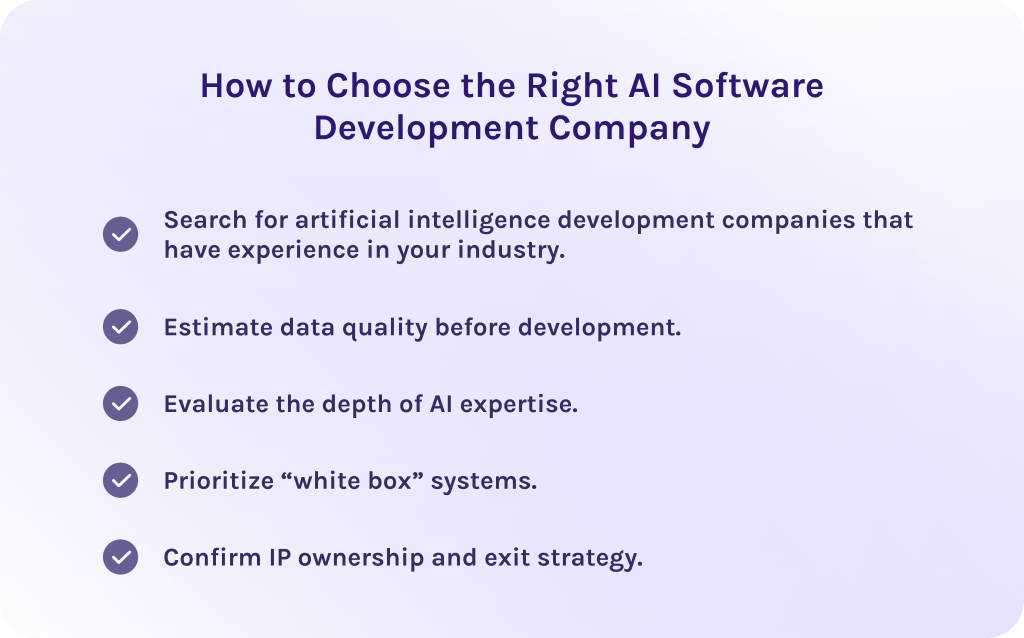
1. Search for artificial intelligence development companies that have experience in your industry.
When the vendor has experience in your specific niche, it means they’ve dealt with certain regulations and operational challenges that are unique to your sector. This significantly reduces the learning curve and minimizes implementation risks.
2. Estimate data quality before development.
A top-tier firm will spend more time talking about your data architecture than the AI itself. Thus, avoid AI development companies that promise immediate results without first auditing your data quality, volume, and labeling processes. While selecting, ask your potential vendor how they identify ‘poisoned’ or biased data before training begins.
3. Evaluate the depth of AI expertise.
It is a common situation when the organization positions itself as an AI software development company, but, in fact, they simply plug into existing models (like GPT-4) without deep engineering. You can ask to see a system they’ve built that has been running in a live environment for over six months to ensure that they build software that can handle real-world conditions.
4. Prioritize “white box” systems.
Especially in regulated industries (finance, healthcare, legal), you cannot afford a “black box” system where no one knows why the AI made a certain choice. Look for companies developing AI that use Explainable AI frameworks. This allows humans to audit the AI’s reasoning, which is essential for compliance and trust.
5. Confirm IP ownership and exit strategy.
Many vendors use proprietary “engines” that lock you into their ecosystem forever. Ensure the contract clearly states that you own the model weights, the custom code, and the processed data. So, ask the potential vendor what will happen if you terminate your partnership in two years. Will you still be able to host and run this model on our own servers?
Don’t hesitate to contact HYS Enterprise experts to build trusted partnership, reliability of which was proven by many success cases.
Read More: Unveiling the Surprisingly Diverse Uses of Large Language Models
Conclusion
- The most promising AI software development companies are OpenAI, DataArt, 10Pearls, NVIDIA, Anthropic, Scale AI, Meta AI, Master of Code Global, IBM Watson, Microsoft AI.
- AI streamlines messy workflows and data, making them readable and structured. As well, it can take autonomous actions and, over past years, has been gaining more and more independence from humans.
- Industries that benefit most from AI are healthcare, telecom, IT services, manufacturing, marketing, and finance.
- To calculate the cost of AI software development, you need to consider the complexity of software and architecture, find the quality data for training, decide whether you need the system developed from scratch or not, evaluate data security measures, and, ultimately, decide if you need maintenance or not.
- To choose from a variety of AI software development companies the right one you must search for artificial intelligence development companies that have experience in your industry, estimate data quality before development, evaluate the depth of AI expertise, prioritize “white box” systems, and, finally, confirm IP ownership and exit strategy.
HYS Enterprise teams are here to prove to you that, in terms of AI, sky is a limit. Book a call with our experts to find it out for yourself.
FAQ
1. What are the top AI software development companies?
From our perspective, the best AI development companies in USA are the top market leaders whose reputation goes far beyond just “quality software services”. Their approach to AI research has made a revolution in the development of modern AI. These companies are HYS Enterprise, DataRoot Labs, 10Pearls, Rootstrap, eSparkBiz, Scale AI, 10Clouds, Master of Code Global, Netguru, Valiance Solutions.
2. Which company is leading AI development?
The best companies for AI software development that lead the market today are HYS Enterprise, 10Clouds, Netguru, DataRoot Labs, Rootstrap, and Master of Code Global.
3. How do I choose the right AI company for my business?
To choose the right AI software development company, pay attention to the following moments:
- Whether the vendor has experience in your industry or not.
- How high the quality of the data they use to train the models is.
- They develop AI systems from scratch or just plug into existing models.
- Whether you can understand why AI made those exact choices.
- Whether you will still be able to use their models after partnership termination.
4. Who owns ChatGPT?
ChatGPT is developed by American AI development company OpenAI and was released in 2022 for the general public. Since then, it quickly became one of the fastest-growing AI applications in history.
5. Do AI development companies provide ongoing support?
Definitely, the best AI development companies that deliver quality services should as well provide continuous maintenance and support. It is essential because AI isn’t static – it learns from data and the accuracy and must be monitored and updated to maintain accuracy and reliability over time.
6. What technologies do AI development companies use?
Commonly, AI software development companies use different:
- Machine learning (ML) frameworks like PyTorch or TensorFlow.
- Cloud platforms like AWS or Azure.
- Programming languages, mostly Python but as additional ones can be C++ or Java.
7. What is the AI development process?
AI software development lifecycle contains the following steps:
- Defining the problem of why you need to implement this solution. For example, it can be improving customer experience or developing the internal product for your specific needs.
- Collecting the relevant and accurate data. You should identify sources where you’ll gather the quality data and ensure compliance with privacy regulations.
- Before you start to train your model, you should ensure that the data does not include duplications and remains accurate.
- Then, you should select exact training algorithms and feed the model with data you gathered before.
- Test the model using validation datasets to measure accuracy and other KPIs.
- Now, you can ultimately deploy your model and control its work.
8. What is AI software development and how does it differ from traditional software development?
The main distinguishing feature is that traditional software follows static logic and relies heavily on predefined structure. In turn, AI software development requires training models on various accurate datasets to teach the system to act on its own. This means that instead of explicitly programming every possible rule and outcome, developers train algorithms to recognize patterns and make decisions based on data.
9. How has the AI software development industry evolved over the past decade?
Over the past decade we were able to observe four key stages of AI software development evolution:
- 2016-2018: All began with pattern recognition and niche automation. Google’s AlphaGo defeats Lee Sedol (2016); widespread adoption of TensorFlow.
- 2019-2021: Contextual understanding and NLP breakthroughs. Shift from rule-based logic to large-scale statistical learning.
- 2022-2024: Content creation and public democratization. ChatGPT launch (2022); AI becomes accessible to the general public and non-devs. Rise of GenAI.
- 2025-2026: Autonomous execution and “AI-first” design. Rise of AI agents that act as autonomous digital collaborators.
10. Why is partnering with AI software development companies important for businesses?
Partnering with companies that develop AI is essential for businesses to stay competitive. Today, artificial intelligence is a main driver of growth and digital transformation in nearly any industry. Thus, companies that don’t adopt AI are likely to lose their competitive advantage and struggle to keep pace with more agile competitors.
References:
- https://www.grandviewresearch.com/press-release/global-artificial-intelligence-ai-market
- https://www.mckinsey.com/capabilities/tech-and-ai/our-insights/superagency-in-the-workplace-empowering-people-to-unlock-ais-full-potential-at-work
- https://arxiv.org/abs/2509.14532
- https://www.businesswire.com/news/home/20260122526477/en/Clutch-Report-65-of-Consumers-Use-AI-to-Research-Products-Before-Making-a-Purchase
- https://martech.org/57-of-consumers-trust-brands-more-when-they-use-ai-study-finds/?utm_source=chatgpt.com
- https://www.mckinsey.com/capabilities/growth-marketing-and-sales/our-insights/unlocking-the-next-frontier-of-personalized-marketing
- https://researchfdi.com/why-the-us-leads-the-world-in-entrepreneurship-and-innovation/#:~:text=Supportive%20Infrastructure%20and%20Resources,support%20they%20need%20to%20succeed.
