
What Is Agentic AI in Healthcare?
Agentic AI in healthcare is software that can adapt on the fly, requiring minimal human intervention. Moreover, its main purpose is to do everything autonomously, so it can connect with specialized models and interact with external tools to solve problems. This ability to collaborate on complex tasks, while maintaining a high degree of operational independence, is what defines agentic AI and distinguishes it from other AI types (like generative AI).
“Patients aren’t waiting for permission – they’re already running their doctor’s notes and lab results through ChatGPT. Meanwhile, hospitals are afraid to deploy AI primarily because there’s no official standard. In 2026, healthcare will be forced to catch up as a patient-facing AI standard emerges – one that finally makes AI safer than what no-clinical-context LLMs can offer today.”
– Aaron Patzer, CEO and co-founder of Vital.
If we’re talking specifically about the healthcare industry, agentic systems are used for:
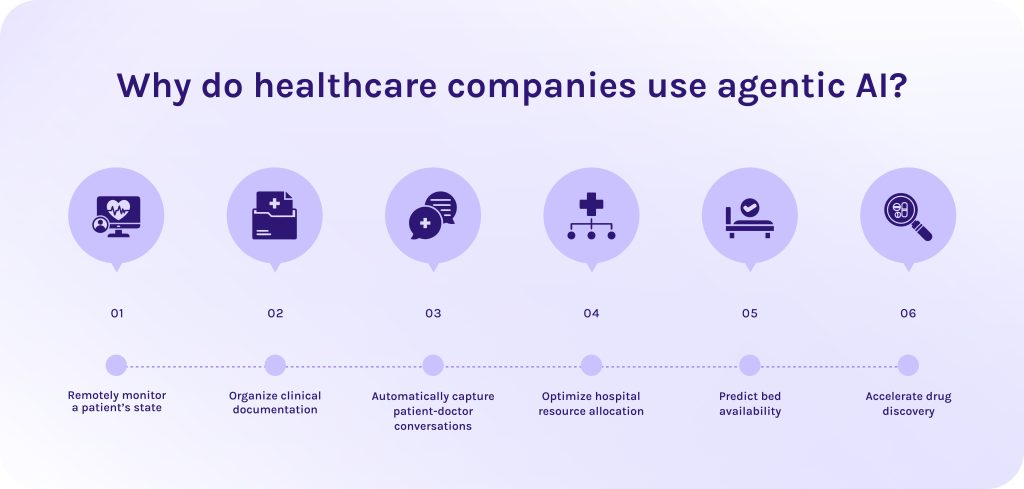
- Remotely monitor a patient’s state based on real-time data from physical sensors or wearables.
- Organize clinical documentation and update Electronic Health Records (EHR) in real time.
- Automatically capture patient-doctor conversations and map them to correct diagnostic and billing codes.
- Optimize hospital resource allocation, thanks to multi-agent networks, and dynamically adjust staff scheduling.
- Predict bed availability to prevent bottlenecks.
- Accelerate drug discovery and clinical trials.
Read More: The Best Autonomous AI Agents of 2026: Top Tools for Automation
What Are the Benefits of Agentic AI in Healthcare?
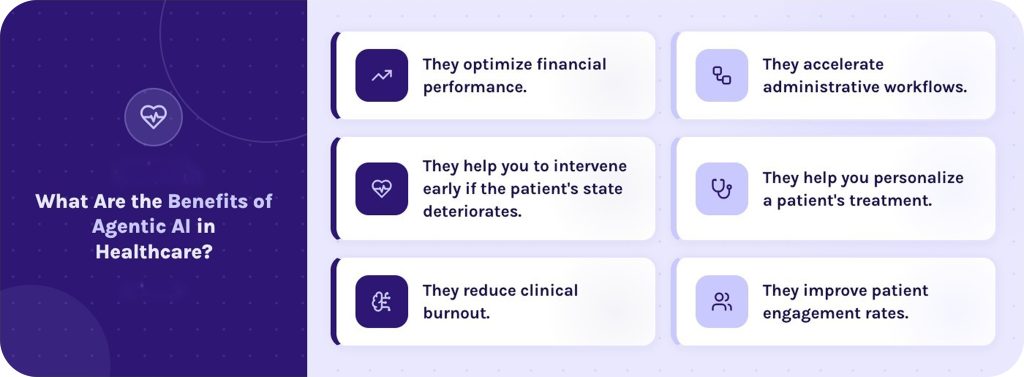
If agentic AI in healthcare is so popular that it becomes almost inevitable, then something must drive this obsession, right? We’ve analyzed the main benefits of AI agents in healthcare and are ready to present them to you.
- They optimize financial performance. Agentic AI in healthcare can autonomously identify billing errors or resolve documentation gaps before submission. It helps hospitals avoid costly insurance rejections.
- They accelerate administrative workflows. You can delegate some tasks to smart AI systems to automate workflows and free the time of healthcare professionals for more important activities. When companies upgrade to specialized systems powered by agentic AI, time savings skyrocket. According to a McKinsey and Slack survey, when knowledge workers utilize production agents, they reclaim a median of 6.4 hours per week [6].
- They help you to intervene early if the patient’s state deteriorates. Agentic AI applications in healthcare continuously process data from patient wearables and remote monitoring sensors to control metrics of a patient’s state and flag changes if the tendency is dangerous.
- They help you personalize a patient’s treatment. Healthcare IT leaders use agentic AI to analyze a patient’s deep genetic profile, lifestyle data, and entire clinical history to propose precise medication and therapy adjustments.
- They reduce clinical burnout. Agentic AI platforms handle the tedious manual data entry and patient follow-ups, giving your employees more free time for more important strategic activities.
- They improve patient engagement rates. Agentic AI in healthcare doesn’t need to sleep. This makes it available 24/7 with the ability to message patients to check on medication adherence or answer complex medical questions. Because these agents communicate in real time and lower barriers to care, they can improve overall medical adherence rates by 60% to 75% [7].
Read More: Why Enterprise Agentic AI is the Future of Efficient Workflows
What Are Real-World Use Cases of Agentic AI in Healthcare?
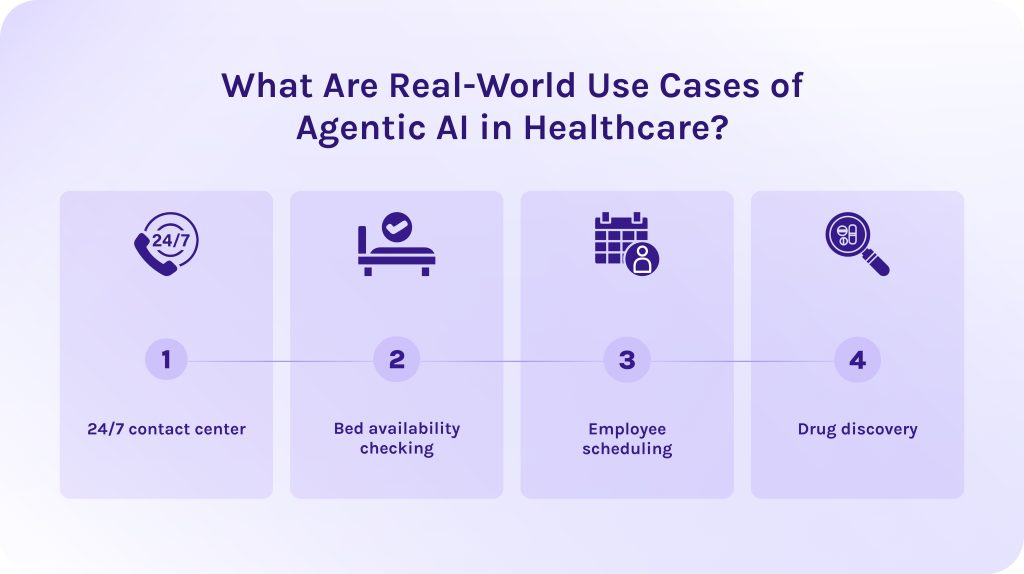
Use case #1 – 24/7 contact center.
One of the most illustrative agentic AI in healthcare examples are autonomous call centers. Help centers, in 2026, move away from simple chatbots to more efficient solutions. Chatbots that we are already familiar with quote static FAQ pages and give predefined answers. However, if a patient calls to reschedule a surgery, the AI platform checks the patient’s record and doctor availability, updates the pharmacy, changes pre-operation testing requirements, and ultimately texts the patient new instructions.
Why is it important?
It increases the productivity of the team because the risk of human errors is much lower. Moreover, if we are talking about, for example, surgery rescheduling, patients can forget to alter their medication or pre-operation fasting timeline, which leads to dangerous clinical complications or costly day-of-surgery cancellations. In turn, an AI agent ensures that recommendations and all dependent tasks are updated.
Use case #2 – bed availability checking.
One of the best examples of agentic AI in healthcare is a bed availability check. In complex hospital systems, checking bed availability requires endless coordination between different departments. Thus, you can use agentic AI to monitor different needed data in real time, like new patients arrivals or room cleaning statuses.
Why is it important?
Implementing agentic AI in healthcare significantly minimizes bottlenecks while placing patients in hospitals.
Use case #3 – employee scheduling.
Thanks to the agentic AI in healthcare, you can schedule shifts in a way that will prevent employee burnout. When a staff member calls out sick, the agent autonomously checks labor laws and individual competencies, instantly identifies the best backup candidates, and automatically pushes out requests for who can work out this shift.
Why is it important?
For the healthcare enterprises, it means fewer shift gaps, better productivity, simultaneously with lower burnout rates.
Use case #4 – drug discovery.
Traditional drug discovery requires researchers to spend years testing chemical compounds. Agentic AI in healthcare simulates billions of molecular interactions, analyzes genetic markers, self-corrects its searching algorithms based on simulated trial failures, and independently predicts which compounds will yield the highest treatment response rates.
Why is it important?
Agentic AI in healthcare market significantly reduces the drug development lifecycle from years to months, in some cases.
Read More: A Practical Guide to Agentic AI Governance for Scale
Searching for a Perfect Agentic AI platform?
Market offers lots of agentic AI platforms for healthcare professionals. If you’re searching for the one that will fit your needs perfectly, you’re at the right place.
EpicStaff is an AI agent orchestration platform developed by HYS Enterprise specialists for the needs of both technical and non-technical specialists. By using EpicStaff, you can develop your own workflows and automate almost any process you wish.
EpicStaff has already proven its reliability in other industries. In 2024, it collaborated with logistics company Move Your Machine, co-developing an AI-based transportation solution. With EpicStaff, MYM entirely automated its order processing, marketing, and finance tasks. Consequently, this enabled them to handle their complex logistics operations with a core team of just two people instead of twenty, while simultaneously slashing delivery times by up to 40%.
Now, HYS Enterprise is bringing that same level of operational autonomy and flexible workflow orchestration to the healthcare sector. Whether you need to streamline patient intake or coordinate multi-system staff schedules, EpicStaff allows you to build a reliable digital workforce that works 24/7, allowing your human staff to focus on what matters most: patient care.
Contact our experts to get a detailed consultation about EpicStaff capabilities.
Read More: Mastering AI Agent Orchestration for Complex Workflows
Conclusion
Let’s briefly summarize everything:
- Agentic AI in healthcare market is transitioning from a trend into an operational necessity. It is currently valued at up to $1.83 billion and projected to surge past $33 billion by 2035 at a 45% annual growth rate.
- Agentic AI in healthcare can analyze situations on the fly, use external tools, and execute multi-step workflows with minimal human oversight.
- Key benefits of AI in healthcare include optimizing financial performance, the ability to take actions before the health state of your patient gets worse, and, of course, smart resource allocation and tracking the availability of your employees.
- Real-world agentic AI use cases in healthcare are actively solving systemic hospital pain points. They include eliminating human error in 24/7 call centers and optimizing bed availability, predicting shift backups for nurses, and accelerating drug discovery from years to months.
- Because of risks like AI hallucinations, current agentic AI in healthcare platforms functions as an assistant rather than a final decision-maker.
FAQs
1. What is agentic AI in healthcare?
Agentic AI in healthcare is an autonomous system powered by artificial intelligence that is capable of planning and executing complex, multi-step clinical or administrative tasks. These platforms take a step further from simple data analysis. They can analyze the environment they are working within and decide which action to take next, but they still operate under human supervision to ensure patient safety.
2. How is agentic AI being applied in healthcare?
Agentic AI systems are used in healthcare to process recent studies and apply the newest approaches to patient care. As well, it can give suggestions about how to tailor general protocols to the specific case of your patient. It plays a critical role in drug discovery and, ultimately, can automatically update information or draft summaries of consultations [3].
3. How does agentic AI differ from generative AI?
These two types of artificial intelligence have completely different purposes:
In a nutshell, generative AI processes a human prompt and generates different types of content, while agentic AI independently executes tasks almost without human intervention.
4. Are agentic systems currently used in hospitals?
Yes, hospitals are actively using agentic systems. These systems are integrated into clinical environments to automatically summarize patients’ electronic health records and monitor remote patient data, which significantly cuts down on administrative burnout [3].
5. What are the main benefits of agentic AI for healthcare?
6. Can agentic AI diagnose patients without a healthcare specialist?
No, agentic AI cannot diagnose patients fully autonomously at this moment. According to recent studies, “An Agentic AI system for disease diagnosis with explanations” and “Agentic AI: Changing diagnostics with smarter, faster, and fairer healthcare” show that, even though it gives major benefits to healthcare organizations, AI still has problems with hallucinations and inaccurate responses [1][2]. Thus, it requires human review, acting more like an assistant than an independent entity.
However, federal initiatives (like ARPA-H’s ADVOCATE program) are actively developing and testing the first FDA-authorized autonomous agents designed to safely diagnose and treat chronic conditions in the future.
7. How does agentic AI assist with patient monitoring?
Agentic AI analyzes real-time data from wearables and bedside monitors to alert about dangerous tendencies in a patient’s vital signs. Once an anomaly is detected, it can alert human doctors about problems.
8. Can an AI agent write prescriptions or order medical tests?
No, AI agents can’t independently issue prescriptions or order medical tests. All licensing regulations require a human professional to hold accountability. But they can draft these prescriptions and leave them for a clinician to review.
9. How do autonomous AI agents improve patient outcomes?
AI agents monitor real-time health data to identify early signs of deterioration in the patient’s health state. Thanks to it, they can draft targeted intervention plans and reduce hospital readmissions and accelerate patient recovery times.
10. Can agentic AI help personalize patient treatment plans?
Yes, AI agents can create personalized treatment plans. They analyze a patient’s entire medical history and current medical protocols to draft tailored therapy adjustments. In this case, it needs human approval because it has to do with continuous impact on the human body and health.
References
- https://www.sciencedirect.com/science/article/pii/S2949953426000019
- https://fractal.ai/article/agentic-ai-changing-diagnostics-healthcare/
- https://www.bcg.com/publications/2026/how-ai-agents-will-transform-health-care#:~:text=Meanwhile%2C%20targeted%20drugs%20and%20precision,and%20behave%20in%20the%20body.
- https://www.towardshealthcare.com/insights/agentic-ai-in-healthcare-market-sizing
- https://www.deloitte.com/us/en/insights/industry/health-care/agentic-ai-health-care-operating-model-change.html
- https://www.mckinsey.com/capabilities/quantumblack/our-insights/the-state-of-ai
- https://dlabs.ai/blog/10-biggest-challenges-facing-the-healthcare-industry/