
What is AI agent orchestration?
Let’s start from the very beginning – from the definition.
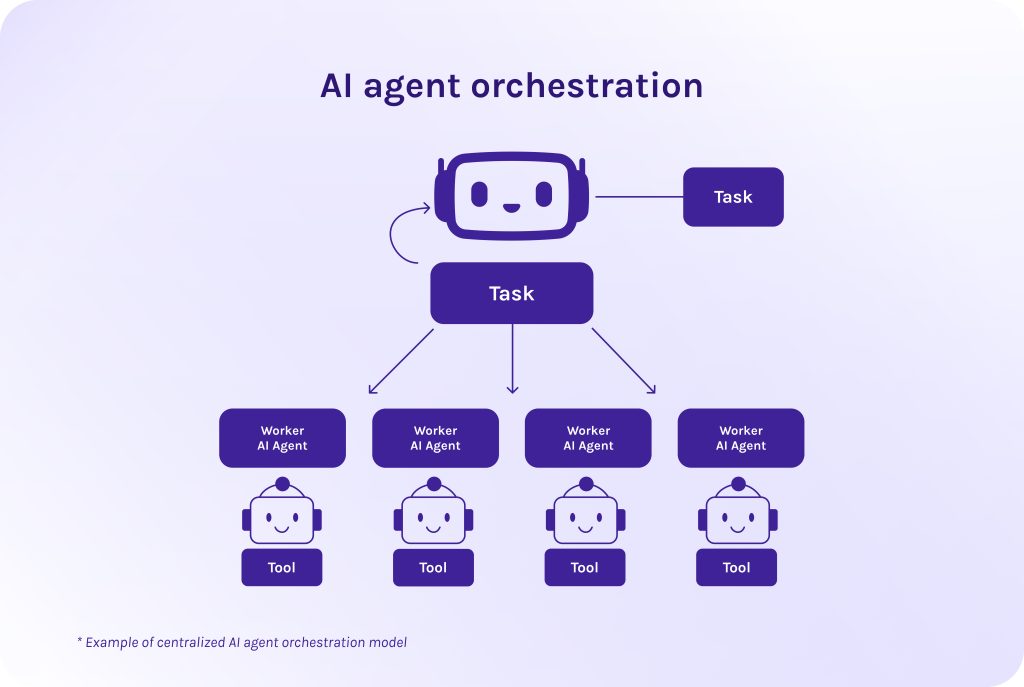
AI agent orchestration is a process where the system itself coordinates the work of multiple specialized AI agents in order to achieve exact objectives and goals.
The most common example of an agentic AI system is a simple project team. To build and sell your product, you need:
- Dev team that will be responsible directly for the development process.
- Marketer who will create a promotional strategy.
- Designer, who will create UI/UX and ad content.
- Ultimately, you need an experienced project manager who will coordinate the work of all these specialists to ensure consistent delivery and project success.
Of course, you can add as many specialists as you need, thereby expanding your team and scaling your capabilities. AI agent workflow, basically, works in the same way – the dev team, marketer, and designer are different types of AI agents and each of them is responsible for a different pool of tasks, while the project manager is the system’s orchestrator that coordinates all processes to achieve consistency and alignment with the overall business strategy.
Read More: 10 Zapier Alternatives You Should Be Using
The Critical Role of AI Agent Orchestration in Managing Complex Workflows
In traditional systems, siloed AI agents operate separately from each other, which creates bottlenecks and fragmented data streams that require constant human intervention to bridge. Without a centralized orchestration layer, these siloed AI agents cannot share context or hand off tasks effectively [3].
Read More: Empowering Your Workflow: Unveiling the Surprisingly Diverse Uses of Large Language Models
Why Use an AI Agent Orchestration Platform? Benefits and Disadvantages
AI agent platform creates a workspace where different specialized AI agents work as a real human team: they communicate with each other, share knowledge, and hold each other accountable through built-in feedback loops.
Let’s compare how workflows are managed with and without an agentic automation engine.
| Feature | Without AI agent orchestration | With AI agent orchestration |
| Managing process | Manual, need human intervention. | Automated, agentic workflow can heal itself autonomously. |
| Logic | Static “if-then” scripts. | Dynamic, goal-oriented reasoning. |
| Error handling | Cascading failures. | Circuit breakers & self-correction. |
Read More: Top 10 AI Software Development Companies
Benefits of Implementing AI Agent Orchestration Platform
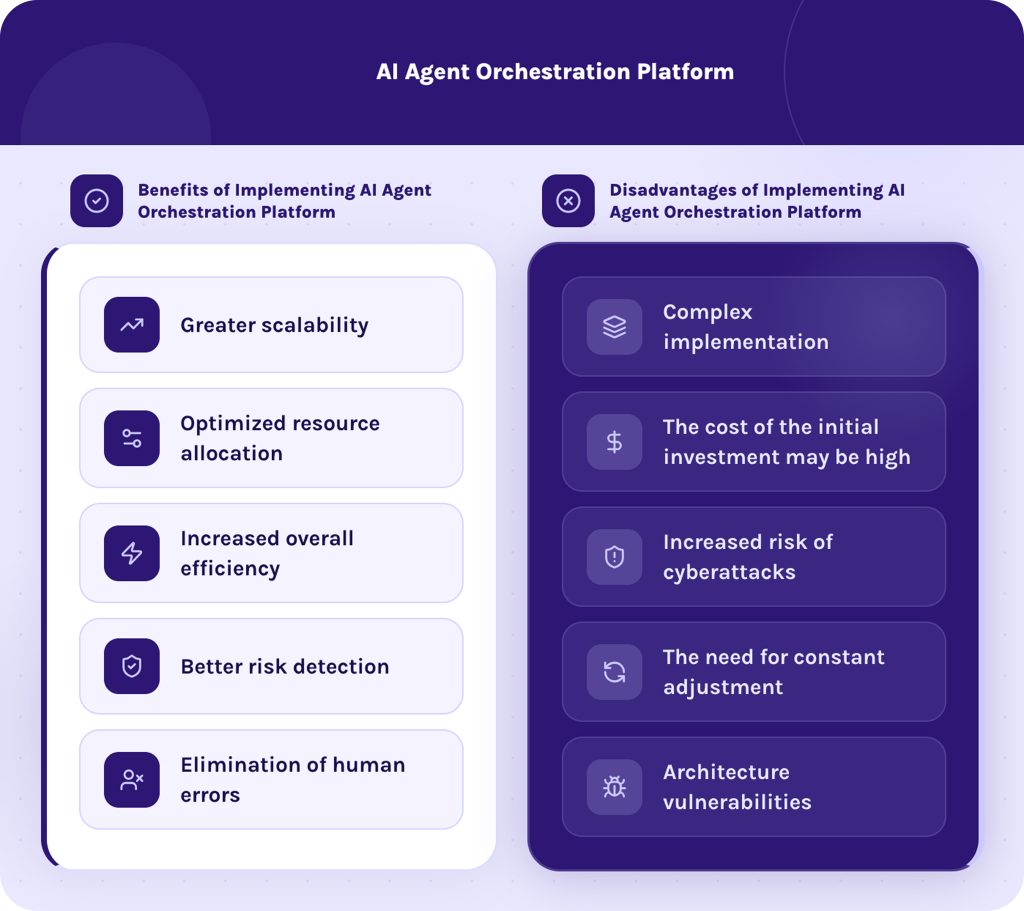
- Greater scalability. Multi-agent orchestration enables parallel processing, allowing the system to deploy dozens of specialized agents simultaneously to handle massive workloads that would overwhelm a single linear model [4].
- Optimized resource allocation. The platform itself decides how to execute tasks and to which agents to assign the specific task. An agentic AI system assigns routine tasks to low-cost, high-speed models while reserving expensive, high-reasoning models for critical decision-making.
- Increased overall efficiency. When you automate the hand-offs between multiple AI agents, the platform eliminates manual data transfers and ensures a continuous, high-speed workflow from start to finish [5].
- Better risk detection. Monitoring layers of the AI agent workflow provides real-time oversight and identifies hallucinations or logical contradictions before they can impact the final output.
- Elimination of human errors. The AI workflow system replaces manual, tedious tasks and subjective oversight with rule-based logic that maintains perfect consistency across thousands of operations.
Disadvantages of Implementing AI Agent Orchestration Platform
- Complex implementation. Moving from simple prompts to a multi-agent orchestration system requires deep architectural expertise to define agent boundaries, communication protocols, and state-management logic [6].
- The cost of the initial investment may be high. Beyond licensing fees, the costs of talent, infrastructure setup, and the extensive “fine-tuning” of AI workflows create a significant financial barrier to entry for many organizations.
- Increased risk of cyberattacks. Connecting multiple AI agents to external APIs and tools expands the so-called attack surface, making the AI agent workflow system vulnerable to prompt injection or unauthorized data exfiltration across the agent network.
- The need for constant adjustment. Agentic workflows require continuous monitoring and recalibration as underlying LLMs update and external software APIs evolve.
- Architecture vulnerabilities. Poorly designed AI agent orchestration for complex workflows can lead to agentic loops or deadlocks where agents stall while waiting on one another, potentially causing system-wide failures or runaway API costs.
Read More: 10 AI Project Management Tools to Pay Your Attention to in 2026
Solving Enterprise Challenges with AI Agent Orchestration Examples
Today, we were talking a lot about agentic AI generally and its exact strengths and drawbacks. One thing we weren’t talking about is the specific cases where AI agent orchestration systems have proven their efficiency in practice.
EpicStaff, created by a team of professionals from HYS Enterprise, is a leading open-source AI agent orchestration platform designed to help both non-technical users like marketers or HRs and technical specialists like software developers or QAs create efficient enterprise automation workflows with various types of AI agents.
It allows companies to build a digital crew—a workforce of specialized agents that operate within a visual, drag-and-drop workspace with ability to inject custom Python code in any node to extend the system’s capabilities.
In 2024, EpicStaff had a collaboration with a Dutch logistics company MYM (Move Your Machine). MYM, which specializes in transporting oversized industrial machinery across Europe, used the platform to transition from manual operations to a fully autonomous digital workforce.
What were the most striking outcomes of the partnership?
- MYM’s ability to handle record-breaking order volumes with a core team of just two people, whereas a traditional brokerage would require a staff of twenty to manage the same workload.
- Orchestrated agents replaced a process that typically took days. Using real-time data, the system now calculates exact transport prices and matches carriers in under 60 seconds.
- Approximately 80-90% of all business processes are now handled entirely by autonomous AI agents.
- By eliminating waiting for emails or manual approvals, the time from initial request to delivery was reduced by nearly half.
This transformation at Move Your Machine isn’t just a success story. It’s rather an example of our future. By moving away from rigid automation and embracing a flexible digital crew, MYM proved that even the most complex, high-stakes industries can achieve unprecedented scale with minimal overhead.
Contact the experts at HYS Enterprise today to discuss how to tailor an AI agent orchestration platform to your specific business needs and create your own autonomous revenue drivers.
Read More: Low Code Platform: Complete Guide to Low-Code Development Platforms in 2026
What Are 4 Types of AI Agent Orchestration for Complex Workflows
The multi-agent orchestration architecture you choose defines the balance between control, speed, and privacy. Here are the four primary types of orchestration used to manage multi-agent workflows [8]:
1. Centralized orchestration.
In this model, multiple AI agents are governed by an orchestrator, which, in our analogy, was a project manager.
Its work can be described as the following small algorithm:
- The central manager receives the user’s intent.
- Breaks it into sub-tasks.
- Assigns them to specialized agents.
- Synthesizes the final output.
This AI agent workflow architecture works best for regulated industries where strict governance and a single point of accountability are mandatory.
2. Decentralized orchestration.
In this multi-agent orchestration architecture, the main orchestrator is absent, but instead, agents here are gaining more autonomy. They can communicate directly with each other through shared protocols or blackboard systems.
Thus, the work of these agentic AI platforms is slightly different from the previous one. Specialized AI agents negotiate task allocation among themselves. To be more precise, I’ll give you an example: a Research agent might send its findings to a Writer agent because it can recognize the next logical step in the sequence on its own [9].
This model fits best for highly dynamic environments where speed and resilience are the top priorities [9].
3. Hierarchical orchestration.
This AI agent orchestration model organizes siloed AI agents into different layers of authority, thereby copying the structure of real companies.
We can understand this model using my analogy with an IT company one more time. A Director agent delegates broad objectives to Team Lead agents, who then manage their own specialized sub-agents. It creates complex hierarchies, where a Marketing Lead agent can manage multiple agents for SEO optimization, content creation, and market analysis.
This agentic workflow structure is most compatible with massive enterprise operations that require the ability to scale by adding entire “departments” of AI without overwhelming a single central controller.
4. Federated orchestration.
This type of AI agent orchestration for complex workflows allows independent AI systems, often owned by different organizations or departments, to collaborate without fully sharing their internal data or logic.
Here, each platform for AI agent orchestration in complicated conditions maintains its own local orchestration and security protocols, only sharing the specific outputs necessary to complete a cross-functional goal, making it the best choice for B2B collaborations or, for instance, for supply chain management where data sovereignty is a non-negotiable requirement.
Now we know more about AI agent orchestration architecture patterns, so it’s time to, ultimately, take a closer look at how exactly AI agent orchestration works in complex conditions.
Read More: What Are the Top 10 n8n Alternatives to Watch This Year
How an AI Agent Orchestration Platform Functions in Complex Environments
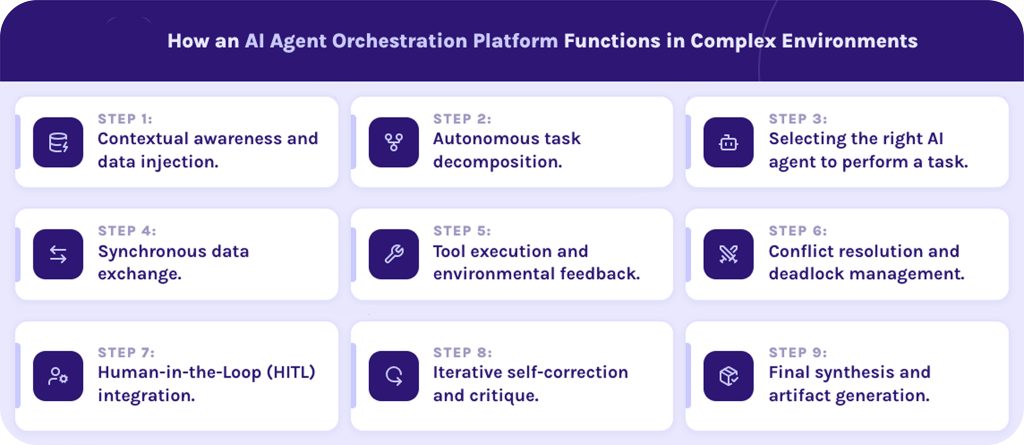
AI agent orchestration platforms work autonomously and require minimum human oversight which makes them one of the most effective solutions for business process automation. AI agents scale automation managing every stage of a multi-agent lifecycle to ensure reliability. Let’s now talk about how exactly they do it.
1. Contextual awareness and data injection.
Agentic AI systems retrieve relevant historical data, injecting this long-term memory into the prompt to ensure agents understand the specific business environment.
2. Autonomous task decomposition.
AI workflow systems use high-reasoning models where the orchestrator breaks down a big goal into a logical sequence of granular sub-tasks with clear success criteria.
3. Selecting the right AI agent to perform a task.
Then, the system dynamically evaluates available agents based on their specialized skills and current workload to assign the best “digital worker” for each specific sub-task.
4. Synchronous data exchange.
Agents communicate through standardized protocols (like Anthropic’s MCP), ensuring that the output of one agent is instantly translated into the formatted input required by the others.
5. Tool execution and environmental feedback.
Agentic workflow system manages agent access to external APIs, databases, and software, capturing real-time results and feeding “observations” back into the agent’s reasoning loop for the next step [7].
6. Conflict resolution and deadlock management.
The orchestrator monitors for agentic loops or contradictory outputs, intervening with “tie-breaker” logic or deterministic rules to keep the agentic workflow moving toward completion [7].
7. Human-in-the-Loop (HITL) integration.
For high-stakes actions like financial transfers or legal approvals, the AI agent orchestration platform automatically pauses workflows and presents a “decision gate” for a human to review and authorize [10].
8. Iterative self-correction and critique.
Independent Critic agents audit the work of Worker agents, to identify hallucinations or logical errors and triggering a rewrite cycle before the artifact is finalized.
9. Final synthesis and artifact generation.
Once all sub-tasks are validated, the AI agent orchestration platform merges fragmented agent outputs into a single, high-quality solution, such as a comprehensive report or a launched marketing campaign [7].
Read More: Top IT Outsourcing Companies: Complete Guide to Choosing the Right Provider
Conclusion
Times when you could automate your workflows without AI agents are now in the past. For businesses it means that without AI agent orchestration they risk to fall behind the competitors and lose their market position. Organizations that fail to adopt multi-agent systems face shrinking margins and climbing labor costs, as their competitors utilize “digital assembly lines” to execute end-to-end processes at a speed and scale that manual oversight simply cannot match.
According to current industry data, this shift is so significant that businesses ignoring AI orchestration in 2026 risk becoming obsolete by 2027, as they lose the ability to scale operations without a proportional increase in headcount [1].
Whether you’re looking to automate logistics, marketing, or high-stakes financial workflows, our team is ready to help you design a secure solution that will boost your ROI up to 10x. Contact our experts to book a consultation.
FAQs
1. What is AI agent orchestration?
AI agent orchestration is an approach that allows users to coordinate the work of multiple specialized AI agents to execute complex workflows. Orchestration manages the way agents communicate with each other, execute tasks, and adapt to changing variables, ensuring that individual outputs are synthesized into a single solution.
2. Why does AI agent orchestration matter in complex workflows?
AI agent orchestration for complex workflows is critical because it manages dependencies and tasks that a single model cannot handle, thereby ensuring specialized agents work in harmony without losing context. This approach gives more reliable outputs as each specific agent is responsible only for its part of the work and concentrates only on one activity.
3. What is the best AI orchestration platform?
In our opinion, selection of the best fit platform depends on your specific needs. Thus, the most decent choice would be picking a highly customizable platform that can easily adjust to your requirements and scale without losing efficiency. EpicStaff, developed by HYS Enterprise, has proved its reliability, collaborating with clients from different highly regulated industries across Europe.
4. Why can’t a single LLM handle complex workflows without orchestration?
A single LLM cannot handle complex workflows on its own because it lacks the specialized modularity and state management, often leading to hallucinations when managing multiple competing variables simultaneously. In this case, without orchestration, a model cannot reliably coordinate external tool calls, self-correct its logic through independent peer review, or maintain a consistent long-term memory across multi-stage processes.
5. What are the most common architectures for AI agent orchestration?
The most common architectures for agentic AI workflows include:
- Sequential chains for linear tasks;
- Hierarchical structures where a “manager” agent delegates tasks to specialists.
- Joint collaborative graphs for non-linear, iterative problem-solving.
Other emerging patterns include parallel/concurrent execution for speed and event-driven orchestration, which allows agents to react dynamically to real-time data triggers.
6. How does AI agent orchestration improve scalability?
Multi-agent orchestration improves scalability by enabling parallel processing. You can add to the system as many specialized AI agents as you wish to handle different tasks rather than waiting on a single linear model. This modular approach allows organizations to increase throughput by simply adding more agent instances without increasing the complexity or cognitive load of the individual models.
7. How do agents maintain long-term memory and context across different sessions?
Agents maintain long-term memory by utilizing vector databases to retrieve relevant historical data through semantic search and knowledge graphs to preserve complex relationships between entities.
8. What is the significance of Human-in-the-Loop (HITL)?
Humap-in-the-loop (HITL) serves as a critical governance layer that allows humans to control and approve high-stakes decisions made by an AI agent orchestration platform before they are finalized. This integration ensures that autonomous workflows remain aligned with ethical standards and business objectives.
9. How do you prevent “deadlocks” in multi-agent systems?
Usually, to prevent deadlocks, AI agent orchestration in complicated conditions uses “time-to-live” (TTL) thresholds and cyclic dependency detection to automatically terminate or reroute stalled agent loops.
These systems also utilize a central supervisor to enforce deterministic priority rules, ensuring that if two agents are waiting on each other, the orchestrator intervenes to break the stalemate.
10. Are AI agent orchestration platforms secure for sensitive data?
Definitely, modern agentic AI systems use “Sovereign AI” architectures that allow them to use confidential data without the risks of data leaks. Today, these platforms maintain security by using zero-trust execution and automated PII masking, which strips sensitive information before any external model processing occurs.
References
- https://cloud.google.com/resources/content/roi-of-ai-2025
- https://adverant.ai/docs/insights/automation-to-orchestration-hbr
- https://www.researchgate.net/publication/398936154_The_Role_of_Agent_Orchestration_in_Scalable_AI_Workloads
- https://www.researchgate.net/publication/404424634_Architecting_Agentic_AI_Systems_for_Scalable_Real-_Time_Data_Products
- https://www.researchgate.net/publication/398083685_Building_Scalable_and_Reliable_Agentic_AI_Systems_A_Technical_Blueprint_for_Autonomous_Intelligence
- https://www.researchgate.net/publication/392715985_Challenges_in_Managing_the_Relationship_Between_Agentic_AI_Systems_and_Humans_in_Organizations
- https://www.researchgate.net/publication/386083531_A_Comparative_Study_of_AI_Agent_Orchestration_Frameworks
- https://www.researchgate.net/publication/399522382_Orchestral_AI_A_Framework_for_Agent_Orchestration
- https://www.researchgate.net/publication/404646587_Decentralized_Agentic_AI_Orchestration_for_Autonomous_Self-Healing_and_Resilience_in_Distributed_Cyber-Physical_Systems
- https://www.researchgate.net/publication/402228999_The_Human-in-the-Loop_Paradigm_Orchestrating_Human_Intelligence_and_Agentic_AI_for_Scalable_Customer_Experience_A_Metrics-Focused_Review