
What is aerospace risk management?
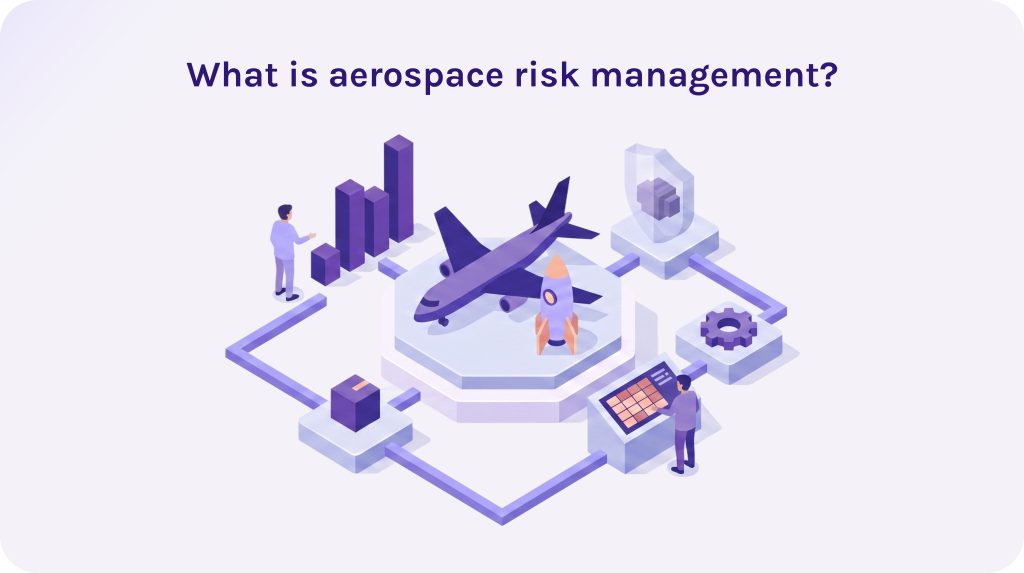
Aerospace risk management is a set of techniques and methodologies used to identify and mitigate the impact of risks in aerospace and defense.
Because aircraft and spacecraft operate in unforgiving environments where single component failures can lead to catastrophic loss, risk management in this industry is far more stringent than in standard commercial sectors. Here, safety managers must manage not only software bugs or miscommunication. It’s a full, complicated chain of communication, software development, testing, hardware development, creating details for flights and spaceships, managing supply chains, and specific regulations all at once.
That is why aviation risk management specialists use specialized software. Companies use specialized enterprise risk management software for aerospace and defense to automate risk management, resource allocation, dependency tracking, and bottleneck detection across the entire project portfolio.
Read More: Overcoming Project Portfolio Management Challenges: A Guide to Scaling Enterprise Delivery
Why is aerospace risk management so important?
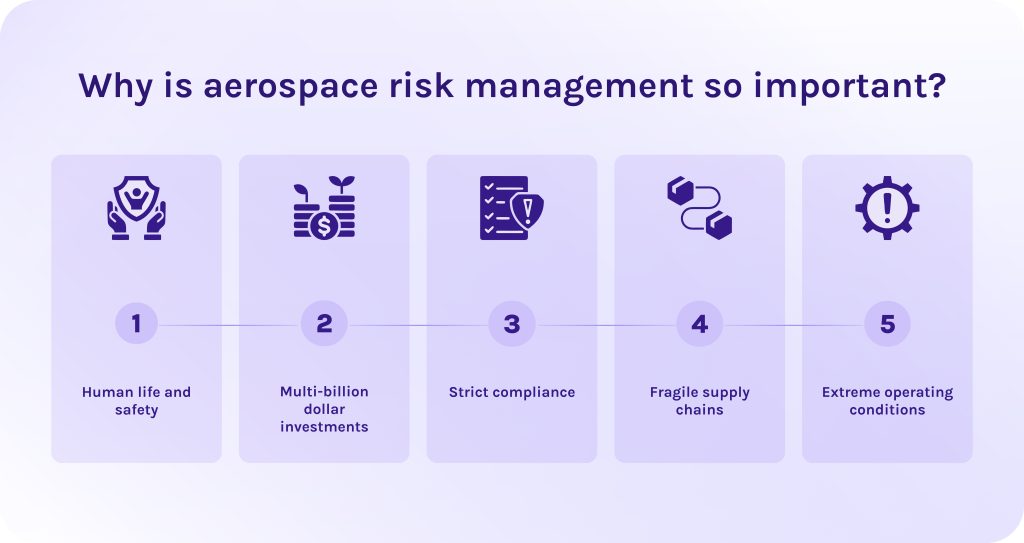
Every project needs to be managed properly. But when we’re talking about aerospace projects, their complexity and need for quality risk management rise significantly. Below, we gathered the main reasons why aerospace risk management is inevitable.
- Human life and safety. Efficient aviation risk management is, first of all, focused on proper work conditions and the safety of your employees. It helps to prevent catastrophic incidents, eliminating single points of failure across all flight-critical systems.
- Multi-billion dollar investments. Aerospace and defense development programs span multi-year timelines with enormous financial exposure. Major aerospace programs often face schedule delays, where unmitigated risks can quickly cause compounding budget overruns.
- Strict compliance. Adhering to standards like AS9100, DO-178C, DO-254, and defense export control laws is required to maintain airworthiness certification and safeguard national security data from cyberthreats [3].
- Fragile supply chains. Aviation and space exploration projects rely heavily on specialized materials. This means that single-source disruptions or suspect unapproved parts (SUPs) can halt entire assembly lines.
- Extreme operating conditions. Aerospace hardware must endure extreme temperatures and pressure shifts. Minor manufacturing deviations can lead to structural breakdown under stress.
Read More: The 15 Best Manufacturing Capacity Planning Tools in 2026
What common risks do safety managers need to navigate?
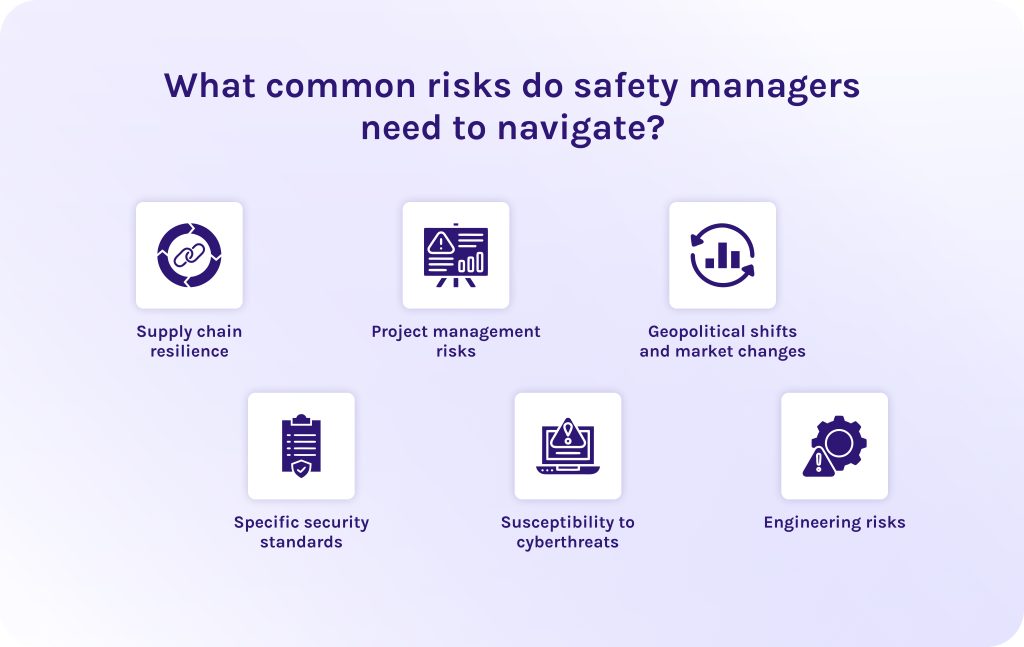
1. Supply chain resilience.
In the aerospace industry, supply chains are extremely vulnerable and highly susceptible to disruptions. According to statistics, supply chain disruptions cost the global economy an estimated $1.6 trillion in lost revenue annually [1]. For aerospace projects where development cycles span years, even minor shipping delays or material shortages can trigger cascading schedule and budget overruns.
Moreover, aerospace industry risk management also deals with the problem of suspect unapproved parts (SUPs). It is a situation when components, materials, or complete assemblies entering the supply chain lack verified proof that they conform to strict regulatory design and airworthiness standards.
Read our article about supply chain digital transformation in 2026.
2. Project management risks.
Project risk management in aerospace engineering couldn’t be described any differently as an extremely complex discipline. Here, managers face scope creep and changing timelines more often than in almost any other sector. Industry benchmarks show that over 75% of major aerospace and defense programs suffer from schedule delays, often accumulating average timeline overruns of 25% to 50% above initial baselines [2].
Project managers need to balance tight deadlines with strict safety standards without forcing teams to cut engineering or testing corners. Moreover, organizations need to manage budget constraints across long multi-year development cycles and at the same time keep safety-critical activities adequately funded.
3. Geopolitical shifts and market changes.
Aerospace and defense companies operate under constant pressure of changing tariffs, regulations, and compliance that has a direct impact on the disruption of cross-border supplier networks. That’s why advanced risk mitigation plans need to take into account possible sanctions and regional trade restrictions.
4. Specific security standards.
Risk management in aerospace companies is complicated by evolving government and industry mandates (such as FAA/EASA airworthiness directives, ISO 27001, or NIST guidelines) [4]. Additionally, you need to remember that aviation companies must protect their physical infrastructure, cleanrooms, testing grounds, and high-value equipment from unauthorized access.
5. Susceptibility to cyberthreats.
Spaceships and flights (especially military ones) operate with highly sensitive secret data, the leakage of which can lead to catastrophic consequences. For that reason, specialised risk management tools for aerospace companies are equipped with special security measures, two-factor authentication, encryption, and others. In addition, the usage of third-party tools and shadow tools is strictly prohibited.
6. Engineering risks.
Risk management specialists manage not only software and cyber threats. They manage physical assets as well. Their responsibility is to prevent latent design defects or single points of failure in mission-critical hardware. Moreover, they must ensure flight-critical software and embedded logic perform perfectly under stress conditions.
Read More: Top Telecom Project Management Challenges and How to Overcome Them
What are the key regulatory compliance requirements in aerospace risk management?
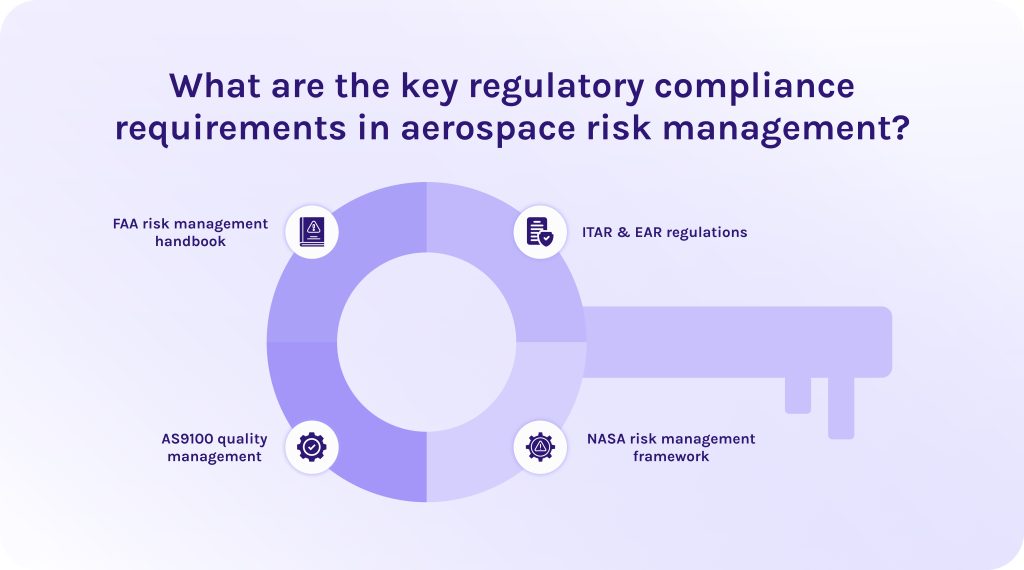
Operational risk management in aerospace relies on many compliance standards that companies should follow. They are the following ones:
- FAA risk management handbook. This risk management handbook, published by the Federal Aviation Administration, provides foundational frameworks for aviation specialists to identify and mitigate in-flight and operational safety hazards.
- AS9100 quality management. The premier international quality management standard for aviation and defence organizations. It mandates proactive thinking across the entire product lifecycle to ensure component safety and reliability.
- ITAR & EAR regulations. International Traffic in Arms Regulations and Export Administration Regulations govern export controls and defense data security. It prevents unauthorized foreign access to sensitive aerospace technologies.
- NASA risk management framework. A continuous, highly structured process combining Continuous Risk Management (CRM) and Risk-Informed Decision Making (RIDM) to manage different risks in high-stakes space exploration missions.
Read More: Best Free ERP Software: Open Source and Free ERP Systems Compared
Why is it important to use aerospace risk management software?
Efficient aerospace risk management relies not only on advanced risk management frameworks and educated specialists. It also relies on dedicated risk management systems that take into account all features and problems connected to exactly aviation risk management.
Using specialized aerospace risk management tools is essential because traditional tools like static spreadsheets cannot handle the extreme complexity and shifting parameters of multi-year flight programs. Aerospace projects involve thousands of interdependent tasks and constrained high-skill resources. Thus, managing such projects without proper software is almost impossible.
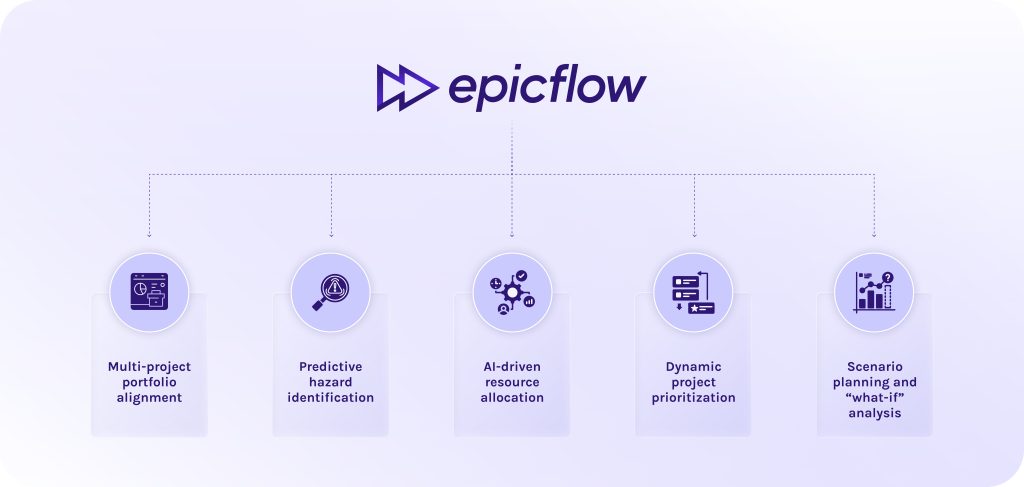
Epicflow is an AI-driven multi-project management and resource allocation software specifically designed to solve conflicts across complex enterprise environments. Originally developed to solve fundamental multi-project issues like improper task prioritization and team overload, it operates as an overlay layer on top of existing project management platforms (such as MS Project, Jira, or Oracle Primavera). Here are some of its capabilities that can help companies address aerospace risk management problems:
- Multi-project portfolio alignment. Epicflow unifies shared specialized resources and dependencies across concurrent flight programs into a single dashboard. It prevents cross-project conflicts and schedule drag.
- Predictive hazard identification. Epicflow uses real-time workload tracking and future load graphs to forecast resource shortages and operational bottlenecks in advance.
- AI-driven resource allocation. Epicflow’s algorithms automatically calculate team capacity and balance specialized engineering workloads. It prevents team burnout and reduces human error in safety-critical tasks.
- Dynamic project prioritization. Moreover, Epicflow continuously re-orders and recalculates task urgencies across all active projects. This reprioritization is based on real-time critical paths and current resource availability.
- Scenario planning and “what-if” analysis. Ultimately, this Epicflow’s function allows managers to simulate the systemic impacts of supplier delays or changes in scope of work. It happens in an isolated sandbox and allows companies to test everything independently before making high-stakes operational changes.
Read More: A Guide to the Best Risk Management Software: Top ERM Tools in 2026
Final words
- Aerospace risk management is a highly complex process of analyzing and gathering all possible risks and creating plans for their successful mitigation.
- Aviation risk management is considered to be one of the most complex ones across industries because of its high-stakes nature, where errors carry zero tolerance, and consequences can lead to the loss of human life.
- Because multi-year flight programs involve thousands of interconnected variables, organizations cannot rely on static spreadsheets or disconnected workflows alone.
- Companies use tools like Epicflow to manage all processes connected to aerospace engineering.
Contact Epicflow experts to get a detailed consultation on how to apply it for your specific needs.
FAQs
1. What is aerospace risk management?
Aerospace risk management is a process of identifying potential risks in aerospace and defense projects and creating plans for how to mitigate them. This process aims to prevent catastrophic failures and ensure strict regulatory compliance across complex engineering and flight operations.
2. Why is risk management so important in the aerospace industry?
Risk management in aerospace development is so important because:
3. What are the main types of aerospace risks?
4. Which quality standards govern aerospace risk management?
Aviation risk management is primarily governed by AS9100. It is the international quality standard for aviation, space, and defense organizations, which embeds risk-based thinking across all operations.
5. What is the best software for managing aerospace risks?
Epicflow is a software that helps aviation companies manage risks in the aerospace industry. It achieves this thanks to predictive analytics and real-time workload tracking. These functions help companies balance resources across multi-project environments.
6. How do you handle supply chain risks in aerospace?
To handle supply chain risks in aerospace and defense, you need, first of all, to diversify vendors of your components and software. It ensures that even if one supplier faces disruption, alternative vendors can step in.
Also, you need to enforce strict vendor quality audits to prevent single-point failures. Additionally, companies use predictive inventory modeling and long-term supplier agreements to buffer against material shortages and geopolitically driven lead-time delays.
7. Who is responsible for aviation risk assessment?
Risk management in aerospace industry is a duty of the project manager and risk/safety manager. They oversee the overall aviation risk strategy and maintain the risk register. However, generally, it is a shared responsibility where every team member is expected to identify and report risks within their specific domain.
8. How does safety culture affect risk management?
Safety culture drives best risk assessment practices and structures how exactly teams react and deal with risks.
9. What are the basic steps in the risk management process?
- Identifying potential threats. Managers look for potential bottlenecks and risks that could negatively impact project objectives or schedules.
- Analyzing their possibility and influence. Next, estimate how likely each threat is to occur and determine the potential impact.
- Evaluating the most and the least urgent risks. Prioritize identified risks by comparing them against acceptance criteria.
- Developing a mitigation plan. Then, you create strategies to reduce the impact of potential risks or avoid them completely.
- Continuous monitoring. When you finally know about possible risks, you can evaluate the efficiency of mitigation plans and detect new threats as project conditions evolve.
10. What is a risk register?
Risk register is a centralized document or database that companies use in project management to keep track of potential risks. In this document, organizations can record different identified risks in great detail to analyze likelihood and potential impact. Moreover, it helps to develop mitigation strategies and manage them.
References
- https://gitnux.org/supply-chain-statistics/
- https://www.openspace.ai/blog/construction-project-delay-statistics/
- https://oxmaint.com/industries/aviation-management/aviation-maintenance-compliance-checklist-2026-regulatory
- https://www.easa.europa.eu/en/light
- https://www.researchgate.net/publication/396686270_Risk_Management_in_Aerospace_Supply_Chains_A_Data-Driven_Approach
- https://www.researchgate.net/publication/372871341_RISK_MANAGEMENT_APPLIED_TO_AEROSPACE_ENGINEERING_DESIGN
- https://www.researchgate.net/publication/396500630_THE_IMPLEMENTATION_OF_RISK_MANAGEMENT_AT_AEROSPACE_MANUFACTURING_COMPANY
- https://www.researchgate.net/publication/262009655_THE_IMPLEMENTATION_OF_RISK_MANAGEMENT_AT_AEROSPACE
- https://www.researchgate.net/publication/403326294_Safety_Measures_in_Aerospace_Risk_Assessment_and_Mitigation_Strategies
- https://www.researchgate.net/publication/222302487_Risk_assessment_in_the_aerospace_industry