

What is aerospace project management?
According to the research, aerospace project management is a combination of traditional project management approaches with strict regulations tied specifically to the aerospace industry [1].
What makes aerospace project management unique?
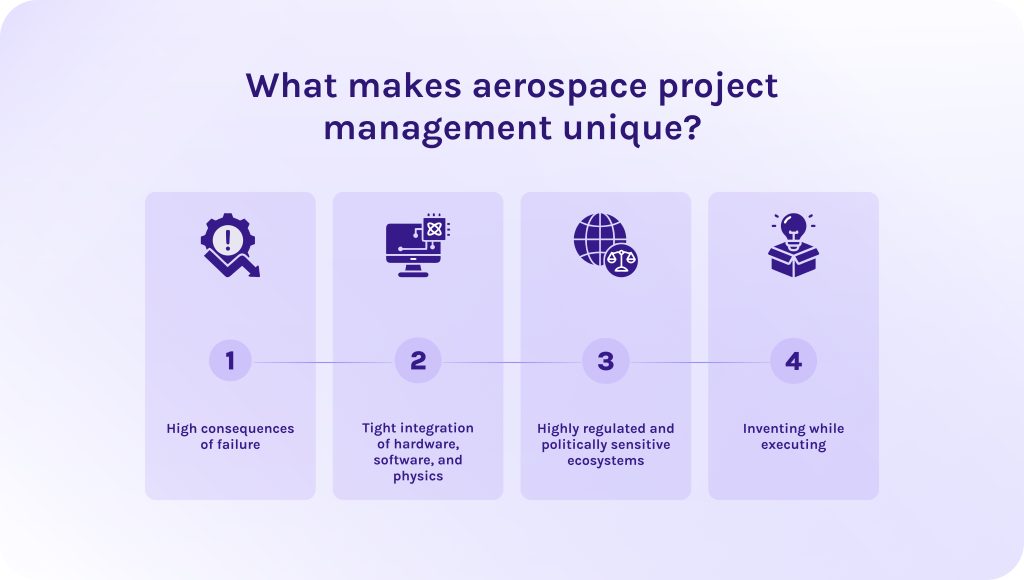
Managing aerospace and defense projects stands out from other industries. During the research, I highlighted four main reasons for such high complexity.
1. High consequences of failure.
In IT or commercial project management, an undetected bug usually results in a patch or a service outage. In aerospace and defense, a minor oversight can trigger a catastrophic loss of life or national defense assets. Every decision carries mission-critical weight.
2. Tight integration of hardware, software, and physics.
Aerospace projects combine tight dependencies between physical assets and software. If you add a new detail to a spaceship or flight, it cascades into, for example, fuel recalculations across the entire vehicle.
3. Highly regulated and politically sensitive ecosystems.
Aerospace project managers operate under a web of government oversight that standard PMs never encounter. It involves flight certifications, strict export controls, and communication with political administrations.
4. Inventing while executing.
In aerospace projects, aerospace project managers frequently lead teams through R&D and manufacturing simultaneously. You are often managing the timeline and budget of a product whose underlying technology or material science is still being tested in a lab.
Read More: How Agentic AI in Manufacturing is Driving the Next Industrial Revolution
What are the key challenges in aerospace project management?
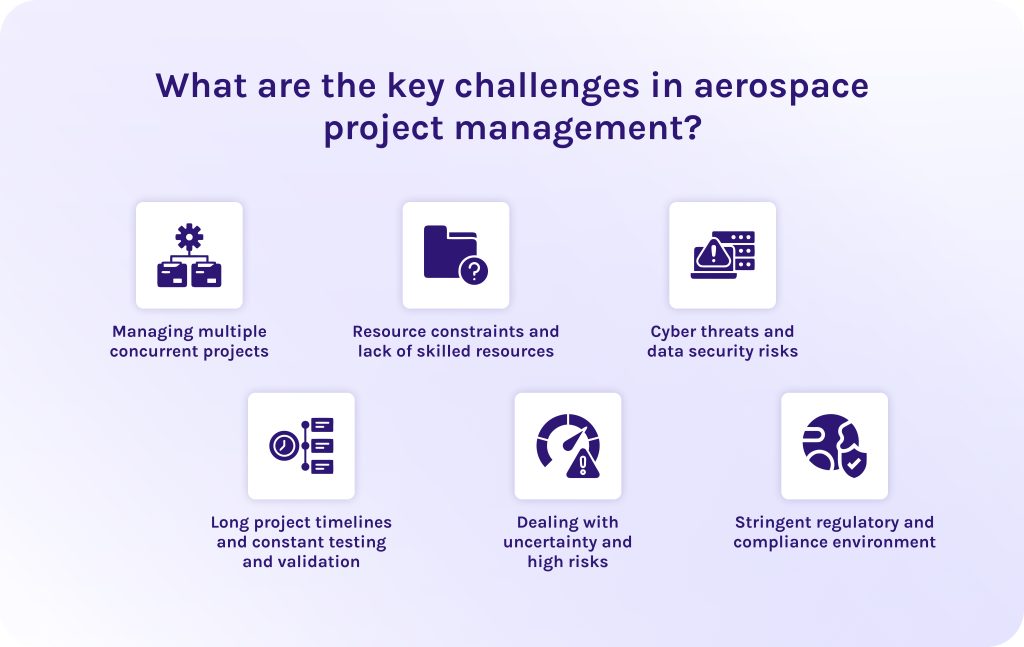
Our team was highly interested in the causes of failure of aerospace projects. Thus, we analyzed many reports and highlighted the main aerospace project management challenges that organizations frequently face.
1. Managing multiple concurrent projects.
Aerospace organizations are forced to balance dozens of concurrent programs with competing priorities. When unexpected technical blockages occur on one program, organizations often attempt to borrow specialized talent or funds from secondary projects. It, in turn, creates a domino effect of delayed launches and cost growth across the portfolio.
How to address it?
Establish a centralized portfolio management (PPM) with standardized scoring frameworks to evaluate project health and prioritize resource allocation based on strategic impact. For this purpose, you can use specialized aerospace project management software, like Epicflow, a multi-project and resource management platform, to create a single source of truth for all team members to be on the safe side.
2. Resource constraints and lack of skilled resources.
The aerospace and defense (A&D) sector faces a severe talent squeeze driven by an aging workforce and specialized engineering requirements.
The Deloitte Aerospace and Defense Industry Outlook consistently highlights workforce shortages and high turnover as top operational bottlenecks for the sector [3]. Furthermore, recent government agency workforce assessments (GAO-26-108556 Assessment) revealed that deep workforce reductions impacted 25 out of 36 active major projects, directly causing skill gaps in critical oversight positions [4].
How to address it?
- Implement AI-driven knowledge repositories before senior personnel retire.
- Adopt unified digital workspaces that connect different simulation and ERP tools to eliminate low-value manual data entry [9].
3. Cyber threats and data security risks.
Aerospace projects manage highly sensitive intellectual property (IP) and national security information. Thus, it is highly susceptible to cyber attacks and data leakages [5].
How to address it?
- Implement zero-trust architecture and enforce strict identity verification and role-based data isolation [7].
- Automate compliance and auditing for lower-tier suppliers.
4. Long project timelines and constant testing and validation.
One of the main aerospace project management challenges is that aerospace hardware cannot easily be patched after deployment. A satellite in geostationary orbit requires exhaustive ground testing that extends project duration for years.
How to address it?
- Run continuous digital simulations early in the design phase to discover edge cases and dynamic failures.
- Deliver projects incrementally, meaning you should break monolithic project architectures into modular blocks.
To address this problem in the defense industry, you should use mature aviation project management software powered by artificial intelligence and predictive analytics. Epicflow has built-in scenario planning and “what-if” analysis features that help company leaders test possible consequences of changes in resource management or project priorities.
5. Dealing with uncertainty and high risks.
As well, we should remember that defense and aerospace engineering routinely operate in extreme conditions. And, what’s more important, defense industry projects often start before every underlying technology has reached full maturity.
How to address it?
Use probabilistic Monte Carlo simulations on cost and schedule to establish realistic contingency reserves.
6. Stringent regulatory and compliance environment.
One of the greatest challenges in aerospace that is worth mentioning is its strict compliance. Compliance with bodies like the FAA, EASA, NASA safety standards, AS9100 quality norms, and ITAR regulations adds immense verification overhead.
How to address it?
Replace static documents with dynamic reporting, automatically tied to compliance. Modern aerospace program management software like Epicflow makes it way easier for companies to keep high quality of reporting while eliminating manual effort and saving time for specialists.
Read More: What Is Agentic AI in Healthcare and How Does It Work?
Conclusion
- Management of aerospace projects is considered to be one of the most difficult ones because of strict regulations and high cost of failure.
- Usually, aerospace project management specialists use strict management methodologies like Waterfall or add incremental deployment stages, using hybrid methodologies, but almost never pure agile project management.
- Main project management challenges in the aerospace industry are related to managing multiple projects with competing priorities at once, strict regulatory compliance tied with uncertainty and high susceptibility to risks, limited resource management, and, ultimately, long project timelines and cybersecurity threats.
- To solve the vast majority of aerospace project management challenges, companies use specialized project management software like Epicflow, which helps predict risks in advance, fighting uncertainty and helping companies allocate constrained resources wisely.
If you struggle to find a proper solution for your aerospace workflows, contact Epicflow experts to get a detailed consultation.
FAQs
1. What is aerospace project management?
Aerospace project management is a process of planning and further managing the development of aircraft, spacecraft, and defense technologies. It requires balancing extreme technical complexity and strict regulatory constraints to deliver projects successfully.
2. What are the core challenges of aerospace project management?
- Managing multiple concurrent projects.
- Resource constraints and lack of skilled resources.
- Cyber threats and data security risks.
- Competing priorities across the portfolio.
- Long project timelines and constant testing and validation.
- Dealing with uncertainty and high risks.
- Stringent regulatory and compliance environment.
3. How does aerospace project management differ from standard project management?
Aerospace project management differs from standard project management mainly because of its high complexity. In the aerospace defense industry, even minor errors can lead to catastrophic mission loss or loss of human life. Consequently, aerospace project management leans much more heavily on rigorous systems engineering and strict compliance and quality assurance, while the stakes in traditional project management are much lower.
4. What makes aerospace projects different from other industries?
5. What project management frameworks are most effective in aerospace?
6. What does an aerospace project manager do?
An aerospace project manager (PM) is responsible for leading complex aviation, space, or defense projects from initial concept to deployment. They are also responsible for:
7. What’s the average salary for aerospace engineers?
According to the information from U.S. Bureau of Labor Statistics, the average salary that an aerospace project engineer can make in a year is around $135K [6].
8. Do aerospace engineers make 800k a year?
No, standard aerospace engineers do not make $800,000 a year. According to U.S. Bureau of Labor Statistics, the average annual salary of an aerospace engineer is around $135K [6].
9. What risk management methodologies work best in aerospace?
10. How can PPM software support aerospace project management?
References:
- https://www.researchgate.net/publication/351644421_The_Exploration_of_Aerospace_Engineering_Project_Management_Method_Based_on_System_Engineering
- https://www.gao.gov/products/gao-26-108556
- https://www.deloitte.com/global/en/industries/defense-security-justice/analysis/gx-aerospace-and-defense-industry-outlook.html
- https://www.gao.gov/assets/gao-26-108556.pdf
- https://www.researchgate.net/publication/389636232_Cybersecurity_Awareness_in_Aerospace_Protecting_Critical_Systems_and_Ensuring_Safety_in_a_Evolving_Threat_Landscape
- https://www.bls.gov/
- https://www.researchgate.net/publication/388922296_Zero_Trust_Architecture_A_Systematic_Literature_Review
- https://www.researchgate.net/publication/266648744_Aerospace-oriented_Project_Management_in_CALT
- https://www.researchgate.net/publication/279515314_Enterprise_Resource_Planning_ERP_Systems_Emergence_Importance_and_Challenges