
Key Takeaways
- Agentic AI in manufacturing is software powered by artificial intelligence that can act autonomously, as a real human employee would [6].
- Agentic AI tools can perceive the environment, reason, and execute physical or digital workflows on the fly [7].
- Agentic AI differs from generative AI mostly by its ability to act independently. GenAI relies on human prompts, while AI agents work continuously in the background to achieve multi-step operational goals [8].
- Agentic AI directly solves manufacturing’s costliest problems: unplanned downtime, high energy costs, and labor shortages.
- Despite their high level of autonomy, successful agentic AI systems rely on robust governance and “Human-in-the-Loop” approval checkpoints for high-risk physical or financial decisions.
Read More: AI in Project Portfolio Management: 7 Key Trends & Features
What Is Agentic AI in Manufacturing?
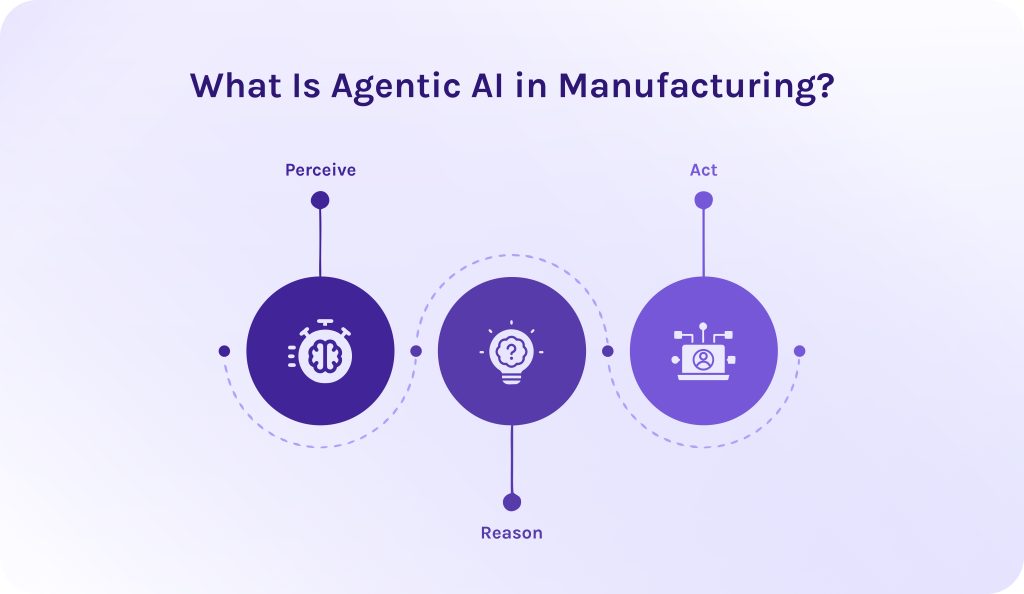
Agentic AI in manufacturing is a software solution that is powered by artificial intelligence and can execute complex goals on its own. In simple terms, it is a program that can make decisions and take actions independently, requiring only minimal human intervention to check outputs and correct when needed [6].
Agentic AI for manufacturing doesn’t follow a linear if-then conditional structure. In fact, it has far more complex logic.
- Perceive: The AI ingests real-time sensory data from the shop floor, including machine temperatures, vibration sensors, production schedules, and inventory levels [9].
- Reason: The system evaluates this data against broader operational goals [9].
- Act: AI agents coordinate with other software systems (like ERP or MES) and machinery to resolve the bottleneck autonomously or draft a plan for rapid human approval [9].
Read More: Mastering AI Agent Orchestration for Complex Workflows
How does agentic AI differ from generative AI?
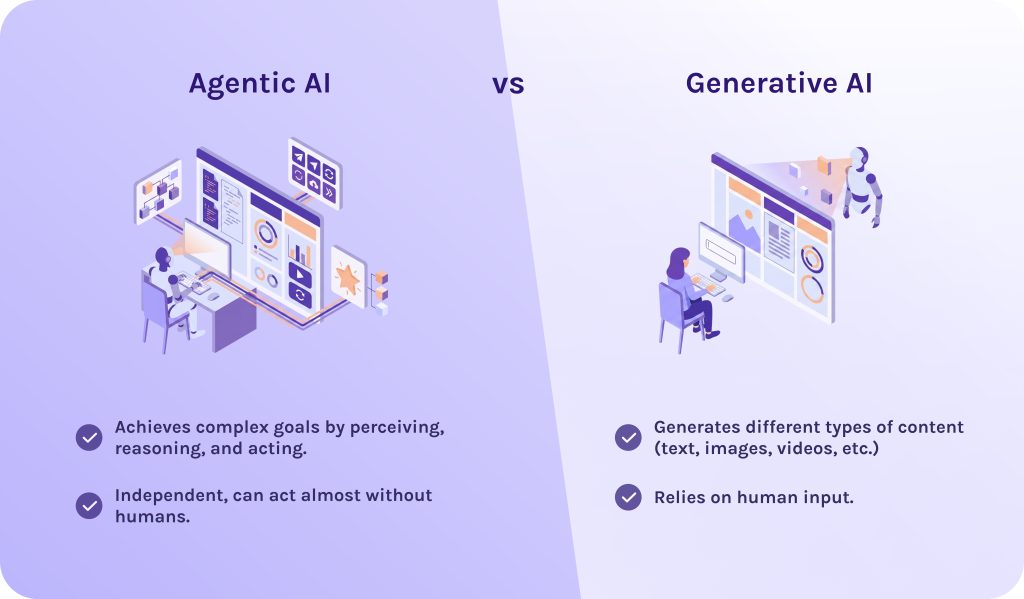
For non-technical specialists, it can be hard to tell the difference between agentic AI and generative AI. Let’s take a look at the main differences.
- Agentic AI executes multi-step workflows to achieve a predefined goal. Once you give it a high-level goal, it works continuously in the background, making decisions and adapting when things go awry [6].
- Generative AI is a rather reactive one. It generates content depending on a human prompt. If you have generated a picture or text in ChatGPT at least once in your life, you’re familiar with GenAI.
Read More: 10 AI Project Management Tools to Pay Your Attention to in 2026
How do traditional manufacturing tools handle workflows compared to agentic systems?
We developed a comparison table that you can use as a cheating paper.
| Traditional tools | Agentic AI | |
| Maintenance | Predictive | Prescriptive |
| Production adjustments | Static | Adaptive |
| Supply chain and sourcing | Manual | Autonomous |
| Energy management | Scheduled | Dynamic |
Why it matters
Traditional systems are static, while in today’s fast-changing environment, you should be able to predict shifts and adapt to them quickly. Companies that are faster than their competitors get a better market position, more loyal clients, and, ultimately, higher profitability and sustainable growth [10].
When you can adapt in real time, you stop wasting money on overproduction. This, in turn, eliminates the massive costs of unexpected downtime, enabling you to capitalize on new market demands before your competitors even realize a shift has occurred. Ultimately, speed and agility translate directly into long-term financial resilience [10].
Read More: Why Enterprise Agentic AI is the Future of Efficient Workflows
Why Does Agentic AI in Manufacturing Really Matter?
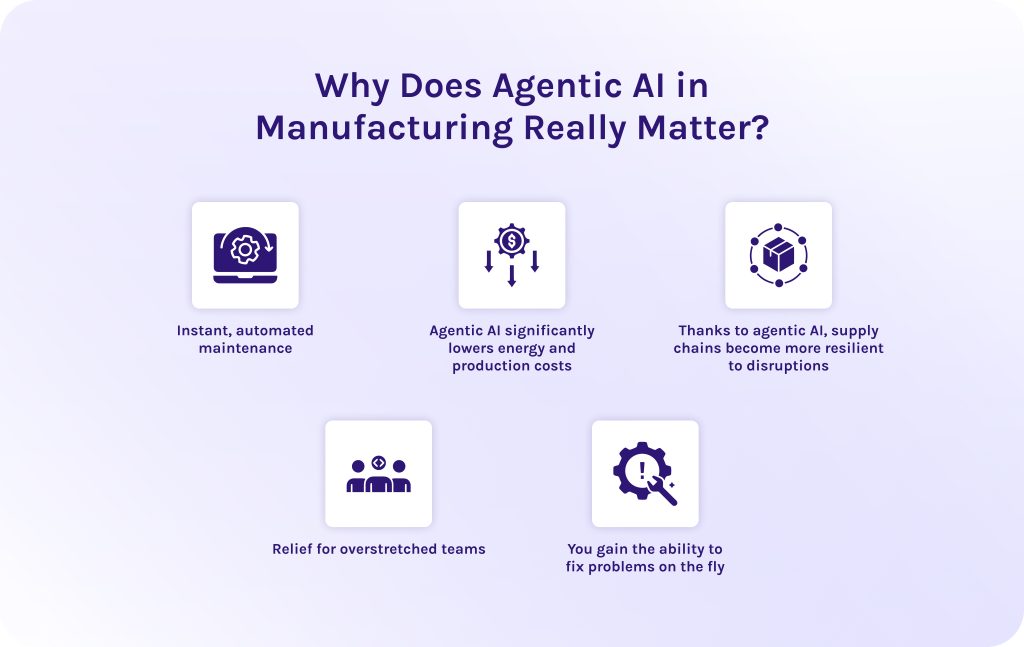
If so many people talk about agentic AI in manufacturing, consequently, it shows that this technology has lots of advantages. Let’s look at the primary agentic AI use cases in manufacturing and how they benefit day-to-day operations:
1. Instant, automated maintenance.
Traditional predictive AI merely alerts you that a machine will fail, leaving humans to do the administrative heavy lifting. Agentic AI in manufacturing, in turn, autonomously verifies replacement part stock in your ERP, purchases needed spares, and schedules the repair slot.
2. Agentic AI significantly lowers energy and production costs.
Agentic AI systems treat resources like electricity as dynamic variables, automatically shifting energy-intensive production runs to off-peak hours to reduce utility costs.
3. Thanks to agentic AI, supply chains become more resilient to disruptions.
If a key shipment is delayed, supply chain AI agents can instantly source alternative vendors to protect the flow of materials. As well, agentic AI solutions can calculate shipping cost changes and draft backup purchase orders in hours instead of days.
4. Relief for overstretched teams.
Autonomous agents automate complex, routine decision-making. Thanks to it, human engineers have way more free time for high-value tasks and business strategy. It, in turn, increases overall efficiency and speeds up physical processes on-site.
5. You gain the ability to fix problems on the fly.
Rather than just flagging defective parts at the end of the line, AI agents directly interface with machinery to adjust operational parameters in real time and fix the root cause of errors.
Read More: Agentic AI in Software Development: Transforming Modern Engineering
What Statistics Say about Agentic AI in Manufacturing?
Data from leading research firms and cloud providers showcases both the massive financial potential and the current operational reality of agentic AI in manufacturing:
- The market value keeps growing. The global demand for agentic AI is skyrocketing. The global market has climbed to over $10.8 billion this year, from $7.6 billion in 2025, and is on track to hit a staggering $139 billion to $196 billion by 2034 [1].
- More and more manufacturers adopt agentic AI. Approximately 28% of manufacturing companies have already deployed AI agents directly into production environments, a massive jump from near-zero adoption just two years prior [2].
- The power of agentic AI adoption in manufacturing 2026. Up to 70% of major manufacturers have integrated active AI agent systems into their digital workflows, specifically to manage predictive maintenance and automated quality control [3].
- Agentic AI in manufacturing significantly reduces costs. Early adopters of smart manufacturing AI systems report up to a 20% increase in overall production output, a 20% improvement in worker productivity, and up to 15% in unlocked capacity on their factory floors [4].
- Ultimately, competitive pressure is only growing, too. An overwhelming 93% of business leaders believe that scaling AI agents over the next 12 months will give them a distinct competitive edge over their industry peers [5].
Read More: AI Outsourcing: Complete Guide to Benefits, Vendor Selection, and Implementation Success
What Agentic AI Systems for Manufacturing Should Be Able to Do?
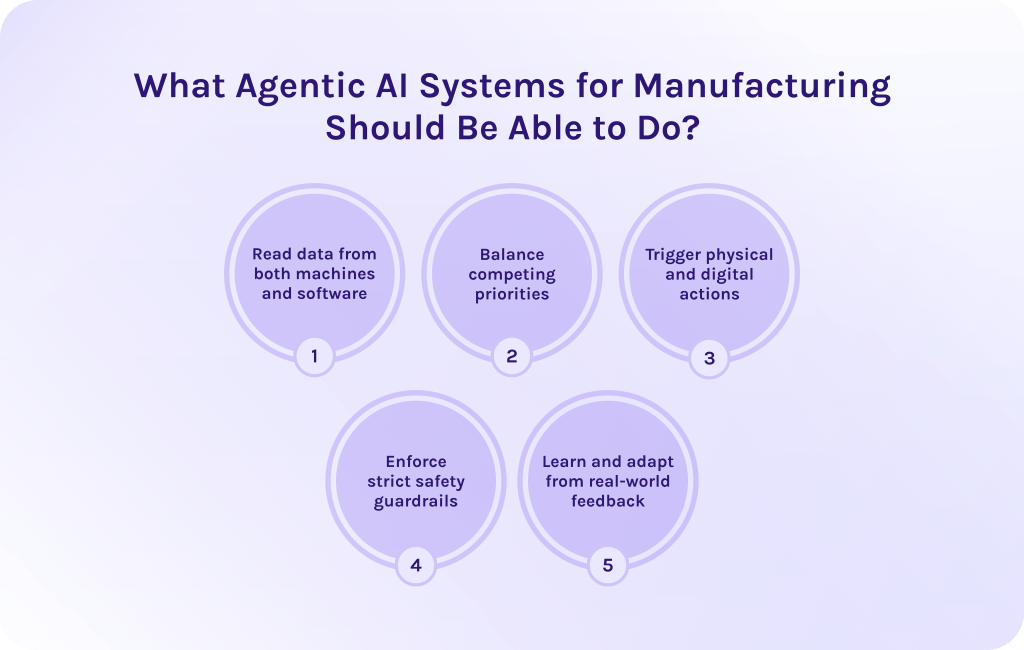
To be truly effective on a factory floor, agentic systems must have at least these core capabilities:
- Read data from both machines and software. Autonomous agents must connect directly to your shop-floor machines and your business software to interpret real-time conditions.
- Balance competing priorities. When a disruption occurs, the AI in manufacturing should weigh trade-offs – like sacrificing a bit of production speed to prevent machine overheating.
- Trigger physical and digital actions. The agentic AI applications in manufacturing must have the ability to execute tasks, such as automatically adjusting a machine’s temperature or rerouting inventory.
- Enforce strict safety guardrails. The platform must support built-in rules that prevent the autonomous agents from making dangerous moves, alongside “human-in-the-loop” checkpoints that require a physical signature for high-stakes decisions [13].
- Learn and adapt from real-world feedback. The AI applications must run on continuous feedback loops, tracking whether their automated adjustments succeeded and using those results to refine their future actions [14].
Read More: A Practical Guide to Agentic AI Governance for Scale
How to Implement Agentic AI into Your Manufacturing Workflows?
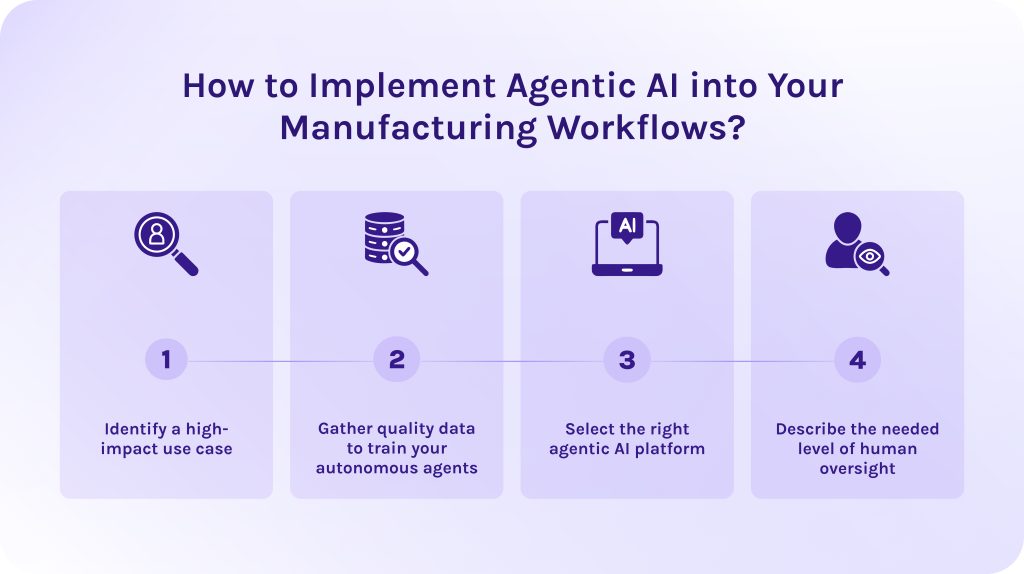
- Identify a high-impact use case. Start by targeting a highly specific operational bottleneck. Don’t try to operate all at once, keep the narrow focus. It will allow you to prove the system’s value and manage risks before scaling up.
- Gather quality data to train your autonomous agents. Connect your physical shop floor machinery with enterprise databases to build a unified stream of real-time data. Grounding your agents with specific maintenance logs and sensor feeds prevents inaccurate AI decisions.
- Select the right agentic AI platform. Choose an AI framework that matches your team’s technical expertise and data security requirements. For mixed teams of engineers and factory managers, a low-code orchestration platform like EpicStaff is highly effective. It provides a visual interface for operations teams to monitor and audit workflows while allowing developers to plug in custom Python code and connect to MES or ERP databases. This choice will allow you to automate more using the same resources. Also, this platform is open-source, which means that it was tested by many contributors and has proven its security, making it an ideal solution for highly regulated industries, like manufacturing or logistics [11].
- Describe the needed level of human oversight. Establish clear safety boundaries by enforcing “Human-in-the-Loop” approval checkpoints for high-risk actions. Limit full autonomy strictly to low-risk digital tasks, ensuring your human staff retains final control over the physical environment [12].
If you’re interested in implementing a solution that has proven its efficiency in practice – contact EpicStaff experts for more details.
Read More: What Are the Top 10 n8n Alternatives to Watch This Year
Final Words
If you’re a manufacturer who wants to implement agentic AI into the company’s workflows, the best time to start is now. You don’t need to overhaul your entire factory overnight; the key is to start small with a highly targeted pilot. At first, you can automate real-time quality control checks, then, for example, automate maintenance scheduling. These small steps will show how effective agentic AI in manufacturing can be. With time, you can scale automation and integrate agentic AI into a larger number of processes, eliminating delays and giving your business a massive competitive advantage.
Don’t forget to contact the EpicStaff team to implement an agentic AI solution in your manufacturing workflows today and get a strong competitive advantage.
FAQs
1. What is agentic AI in manufacturing?
Agentic AI in manufacturing is an autonomous system that can take actions on its own and decide which ones would be more efficient to achieve high-level strategic goals. They can perceive shop-floor conditions and execute actions across a factory with minimal human intervention. For instance, if the system detects resource bottlenecks, AI agents dynamically reschedule assembly lines and adjust machine parameters in real time in order to maintain efficiency.
2. How is agentic AI used in manufacturing?
3. Why is agentic AI so important for manufacturing?
If we compare traditional manufacturing software to agentic AI solutions, we’ll see a huge difference. Previous generations of manufacturing software could hardly estimate risks and predict bottlenecks, which was one of the biggest challenges. In turn, agentic AI is critical because it autonomously adjusts machine parameters and reschedules production lines in real time. This self-correcting loop directly mitigates the industry’s most expensive challenges: costly unplanned downtime and a persistent shortage of skilled labor.
4. What problems can I face with agentic AI in manufacturing?
5. How does agentic AI benefit manufacturing companies?
Here is a list of benefits of agentic AI in manufacturing.
6. What are the main trends in manufacturing software in 2026?
7. What are the best agentic AI solutions for manufacturing?
EpicStaff is one of the best agentic AI solutions for manufacturing. It is oriented towards the dual audience, technical and non-technical specialists, allowing companies to bridge the gap between their IT departments and factory floor managers by offering a visual, low-code interface alongside robust developer tools for custom coding.
8. How to implement agentic AI in manufacturing workflows?
- Identify a high-impact use case.
- Gather quality data to train your autonomous agents.
- Select the right agentic AI platform.
- Describe the needed level of human oversight.
9. Is it costly to implement agentic AI systems in manufacturing companies?
Yes, implementing agentic systems in manufacturing can be costly. With custom deployments typically costs start from around $50,000 to $150,000 for mid-tier solutions, and scale past $500,000 for highly complex enterprise setups.
10. How to choose a perfect agentic AI system for my company?
To choose the right agentic AI solution for your organization, use these steps:
References:
1. “Agentic AI Market Trends 2025 – 2026: Adoption Rates, and What Lies Ahead” (2026). Retrieved from:
https://svitla.com/blog/agentic-ai-market-trends-2026/
2. “AI Agents in Manufacturing: 10 Real-World Use Cases, ROI Results, and Implementation Roadmap” (2026). Retrieved from:
https://assistents.ai/blogs/ai-agents-use-cases-manufacturing
3. “55 AI Agent Market Size Statistics” (2026). Retrieved from:
https://nevermined.ai/blog/ai-agent-market-size-statistics
4. “AI adoption statistics by industries and countries: 2026 snapshot” (2026). Retrieved from:
https://ventionteams.com/solutions/ai/adoption-statistics
5. “Rise of agentic AI” (2025).
https://www.capgemini.com/wp-content/uploads/2025/07/Final-Web-Version-Report-AI-Agents.pdf
6. “What is Agentic AI? Agentic Artificial Intelligence Explained, The Future of Autonomous Intelligence” (2025). Retrieved from:
https://www.researchgate.net/post/What_is_Agentic_AI_Agentic_Artificial_Intelligence_Explained_The_Future_of_Autonomous_Intelligence
7. “AGENTIC AI: A COMPREHENSIVE FRAMEWORK FOR AUTONOMOUS DECISION-MAKING SYSTEMS IN ARTIFICIAL INTELLIGENCE” (2025). Retrieved from:
https://www.researchgate.net/publication/388188752_AGENTIC_AI_A_COMPREHENSIVE_FRAMEWORK_FOR_AUTONOMOUS_DECISION-MAKING_SYSTEMS_IN_ARTIFICIAL_INTELLIGENCE
8. “Generative AI vs. Agentic AI: A Deep Dive into the Future of Intelligent Systems” (2025). Retrieved from:
https://www.researchgate.net/publication/391700108_Generative_AI_vs_Agentic_AI_A_Deep_Dive_into_the_Future_of_Intelligent_Systems
9. “How Agentic AI is Transforming Workflow Automation in 2025” (2025). Retrieved from:
https://www.researchgate.net/publication/398820889_How_Agentic_AI_is_Transforming_Workflow_Automation_in_2025
10. “Agentic AI in Smart Manufacturing: Enabling Human-Centric Predictive Maintenance Ecosystems” (2025). Retrieved from:
https://www.researchgate.net/publication/396926466_Agentic_AI_in_Smart_Manufacturing_Enabling_Human-Centric_Predictive_Maintenance_Ecosystems
11. https://www.epicstaff.com/
12. “Human-in-the-Loop Agentic AI for Financial Services” (2026). Retrieved from:
https://www.researchgate.net/publication/400549815_Human-in-the-Loop_Agentic_AI_for_Financial_Services
13. “A Safety and Security Framework for Real-World Agentic Systems” (2025). Retrieved from:
https://www.researchgate.net/publication/398135364_A_Safety_and_Security_Framework_for_Real-World_Agentic_Systems
14. “Embedding Feedback Loops and Self-Learning Mechanisms in Agentic Data Products” (2026). Retrieved from:
https://www.researchgate.net/publication/404515593_Embedding_Feedback_Loops_and_Self-Learning_Mechanisms_in_Agentic_Data_Products