
Key takeaways
- AI in project portfolio management is machine learning algorithms that continuously analyze real-time data across an entire organization to eliminate assumptions and allocate resources based on accurate, real-time data.
- AI project management significantly reduces project failure rates, while maximizing strategic ROI on company investments and ensuring strategic alignment.
- The main trends in AI in project management are the rise of autonomous AI agents that can independently adjust workflows, mature generative AI for instant executive reporting, continuous anomaly detection to spot micro-risks, and data-driven project prioritization.
Read More: Best Critical Path Software and Modern CPM Tools for Project Management
What is AI in project portfolio management?
AI in project portfolio management (“AI” here and further shortened to artificial intelligence) is machine learning algorithms integrated into the process of managing a company’s entire collection of projects. These algorithms can analyze data across the entire organization, not only the specific projects, to help leaders choose the right investments and optimize resource allocation [1].
Read More: 10 AI Project Management Tools to Pay Your Attention to in 2026
What is the difference between PPM and SPM?
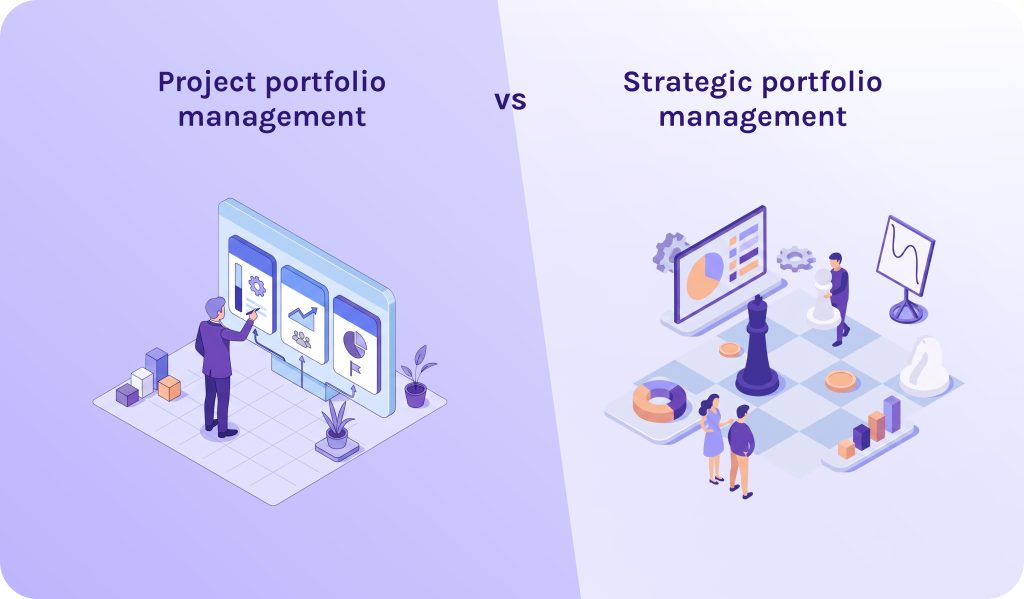
According to the definitions of these terms, the difference lies primarily in their strategic focus:
- Project portfolio management (PPM) is a project management process in which a project manager manages all projects from their portfolio separately, but aligning all of them to the main strategic objective [2]. The primary purpose is to optimize resource allocation and ensure that projects are executed efficiently, on time, and within budget.
- Strategic portfolio management (SPM) is a broader process that aligns an organization’s long-term business strategy with its execution capabilities and technology investments. Here, the main goal is to evaluate business outcomes and ensure the company is funding the right initiatives to achieve its overarching goals.
Read More: Stop Guessing, Start Scaling: Top 8 Capacity Planning Software [2026]
What is the role of artificial intelligence in project portfolio management?
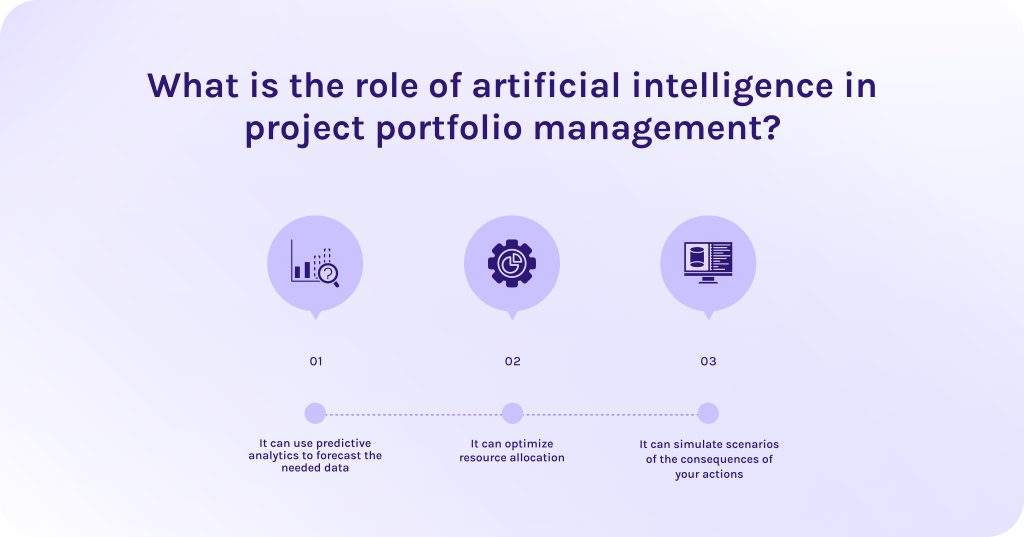
In project management, AI is used primarily for forecasting: outcomes, bottlenecks, future resource demand, or even consequences of your strategic choices. If we take a closer look at the role of AI in PPM, there are main moments we should pay our attention to:
- It can use predictive analytics to forecast the needed data. AI can compare current project velocity against historical data about failures. It flags budget overruns and timeline slippage weeks in advance to provide unprejudiced early warnings.
- It can optimize resource allocation. AI handles the entire project portfolio data to control resource availability and analyze where they may become overbooked. It helps to avoid overallocations and, consequently, underutilization to manage constrained resources as efficiently as possible. Also, it can assign employees to the tasks that match their skills the most to increase efficiency and outcomes (competence management).
- It can simulate scenarios of the consequences of your actions. When sudden market shifts happen, AI runs thousands of immediate “what-if” simulations. Executives can instantly see the exact downstream impact on all other projects if they divert funding or pause specific initiatives.
Read More: What is Program Management? A Deep Dive into Strategic Success and Program Leadership
What are the benefits of AI in project portfolio management?
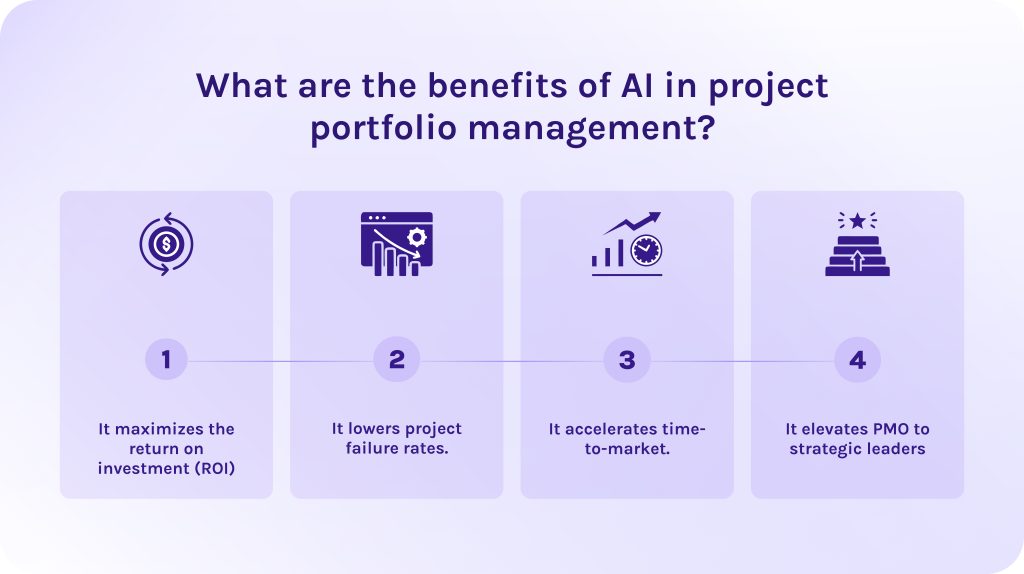
Before we proceed to the most important part of the article, project managers need to understand how exactly AI in portfolio management benefits their business.
- It maximizes the return on investment (ROI). AI in project portfolio management makes the evaluation of outcomes less emotional and more rational. Thanks to it, you can objectively evaluate new project proposals against company goals (OKRs) and past performance data to decide whether this exact project delivers needed strategic value or not.
- It lowers project failure rates. As we discussed earlier, AI in the management of projects and portfolios functions as an early warning system. Thus, leadership can intervene and course-correct projects before they completely derail, helping to protect portfolio investments.
- It accelerates time-to-market. AI in project portfolio management streamlines your project workflows and eliminates idle resources. Thanks to this, it can catch scheduling conflicts early, helping the entire project portfolio move faster.
- It elevates PMO to strategic leaders. Ultimately, AI project management automates repetitive data aggregation to remove tedious work and free up employees’ time for more strategic activities. This allows PMO leaders to focus entirely on stakeholder alignment and complex problem-solving.
Read More: 3 Essential Types of Capacity Planning Strategies and When to Use Them
What are the common use cases of AI in project portfolio management?
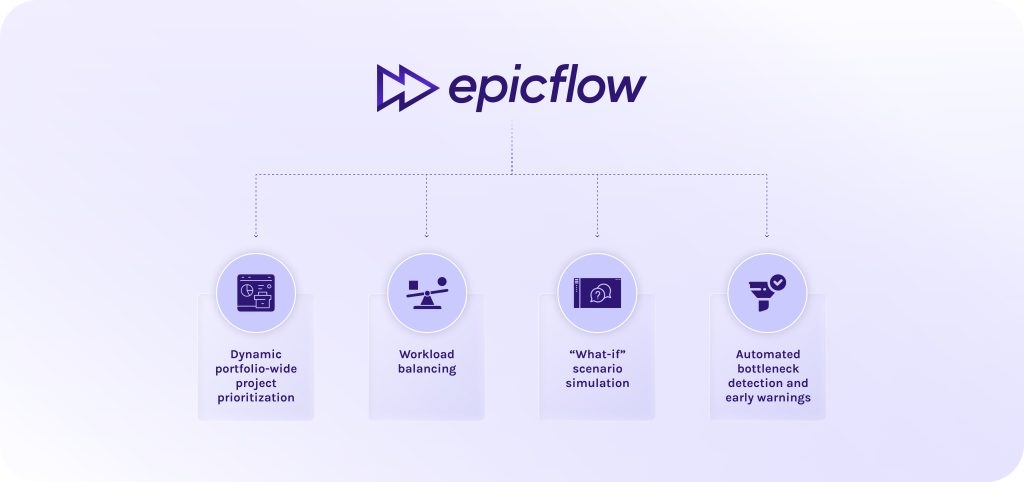
To see exactly how the abstract benefits of AI in project portfolio management translate into daily operations, we can look at the real-world use cases of Epicflow. It is a leading AI-driven resource and project portfolio management platform built specifically for multi-project environments.
Epicflow shows in practice how machine learning can be practically applied to solve core project portfolio management challenges like shifting deadlines and resource constraints through several key use cases:
1. Dynamic portfolio-wide project prioritization.
Epicflow solves one of the most painful problems of traditional project management tools – when everything is a priority, nothing is priority. Epicflow uses machine learning algorithms to calculate a system-wide task priority list. Thanks to it, project managers don’t need to negotiate which task is more critical – AI automatically calculates dependencies across the entire project portfolio. It reprioritizes tasks in real time based on which specific delays would threaten the final delivery date of the highest-value portfolio projects [3].
2. Workload balancing.
The second problem of traditional project management addressed by Epicflow is poor resource management. Its Future Load Graph continuously analyzes team capacity and historical performance to forecast future resource demands, warning portfolio managers precisely when and where a bottleneck will occur [3].
3. “What-if” scenario simulation.
When market conditions change or an unexpected crisis hits, leaders need to make fast allocation adjustments without destroying the rest of their project portfolio. Before making a change in the real world, a project manager can simulate a change within the software. The AI in project portfolio management runs a predictive simulation to instantly show the exact domino effect that the decision will have on the budgets and deadlines of all other active projects [3].
4. Automated bottleneck detection and early warnings.
Epicflow uses machine learning for continuous predictive analytics, while traditional PPM software lets you know a project is in trouble only after a milestone is missed. The platform runs predictive models against historical data and current project velocity to continuously forecast completion dates. If a project begins to deviate from its successful path, the embedded Epica AI assistant triggers real-time alerts to the project management office (PMO), isolating the specific bottleneck. Thus, leadership can implement an automated mitigation strategy before a deadline is breached [3].
Thus, don’t hesitate to try all Epicflow capabilities. Contact our specialists today and get a detailed consultation about all the benefits of Epicflow.
Read More: Tired of MS Project? 16 MS Project Alternatives for Modern Teams
What are the key trends in project portfolio management for 2026?
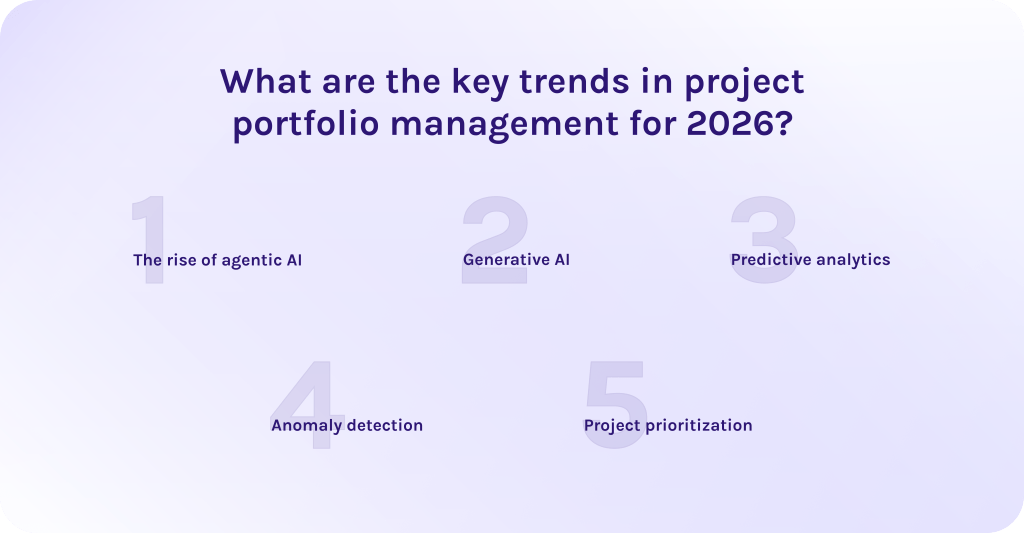
1. The rise of agentic AI.
If previous years were about passive chatbots, 2026 is the year of AI agents. They are autonomous software entities that, instead of waiting for a human command, can execute tasks on their own within set boundaries. In project portfolio management, these agents sync across enterprise tools to independently manage workflows [4].
For instance, if a foundational tech project hits a two-week delay, AI agents can autonomously calculate the domino effect across the project portfolio and shift dependent timelines, taking into account resource availability.
2. Generative AI.
A few years ago, generative AI was just a chatbot that could generate text and messy images. But in 2026, it has matured into a core technology for governance and agility. Enterprises use it to synthesize thousands of messy daily project logs into high-level executive summaries and automatically draft risk mitigation compliance documents based on historical project templates [5].
3. Predictive analytics.
Predictive analytics in project management software helps companies rely on data instead of guesses. It uses advanced machine learning algorithms to analyze current project velocity to forecast the exact completion date and total cost of a portfolio. Therefore, this allows executives to see future resource bottlenecks and budget shortfalls well before they actually happen.
4. Anomaly detection.
AI anomaly detection continuously monitors errors and bottlenecks across the entire project portfolio. It flags even the most subtle deviations from the norm, like minor but repeated task delays. Anomaly detection feature instantly isolates an unexpected drop in developer code commits and triggers early warnings to mitigate even the smallest risks.
5. Project prioritization.
Thank God, today, project planning and prioritization don’t depend on “whose voice is louder”. In 2026, AI is used to objectively score and rank new project proposals. The technology evaluates incoming demands against the company’s real-time resource capacity and historical ROI data to recommend exactly which initiatives should be funded, paused, or cut to maximize project portfolio value.
Read More: Best Engineering Project Management Tools: Complete Guide & Comparison
Conclusion
I think it would be great to finish this article with a quote:
“Right now, people talk about being an AI company. There was a time after the iPhone App Store launch where people talked about being a mobile company. But no software company says they’re a mobile company now because it’d be unthinkable to not have a mobile app. And it’ll be unthinkable not to have intelligence integrated into every product and service. It’ll just be an expected, obvious thing.”
– Sam Altman , co-founder and CEO in OpenAI.
A few years ago, AI was like a magic wand that could solve many problems and boost business growth almost immediately. Today, it can do it as well, but in a more mature way. AI in project portfolio management in 2026 isn’t just an experimental competitive advantage, it’s rather a basic requirement for keeping resources optimized while staying ahead of the competition.
Don’t forget to contact Epicflow experts to see all AI-powered capabilities in action.
FAQs
1. What is AI in project portfolio management?
AI in project portfolio management (PPM) is a software that uses machine learning and predictive analytics to analyze data across all company initiatives. It helps organizations to optimize resource allocation, predict possible risks, create mitigation strategies, test various scenarios of project changes, and ensure strategic alignment. Its main strength lies in the ability to forecast future outcomes, making it almost indispensable for modern businesses.
2. What are some leading AI tools currently available for project management?
One of the best leading AI-powered platforms for project management is Epicflow. It uses advanced algorithms and real-time data analysis to predict future resource demand, giving teams the ability to prepare in advance, detect and solve possible bottlenecks, and, of course, boost portfolio efficiency at the same time.
3. How can AI automate repetitive tasks in project portfolio management?
AI project management tools continuously gather updates from various teams in real time to generate status reports and portfolio summaries. It can also schedule tasks automatically or alert about occurring resource bottlenecks [8].
4. Can AI automate risk assessment and mitigation strategies in a project portfolio?
Yes, artificial intelligence can automate risk assessment. It continuously monitors real-time portfolio data to flag and score potential threats long before they impact project timelines. As well, it can also automatically recommend tailored mitigation strategies and analyze what specific solutions have successfully resolved similar bottlenecks in historical project data [6].
5. When can AI automate routine PPM tasks?
Artificial intelligence can automate routine project portfolio management tasks immediately when integrated with modern project management platforms. It is highly effective right now for automating tasks like aggregating status updates and flags for budget or resource overruns.
6. How can AI help with project prioritization and resource allocation in portfolio management?
Artificial intelligence can prioritize projects without prejudices and human errors. It analyzes the strategic value and projected ROI of each project against historical success data. Simultaneously, it optimizes resource allocation through predictive capacity planning. This approach allows the software to automatically match the right talent to the right initiatives and dynamically resolve staffing bottlenecks before they cause delays.
7. How does AI-powered project portfolio management differ from traditional methods?
Traditional portfolio management software relies on manual data entry, which often leads to reactive decision-making based on outdated information. In contrast, AI-powered PPM uses real-time data, machine learning, and predictive modeling to automate administrative tasks and proactively forecast risks.
8. How does AI improve decision-making in project portfolio management?
It improves decision-making because it replaces humans with data-driven predictive modeling. Thanks to it, executives can run multiple “what-if” scenarios to see the long-term impact of their choices. Thus, organizations can objectively select and fund the projects that offer the highest strategic value [7].
9. How can AI help with risk management in project portfolios?
10. How to measure the ROI of AI in PPM?
Project managers can measure the ROI of AI in portfolio planning by comparing the financial gains from increased project success rates, reduced project delays, and optimized resource utilization against the total cost of the AI software and implementation. You need to create your own success criteria and measure against it.
References
- https://www.researchgate.net/publication/384542698_AI-Enabled_Project_Portfolio_Management_and_Selection_in_the_US_Healthcare_Sector_Maximizing_Efficiency_and_Value
- https://www.researchgate.net/publication/404511249_PROJECT_PORTFOLIO_MANAGEMENT
- https://www.epicflow.com/features/
- https://www.researchgate.net/publication/393393189_Agentic_AI_A_Comprehensive_Survey_of_Technologies_Applications_and_Societal_Implications
- https://www.researchgate.net/publication/379520093_Generative_AI_An_In-depth_Exploration_of_Methods_Uses_and_Challenges
- https://www.researchgate.net/publication/390660531_AI-POWERED_RISK_MANAGEMENT_SYSTEM
- https://www.researchgate.net/publication/404946460_How_does_artificial_intelligence_improve_decision-making_in_small_businesses
- https://www.researchgate.net/publication/389174401_IMPLEMENTING_AI_TOOLS_TO_AUTOMATE_REPETIVE_TASKS_IN_OPERATIONS_AND_LOGISTICS