
Key Takeaways
- Program management is a project management approach where you manage a group of related projects to achieve a global strategic goal [2].
- Program managers‘ responsibilities are to manage constrained resources, coordinate risks, and ensure that every step is aligned with the business strategy and supports the company’s growth [7].
- Meanwhile, project managers handle risks, track tasks, and monitor the daily progress of individual projects.
What Is a Program in the Context of Program Management?
A program is a group of related initiatives, projects, activities, etc., that are managed as a single whole to achieve benefits that would not be available if they were managed individually [2].
With an understanding of this term, we can ultimately proceed to the program management definition.
What Is Program Management?
IT program management is a process of managing a group of projects that are related to each other by mutual business benefits that cannot be achieved by managing these projects individually. They are not independent, but are closely connected and support the same values, growing as business goals change.
Read More: Best Critical Path Software and Modern CPM Tools for Project Management
Importance of Program Management
PMI research says that nearly 73% of projects in companies with high project management maturity meet their initial strategic goals compared to those with low project management maturity [1]. But what exactly makes program management that effective?
- Risk mitigation. It helps organizations to identify risks and lower their impact before they affect all initiatives and cause an irreversible chain reaction.
- Strategic alignment. Program management tools ensure that if the market shifts, the entire program can adjust, even if it means canceling individual projects that are no longer relevant.
- Reducing costs while scaling. It manages all resources and instruments at the same time, helping companies to avoid resource overbooking and perform more with the same resources.
Read More: Enterprise Workflow Automation: The Key to Scalable Operations
Program Management vs. Project Management: The Core Differences
To understand the program and project management differences, we need, first of all, to understand what project management is.
What Is Project Management?
Project management is a process of managing tasks, performance, timelines, and an execution team related to a specific project, using specialized project management methodologies such as Scrum, Agile, Waterfall, etc [4].
At this point, it is also important to mention project portfolio management. It is the process of managing multiple programs and projects as a single investment portfolio to ensure they align with the organization’s high-level strategic objectives and financial goals [5].
Consequently, if we compare these three concepts, we’ll get the following picture:
Program Management vs Project Management vs Project Portfolio Management
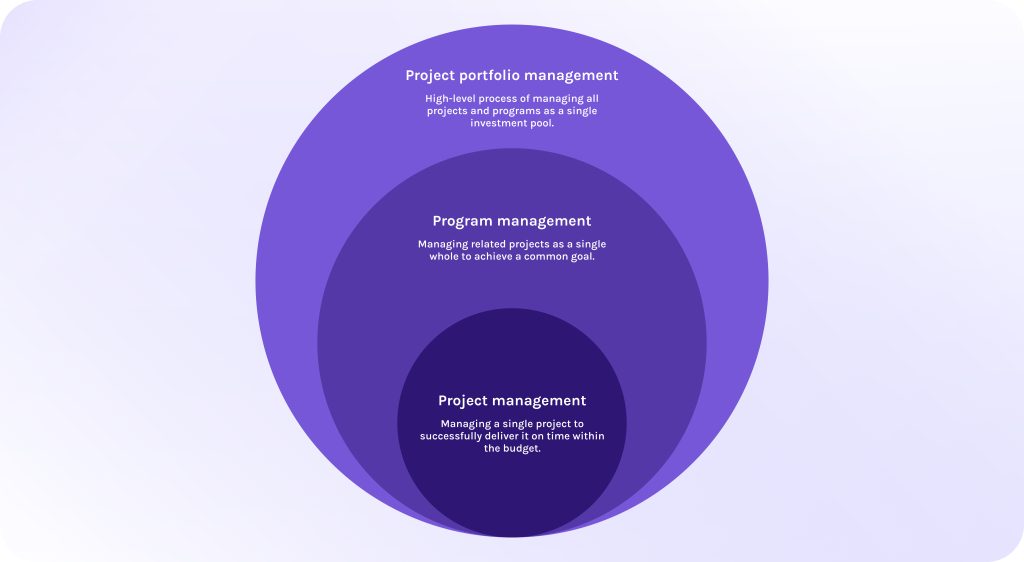
- Project management = Managing a single project to successfully deliver it on time within the budget.
- Program management = Managing related projects as a single whole to achieve a common goal.
- Project portfolio management = High-level process of managing all projects and programs as a single investment pool.
Read More: Product Portfolio Management Tools: Complete Guide to Choosing the Best Solution in 2026
The Role of the Program Manager
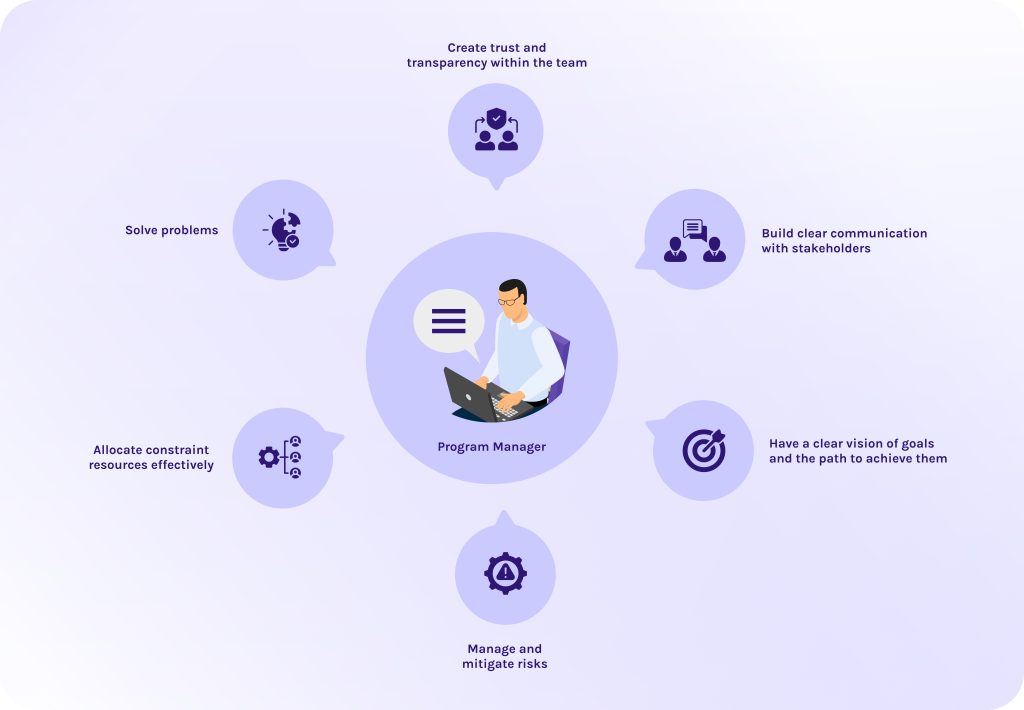
An IT program manager is a specialist who ensures that every project under their umbrella remains aligned with the organization’s evolving strategy. But you may ask, “What exactly does a program manager do?” [6] We’ve prepared the answer below.
Core Responsibilities of a Program Manager
On a daily basis, routine tasks of a program manager may be the following ones:
- Create trust and transparency within the team. A program manager must foster a unified culture among multiple project managers who might otherwise work in isolated silos. They align diverse teams to ensure everyone understands how their specific project contributes to the bigger picture [7].
- Build clear communication with stakeholders. Such specialists act as a bridge between execution teams and stakeholders. They translate technical project updates into the language of ROI and business value for the C-suite to keep everyone on the same page [7].
- Have a clear vision of goals and the path to achieve them. Program managers with this skill ensure that every project within the program directly contributes to the organization’s long-term goals. If a project’s direction shifts and no longer serves the strategic vision, the IT program manager must adjust or terminate it to protect the organization’s investment [7].
- Manage and mitigate risks. A program manager must identify possible risks that could cause a domino effect across the entire suite of projects. It is particularly convenient to accomplish this with dedicated program management software that analyzes your previous performance data and, based on that, gives predictions on where the bottleneck might happen [8].
- Allocate constraint resources effectively. This skill ensures that key personnel aren’t being overbooked across multiple projects. Experienced managers have the authority to move budget and people from lower-priority tasks to the high-priority ones to keep the entire program on schedule [7].
- Solve problems. They tackle obstacles that are too large for an individual project manager. This often involves negotiating with external vendors, navigating regulatory changes, or securing additional funding during a crisis [7].
In some points above, I wrote about program management software, not without reason. To handle these multi-layered responsibilities without burning out, you need a tool that acts as your strategic partner. In this case, Epicflow is designed specifically to be that partner for program managers.
Are you ready to see how Epicflow can transform your program’s efficiency? Book a demo today and take the first step toward stress-free multi-project management.
Read More: What Is Business Process Automation? Strategy, Tools, Benefits, and Enterprise Use Cases
Program Manager vs Project Manager
The difference between program manager and project manager lies in their role. When we are talking about IT program managers, they are rather strategic team members, while the role of project managers is more tactical.
Program vs Project Manager Table of Comparison
| Feature | Program manager | Project manager |
| Primary goal | To achieve a strategic business objective. | To deliver a specific product or service. |
| Focus | Rather strategic, with high emphasis on benefits and ROI. | More tactical, includes task execution, schedule management, etc. |
| Perspective | Focuses on the project interdependencies. | Focuses on individual tasks. |
| Duration | Continues until the benefits are realized. | Ends when the project is delivered. |
| Risk focus | How problems in one project affect the entire program. | Internal risks to the specific project tasks. |
| Resources | Moving talent/budget between projects. | Managing the team assigned to a specific project. |
| Change management | Managing the cultural and operational shift in the firm. | Focused on project deliverables. |
The Program Management Lifecycle
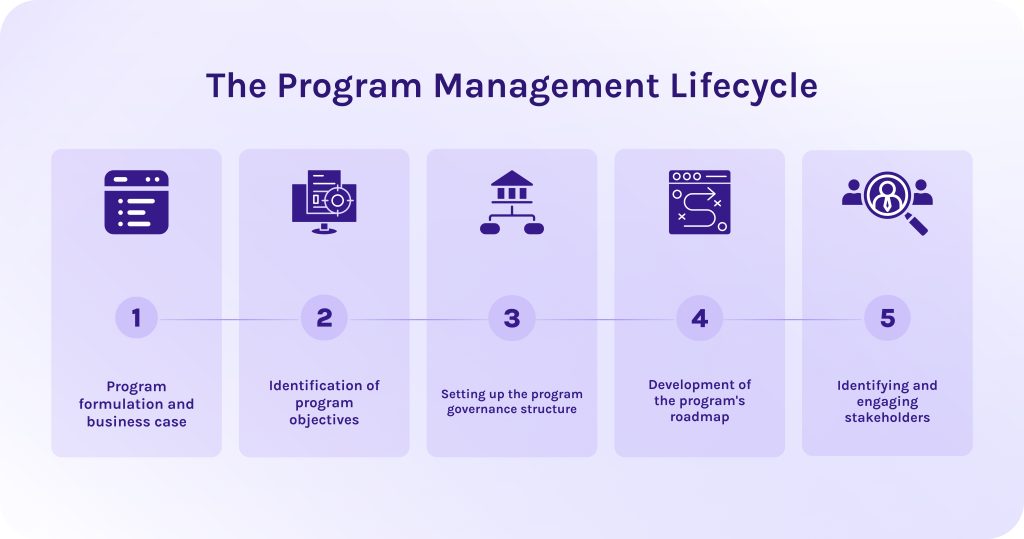
The program management lifecycle involves different phases that each project management program has to go through. These phases consist of different steps that create a structured way to ensure a program remains aligned with its strategic goals and will be completed successfully. Let’s take a closer look at these phases:
Phase #1: Program initiation phase.
This is where everything starts. During this phase, you create a concept for your project management program, brainstorm ideas of how it should look, and what activities it should involve. The goal here is to prove that the proposed group of projects will actually provide value to the organization. It, in turn, involves:
- Program formulation and business case. This step involves identifying the specific strategic gaps in the organization and demonstrating how this program will fill them. You’ll define the expected ROI, the required budget, and the high-level risks [9].
- Identification of program objectives. It outlines the program’s scope, objectives, and, most importantly, the success criteria that will be used to judge the program’s performance in the years to come [10].
- Setting up the program governance structure. It is the system of rules, practices, and processes by which a program is directed and controlled.
- Development of the program’s roadmap. It maps out the major milestones and the chronological order in which individual projects will be launched to ensure a logical flow of benefits [11].
- Identifying and engaging stakeholders. Early initiation involves identifying every group that will be affected and establishing a plan to keep them aligned. If the stakeholders don’t buy into the vision now, the program will face resistance during the delivery phase [12].
Read More: A Guide to the Best Risk Management Software: Top ERM Tools in 2026
Phase #2: Program planning phase.
The previous phase was mostly focused on proving that a program is worth doing. However, this phase determines how exactly the program will be built and managed.
- Defining the program’s scope. Scope definition involves identifying exactly which initiatives fall under the program’s umbrella and, more importantly, what is excluded. This prevents scope creep from draining shared resources and ensures that every project included is strictly necessary to achieve the final strategic outcome [14].
- Identifying core objectives. The program manager translates broad goals into KPIs and measurable milestones. You can use the SMART framework to create realistic and achievable goals [15].
- Mapping interdependencies. The program manager must identify how the outputs of one project serve as the inputs for another.
- Resource allocation. Planning involves mapping out where specialized personnel, budget, and equipment will be needed across the entire timeline. If companies use program management software, leaders can prioritize the most important projects and programs and allocate resources accordingly.
- Risk identification. One of the most important activities in program and project management is to identify potential risks early. Of course, you’ll never know what might happen in the future, but at least you can prepare for the contingencies that could derail your strategic objectives and create mitigation plans.
Read More: Ultimate Guide: The Best Backlog Management Tools in 2026
Phase #3: Benefits delivery phase (execution).
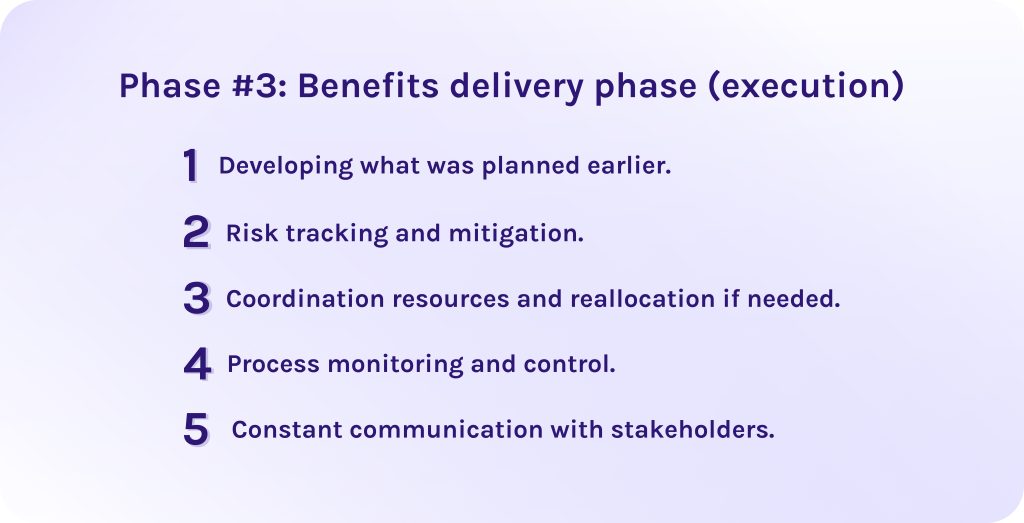
At this phase, the program manager oversees every step of the execution process and monitors the consistency, performance, and delivered results. This involves:
- Developing what was planned earlier. Execution is the realization of the program roadmap. The program manager ensures that the integration of these tasks happens gradually and smoothly.
- Risk tracking and mitigation. A delay in one project is a risk to the entire program’s ROI. The program manager tracks these cross-project risks, looking for possible bottlenecks that might cascade into a domino effect.
- Coordination resources and reallocation if needed. The program manager uses program management software tools to visualize capacity and reallocate personnel from lower-priority tasks to critical path projects.
- Process monitoring and control. It ensures that governance standards are being followed and that the quality of the outputs remains consistent across all workstreams.
- Constant communication with stakeholders. During execution, the program manager communicates strategy shifts to the project teams to ensure the work remains relevant [12].
Phase #4: Program monitoring and control phase.
This phase is one of the most important ones in IT program management because it ensures consistency and confidence that the entire initiative remains healthy, on track, and aligned with the corporate strategy.
- Performance tracking. Program management software tools, in this case, help companies to track not only task execution, but the health of the entire program, answering the question, “Are we actually moving closer to the intended ROI?”
- Quality assurance. The program management ensures that quality is consistent across all project workstreams. It’s not enough for one project to succeed if its output is incompatible with the rest of the program [16].
- Change management. This is about assessing how the program’s deliverables will change the daily lives of employees or customers and how it will affect the expected ROI [13].
Phase #5: Program closure phase.
The program closure phase is the final stage of the lifecycle where the focus shifts from active execution to ensuring long-term sustainability and accountability.
During this phase, the program manager oversees the formal transition of all deliverables to the functional business units and ensures that operational teams are fully trained to maintain the new implementations. A critical component of this stage is the benefit realization assessment, where the actual outcomes are measured against the original business case to verify that the intended ROI was achieved [17].
Finally, the program infrastructure is systematically dismantled by releasing shared resources, reconciling budgets, and archiving lessons learned to improve the success of future organizational initiatives. This structured conclusion prevents “zombie programs” from draining company resources long after their strategic value has been delivered.
Read More: AI-Driven Automation as the Foundation of Next-Gen SaaS Models
Essential Features in Program Management Tools & Software
Core features of the perfect program management software are designed to embed program management principles directly into the digital workflow. To truly support a program’s lifecycle, the software must provide the following essential capabilities:
- Resource-aware planning. The program management tools must visualize cross-project capacity to ensure that specialized talent is not overbooked to set realistic plans and keep the most critical workstreams moving.
- Automatic prioritization of high-value initiatives. To ensure strategic alignment, the program management software should rank projects based on their potential ROI or strategic impact, ensuring that low-value tasks do not drain resources from mission-critical goals.
- Early risk forecasting. The software identifies when a minor delay in a foundational project will inevitably clash with a future milestone in a dependent project and alerts about it.
- Predictive analysis. This feature uses historical data and machine learning to project the most likely future state of the program.
- What-if scenario simulation. This allows IT program management specialists to model possible consequences of their actions in a safe environment, where simulations don’t affect real project data. It helps managers and executives make more confident decisions and consider several options to choose the best one.
- Single source of truth. The program management tools must serve as an archive for all information related to your projects to ensure consistency and keep everyone on track with the latest changes.
- End-to-end visibility. This feature is different from the previous one because it provides a full picture of the program’s health and ensures that all stakeholders are working from the same real-time information.
Read More: Best Scenario Planning Tools to Consider in 2026
How Epicflow Supports Effective Program Management?
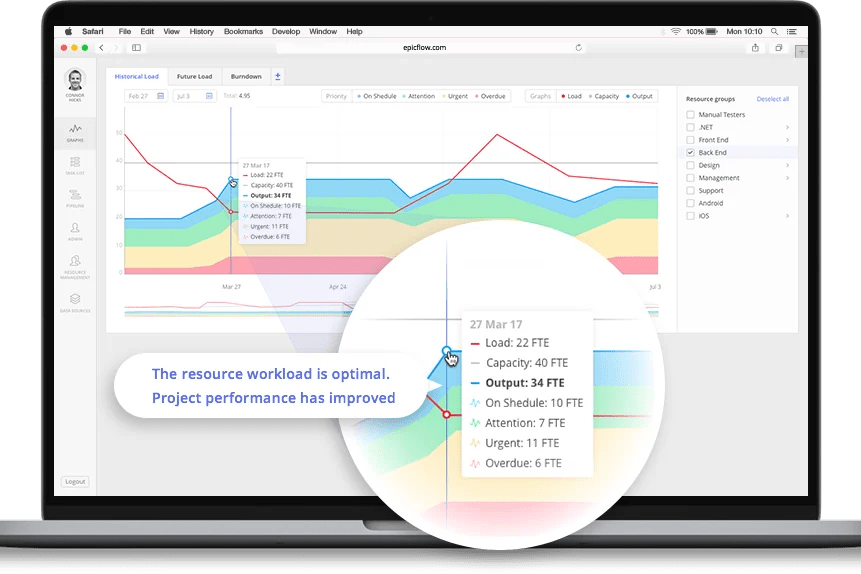
Many tools on the market offer just basic tracking, but for proper program management, it’s not enough. In this regard, you should choose the advanced software that offers all the features described above.
Epicflow is a specialized resource management and multi-project software specifically designed to solve the high-stakes complexity of program management. It treats your program as a living and breathing ecosystem where resources and priorities are managed dynamically. Which exact features make it special?
- Epicflow, at its core, is built on the resource-aware planning approach. The system continuously monitors resource capacity and highlights resource overload to ensure that plans remain realistic and executable.
- Epicflow ensures that resources always work on the most critical tasks, based on project deadlines, dependencies, and overall system constraints.
- Early risk forecasting is enabled by Epicflow’s ability to simulate the entire project environment. It identifies potential bottlenecks and future conflicts in advance, allowing managers to take corrective actions before risks materialize.
- Predictive analysis is delivered through Epicflow’s prediction engine, which calculates reliable project completion dates and evaluates the impact of any changes.
- What-if scenario simulation allows users to test changes without affecting the live environment. This supports confident decision-making.
- All projects, resources, and priorities are consolidated into one system and synchronized with execution tools like Jira or Azure DevOps. This ensures consistency and alignment across all teams.
If you want to see how these capabilities can be applied to your specific environment, you can contact Epicflow experts for a tailored walkthrough and practical insights into improving your program performance.
Conclusion
Program management is a difficult process of managing a set of connected projects in a way that drives them to achieve mutual goals.
If we compare project vs program management, we’ll see that the first one is about managing tasks and schedules within a single project, while the second one is about orchestrating the synergy between multiple initiatives to deliver strategic value and long-term business benefits. While a project is successful when it delivers a specific output on time, a program is only truly successful when those combined outputs create a measurable impact, such as increased market share or organizational transformation.
FAQs
1. What is program management?
Program management is a process of managing multiple concurrent projects together to achieve a bigger strategic goal that would be impossible to reach if the projects were handled separately.
2. What is a program in project management?
If we are talking about a program in the context of project management, it is a group of related projects or activities that are united under one roof by mutual strategic goals and are handled together to achieve a specific business objective.
3. What are common challenges in program management implementation?
The most frequent obstacles during program management implementation often stem from the sheer scale and complexity of coordinating multiple moving parts:
- Resource contention and overlap. Organizations frequently struggle when multiple projects within a program compete for the same specialized talent or limited budget simultaneously.
- Invisible interdependencies. Many programs fail because the logical links between different projects are not clearly mapped, causing a minor delay in one area to trigger a catastrophic domino effect across the entire roadmap.
- Scope creep. Programs are particularly vulnerable to executive drift, where new projects are added to the portfolio without a corresponding increase in resources or adjustments to the timeline.
4. What software tools are best for program management?
Epicflow is an advanced program management software that solves the main problem of the vast majority of project failures – the wise allocation of constrained resources shared across multiple initiatives simultaneously. Its main distinguishing features are the following ones:
- Resource-aware planning across the entire pipeline.
- AI-driven prediction of delivery dates and risks.
- Automatic prioritization of high-value initiatives over low-value ones.
- What-if scenario simulation of the consequences of your decisions.
- Clear visibility into resource overload and bottlenecks.
5. What is a program management office?
A program management office (PMO) may be a department within the organization or a group of experienced specialists that defines, maintains, and ensures standards for program management. In simple English, PMO looks across the entire organization to ensure consistency and strategic alignment, while individual program managers focus on their specific fleet of projects.
6. What is a program manager?
A program manager is a senior-level specialist who is responsible for strategic oversight and coordination of a group of related projects. They orchestrate multiple projects as a single whole to deliver real business value and measurable results.
7. What are the top 3 skills of a program manager?
Generally speaking, there are lots of necessary skills without which you cannot hold a program manager position, but if we are talking about the three most important ones, they are the following:
- Strategic thinking. A program manager must look far beyond the daily checklists of individual projects to understand how the entire program fits into the company’s long-term roadmap.
- Advanced stakeholder engagement. A program manager must be an expert communicator who can translate complex technical milestones into clear business value for the C-suite, while simultaneously negotiating for shared resources and maintaining buy-in across conflicting departments.
- Managing the interdependencies between projects. This skill involves mapping the logical links between dozens of projects and workstreams to prevent a single delay from crashing the entire initiative.
8. What industries benefit most from program management approaches?
Program management, at its core, is designed to handle high-stakes complexity and long-term strategic goals. So, it suits best for industries where projects are deeply interconnected. For example:
- Information technologies and Software-as-a-Service (SaaS).
- Construction.
- Healthcare.
- Aerospace and defense.
- FinTech and banking.
9. What skills are essential for effective program management?
The skillset of an IT program manager must be much more advanced than that of a standard project manager. To succeed, they must learn the following skills:
- Proper resource allocation. They must know how to allocate constraint resources wisely to avoid overbooking or underutilization.
- Risk management. They must see potential risks in advance and know how to create efficient mitigation plans.
- Stakeholders engagement. They must communicate with stakeholders and translate their vision to the execution team in simple terms.
- Problem solving. When some bottlenecks occur, the manager must immediately intervene and offer solutions.
- Strategic alignment. Program management specialists must ensure that every activity within the program contributes directly to the company’s strategic goals.
10. What certifications are most valuable for program managers?
Here are the most popular certifications for program managers, ranked by their global recognition and career impact.
- Program Management Professional (PgMP) – best for senior leaders in large corporations or government agencies.
- Managing Successful Programmes (MSP) – best for managers leading large-scale organizational change or digital transformation initiatives.
- IBM Program Manager Professional Certificate – best for IT program managers who want to master the intersection of traditional program governance and modern leadership.
- Portfolio Management Professional (PfMP) – best for program managers who want to move into executive roles.
References:
- https://www.pmi.org/-/media/pmi/documents/public/pdf/publications/pmi-executive-guide.pdf?rev=c5e95af2b68347e1b85fdca066eaf1fa
- https://www.researchgate.net/publication/265205559_Program_Management_The_Next_Step_in_the_Evolution_of_Project_Management
- https://tac4solutions.com/insights/it-cant-happen-to-us-reasons-why-70-of-projects-fail/#:~:text=Rest%20assured%20that%20employees%20can,How%20exactly%20is%20this%20accomplished
- https://www.researchgate.net/publication/372761291_Project_Management
- https://www.researchgate.net/publication/359177655_Project_portfolio_management_practices_-_a_theoretical_base_and_practitioner_guidelines
- https://www.researchgate.net/publication/285349809_Program_Manager_Core_Competencies
- https://www.researchgate.net/publication/276916135_The_program_manager’s_leadership_competence_and_program_success_a_qualitative_study
- https://www.researchgate.net/publication/277611344_Towards_Program_Risk_Management_and_Perceived_Risk_Management_Barriers
- https://www.researchgate.net/publication/395188353_Project_Management_Life_Cycle_Approaches_For_Software_Development
- https://www.researchgate.net/publication/370538648_Development_of_a_Project_Objective_and_Requirement_System_PORS_for_major_infrastructure_projects_to_align_the_interests_of_all_the_stakeholders
- https://www.researchgate.net/publication/383943728_Development_of_Outcome-Driven_Product_Roadmaps
- https://www.researchgate.net/publication/380364809_Stakeholder_Management_in_Large_Complex_Programs
- https://www.researchgate.net/publication/335698794_Program_Management_and_Organisational_Change_New_Directions_for_Implementation
- https://www.researchgate.net/publication/257718824_Managing_Project_Scope_Definition_to_Improve_Stakeholders’_Participation_and_Enhance_Project_Outcome
- https://www.researchgate.net/publication/387976768_SMART_Objectives_A_Strategic_Approach_to_Achieving_Business_Success
- https://www.researchgate.net/publication/353588851_Effective_Project_Management_and_the_Role_of_Quality_Assurance_throughout_the_Project_Life_Cycle
- https://www.researchgate.net/publication/367966056_Closing_a_Project_the_right_way