
What is agentic AI in software development?
First things first, let’s understand the AI agent definition.
An AI agent is an autonomous system most often driven by a foundation model (like an LLM). It perceives its environment, creates an internal plan, uses external digital tools, and self-corrects until it achieves a high-level goal [1].
In the context of software development, these systems behave like digital software engineers. Now, devs don’t need to prompt the AI line-by-line. Instead, they provide a strategic objective, for instance, “Migrate this service from one technology to another and ensure all integration tests pass”. Agentic software executes the multi-file workflow on its own.
Read More: A Practical Guide to Agentic AI Governance for Scale
AI agents VS. agentic AI
In fact, these are two sides of the same coin.
- An AI agent is a specific software tool or entity designed to perform autonomous tasks [2].
- Agentic AI is the broader capability of an AI system to act autonomously and self-correct.
Read More: What Is Business Process Automation? Strategy, Tools, Benefits, and Enterprise Use Cases
How does agentic AI work across the software development lifecycle?
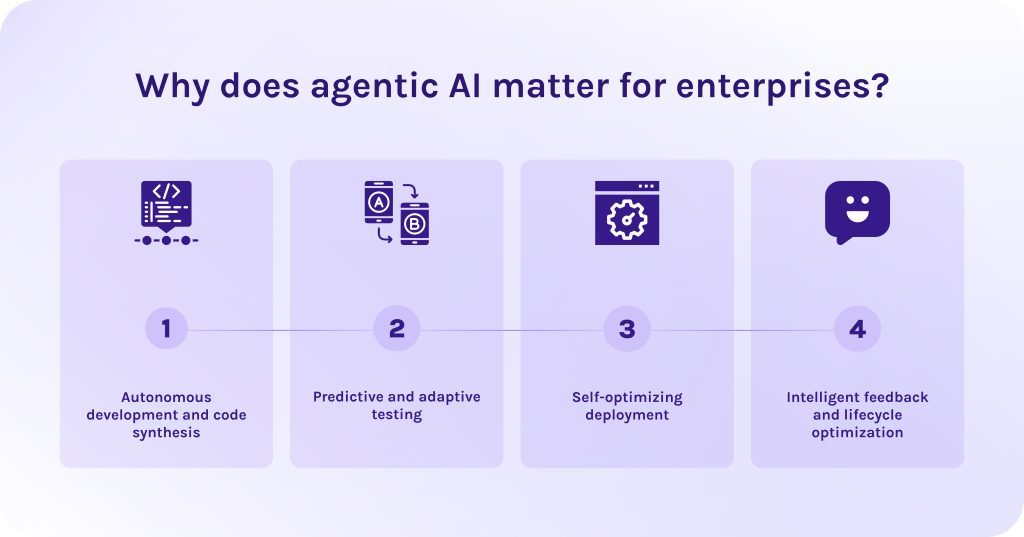
The main goal of agentic AI in software development lifecycle (SDLC) is to shift the software development process from running a pre-defined set of instructions to autonomy. Autonomous AI agents understand context, handle errors, and, ultimately, can collaborate with other agents responsible for other processes. For instance, after developing some functionality, the AI coding agent can trigger a QA agent who will test the system for bugs and errors.
Autonomous development and code synthesis
Agentic systems review entire codebases to decompose a high-level feature into iterative small steps, like sub-tasks, for further execution. Specialized AI agents then collaborate to write the code and autonomously fix any compile errors before human review.
Predictive and adaptive testing
Intelligent agents analyze code changes to predict exactly which test suites need to run. At the same time, AI coding agents rewrite broken test scripts. As well, agentic AI reduces bugs in software development when it proactively tests the system for security vulnerabilities and edge-case bugs.
Self-optimizing deployment
During rollouts, AI agents monitor ongoing processes and data volumes to safely scale up traffic or execute immediate rollbacks if anomalies arise. They continuously analyze production performance to adjust cloud resources to heal crashing services.
Intelligent feedback and lifecycle optimization
Ultimately, agentic AI in software development continuously analyzes different data to, for example, automatically generate Jira tickets and prioritize the engineering backlog. This creates a continuous feedback loop where the system learns from operational failures to guide the planning and design of future software iterations in advance.
Read More: Mastering AI Agent Orchestration for Complex Workflows
What are multi-agent systems and AI agent orchestration?
Single AI models have a fundamental limitation: if you ask a single LLM to analyze requirements, write complex code, test it, and deploy it all in one go, the sheer complexity degrades its performance.
Multi-agent systems (MAS) solve this by breaking down large problems into smaller ones, redirecting each task to a specific AI agent. They, in turn, act like members of an engineering team, possessing unique tools, personas, and specialized prompt instructions [3].
How does it work in practice?
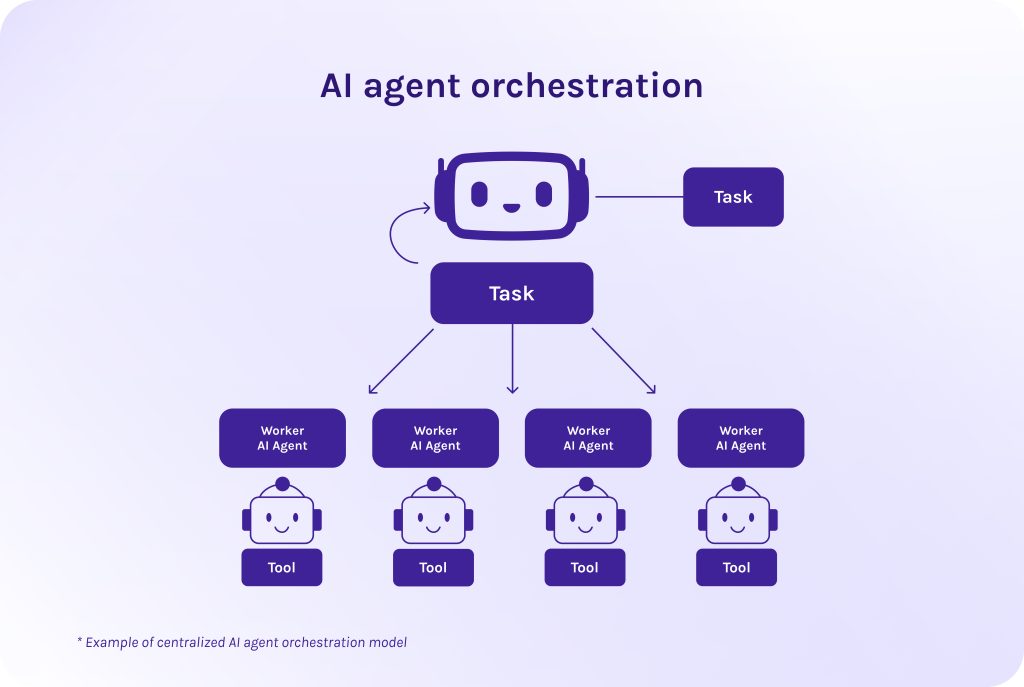
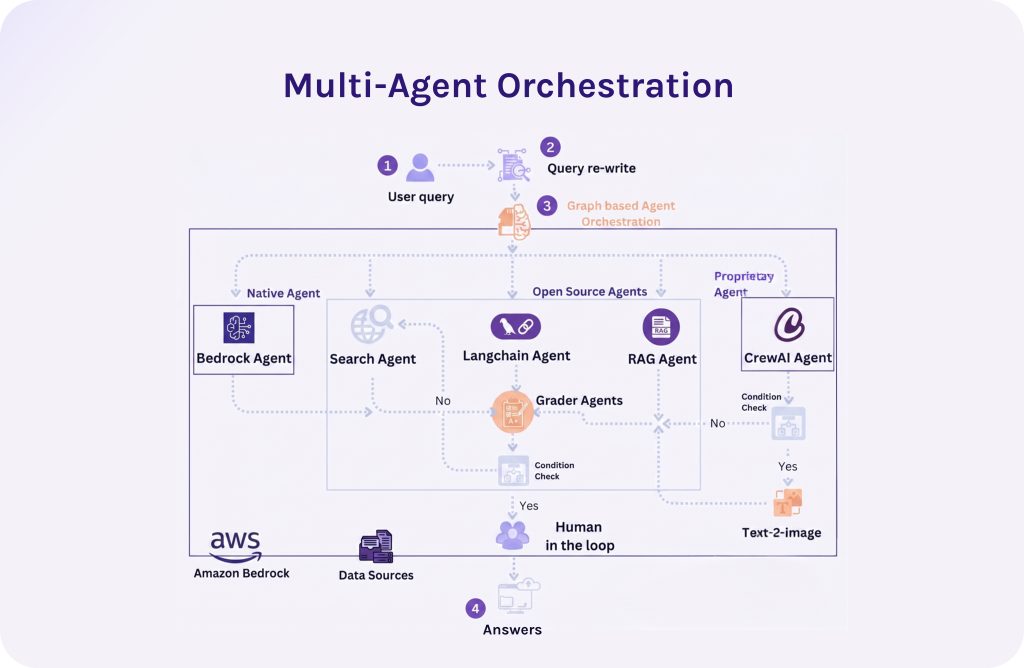
For multiple AI agents to work together seamlessly without descending into chaos, they require structured AI agent orchestration. This is the AI agent workflow that defines how information flows and how agents are managed [3].
As shown in the design below, a primary user query gets rewritten and routed through a structured graph. Specialized AI agents (like Search, LangChain, or RAG agents) process their respective tasks, while Grader Agents and Condition Checks validate the outputs before passing them to a human or triggering a final response.
Read More: AI Agent Orchestration in 2026: A Guide to Building Scalable Multi-Agent Systems
Real-world example of how agentic AI drives efficiency
I want to show you how exactly agentic AI can help you boost productivity and reach better results. For example, I’ll take EpicStaff. It is an open-source AI agent orchestration platform that you can self-host on your own servers, ensuring maximum possible security. It was designed to help both engineering teams and non-technical teams to scale and automate their workflows.
The platform has shown great results in many industries, but the best case I want to tell you about is about software engineering in the logistics industry.
EpicStaff’s team had a collaboration with Dutch logistics services provider Move Your Machine (further MYM). Transportation and logistics across Europe always was an environment with high friction and lots of manual operations, which relied on endless phone calls and complex route planning. To address all these challenges, MYM set out to be an “AI-first” logistics provider from day one, using EpicStaff as their core orchestration platform.
Here is how exactly EpicStaff was used
MYM wanted to build a flexible platform that would be easy to scale and work with. They used EpicStaff to deploy a modular network of 43 specialized AI agents. Fifteen of these were developed and launched dynamically over their first few months of operation to handle evolving real-world challenges. These agents act as a real human team but capable of making faster and more efficient decisions. While working with EpicStaff, MYM achieved:
- 80% to 90% of tasks associated with orders, marketing, and finances are fully handled by AI agents.
- Scaled operations smoothly with a lean human team of just 2 people acting as supervisors.
- Saved up to 40% of delivery lead times through immediate processing and predictive routing.
- 24/7 client support and instant quoting because the digital workforce never sleeps.
You can achieve the same or even better results in any industry using EpicStaff. Whether you need to automate marketing operations or code writing, you can create your own efficient platform and save significant time and costs.
No matter what sector you operate in, you can start small and scale dynamically, just like Move Your Machine did. Contact our experts to start scaling today.
How does agentic AI in software development impact your business and ROI?
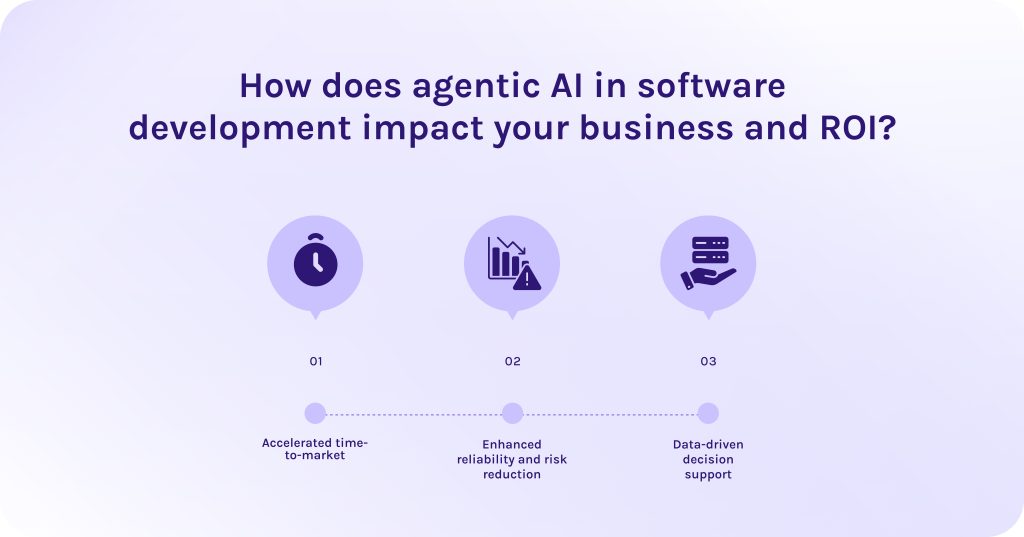
- Accelerated time-to-market. Agentic software development reduces the time of the software development lifecycle from months to days. It becomes possible, thanks to autonomous management of end-to-end feature implementation and bug-fixing. This dramatically reduces engineering costs and lets companies rapidly iterate on prototypes to pivot ahead of market competition [4].
- Enhanced reliability and risk reduction. Autonomous security and testing AI agents are able to catch vulnerabilities and edge cases before they ever reach production. If issues occur post-deployment, self-healing DevOps agents analyze telemetry to immediately execute rollbacks or apply hotfixes, minimizing revenue-losing downtime [4].
- Data-driven decision support. By continuously monitoring production performance, agentic AI in software development automatically organizes and prioritizes the engineering backlog based on actual business impact [4].
Read More: What Are the Top 10 n8n Alternatives to Watch This Year
How does agentic AI in software development change the role of developers and their skills?
When AI agent workflows emerged, the role of software developers also changed immediately. Now, writing code is no longer the primary differentiator for human engineers.
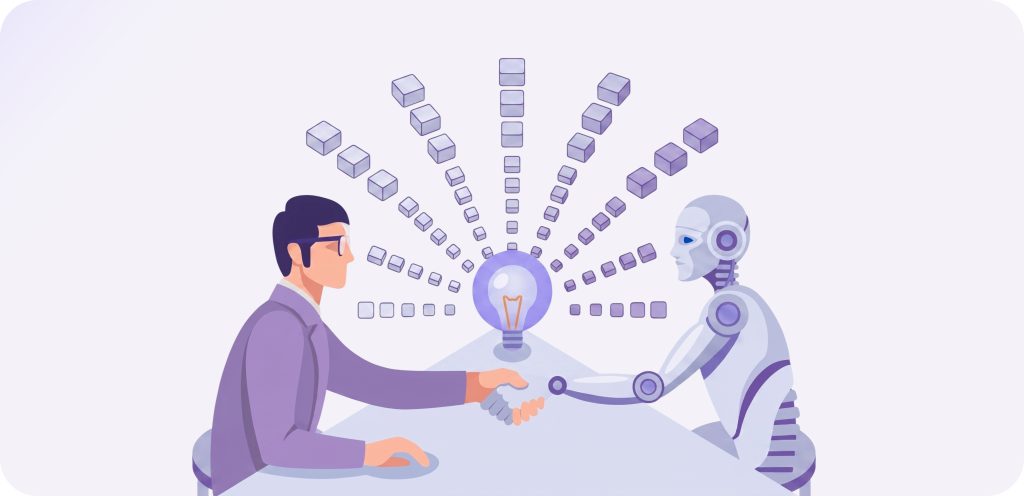
- Less syntax, more strategy: Developers spend less time managing code itself. Instead, they break down large business problems into smaller logical modules and define the system boundaries within which AI agents execute.
- AI acts like a full-stack engineer: Because an AI coding agent can learn unfamiliar technologies, the division between frontend, backend, database, and DevOps engineering is no longer that strict. Thus, devs can now safely direct an agent to provision a database or tweak infrastructure files, drastically broadening an engineer’s effective scope.
- More code review and audit: Developers don’t need to write every line of code themselves. Now, they mostly audit codebases and pull requests generated by an agentic engineering system.
Read More: Low Code Platform: Complete Guide to Low-Code Development Platforms in 2026
Conclusion
Let’s quickly recap the most important points of the article:
- Agentic AI in software development entirely changes the approach to software development from manually writing code line by line to reviewing and improving the work of the agentic system.
- Agentic AI in software development lifecycle has changed from code synthesis to deployment and feedback.
- Companies still need human developers to review the work of AI agent services and improve them.
- AI agent capabilities in software development include collaboration of multiple AI agents to achieve mutual goals, decomposing each huge task into smaller ones, and, ultimately, self-correcting errors and bugs during the build process.
- Agentic AI use cases in software development include legacy code migration, where orchestrated agents autonomously map out old system architectures and rewrite codebase dependencies into modern frameworks.
FAQs
1. What is agentic AI?
Agentic AI is a system built with artificial intelligence that doesn’t just respond to static prompts, but can autonomously achieve a high-level goal like “Audit our codebase for security vulnerabilities and create a pull request with the fixes ”.
2. How agentic AI differs from traditional AI?
- Traditional AI is more static and can only solve one problem at a time. Mostly, it is built for data analysis and functions on the set of pre-built rules.
- Agentic AI is more advanced and can learn from different sources. It can solve multiple problems at the same time, thereby demonstrating true operational autonomy. Agentic AI systems can plan tasks, connect to different third-party software, and correct its own mistakes to achieve a high-level goal without human intervention.
3. What are the common challenges developers face with agentic AI in software development?
Limitations of agentic AI in software development include:
- Infinite loops. AI agents can trap in the infinite self-correcting loops, trying to correct their own mistakes.
- Fragile long-term memory. If the retrieval pipeline fails to fetch a hidden file dependency, the agent will write code that looks perfectly correct on its own but completely breaks the broader system architecture.
- Hard rollbacks. Implementing clean rollbacks for autonomous code modifications requires highly complex version-control sandboxing.
4. Will agentic AI replace software developers?
No, in the near future agentic software won’t replace human software developers. However, it will definitely redefine their role and responsibilities. Developers who learn to effectively direct and collaborate with these autonomous AI agents will become significantly more productive and highly valued [5].
5. What skills should developers focus on to work effectively with agentic AI?
Developers should focus on the following pillars:
- They should be able to create AI agent workflows and multi-agent systems.
- Developers must know how to build secure APIs and utilize emerging standards like the Model Context Protocol (MCP).
- They should be able to write highly precise business requirements and logical boundaries for AI agents.
- Developers must review AI-generated code for hidden security flaws.
6. Does implementing agentic AI require coding knowledge?
Not necessarily. Agentic AI implementation doesn’t strictly require deep coding knowledge. Many modern no-code/low-code agent builders allow you to drag, drop, and connect AI agents using visual interfaces. However, having basic programming knowledge is a massive advantage for customizing agent behavior.
7. Why do humans still need to make decisions in agentic AI software?
Humans must remain in the loop because intelligent agents, although smart enough to take autonomous actions, still lack:
- Genuine ethical judgment.
- Business intuition.
- Legal accountability.
Human oversight ensures the autonomous system aligns with broader company strategy and real-world safety guardrails [5].
8. Is agentic AI reliable enough for mission-critical applications?
No, agentic AI is generally not reliable enough to run entirely unsupervised in mission-critical applications [6]. Its behavior still can be non-deterministic or it can hallucinate. To use them in high-stakes environments, enterprises must include guardrails and human-in-the-loop validation for proper oversight.
9. Does agentic AI necessarily require large language models (LLMs)?
No, agentic AI does not strictly require large language models (LLMs) to function properly. AI agents can be built using traditional reinforcement learning, symbolic logic, or graph-based algorithms [7].
10. What ethical considerations should developers keep in mind when implementing agentic AI?
- Remember about accountability. Developers must implement comprehensive tracing and logging so that every decision made by an AI agent can be audited and explained by a human [8].
- Consider prompt injections. Systems must be secured against indirect prompt injections, preventing malicious users from overriding an agent’s core instructions [8].
- Keep in mind limited responsibilities. Intelligent agents must operate under the Principle of Least Privilege, using strict boundary guardrails and human-in-the-loop checkpoints before executing irreversible actions [8].
References
- https://www.researchgate.net/publication/391373257_AI_Agents
- https://www.researchgate.net/publication/394937970_Artificial_intelligence_AI_agents_and_the_future_of_customer_loyalty
- https://www.researchgate.net/publication/388631375_Multi-Agents_Systems_A_review
- https://www.researchgate.net/publication/398821325_Introduction_to_Agentic_AI_Concepts_Architecture_and_Benefits
- https://www.researchgate.net/publication/389510618_Will_AI_replace_Software_Engineers_Hold_your_Breath
- https://www.researchgate.net/publication/394049492_Agentic_AI_and_Hallucinations
- https://www.researchgate.net/publication/395264831_The_Rise_of_Agentic_AI_A_Review_of_Definitions_Frameworks_Architectures_Applications_Evaluation_Metrics_and_Challenges
- https://www.researchgate.net/publication/403123616_Ethical_perspectives_on_AI_Agents_and_Agentic_AI