

Key takeaways
- AI outsourcing is the practice of entrusting the development of your AI software to an external vendor.
- Outsourcing AI development became extremely popular because of talent shortages, while compensation for those positions is only growing.
- Traditional software follows linear logic, while AI software learns from data.
- Businesses that use AI outsourcing services reduce operational costs by up to 40% on average [4].
What is AI outsourcing?
At its core, AI outsourcing is a practice of delegating the development and further maintenance of AI software to an external team of professionals. Why can’t you create an internal AI development team? Of course, you can. But would it be a wise decision? That’s a contentious issue.
- Bain statistics say that demand for AI job positions has been growing 21% annually since 2019, whereas compensation for those positions has increased 11% annually. It makes hiring such specialists too expensive [2].
- At the same time, PwC’s 2025 Global AI Jobs Barometer reports AI-related job skills are changing 66% faster than traditional roles, which makes it difficult for internal teams to keep up [3].
In this case, AI outsourcing helps companies save money while remaining competitive in the market, providing quality AI services to the users.
Read More: Mastering AI Agent Orchestration for Complex Workflows
What AI outsourcing models exist?
When choosing an artificial intelligence outsourcing model, evaluate how much control you need to have over intellectual property and how dynamic project requirements are.
What is the difference between end-to-end outsourcing and task-specific outsourcing?
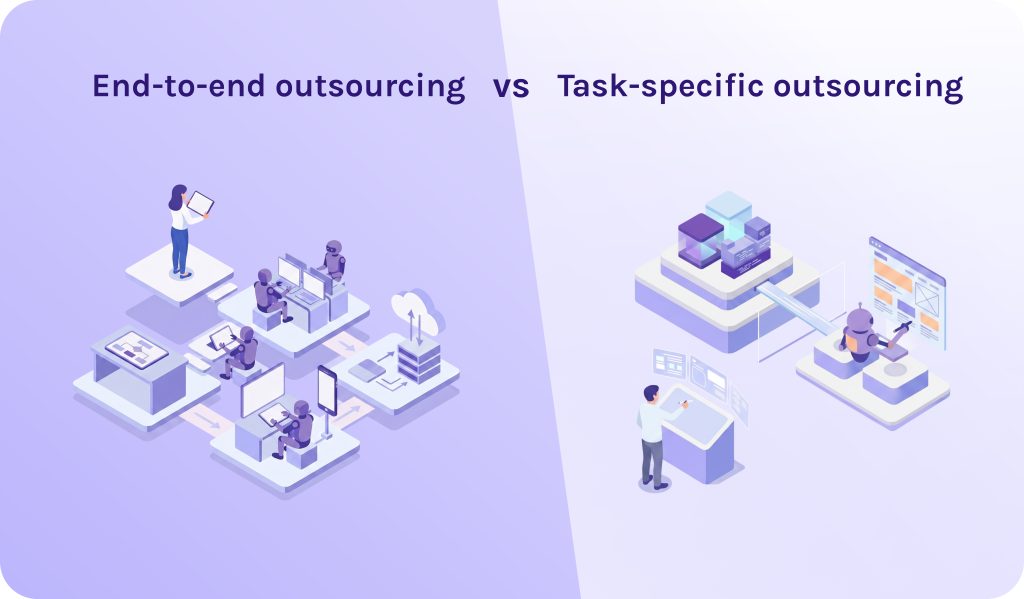
These AI software outsourcing models differ by the breadth of the lifecycle handled by the vendor [22].
- End-to-end outsourcing. In this artificial intelligence outsourcing model, the vendor handles the entire software development lifecycle [5]. It is the best solution for non-technical companies that need a ready solution without creating an internal IT department.
- Task-specific outsourcing. Here, you outsource only a specific task, but not the whole AI and ML development process. It is an ideal choice for companies with an existing AI team that has hit a bottleneck in a specific task and cannot solve it on their own [6].
What is the difference between dedicated development teams and project-based models?
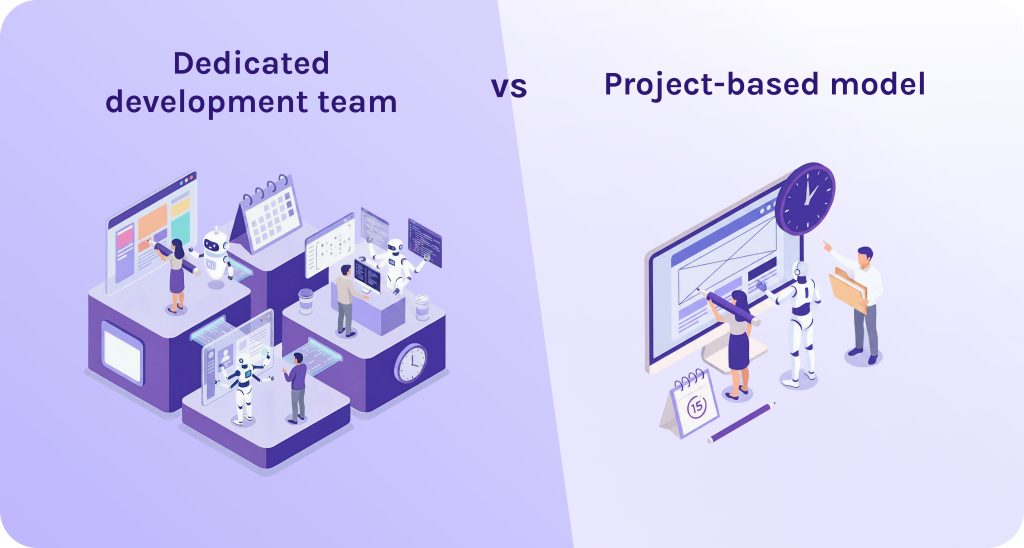
In this case, AI development outsourcing models differ by time and integration.
- Dedicated development team. An external artificial intelligence outsourcing team of specialists works exclusively for you as a long-term extension of your company. They integrate into your company’s culture and tools.
- Project-based model. Here, you hire an outsourcing AI development team just for one activity with fixed deadlines and a scope of work.
What are hybrid models?
Hybrid models are a combination of multiple outsourcing models that help to reach better agility. For example, you keep a small internal AI software development department, but outsource execution to a reliable outsourcing vendor [18].
What is AI-as-a-Service (AIaaS)?
In this AI software outsourcing model, you don’t need to hire a team at all. You just need to subscribe to the platform. For instance, you can use OpenAI’s API for customer service or Zapier for workflow automation [7].
Read More: Empowering Your Workflow: Unveiling the Surprisingly Diverse Uses of Large Language Models
What are the key differences from traditional software outsourcing?
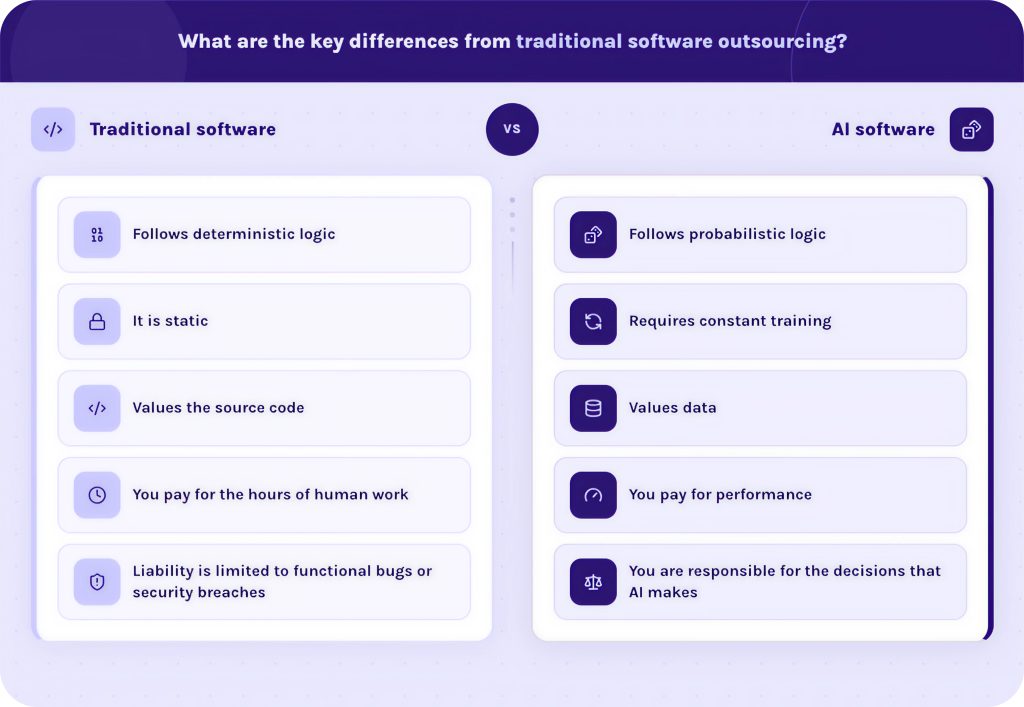
1. Traditional software follows deterministic logic, while AI software follows probabilistic logic.
- Traditional software. It follows linear conditional logic (if smth, then smth). You can test every possible path, and the code remains the same unless a human changes it.
- AI software. It provides output based on data. Artificial intelligence can work properly one day but hallucinate the other day, requiring constant monitoring that traditional software doesn’t need.
2. Traditional software is static, while AI requires constant training.
- Traditional software. Once the software is built and debugged, it needs less oversight. You can add features or improve it, but overall, it is ready to use.
- AI software. Artificial intelligence suffers from constant model drift. As the world changes, you need to retrain the model on new data to keep it up to date [8].
3. Traditional software values the source code, while AI values data.
- Traditional software. The primary value is the source code. Thus, if you have a code, you have a product.
- AI software. The primary value is data. AI outsourcing is more about data engineering than just writing lines of code [9].
4. Different pricing models.
- Traditional software. Here, you usually pay for the hours of human work.
- AI software. As artificial intelligence processes data and does tasks much faster than human beings, completing complex workflows in seconds, you pay for performance.
5. Different regulations.
- Traditional software. Liability is usually limited to functional bugs or security breaches.
- AI software. Under the 2026 EU AI Act, you are responsible for the decisions that artificial intelligence makes.
Read More: Top IT Outsourcing Companies: Complete Guide to Choosing the Right Provider
What are the top AI outsourcing services in demand?
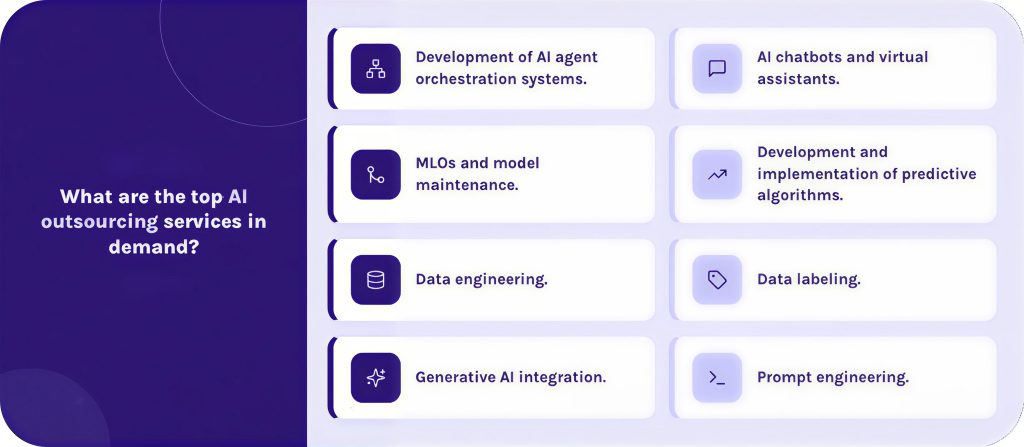
In 2026, demand for AI services reflects a shift from simple automation to the creation of autonomous digital ecosystems [17]:
- Development of AI agent orchestration systems. AI outsourcing firms are hired to build systems where multiple AI agents collaborate to execute complex workflows. Their main distinction from traditional AI is that they can take autonomous action and decide how to perform a specific task [19].
- AI chatbots and virtual assistants. Conversational AI is one of the most desirable AI functions for many businesses as it allows them to improve customer support, thereby improving customer satisfaction. AI can process natural language and respond to human queries, answering questions or giving suggestions.
- MLOs and model maintenance. Over time, models become less accurate, so external specialists from AI outsourcing partners monitor, retrain, and redeploy them to ensure they stay sharp and secure [14].
- Development and implementation of predictive algorithms. These are the algorithms that process historical data to forecast possible future outcomes in different situations. It allows companies to predict possible bottlenecks in advance and create mitigation strategies as early as possible [10].
- Data engineering. To train and give meaningful responses, AI needs data. AI outsourcing companies help their clients to gather accurate data, structure it, and securely move it into environments where models can actually use it.
- Data labeling. Human in the loop remains the essential layer in AI software outsourcing, where external specialists tag, annotate, and verify massive datasets to ensure machine learning models achieve high accuracy.
- Generative AI integration. Companies hire an AI outsourcing partner who can accurately set up and train popular models like GPT-4 or Claude on their own proprietary data to prevent hallucinations and keep outputs accurate and relevant [11].
- Prompt engineering. External experts from AI outsourcing companies design the complex instructions called “prompts” that keep AI outputs professional and aligned with brand voice.
Read More: Revolutionizing Education: How AI-Powered Chatbots are Changing Student Support and Tutoring
How to choose a reliable AI outsourcing vendor?
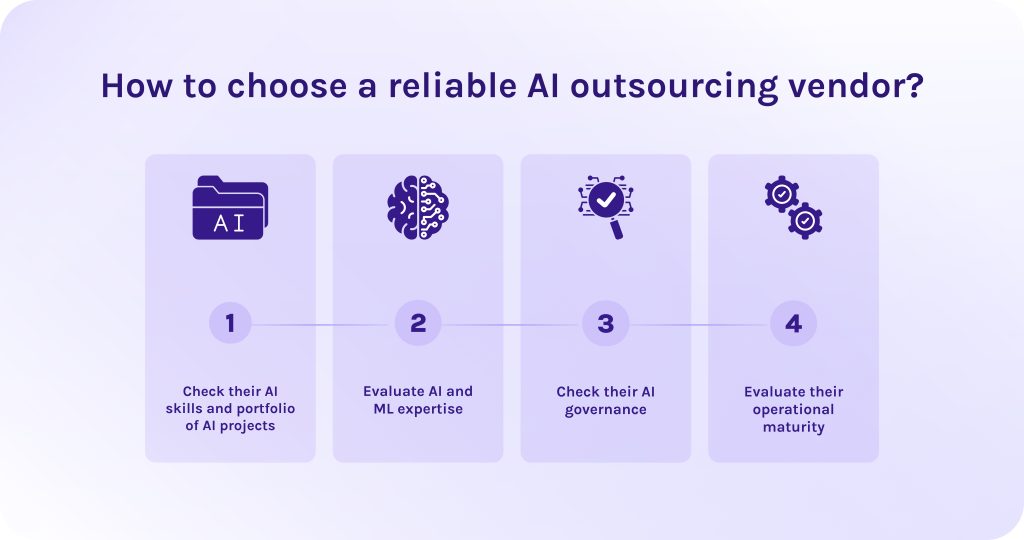
- Check their AI skills and portfolio of AI projects. Look for a reliable outsourcing vendor with a deep portfolio in your specific domain to ensure they understand your exact data edge cases and regulatory rules [12].
- Evaluate AI and ML expertise. Modern AI software outsourcing companies must have experience not only with simple data analysis but also in building agentic AI systems and retrieval-augmented generation (RAG). Ensure they use open formats and can prove that you can switch providers easily, avoiding a “vendor lock-in” problem.
- Check their AI governance. Choose an AI outsourcing company that is compliant with the EU AI Act to ensure its liability. Ask how they test AI software to find biases or security holes [13].
- Evaluate their operational maturity. Select an AI outsourcing company that will be responsible not only for launch, but also for the whole lifecycle. Ask how they track the accuracy of their systems over time and how they manage disruptions and biases. A mature and reliable outsourcing vendor will have automated MLOps pipelines that alert you when a model starts performing poorly due to changing real-world data [12].
Evaluating a vendor’s operational maturity and governance is a complex task that requires both technical and legal oversight. HYS Enterprise is a Dutch software development house with more than 10 years of experience in developing robust software solutions, including agentic AI and conversational assistants, can help you to fight this complexity.
Contact the experts at HYS Enterprise today to discuss your AI roadmap and ensure your outsourcing strategy is secure, compliant, and built for scale.
Read More: Top 10 AI Software Development Companies (2026 Guide)
Conclusion
I want to summarise this article with a quote of famous artificial intelligence researcher:
“AI doesn’t replace people. People who use AI replace people who don’t.”
– Andrew Ng
AI outsourcing isn’t about replacing humans, even on the contrary, it opens new doors for companies to grow and make more time for strategic business activities. It gives you the ability to save costs on hiring highly experienced professionals, thereby maximizing ROI and proving that your investments are paying off in real-time scalability and faster time-to-market [15].
As you look toward the future of AI and outsourcing, remember that the right partnership is your strongest competitive advantage. Contact HYS Enterprise experts for a specialized consultation on your next AI initiative.
FAQs
1. What is AI outsourcing?
By the definition, AI outsourcing is a common practice among companies where they partner with an external software development company to develop and maintain their AI services. This strategic partnership allows organizations to leverage sophisticated technology without the operational friction of building an entire department from scratch [16].
2. How will AI change outsourcing?
3. Why should we outsource AI instead of building an in-house team?
In 2026, the main driver of artificial intelligence outsourcing is a gap between talent shortage and increasing salaries that makes maintaining an internal team financially unsustainable. However, thanks to AI outsourcing, companies avoid the massive capital expenditure of specialized infrastructure, gaining immediate access to a “future-proof” workforce at the same time [16].
4. How do I protect my data when outsourcing AI development?
5. What are the most common AI functions being outsourced today?
6. Should we prioritize nearshore or offshore providers?
7. What is the biggest risk of AI outsourcing?
In 2026, the biggest threat to AI development outsourcing is data security and leaks. Organizations share their private data with an external vendor that can expose sensitive business secrets or lead to legal complications if the vendor’s security protocols are breached.
Additionally, over-reliance on one vendor leads to the so-called “vendor lock-in” problem. It is a situation where only external specialists know what exactly happens in your system and how it works.
8. What are the benefits of outsourcing AI projects?
The main benefits of outsourcing AI development are as follows:
9. Does our vendor need to comply with the 2026 EU AI Act?
Yes, if your company operates within the EU or if the AI’s output affects individuals in the EU, your vendor must comply regardless of where they are headquartered. The Act applies to any global provider whose systems are placed on the EU market or whose data outputs are used within the European Union.
10. How does AI outsourcing improve speed to market?
References
- https://www.mckinsey.com/capabilities/quantumblack/our-insights/the-state-of-ai
- https://www.bain.com/about/media-center/press-releases/20252/widening-talent-gap-threatens-executives-ai-ambitions–bain–company/
- https://www.pwc.com/gx/en/services/ai/ai-jobs-barometer.html
- https://www.deloitte.com/content/dam/assets-zone3/us/en/docs/services/consulting/2024/us-global-outsourcing-survey-2024-report.pdf
- https://www.researchgate.net/publication/389970139_End-to-End_Automation_of_Software_Development_Lifecycle_SDLC_Tools_and_Processes
- https://www.researchgate.net/publication/257105521_The_influence_of_task-_and_location-specific_complexity_on_the_control_and_coordination_costs_in_global_outsourcing_relationships
- https://www.researchgate.net/publication/390051605_AI_as_a_Service_AIaaS_The_Future_of_Cloud-Based_Artificial_Intelligence
- https://www.researchgate.net/publication/394502963_Understanding_Model_Drift_and_Its_Impact_on_Health_Care_Policy
- https://www.researchgate.net/publication/2881159_Data_Quality_Assessment
- https://www.researchgate.net/publication/384886529_Predictive_Algorithms_for_Enhanced_Data_Analysis_in_Diverse_Applications
- https://www.researchgate.net/publication/386573199_Generative_AI
- https://www.researchgate.net/publication/280859493_Outsourcing_A_Guide_to_Selecting_the_Correct_Business_Unit_Negotiating_the_Contract_Maintaining_Control_of_the_Process
- https://www.researchgate.net/publication/382927329_Artificial_Intelligence_Governance
- https://www.researchgate.net/publication/382670568_Enhancing_Machine_Learning_Models_and_Classification_Accuracy_with_Advanced_Attention_Mechanisms
- https://www.researchgate.net/publication/382442865_The_Transformative_Impact_of_AI_Technologies_on_Software_Development_and_IT_Outsourcing_A_Comprehensive_Analysis
- https://www.researchgate.net/publication/360408189_Outsourcing_Artificial_Intelligence_Responding_to_the_Reassertion_of_the_Human_Element_into_Automation
- https://www.oecd.org/content/dam/oecd/en/about/projects/edu/artificial-intelligence-and-the-future-of-skills/artificial-intelligence-future-of-skills-brochure.pdf
- https://www.researchgate.net/publication/395444687_The_hybrid_IT_sourcing_model_Will_it_work_for_media_enterprises
- https://www.researchgate.net/publication/386083531_A_Comparative_Study_of_AI_Agent_Orchestration_Frameworks
- https://www.researchgate.net/publication/381545968_DATA_ENCRYPTION_The_Definitive_Guide_to_Protecting_Your_Digital_Assets
- https://www.researchgate.net/publication/397000720_Machine_Learning_An_Overview
- https://www.deloitte.co.uk/makeconnections/assets/pdf/the-outsourcing-handbook-a-guide-to-outsourcing.pdf