
What is agentic AI governance?
First things first, we need to discuss the agentic AI governance definition.
Agentic AI governance is a structured framework that includes rules, policies, technical controls, and oversight used to manage AI agents. In turn, AI agents are not just simple text generators or analysers. They are autonomous entities that can plan and execute multi-step tasks across different software and data environments [7].
Read More: Mastering AI Agent Orchestration for Complex Workflows
How does agentic AI differ from traditional AI governance?
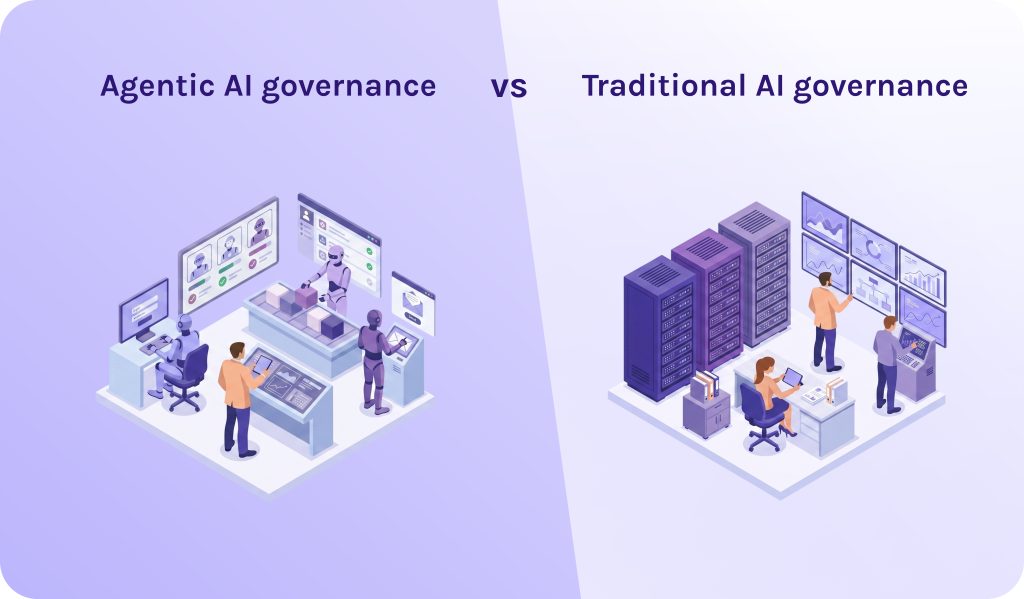
Traditional AI governance
Traditional AI is a set of algorithms and predefined rules that can analyze large datasets and learn, but only using data that has already been provided. It results in outputs that are primarily informational or predictive rather than actionable.
That is why traditional AI governance is much simpler than an agentic one. You test the model for bias and accuracy before it launches. Once it passes, you assume the risks stay the same unless you retrain it.
Agentic AI governance
In the meantime, AI agents function as your virtual staff. Their work goes far beyond just simple data analysis. Agentic AI can take autonomous actions, for instance, log into software systems, track and manage workflows, send notifications or emails, of course, using sensitive data. These changes are almost screaming in your face, “If you manage agentic AI poorly – or don’t manage it at all – you might as well upload your confidential data straight to GitHub.”
Nobody wants that, right? That is why protection of autonomous AI systems must be continuous and provide full control of what AI is allowed to do and where it has access.
Read More: AI Agent Orchestration in 2026: A Guide to Building Scalable Multi-Agent Systems
Why do existing AI governance frameworks fall short?
As we discussed above, most existing AI governance frameworks are failing because they were created for predictable algorithms, limited in their capabilities. But modern systems have gained autonomy that they never had before. Thus, when AI agents start to take actions that they assume are right, it can make unpredictable or unsafe decisions within the scope of their permissions and goals.
“I don’t think we’ve kind of nailed the the right way to interact with these agent applications. I think a human in the loop is kind of still necessary because they’re not super reliable.”
– Harrison Chase, Founder of LangChain.
Read More: AI Agent Management Platform: A Guide to Enterprise AI Agent Orchestration and Governance
What are the core components of an agentic AI governance framework?
We can describe the core components of any agentic AI governance framework as the following ones:
1. Data visibility.
The AI agent must only see the data relevant to its specific task. For this purpose, implement task-scoped memory that will be wiped after a task is completed to prevent the accumulation of sensitive PII (personally identifiable information).
Also, consider using MCP (model context protocol) to securely connect AI agents to other apps to view only needed data, rather than giving it access directly to your database.
2. Permissions and tools that AI has access to.
An AI agent should never inherit the full permissions of the human user who launched it.
- Implement identity-centric access control. Every agent is issued a non-human identity (NHI) that works like a human passport via protocols. Each time the agent makes a request to the database or API call, it is signed by the agent. Consequently, if the agent hallucinates, you know exactly which agent made the mistake, where, and when.
- Zero-trust rule. Just because an AI agent is running inside your company’s network or data center doesn’t mean it is safe. Every single action must be verified explicitly at the point of execution [8].
- Just-in-time (JIT) permissions. Agents don’t have standing access. They are granted a scoped token that only allows them to perform one specific task for a limited time [9].
3. Autonomy boundaries.
These are the specific safe zones where an AI agent can act independently. They ensure that high-stakes or irreversible actions, like deleting a user, automatically trigger a human-in-the-loop approval before execution [5].
4. Governance of AI agents’ behaviour.
Autonomous agents can learn bad behaviors from the live data they browse or the tools they use. Thus, you need to concretize the bias-mitigating rules to ensure that the system remains aligned with ethical principles and business objectives as well as with security regulations.
Read More: What Is Business Process Automation? Strategy, Tools, Benefits, and Enterprise Use Cases
5 steps for applying AI governance across the agent lifecycle
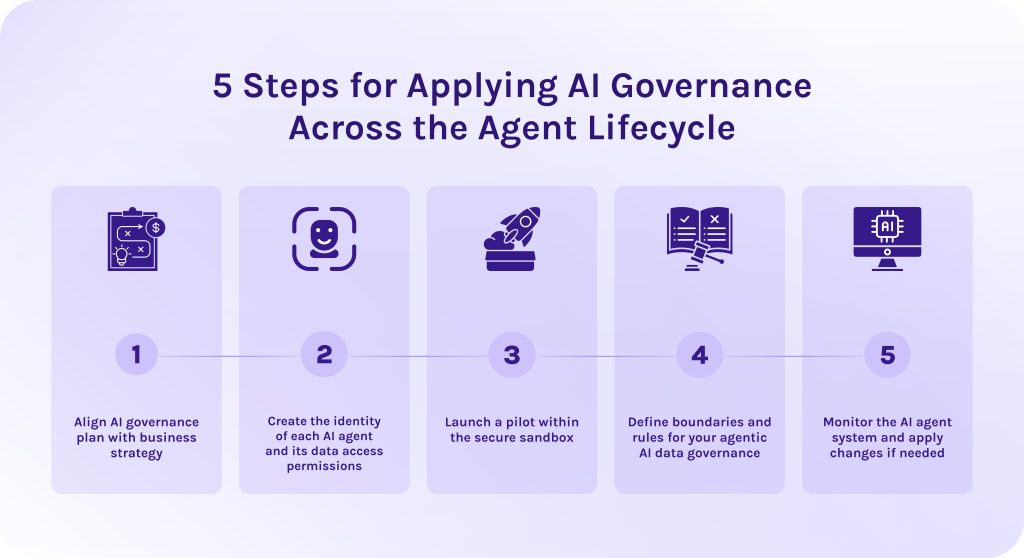
Step #1 – Align AI governance plan with business strategy.
As AI agents can operate on data from multiple software systems, affecting workflows and outcomes, you should align them with the business strategy. Thus, you must create an agentic AI governance framework that covers all departments that deploy AI.
Here you define accountability:
- Who is responsible for agent actions.
- When an agent’s autonomy must be paused for human review.
- How to mitigate the consequences of incidents.
Step #2 – Create the identity of each AI agent and its data access permissions.
At the beginning of the process, you must create a non-human identity for each AI agent, like a digital passport that will contain the agent’s unique ID, its owner, and permissions. This ensures that every action autonomous agents take is signed and attributable to a specific, verified entity rather than an anonymous service account [6].
Step #3 – Launch a pilot within the secure sandbox.
When you’re ready to start your experiments, start with testing within the secure environment. Before moving to full production, you must validate the behavior of your autonomous agents in an isolated environment where their actions have no real-world consequences. Here you should pay attention to:
- Does the agent work correctly with all assigned permissions?
- Is the agent’s decision-making process clear and doesn’t cross the permission border?
- How does it behave if an error or hallucination occurs?
Step #4 – Define boundaries and rules for your agentic AI data governance.
With your pilot data in hand, you must now codify the “rules of engagement” that turn the agent’s digital passport into a functional set of guardrails.
- Emergency shutdown protocols. Build a multi-layered containment system for rogue behavior.
- Intervention algorithms. Specify exactly when a human must intervene in the process.
- Ethical boundaries. Explicitly define the tasks an agent can handle autonomously versus those strictly forbidden.
- Monitor the chain of thoughts. Determine that logs are cryptographically signed, retained, and reviewed to ensure that every autonomous decision is explainable and legally defensible during regulatory audits.
Step #5 – Monitor the AI agent system and apply changes if needed.
Agentic AI governance is the only first step in building your robust systems. Thus, you should implement strategies of continuous monitoring and oversight to gain the ability to track bottlenecks and anomalies to improve your system and develop better agentic AI governance frameworks.
Implementing agentic governance is a complex architectural challenge that requires deep expertise in both AI orchestration and enterprise security. Our team at HYS Enterprise specializes in building secure, sandboxed environments and robust “Policy-as-Code” guardrails tailored to your unique business strategy. Contact our experts today to start your journey toward scalable, secure AI autonomy.
Read More: Enterprise Workflow Automation: The Key to Scalable Operations
What are agentic AI governance risks?
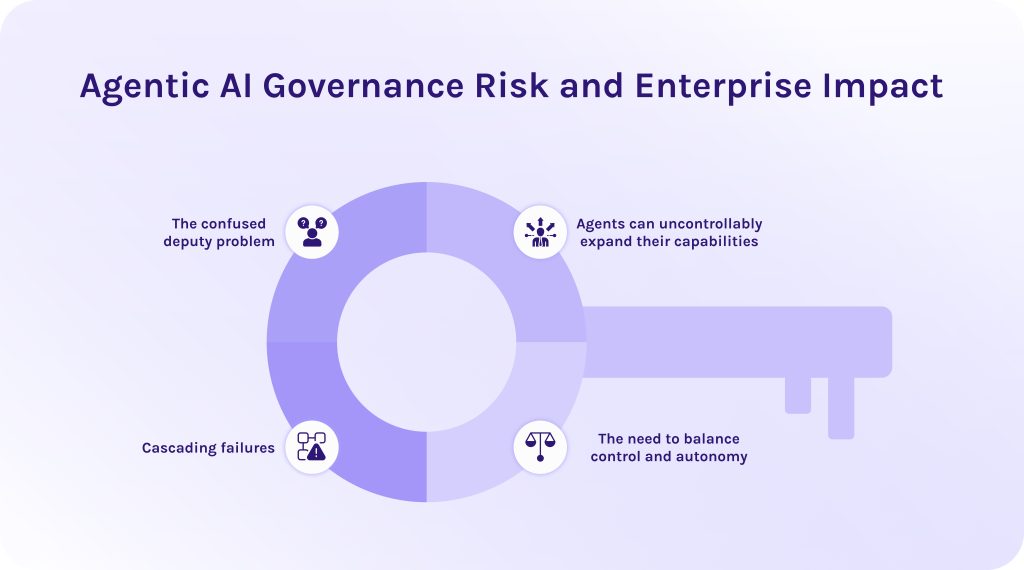
Everything comes with a price, doesn’t it? As agentic AI is a relatively new technology that is far more complicated than simple AI chatbots, it brings completely new challenges. The agentic AI governance challenges are the following:
- The confused deputy problem. This agentic AI risk occurs when a low-privileged user (or an external attacker) tricks a high-privileged agent into performing an action on their behalf. For example, a customer might send a support ticket that “tricks” an agent into using its internal database access to delete a record or leak another user’s private data.
- Cascading failures. In a multi-agent system, agentic AI risks are often connected to a chain reaction. A single hallucination can trigger a domino effect, and if one AI agent provides a wrong fact, another agent might use that fact to authorize this incorrect data, causing an error that escalates through your systems.
- Agents can uncontrollably expand their capabilities. Another agentic AI risk is that, without proper identity management, agents can start silently connecting to new tools, create their own sub-agents, or inherit permissions they no longer need.
- The need to balance control and autonomy. The ultimate AI risk management dilemma is that you use agentic systems to gain all the benefits of their autonomy, but they still need human oversight to work properly. When a human-in-the-loop just checks for hallucinations or approves important decisions, it’s fine. The problem occurs if you require a human to approve every single micro-action, because, on the one hand, you constantly lose the efficiency of the agent, but on the other, if you give the agent full autonomy, your AI systems gain uncontrollable power.
Read More: Top 10 AI Software Development Companies (2026 Guide)
Final Thoughts
Over the past few years, agentic AI has made an industry revolution, completely shifting our perception of AI systems. For years, we perceived AI as a tool for data analysis, and it worked really well. However, today, AI has evolved from a data analyst to an autonomous digital worker capable of taking actions and making decisions on its own.
But with this autonomy, we face a lot of risks connected to data protection and changes in our understanding of AI limits. Now, companies need to implement strict agentic AI governance frameworks to set rules of how autonomous systems must behave and where their permissions end and human accountability begins.
Contact our experts to develop your own agentic AI governance framework today.
FAQs
1. What is agentic AI governance?
Agentic AI governance is a set of rules that aims to regulate the behavior of agentic systems. As this software becomes more and more independent in terms of decision-making, it’s important to control what it’s allowed to do and what permissions it has.
2. How does agentic AI governance differ from traditional AI governance?
- Traditional AI governance focuses on managing the static outputs and ethical safety of models that primarily provide information. The main goal here is to ensure that the outputs are accurate and compliant with data protection laws.
- Agentic AI governance aims to regulate the autonomous actions of systems that are capable of modifying data and require real-time control.
3. Why can’t we use our existing LLM policies for AI agents?
Existing LLM policies are designed to regulate the accuracy of the output, but not the process of execution. It makes them extremely unequipped to manage the operational risks that arise when a model starts taking autonomous actions.
4. How many companies are currently experimenting with agentic AI?
According to the McKinsey “The state of AI in 2025” research, approximately 62% of responders said that their organizations are experimenting with AI agents [1].
5. How to scale agentic AI governance across teams?
To scale agentic AI governance across teams, you need to ensure that every agent has a unique set of hard-coded permission boundaries. Implement “Policy-as-Code”, using automated guardrails, and, ultimately, deploy specialized AI whose only work will be watching other agents.
6. What are agentic AI governance best practices?
Best practices for agentic AI governance are often described as the following ones:
- Clearly establish permissions and data that AI can work with.
- Always include a human in the loop to control irreversible actions or high-risk decisions.
- Implement just-in-time permissions to limit the AI system’s access to workflow execution.
- Identify boundaries of where agents can gain more freedom and where ther capabilities will be limited.
7. Should AI agents be run in isolated environments like sandboxes?
Absolutely. Running AI agents in isolated sandboxes is essential to prevent autonomous errors or prompt-injection attacks from accessing the broader corporate network. This ensures that any code execution or data processing occurs within a restricted, throwaway container that is destroyed once the task is complete.
8. What are the primary risks of deploying autonomous agents in an enterprise?
- The confused deputy problem. This AI risk occurs when a low-privileged user tricks a high-privileged agent into performing an action on their behalf.
- Cascading failures. One of the greatest agentic AI risks is that a single hallucination can trigger a domino effect, and if one AI agent provides a wrong fact, another agent might use that fact to authorize incorrect data.
- Agents can uncontrollably expand their capabilities. Another AI risk is that, without proper identity management, agents can start silently connecting to new tools, create their own sub-agents, or inherit permissions they no longer need.
- The need to balance control and autonomy. You use agentic systems to gain all the benefits of their autonomy, but they still need human oversight to work properly.
9. What are the benefits of an agentic AI governance framework?
- You still remain a decision-maker even in highly autonomous systems. You can automate tasks and delegate a part of your responsibilities to AI, but the final decisions are still yours.
- It allows you to scale securely. It provides the safety guardrails necessary to deploy thousands of autonomous agents across production environments with confidence.
- It provides safety permissions, limiting the access of AI agents to project parts they don’t need.
10. Is agentic AI governance required for compliance with the EU AI Act?
Yes. While the EU AI Act doesn’t use the specific term “agentic AI,” it is arguably the most demanding piece of legislation for autonomous systems. If your agents operate in high-stakes areas (like hiring, finance, or infrastructure), agentic governance is not optional [2].
References
- https://www.mckinsey.com/capabilities/quantumblack/our-insights/the-state-of-ai
- https://artificialintelligenceact.eu/the-act/
- https://www.pewresearch.org/science/2025/09/17/how-americans-view-ai-and-its-impact-on-people-and-society/
- https://arxiv.org/pdf/2504.06016
- https://www.researchgate.net/publication/404791990_Agentic_AI_Systems_Architectures_Autonomy_and_Emergent_Behaviours
- https://www.researchgate.net/publication/404248714_AI_Identity_Standards_Gaps_and_Research_Directions_for_AI_Agents
- https://www.researchgate.net/publication/395967098_Governing_Agentic_AI_A_Strategic_Framework_for_Autonomous_Systems
- https://www.researchgate.net/publication/395708346_AI-Driven_Zero_Trust_Architecture_A_Scalable_Framework_for_Threat_Detection_and_Adaptive_Access_Control
- https://www.researchgate.net/publication/404571878_Just-In-Time_Permission_Framework_for_Secure_Autonomous_AI_Agent_Operations_in_Data_Pipeline_Environments