
What is capacity planning?
Before we proceed to capacity planning strategies themselves, we need to define what capacity planning is.
Capacity planning is the process of balancing available resources (it can be people, machinery, technology, equipment, money, space) against demand (for instance, customer orders, projects, data volumes). The goal of effective capacity planning is to minimize inefficiencies and utilize resources in a way that will increase outcomes, thereby avoiding both burnout and waste.
Read More: Product Portfolio Management Tools: Complete Guide to Choosing the Best Solution in 2026
What is the difference between capacity planning and resource planning?
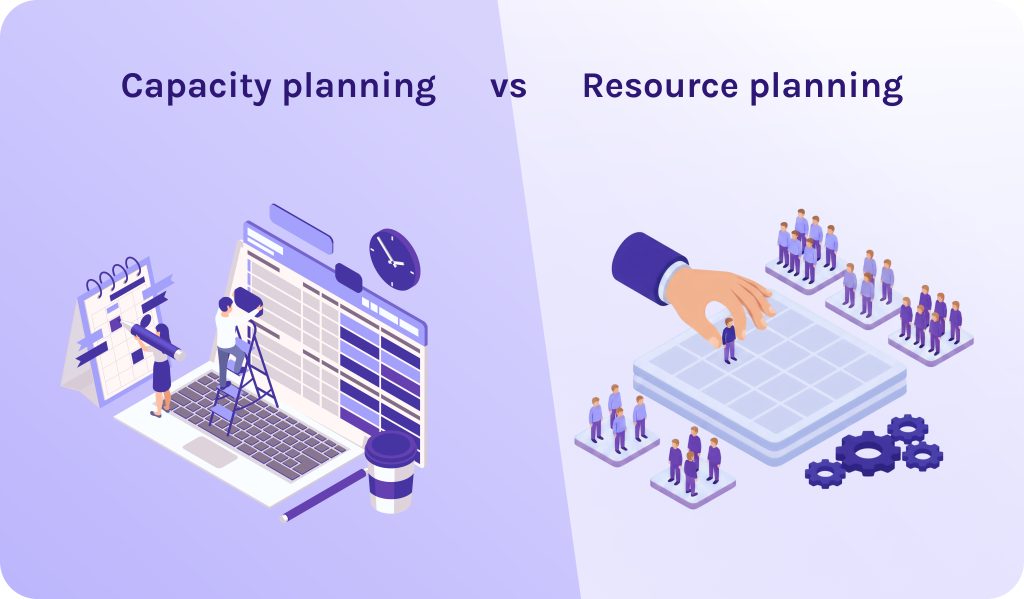
Quite often, people mistake capacity and resource planning, as they are the two sides of the same coin.
- Capacity planning is the estimation of the total volume of work a system or team can handle over a long period.
- Resource planning is identifying available resources and their allocation to specific tasks.
What is the difference between capacity planning and capacity management?
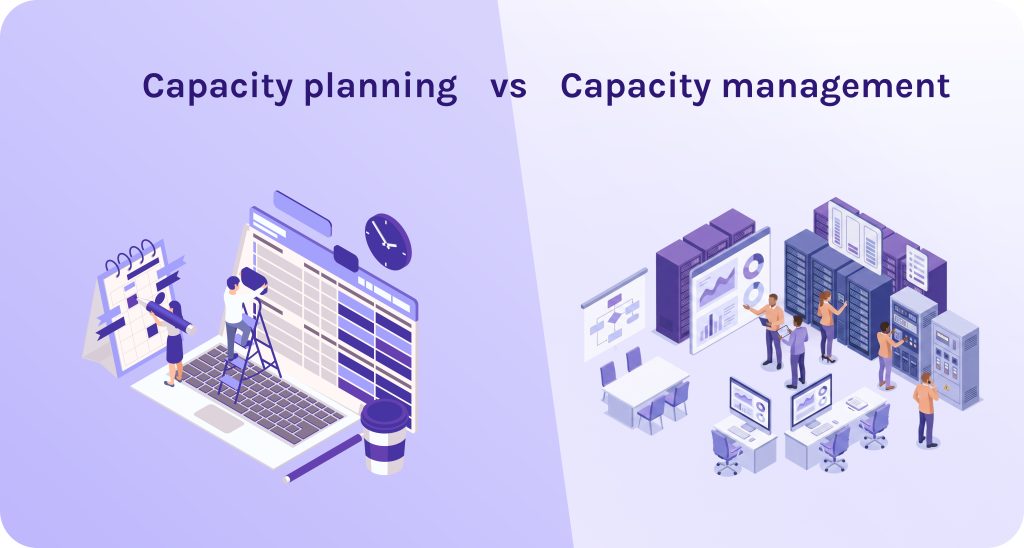
The difference between capacity planning and capacity management lies mainly in the time horizon and the focus of the objectives.
- Capacity planning process is about the future. It looks at historical trends and market forecasts to prepare for what’s coming. The main goal here is to identify possible bottlenecks before they occur in reality.
- Capacity management is about the present and optimizing what you already have. Here, you monitor current performance to ensure that resource utilization is efficient and existing resources are running efficiently.
Read More: Best Critical Path Software and Modern CPM Tools for Project Management
What are the types of capacity planning?
One more important moment to mention is what types of capacity planning exist.
- Strategic capacity planning. Strategic capacity planning focuses on long-term goals and massive resource shifts, such as building new facilities or entering new markets over the next three to five years.
- Tactical capacity planning. This strategy helps to align resource allocation with mid-term project demands, typically on a quarterly or bi-annual basis [2].
- Operational capacity planning. Handles the day-to-day or weekly scheduling of tasks to ensure that immediate deadlines are met without overextending the current team [3].
- Workforce capacity planning. Specifically evaluates the availability, skill sets, and billable hours of employees to ensure the right human capital is assigned to the right projects [4].
- Product capacity planning. Determines the maximum volume of goods or services a company can produce based on its current manufacturing limits and inventory constraints.
- Tool capacity planning. Monitors the performance and limits of physical machinery or digital infrastructure, such as software licenses and server bandwidth, to prevent technical bottlenecks [5].
Read More: 10 AI Project Management Tools to Pay Your Attention to in 2026
What are capacity planning strategies?
Capacity planning strategies, if we are talking about project management, are proven methodologies of identifying when and how to scale organizational resources to align with fluctuating customer demand.
Leadership needs these capacity planning strategies to decide whether to invest in growth early or wait for the exact market need and scale later. Therefore, it helps to avoid the financial risks of over-capacity and reputational damage, and avoid losing revenue associated with under-capacity.
There are three different types of capacity planning strategies in project management that you need to consider while choosing the one that fits you the best. Let’s take a closer look at them.
Read More: Tired of MS Project? 16 Streamlined MS Project Alternatives for Modern Teams
Lead Strategy
The lead strategy is an approach in which you increase capacity in anticipation of an increase in demand. In other words, you can increase your capacity in advance if you know for sure that a significant growth in the workload is around the corner, for example, a seasonal selling peak on Christmas or a new product launch [6].
Advantages
- It has high customer satisfaction rates. Thanks to its proactive nature, you can satisfy every customer immediately and prevent them from turning to competitors.
- It has high service levels. It minimizes delays and ensures a high quality of service or product delivery.
- Gives you a significant competitive advantage. If you are prepared, it allows you to stay stable and dominate the market even during sudden surges.
Disadvantages
- It has higher financial risks. If you decide to use this strategy and the forecasted demand fails to materialize, you’re left with expensive, idle resources.
- It has high overhead. You incur the costs of hiring, training, equipment, technology long before you see the ROI.
Lag Strategy
The lag method is the next capacity planning strategy that is more reactive than proactive. In this case, you add capacity only once your current resources are stretched to their absolute minimum and demand has clearly exceeded supply [6].
Advantages
- It is extremely cost-efficient. You don’t need to worry about overspending because you only spend money on resources that you’re 100% certain you need.
- It keeps high resource utilization rates. Your existing resources are always working at maximum efficiency, thereby minimizing waste.
- It keeps your finances stable and spending predictable. Ultimately, it minimizes the risk of over-investing.
Disadvantages
- It leads to customer dissatisfaction. Long wait times due to its reactive nature lead to potential client loss to faster competitors.
- It leads to faster employee burnout. When your employees are constantly working at 100% capacity, it puts immense pressure and stress on them, consequently leading to turnover.
Match Strategy
The match strategy is rather incremental and allows you to adapt on the fly. This capacity planning strategy attempts to adjust capacity in small steps to follow the actual demand as closely as possible [6].
Advantages
- It keeps you competitive longer than other strategies. This strategy allows organizations to adjust quickly to changing demand based on real-time data.
- It is far more secure in terms of financial planning and investment. It significantly reduces the risk of over-capacity, thereby attempting to meet customer demand.
- It optimizes ROI. Companies don’t make huge, one-time investments. Capital is deployed gradually as the business grows.
Disadvantages
- It requires high effort in terms of management. It needs constant monitoring and frequent adjustments. Usually, for this purpose, companies use sophisticated resource management software.
- Optimization here is complex. It can be difficult to scale in small increments if the necessary resources (like specialized talent) are available only as a whole.
When to use these strategies?
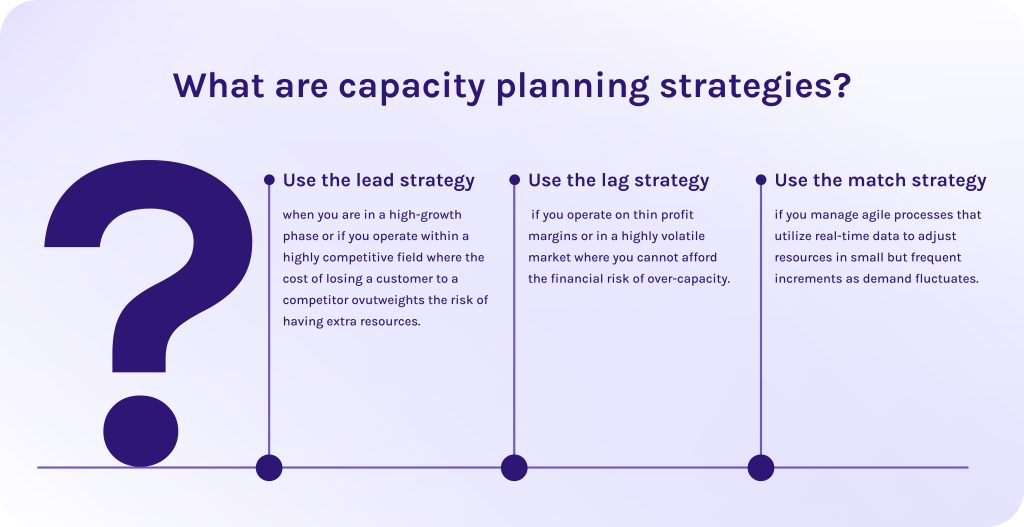
- Use the lead strategy when you are in a high-growth phase or if you operate within a highly competitive field where the cost of losing a customer to a competitor outweights the risk of having extra resources.
- Use the lag strategy if you operate on thin profit margins or in a highly volatile market where you cannot afford the financial risk of over-capacity.
- Use the match strategy if you manage agile processes that utilize real-time data to adjust resources in small but frequent increments as demand fluctuates.
What is the role of capacity planning and forecasting software?
Nowadays, project managers don’t need to manually track resource management and calculate capacity to estimate possible bottlenecks. Modern project management software incorporates features for advanced resource allocation, allowing users to shift their focus from just simple data entry to diving deeper into business strategy. These platforms leverage real-time data integration, which makes them automatically surface resource conflicts and utilization gaps that would be nearly invisible in a static spreadsheet [7].
If you search for resource management software like that, our specialists already know how to help you. With years of experience in developing sophisticated PM solutions, we know how to deliver measurable outcomes even in the most complex conditions. Epicflow, developed by HYS Enterprise IT specialists, is a multi-project management software for capacity planning and forecasting that utilizes AI-driven predictive analytics to balance workloads across complex project landscapes.
Book a consultation with our experts today to discover how exactly capacity planning solutions can change your workflows.
Read More: What is Program Management? A Deep Dive into Strategic Success and Program Leadership
Quick summary
In conclusion, I can say that capacity planning is as necessary as breathing. Without it, your processes will quickly become inefficient, and your team will likely suffer from chronic overextension. In this case, capacity management strategies become a helping hand that allows you to regain control and optimize resource allocation even as project complexity grows.
Let’s quickly recap when to use each strategy:
- Lead strategy. It’s the best choice for companies that operate within extremely competitive environments where losing a customer will cost an arm and a leg.
- Lag strategy. A proper solution for companies that can’t afford the risk of hiring extra resources.
- Match strategy. This strategy is a bridge between the ones above. If you need a very flexible solution, decomposed into small, iterative steps to adjust to fluctuating demand, choose the match strategy.
HYS Enterprise experts know the ropes of implementing the right capacity management strategy as well as incorporating proper software to boost your efficiency to the next level. Contact us today to learn more about opportunities for your business.
FAQs
1. What is an example of a capacity strategy?
As an example of a capacity planning strategy, imagine a SaaS company that prepares for a new product launch using a lead strategy. First thing they do is scale the server infrastructure and hire additional customer support staff months in advance to handle the increased number of users without any downtimes.
2. What are the capacity planning strategies?
In simple terms, capacity planning strategies are methodologies for identifying when it’s better for you to scale the available resources. It usually depends on the industry in which you’re working, market demand, and your organization’s specific risk tolerance.
3. How do you measure capacity planning success?
To measure the success of your capacity planning, you need to think about your ability to optimize resource allocation. It’s a mandatory requirement because it ensures that every team member is working at their highest potential without crossing the border of burnout.
4. What are the different types of capacity planning?
The types of capacity planning are usually described as the following ones:
5. When should I use a lead strategy?
It’s better to use the lead strategy when you’re a quickly growing company or you’re operating within a highly competitive market where the cost of losing customers is higher than the risk of having idle resources.
6. When should I use a lag strategy?
This strategy is rather conservative and allows expanding the capacity only when your current resources have already been used up. Use it if you operate within an environment where you cannot afford the financial consequences of over-capacity.
7. When should I use a match strategy?
Use the match strategy if you need to scale quickly and deal with real-time data while adjusting to changing demand. It allows companies to avoid employee burnout, thereby remaining flexible and competitive in a shifting marketplace.
8. Is capacity planning the same as resource planning?
No, they are distinct but complementary processes.
9. What are the benefits of capacity planning?
The primary advantage of effective capacity planning is the ability to optimize resource allocation across your entire portfolio of projects. The other benefits include:
10. What is the “80/20 rule” in capacity planning?
This rule is also called the “Pareto principle”. It says that 80% of bottlenecks and issues in companies come from 20% of causes. In the concept of effective capacity planning, this means that most of your project delays are usually triggered by a small handful of overloaded resources or critical skill gaps.
References
- https://www.pmi.org/about/press-media/2026/pulse-why-complex-projects-fail-best-practices-are-not-enough-system-thinking
- https://www.researchgate.net/publication/239393443_Tactical_capacity_management_under_capacity_flexibility
- https://www.researchgate.net/publication/392910273_OPERATIONAL_CAPACITY_PLANNING_AND_EFFECTIVENESS_OF_MORTGAGE_BANKS_IN_RIVERS_STATE_NIGERIA
- https://www.researchgate.net/publication/357421807_Workforce_capacity_planning_with_hierarchical_skills_long-term_training_and_random_resignations
- https://www.researchgate.net/publication/220471541_Tool_capacity_planning_in_semiconductor_manufacturing
- https://www.scribd.com/document/85234552/04-Capacity-Planning
- https://www.researchgate.net/publication/3426592_Capacity_planning_An_essential_tool_for_managing_Web_services