
What Is Cloud Computing in Telecom?
To begin with, let’s discuss what cloud computing in telecom actually means.
Cloud computing in telecom is a technology that helps untie telecom operations from the physical hardware and transform them into highly flexible, virtualized software services. It allows telecom operators to rely less on proprietary “black boxes” from single vendors and use cloud technology to treat their entire network as a programmable, elastic resource.
This shift allows a service provider to manage its core operations, such as voice switching and data routing, as cloud-native network functions (CNFs) that can be updated or scaled instantly, much like a smartphone app.
Cloud service models
There are 3 types of cloud service models, described below:
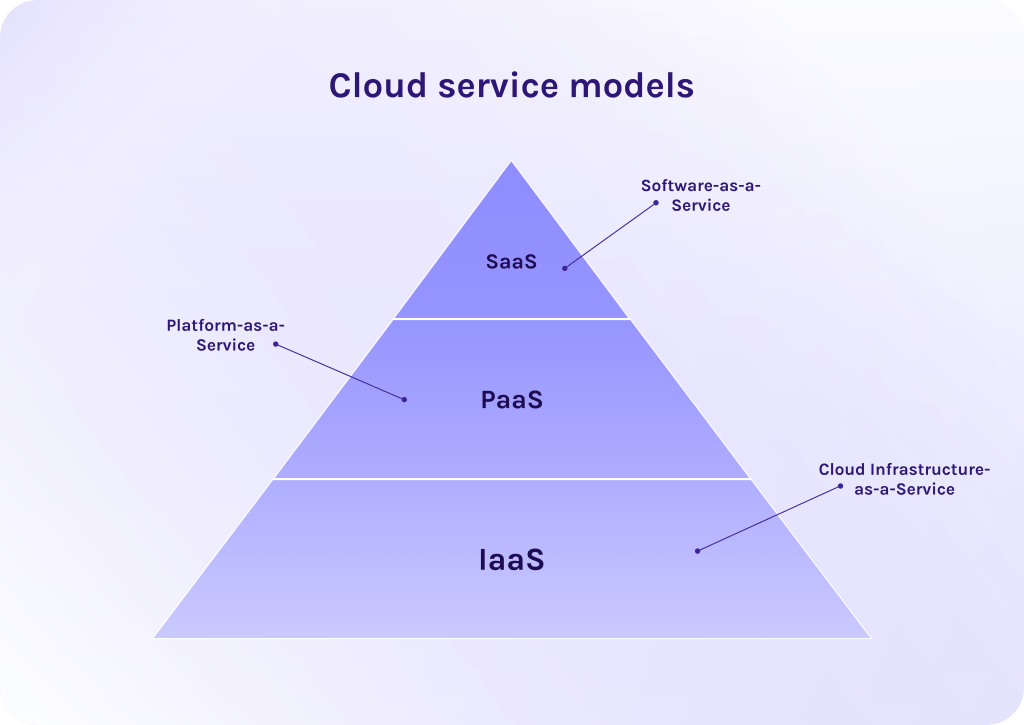
- Cloud Infrastructure-as-a-Service (IaaS): In this model, other operators that don’t own the infrastructure can rent an already existing one from the market leaders like Azure or Amazon. It allows smaller or virtual operators to avoid buying physical hardware.
- Platform-as-a-Service (PaaS): In turn, this model provides not only infrastructure but also operating systems. It means that operators can rent infrastructure and software platforms at the same time without the burden of configuring server environments from scratch.
- Software-as-a-Service (SaaS): In this model, the vendor provides its own software on a subscription basis, so that you can purchase subscription, install software and use it when and how you want.
Now we know more about cloud computing in telecom operations. But what about the role of cloud computing in telecom industry?
Read More: Cloud Computing or Edge Computing: Which One to Choose?
Benefits of Telco Cloud Computing
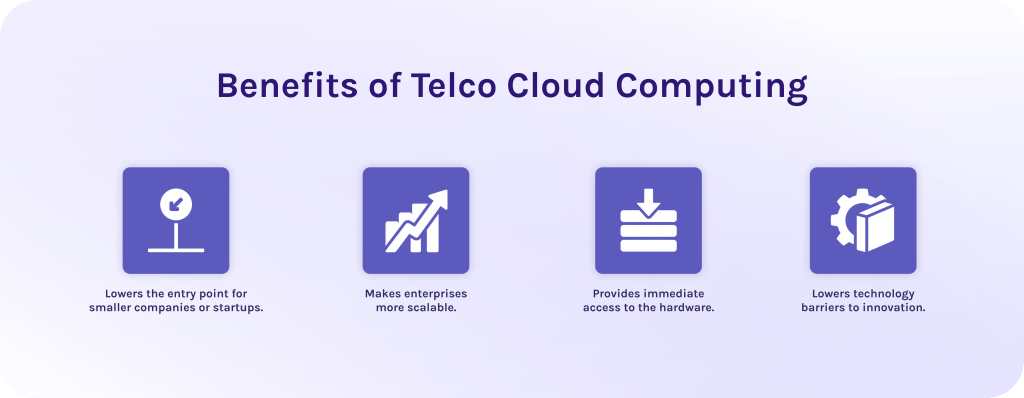
Cloud computing in general brings many advantages that make this technology extremely popular and almost inevitable. If we dive into this topic deeper, we’ll see that the benefits are not limited to cost reduction or increased productivity. According to the research study “Advantages and Challenges of Adopting Cloud Computing from an Enterprise Perspective” [1], advantages are the following ones:
1. It significantly lowers the entry point for smaller companies or startups.
When we are talking about the telecom industry, traditional infrastructure has historically required extremely high capital expenditures (CAPEX). However, now, companies that don’t own huge infrastructure, like Mobile Virtual Network Operators (MVNOs) or digital service providers can use cloud computing to deliver their services to the end users. They can leverage virtualized infrastructure instead of investing in costly physical equipment which significantly reduces upfront investments.
2. Makes enterprises more scalable.
Imagine that your app went viral overnight. Consequently, server loads have significantly increased as well. In this case, the cloud automatically connects to more virtual servers to handle the load, making enterprises more stable and reliable.
3. Provides immediate access to the hardware.
Instead of waiting for a hardware delivery and an electrician to install it, developers can create a powerful server via a web console in about 30 to 60 seconds. It leads to faster time-to-market delivery. As well, cloud telecoms can test a new idea on 100 servers in parallel, and if it doesn’t work, they simply delete them and stop the bill.
4. Lowers technology barriers to innovation.
Most cloud providers offer pre-trained AI models that companies can plug into their products. It makes digital transformation of rigid networks much easier and accelerates your growth and competitiveness.
Let’s now proceed to the next part of our discussion – what cloud deployment models exist?
Read More: A Journey Through the Cloud Maze: Comparing Azure, AWS, and GCP
Cloud Deployment Models for the Telecom Industry
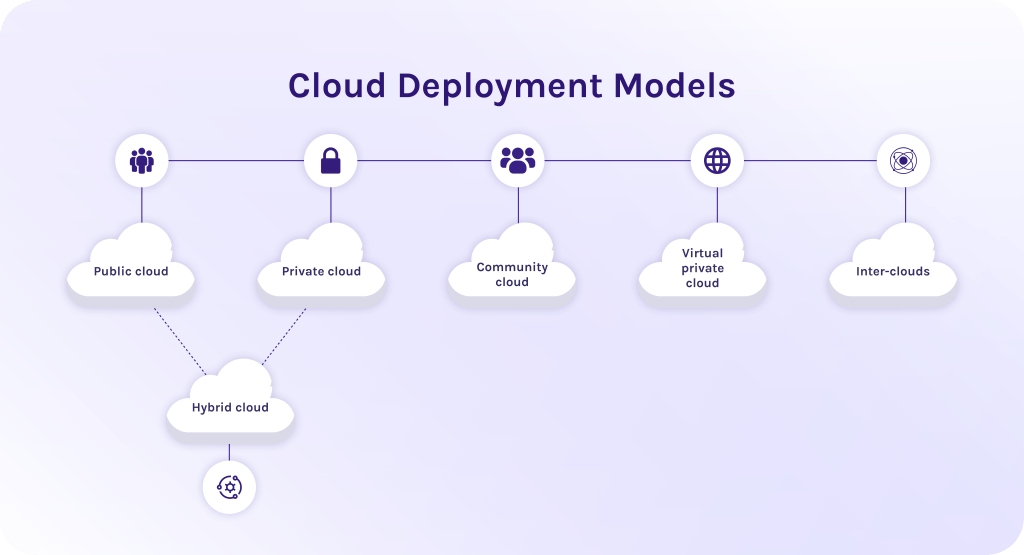
As was said in the article “Cloud Computing Deployment Models: A Comparative Study” [2], there are 6 types of cloud deployment models:
- Public cloud. Here operators host non-critical applications (like customer service portals, marketing websites, or HR systems) on shared infrastructure provided by giants like AWS, Google Cloud, or Azure. Thanks to it, BSS (business support systems) like billing and CRM can be moved to the public cloud to save on maintenance costs and leverage advanced AI for customer analytics.
- Private cloud. It is a golden standard for telecom operations. The cloud infrastructure is dedicated exclusively to one operator and is usually hosted in their own secure data centers. It provides the high security and reliability required for national communication infrastructure.
- Hybrid cloud. As the name suggests, this telecom cloud type is a combination of two previous points. This model allows you to move data and apps between private and public clouds. For example, an operator might keep sensitive data in their private cloud but use the public cloud to handle massive traffic spikes during global events (like the World Cup) when their own capacity is reached.
- Community cloud. This type of cloud for telecom is often used for industry-wide fraud prevention or roaming clearinghouses. Several operators in a specific region (e.g., the EU) might share a community cloud to comply with unified data sovereignty laws while sharing threat intelligence.
- Virtual private cloud (VPC). A VPC is a private, isolated “room” carved out within a public cloud. It gives the operator the security of a private cloud with the ease of a public one. Telco engineers can spin up an isolated environment in AWS to test a new network software update without risking the actual network or buying new hardware.
- Inter-clouds. This model is also known as multi-cloud and it remains one of the most effective ones in terms of the vendor neutrality approach. It involves using multiple cloud providers (e.g., using both AWS and Azure telecom) and making them work together as a single seamless environment to avoid “vendor lock-in.” If one cloud provider has an outage, the network functions can failover to a different provider.
Navigating these complex deployment models requires deep architectural expertise and a proven track record in network transformation. Book a call with HYS Enterprise experts today to identify the ideal cloud strategy for your operations and turn your technological challenges into a sustainable competitive advantage.
Read More: IBM Cloud or Microsoft Azure: A Comparative Analysis of Two Tech Titans
Key Use Cases of Cloud Computing in Telecom
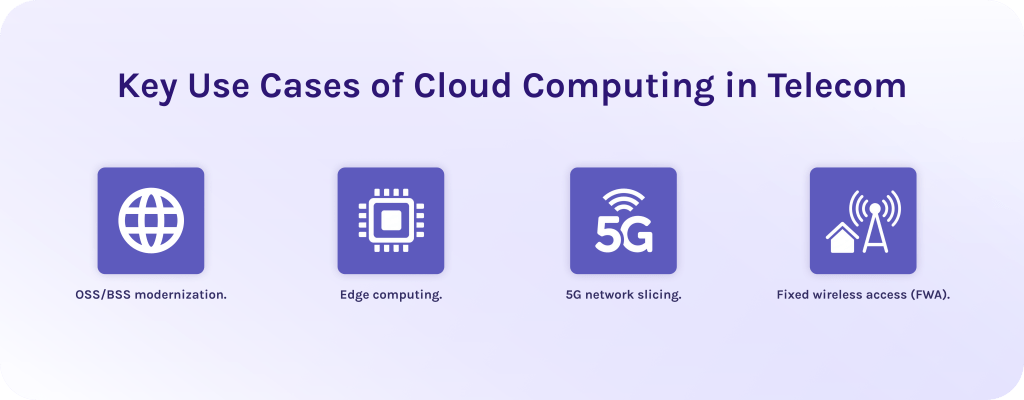
1. OSS/BSS modernization.
Cloud computing allows telcos to move their business support systems (BSS) and operational support systems (OSS) from old databases to microservices-based platforms. As an example, I can mention that a telco can launch a new roaming plan or a streaming bundle in days instead of months because the billing and provisioning systems are modular and cloud-based.
2. Edge computing.
As well, operators deploy cloud services for telecom at the “Edge” (closer to the user, like at a base station or local hub), telcos can process data locally instead of sending it to a distant data center. For instance, it can support autonomous vehicles that require quick decision-making or remote surgery, where a millisecond of lag can cost you more than just financial losses.
3. 5G network slicing.
Operators can use cloud computing for telecom industry to “slice” a single physical 5G network into multiple virtual networks, each with its own specific speed, latency, and security settings. For example, a telco can provide a “gaming slice” with ultra-low latency for cloud gaming while simultaneously providing a “massive IoT slice” for millions of smart utility meters that don’t need much speed but require high reliability.
4. Fixed wireless access (FWA).
Thanks to cloud computing in telecom, telcos can deploy virtual RAN (vRAN) to provide high-speed home internet over 5G/6G signals, thereby replacing the need for expensive fiber-to-the-home (FTTH) in rural or underserved areas. They can also quickly expand broadband access and telecom operations to remote villages by “spinning up” virtual network functions in a centralized cloud rather than installing heavy physical equipment at every site.
Read More: AI-Driven Automation as the Foundation of Next-Gen SaaS Models
Challenges of Cloud in Telecom
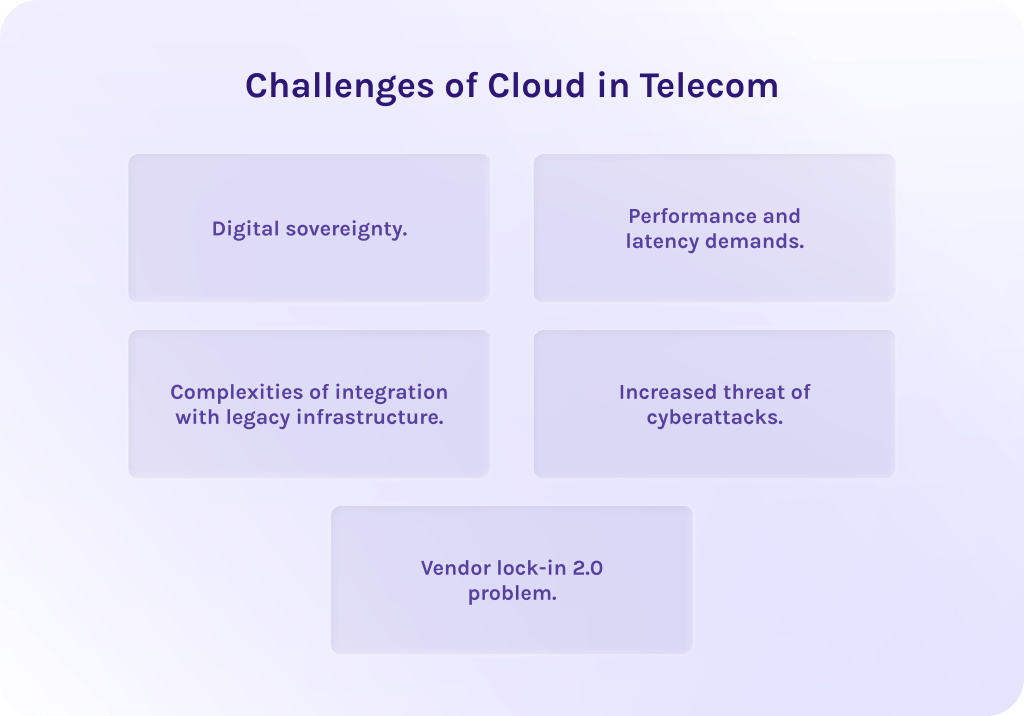
However, in spite of being extremely beneficial for every business, innovation always comes with challenges. Below we’ve analyzed what difficulties companies can face while implementing cloud computing in telecom industry:
1. Digital sovereignty.
Telcos want the massive scale and AI tools of AWS for telecom, Google, Microsoft, but governments are increasingly demanding data sovereignty [3]. The main concern here is if a telco runs its core network on a US-based cloud provider, does that country still have full control over its own communications during a geopolitical crisis?
This has led to the rise of “sovereign clouds” – locally governed infrastructures that mimic the public cloud but keep data and control strictly within national borders.
2. Performance and latency demands.
IT cloud can allow half-second delay in an email, but when it comes to cloud computing and telecommunications, operators cannot afford even millisecond latency. Telecom functions require high-level performance, meaning the network must respond exactly the same way every time. Tuning a cloud to handle real-time 5G traffic without dropping packets remains a significant engineering feat.
3. Complexities of integration with legacy infrastructure.
Some operators still think that using outdated systems in 2026 is a great idea to save money. However, usually, it ends up costing way more in the long term. Trying to make a 20-year-old physical switching system talk to a modern 5G core creates even more complexities than if you decided to build the entire system from scratch.
Moreover, most telco engineers are experts in hardware and radio frequency (RF), not Kubernetes and Python. Bridging this talent gap is a major operational hurdle.
4. Increased threat of cyberattacks.
In the past, to hack a telco, you needed physical access to a high-security building. However, now, the networks are almost completely operated by the software, and by using open-source tools and cloud APIs, telcos have opened thousands of new “digital doors” for hackers. Protecting a virtualized network that is distributed across thousands of edges is significantly harder than protecting one central data center.
You see? Decentralization, of course, has advantages, but in this particular case of telecom cloud services, it has become rather an additional problem than a solution.
5. Vendor lock-in 2.0 problem.
Previously, telecom operators struggled with the hardware market monopoly from vendors like Ericsson or Nokia. To avoid this problem, they moved to the cloud based telecommunication services, but the initial problem didn’t just disappear – it also moved to the cloud. And now, once you build your entire network automation using AWS telecom tools, moving to Microsoft Azure or your own private cloud may become nearly impossible and prohibitively expensive.
Read More: Top Telecom Project Management Challenges and How to Overcome Them
How HYS Enterprise Enables Cloud Transformation in the Telecom Industry
HYS Enterprise is a Dutch software development company whose main focus is delivering high-quality services and advanced technology solutions tailored to complex business environments. For us, client requirements and perspective are top-priority factors during any partnership.
We believe that successful digital transformation begins with a deep understanding of our clients’ business goals and operational challenges. That is why we prioritize transparent communication throughout every stage of a project to ensure timely service or product delivery.
1. We are proficient in OSS/BSS modernization.
Our team of dedicated specialists has 10+ years of experience working in such complex industries as telecommunications. We help telcos overhaul their OSS and BSS systems, migrating them from monolithic on-premise databases to cloud-based microservices.
2. We help telcos with cloud migration.
We provide specialized consulting for Azure-based telecom solutions. We don’t just improve old software; we re-architect it entirely for the cloud.
3. We enable continuous software maintenance.
Once you have become our partner, you can be sure that our collaboration doesn’t end after deployment. We provide continuous software support to ensure stable work and solve issues quickly if one occurs. Thus, you don’t need to worry about service disruptions or delays – our professionals are always on guard of your services.
Thus, if you’re struggling to find your reliable telecom software provider – contact our experts. We’ll turn your technological challenges into competitive advantages.
You can read more about our telecom success stories here.
Read More: FiLogic: An All-in-One Cloud-Based Transportation Management System
Future of Cloud Telecommunications
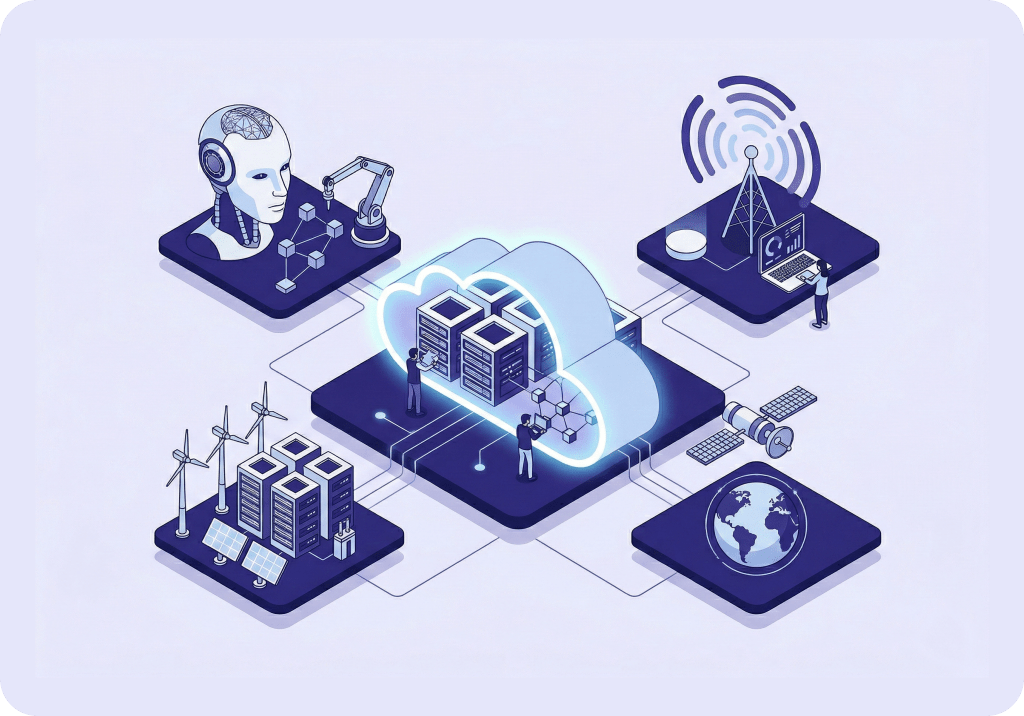
As we’ve already entered 2026, let’s take a quick look at where cloud telecoms will move in the near future.
1. Agentic AI autonomous networks.
In 2026, networks are shifting from being “human-managed” to AI-native, acting with almost full autonomy. AI agents now monitor network health in real-time, thereby predicting hardware failures or traffic congestion before they happen and rerouting data automatically. This is expected to reduce operational costs by up to 25%.
2. Moving forward to 6G.
While 5G was “cloud-friendly,” 6G (slated for 2030 but being built now) is being designed as cloud-native from day one. 6G will use the cloud to process “network sensing” data – essentially using radio waves like radar to detect the movement of people and objects, enabling high-precision gesture control and safer autonomous driving. The goal is to bring the “processing cloud” so close to the user (at the extreme edge) that lag becomes physically imperceptible.
3. Non-terrestrial networks.
In the near future, telecom operations will move beyond on-ground stations and cell towers. Non-terrestrial networks (NTNs) are integrating satellites directly into the cloud stack. Your phone will switch between a 5G tower and a low-earth-orbit (LEO) satellite (like Starlink) seamlessly. The cloud manages this “handover,” ensuring you have high-speed data even in the middle of the ocean or a desert. As well, we are seeing the first “data centers in space,” where initial data processing happens on the satellite itself.
4. Sustainable green clouds.
Although AI brings lots of advantages, it consumes a lot of energy as well. The energy demands of AI have made “green telco” a top priority. The future role of cloud computing in telecom industry will move workloads to data centers where renewable energy (solar/wind) is currently peaking. If it’s sunny in Spain but cloudy in Germany, the cloud can shift non-critical processing to Spanish servers.
Read More: Adopting Cloud Computing: Discovering the Top Programming Languages for Microsoft Azure
Conclusion
Let’s briefly remember the main points of the article:
- Cloud computing in telecom refers to the technologies that allow operators to switch their services from old infrastructure to modern software, far less susceptible to network failures or disruptions.
- By leveraging IaaS, PaaS, and SaaS models, telecom operators can achieve rapid time-to-market, instant scaling for traffic spikes, and significant reductions in both capital and operational expenditures.
- Cloud computing in telecom industry is so popular because it not only reduces operational costs (OPEX, CAPEX), but as well helps smaller companies become more competitive, makes enterprises more scalable, provides immediate access to the hardware, lowers technology barriers to innovation.
- Telecom companies often use cloud computing to modernize their OSS/BSS systems, to immediately gather data from edges, and enable virtual RAN.
Stop letting legacy infrastructure hold your business back and start leveraging the full power of the cloud. Contact HYS Enterprise experts today to bridge the gap between your current operations and a future-ready, cloud-native network.
FAQs
1. What is cloud computing in telecom?
Cloud computing in telecom is the architectural shift from using expensive, proprietary hardware to using software-defined functions running on standard cloud servers. Instead of a physical router or switch sitting in a central office, the “brains” of the network exist as code in a data center.
2. What is the main advantage of cloud computing in telecom industry?
The main advantage of cloud computing in telecom industry is agility – specifically the ability to transform a rigid network into a flexible platform to scale quickly adapting to the demand.
3. How do telecom cloud services support 5G networks?
While 5G provides the high-speed wireless “pipes,” telecom cloud services provide the “brain” that makes those pipes smart and capable of handling specialized tasks. It enables cloud-native core and multi-access edge computing, and self-healing networks capable of detecting failures and fixing them on their own.
4. What are the 4 types of cloud computing?
The four types of cloud computing in telecom are typically considered as the following ones:
- Public cloud – startups, SaaS, and general business apps. Shared infrastructure owned by providers like AWS, Azure, or Google. You pay only for what you use.
- Private cloud – government, banks, and highly regulated firms. Dedicated infrastructure used exclusively by one organization. It offers maximum control and security.
- Hybrid cloud – large enterprises in transition. A blend of public and private. You keep sensitive data on a private server while using the public cloud for high-volume tasks.
- Community cloud – healthcare networks, universities, or research groups. Shared by a specific group with common goals.
5. Why cloud computing is the future?
The main reason why cloud computing is the future is that it provides the only environment capable of supporting the so-called “triple crown” of modern technology: generative AI, quantum computing, and autonomous systems. Without the cloud, these technologies simply cannot function at scale.
6. What are the challenges of cloud in telecom?
In 2026, the main challenges of cloud telecoms can be described as the following ones:
- Balancing the cost-efficiency of global hyperscalers with the security requirements of local governments.
- Telcos are struggling to move up the “value chain” to become digital experience enablers rather than just bandwidth utilities.
- AI is now fighting AI. Telcos must use machine-to-machine security to detect anomalies in milliseconds, as human response is too slow.
- Most global telcos have pledged to be 100% renewable by 2030, but the massive GPU clusters required for AI-native networks are driving energy consumption to record highs.
- As the industry has shifted toward Open RAN (Radio Access Network), now making software from five different vendors talk to each other on a generic cloud server is incredibly complex.
7. What is the difference between telco cloud and IT cloud?
- The IT cloud is designed primarily to support business applications. It focuses on scalability and flexibility, prioritizing the ability to handle varying user loads across a centralized data center environment.
- The telco cloud is a specialized environment designed to run network functions (VNFs/CNFs) that power communication services like 5G and voice calls. Thus, it demands extreme reliability and ultra-low latency.
8. What is computing in cloud computing?
In the context of cloud computing, “computing” refers to the raw processing power required to run applications, process data, and execute commands. If you think of the cloud as a giant virtual factory, the “storage” is the warehouse where goods are kept, and the “computing” is the machinery that actually does the work. It is the engine that transforms input data into output results.
9. What is cloud RAN in telecom?
In traditional mobile networks, the “brains” of a cell tower are located right at the base of the mast in a physical cabinet. Cloud RAN (radio access network), also known as vRAN (virtualized RAN), changes this by decoupling the network software from the underlying hardware.
10. What is AWS in telecom?
In the telecom industry, AWS (Amazon web services) is a dominant cloud provider that helps communications service providers (CSPs) transition from expensive hardware to flexible networks. Essentially, AWS offers specialized infrastructure that meets the high-performance demands of telecommunications.
References:
- https://www.researchgate.net/publication/275539197_Advantages_and_Challenges_of_Adopting_Cloud_Computing_from_an_Enterprise_Perspective
- https://www.researchgate.net/publication/350721171_Cloud_Computing_Deployment_Models_A_Comparative_Study
- https://www.researchgate.net/publication/348703352_Data_sovereignty_A_review
- https://www.researchgate.net/publication/378941441_Benefits_and_Challenges_of_the_Adoption_of_Cloud_Computing_in_Telecommunications_Companies_in_Saudi_Arabia
- https://www.oecd.org/content/dam/oecd/en/publications/reports/2025/05/competition-in-the-provision-of-cloud-computing-services_f42582ad/595859c5-en.pdf