
Key Takeaways:
- Logistics management software is an IT solution whose main goal is to help companies improve their logistics operations by providing corresponding features [6].
- These digital platforms improve visibility of logistics processes, help organizations proactively mitigate risks, reduce operational costs, have a huge positive impact on customer satisfaction, and last but not least make logistics planning more accurate and reliable.
- To choose from the variety of tools the one that will fit your organization, you should, first of all, evaluate your needs and inefficiencies. Then, search for tools with features that will cover these pain points. Then, evaluate required integrations, and, ultimately, request for the demo version to test the tool.
What is logistics management software?
Logistics management system is a digital platform whose main goal is to improve the efficiency of the logistics operations and reduce the cost of logistics operations [2]. Furthermore, thanks to it, companies can optimize allocation of their resources, reprioritize initiatives, and optimize the movement and storage of goods.
The system covers many aspects, for instance:
- Logistics planning,
- Inventory management,
- Transportation management,
- Distribution management, and so on.
Transport and logistics management software collect data about various processes and turn it into clear reports; thus, managers can get actionable insights about improvements and make their logistics more stable and resilient.
Read More: Supply Chain Management and Logistics: Key Differences, Roles, and Why They Matter
What are the types of logistics management software?
While writing this article, I’ve discovered multiple variations and classifications of logistics management software solutions. Each of these types serves different purposes and helps organizations address distinct business challenges.
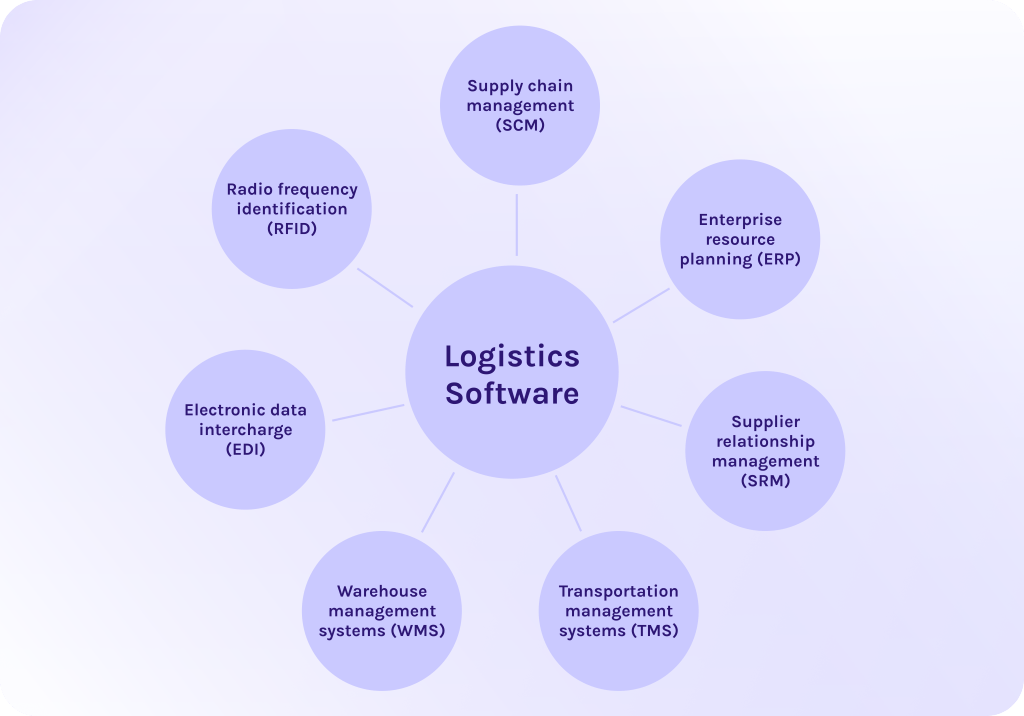
So, according to the study “Logistics Software from a Logistics Management and Management Information Systems (MIS) Perspective” [3] the author highlights the following types of logistics management services:
- Supply chain management (SCM): it is basically about moving products smoothly – getting goods to the right places, at the right time, without shortages or expenses.
- Enterprise resource planning (ERP): focuses the most on the enterprise integration but especially valuable for third-party logistics (3PL).
- Supplier relationship management (SRM): the primary goal of this software is to manage suppliers and vendors to forecast future demand and reduce operational costs.
- Transportation management systems (TMS): here the platform focuses on managing shipping processes. It includes calculation of transportation costs, choosing transportation methods (land, water, or air), and other metrics that ensure timely product delivery in the most efficient possible way.
- Warehouse management systems (WMS): Logistics warehouse management software is about methods of managing the warehouses and their optimization. As well, we can include here inventory control, managing warehouse conditions to store products according to the safety standards, and order management from receiving to fulfillment.
- Electronic data intercharge (EDI): slightly outdated but still working method of real-time computer-to-computer data exchange between organizations in standardized format.
- Radio frequency identification (RFID): it is a technology that uses radio waves to automatically identify and track items through tags attached to them.
Read More: Logistics Trends Shaping the Transportation and Logistics Industry
Now, it’s time to take a closer look at the core features of the software for logistics.
What are the core features of logistics management software?
When you select a proper tool, it’s important to understand what functionalities matter most for your organization. During our research, we’ve analyzed and created a list of features of logistics software you need to consider before choosing.
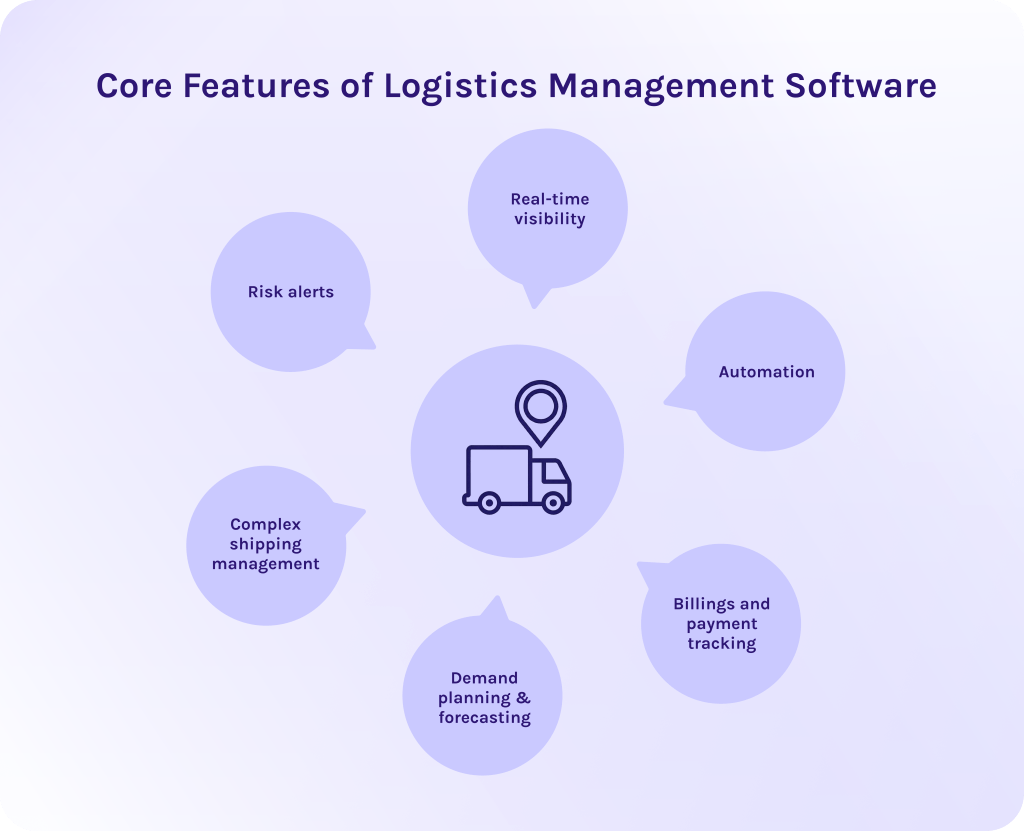
- Real-time visibility. It is the first and the most important function as it provides logistics leaders a full picture of all ongoing processes in real time. Thanks to it, logistics companies and agencies can track statuses of shipments, their location, and manage disruptions as quickly as possible.
- Automation. This feature in logistics tracking platforms helps to automate various activities that previously relied heavily on people. As a result, teams are able to reduce the number of errors related to a human factor as well as address the problem of talent shortages and skill gaps.
- Billings and payment tracking. Automation of financial operations as well reduces the level of errors and significantly increases the efficiency. Billing now doesn’t need to be managed manually, resulting in better financial accuracy and faster payment processes.
- Demand planning & forecasting. Such advanced features in shipping, logistics, and tracking management software help to overcome obstacles connected to uncertainty as well as forecast future global transportation networks market trends. Moreover, it helps to plan changes based on historical insights and current real-time data.
- Complex shipping management. Modern logistics involves managing a huge variety of vehicles, order processing, and products movement across them. Therefore, the proper tool should act like an orchestrator to connect all the pieces of this puzzle together.
- Risk alerts. The platform must have an alert system, to identify and react to risks timely and with maximum efficiency.
Read More: What Is Business Process Automation? Strategy, Tools, Benefits, and Enterprise Use Cases
What are the benefits of using logistics management software?
Once you’ve understood the most essential features of supply chain management logistics software, you should be aware of the advantages that these tools bring to your business.
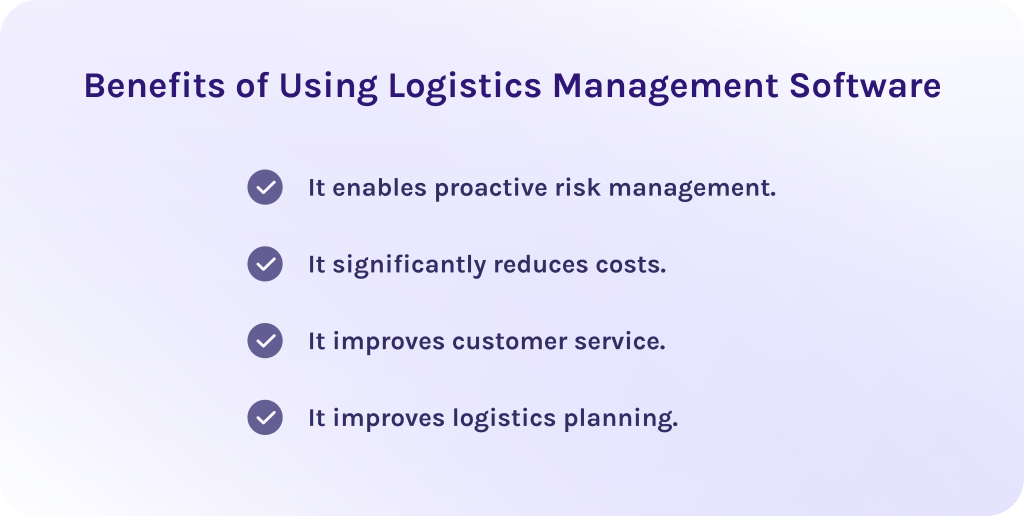
It enables proactive risk management.
With built-in risk management, the logistic management software acts like an early-warning system, thereby alerting about issues in advance. Therefore, logistics teams have enough time to address these problems and develop mitigation strategies to avoid surprising consequences [7].
It significantly reduces costs.
When risks are mitigated and operations are streamlined, organizations experience fewer delays and disruptions. Consequently, logistics leaders don’t need to invest extra costs in emergency shipments or compensations, even vice versa – they can save these costs and invest in more important activities and projects further [8][9].
It improves customer service.
The research “The Effectiveness of Logistics Services on Firms’ Performances – A Literature Review” [4] shows that if implemented well, high-quality logistics management software applications improve customer satisfaction and make people more loyal to your company and services. As a result, your organization’s market position strengthens over time and makes your reputation reliable.
It improves logistics planning.
According to the study “Impact of Automation Technology on Logistics and Supply Chain Management” [5] the right logistics management services may significantly impact logistics planning, resulting in higher delivery efficiency. Processes, in turn, run more smoothly, while risks are taken into account in advance.
Read More: AI and the Future of Modern Logistics
How EpicStaff revolutionizes traditional approach to logistics management?
Compared to traditional software for logistics management, EpicStaff is an innovative solution from Dutch software development company HYS Enterprise which offers an absolutely new approach for managing complex logistics operations. Following digitalization trends in logistics, EpicStaff is an AI agent orchestration platform designed to help streamline complex processes, like supply chain management.
However, instead of creating heavy ERP platform, EpicStaff allows organizations to create a team of digital employees, that closely communicate with each other when performing different tasks like:
- Effectively manage your inventory processes.
- Searching for ways to optimize your routes.
- Automate order processing, and more.
You can create agents for any specific task you need and delegate up to 80-90% of jobs to the virtual team. Although it may sound unbelievable, it has already been proven in practice.
In 2024, EpicStaff partnered with Dutch logistics company Move Your Machine (MYM), and together they co-developed the AI-based transportation solution. By leveraging EpicStaff’s AI agents, MYM was able to:
- Entirely automate business processes and provide their full transparency.
- Delegate almost 90% of tasks associated with orders, marketing, and finances to the AI agent team.
- Save up to 40% of delivery time.
- Efficiently deliver services with a team of two people instead of 20.
- Provide client support 24/7 because your digital workers never sleep.
Sounds like something from the sci-fi movies, right? However, fortunately, it is our present. If you want to develop your own logistics software and achieve tangible outcomes, contact our experts to learn how EpicStaff can boost your operations.
Additionally, you may want to know the other HYS Enterprise stories of success. Read the article below about our other case in logistics.
Read More: FiLogic: An All-in-One Cloud-Based Transportation Management System
What are the top traditional logistics management software?
Here are the top of the best-rated logistics management software.
Blue Yonder
The next software for logistics combines artificial intelligence (AI) and machine learning (ML) under one roof, thereby improving transportation planning and execution. Moreover, these intelligent features come in handy when predicting risks and developing their mitigation strategies for making your operations much more resilient and reliable.
Kuebix TMS
Finally, we approached Kuebix TMS which is a cloud-based logistics tracking software widely-known for its ease of use and scalability. These features make it an ideal solution on the one hand, for small and medium companies, and on the other suitable for large enterprises.
Magaya Supply Chain
The penultimate tool in this list is an all-in-one software logistics management solution which offers its users built-in accounting, freight forwarding, integrated warehouse and transportation management, and other tools that simplify workflows, increasing efficiency as a result.
SAP
It is a comprehensive platform, ideal for organizations that are already using other solutions from the SAP ecosystem. It offers end-to-end transportation features alongside scenario simulation to enable efficient, proactive risk mitigation in tight integration with SAP finance, to handle all processes in one place.
FourKites
The next software for logistics is a leading supply chain visibility and intelligence platform that uses AI-driven predictive analytics to track shipments across all modes of transportation (road, rail, ocean, and air). Moreover, It provides global enterprises with yard management tools and automated workflow exceptions to prevent disruptions.
Read More: Supply Chain Digital Transformation: Everything You Need to Know
Our methodology: How we selected logistics management software for this top
While making research for this article our team created a list of evaluation criteria to objectively review each logistics management software:
- Integration capabilities. We looked how seamlessly each tool can integrate with core ERPs, CRMs, warehouse management systems (WMS), and third-party carrier networks to eliminate data silos.
- The software must show real-time data and analytics. Solutions were evaluated on their ability to provide end-to-end tracking across multi-modal transportation routes (road, rail, ocean, air) and leverage AI/ML for proactive risk mitigation.
- The ability to scale. We analyzed whether the platform could accommodate managing complex supply chains.
- We looked for core logistics functionalities. We evaluated the feature set of each logistics management software so that you’ll be able to automate route optimization and warehouse management.
- We evaluated the ease of use. We reviewed the user interface and overall learning curve to ensure rapid adoption across operational teams and external carrier partners.
- Market reputation was one of the most important criteria. We examined verified user reviews and platform reliability to ensure long-term stable work.
Read More: Cloud Computing in Telecom: Transforming the Telecom Industry in the Digital Era
How to choose the best logistics management software?
Now, it is time to share with you some useful tips on how to select the most suitable logistics management system software for your specific needs. Note, that for every organization this list may vary, but the tips listed below are versatile and you can use them as a stepping stone while choosing.
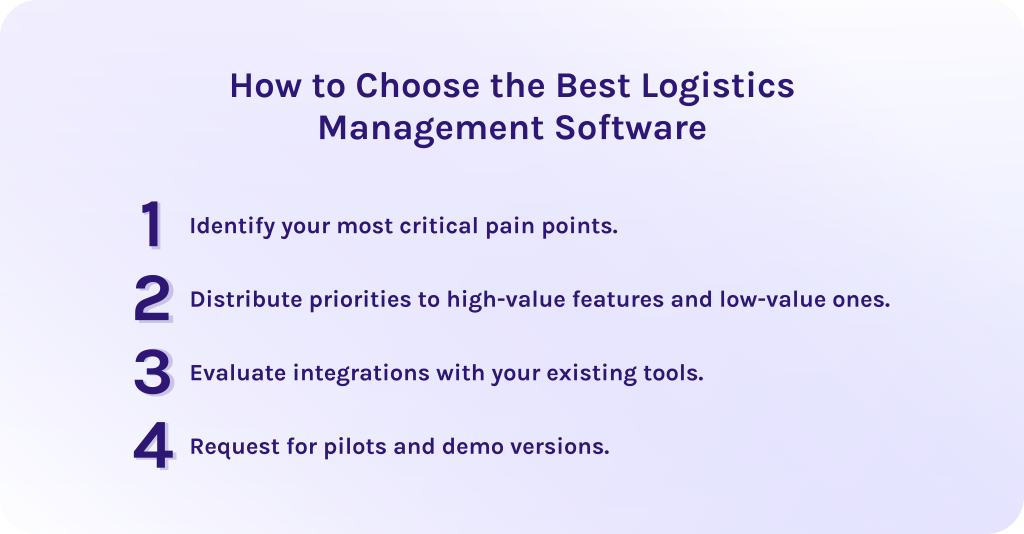
- Identify your most critical pain points. Consider which processes you want to improve and which can work in the same way they worked previously. It will give you an understanding of features you should look for [10].
- Distribute priorities to high-value features and low-value ones. When you know what to look for, it becomes easier to avoid unnecessary functions and focus on ones that deliver real business value [11].
- Evaluate integrations with your existing tools. Think about the need of integration and what tools it would be great to connect through the new software for logistics. Or, perhaps, with integrating a new solution, you won’t need some of those that are already in use [12].
- Request for pilots and demo versions. With hands-on experience, you can literally evaluate ease of use and exact functionality to decide whether the tool is suitable for you or not [13].
Read More: A Guide to the Best Risk Management Software: Top ERM Tools
Summary
Managing logistics today means constantly dealing with the modern challenges that require modern solutions. Thus, let’s recap the main points of the article to briefly summarize the main thoughts of the article.
- To deal effectively with challenges related to logistics, companies should implement logistics management software into their workflows.
- The integration of logistics management tools is extremely important if you want to stay competitive because such software provides tools for managing various aspects of logistics, from transportation to warehouses.
- As well, logistics management software improves planning of logistics operations and customer service. Additionally, it helps to enhance risk management, while thereby reducing costs.
- However, you should look for not only traditional software, but also for innovative solutions, such as EpicStaff – an agentic AI platform that can be tailored to the needs of any specific company.
- When you think of what tool to choose, first of all, identify where your processes become inefficient. Then, analyze which features can help address these inefficiencies and distribute them into two categories: low-priority ones and high-priority ones. After that, evaluate if the tool is easy to use and, finally, request for the demo. If you have some experience in using the tools, it will be easier to estimate its suitability.
FAQs
1. What is logistics management software?
Logistics management software is a digital solution that enables companies to plan, organize, and execute their logistics operations to deliver products and goods to end-users or other suppliers. Also, it shows information about inventory, orders, and their way throughout the supply chain.
2.
What is the importance of logistics management software?
Logistics management software is crucial because it centralizes and automates supply chain operations. Moreover, it provides real-time visibility over inventory, orders, and shipments. This automation eliminates manual errors and ensures seamless coordination from warehouse storage to final delivery.
3. What is the best software for logistics?
The best logistics and supply chain management software is that covers all your unique requirements and needs. Moreover, it should be customizable and scalable enough to adjust quickly and work efficiently.
EpicStaff is an AI agent orchestration platform that is perfectly suitable for businesses of all sizes and niches. Thanks to its capabilities, organizations can create a team of virtual employees that will analyze problems, manage supply chains, inventory, and other aspects to reduce operational costs thereby improving efficiency.
4. How does shipping logistics software help reduce delivery costs?
It reduces delivery costs by optimizing delivery routes and automatically comparing multi-carrier shipping rates to select the most cost-effective option. Additionally, it minimizes costly failed deliveries through automated address validation and batch-processes labels to lower labor expenses.
5. Is WMS difficult to learn?
It depends on a platform. Most platforms can have a steep learning curve due to complex interfaces and advanced functionalities. However, after a few months of training, your staff can become proficient in using such tools.
6. What is a CRM in logistics?
WMS stands for Warehouse Management System. It is a software designed to optimize everyday warehouse operations from the moment inventory arrives until it is shipped out.
7. What technology is used in logistics?
Modern logistics relies on technologies like IoT tracking sensors, AI-driven demand forecasting, and automated warehouse robotics to optimize storage and inventory. Additionally, Transportation Management Systems (TMS) and GPS tracking are used to streamline delivery routes and provide real-time shipment visibility.
8. What software does XPO Logistics use?
XPO Logistics primarily uses its proprietary cloud-based platform, XPO Connect, which leverages machine learning and predictive analytics for real-time freight tracking and carrier price matching.
9. What is the top delivery management software in the market?
Leading delivery management platforms in the market include enterprise solutions like Onfleet, DispatchTrack, Bringg, and OptimoRoute. They excel in dynamic route optimization and real-time tracking.
10. How to choose logistics management software?
To choose the right logistics software solution, you need to take the following steps:
- Step №1. Identify where your processes get stuck.
- Step №2. Analyze what features can help you solve those problems and rank them as low- and high-priority ones.
- Step №3. Think of usability and scalability of the selected tools.
- Step №4. Contact the vendor for a free trial or demo version.
References
- https://www.snsinsider.com/reports/logistics-software-market-9135
- https://www.researchgate.net/publication/376167206_Design_Logistics_Management_System_Based_on_Computer_Algorithm_Model
- https://www.researchgate.net/publication/338880336_Logistics_Software_from_a_Logistics_Management_and_Management_Information_Systems_MIS_Perspective
- https://www.researchgate.net/publication/379738470_The_Effectiveness_of_Logistics_Services_on_Firms’_Performances_-_A_Literature_Review
- https://www.researchgate.net/publication/337038692_Impact_of_Automation_Technology_on_Logistics_and_Supply_Chain_Management
- https://www.researchgate.net/publication/352258336_Impact_of_Logistics_Information_Systems_on_Logistics_Performance
- https://www.researchgate.net/publication/329991117_Benefits_Of_Shift_Scheduling_Automation_Systems_in_Logistics_and_Transportation
- https://www.researchgate.net/publication/307467661_Logistics_Management_as_a_Tool_to_Achieve_Competitive_Advantages_of_the_Enterprise_Trade
- https://www.researchgate.net/publication/228824345_Benefits_of_IT_in_supply_chain_management-an_explorative_study_of_progressive_Finnish_Companies
- https://www.researchgate.net/figure/Most-useful-logistics-software-applications_tbl1_338880336
- https://www.researchgate.net/publication/332879146_Logistics_Software_from_a_Logistics_Management_and_Management_Information_Systems_MIS_Perspective
- https://www.researchgate.net/publication/387490796_Innovative_Approaches_to_the_Development_and_Application_of_Software_in_International_and_Warehouse_Logistics_Current_Trends_and_Future_Perspectives
- https://www.researchgate.net/publication/377740571_Development_of_intelligent_tools_for_logistics_practice_and_prospects_of_use