
What Is Supply Chain Digital Transformation?
In simple words, supply chain digital transformation [1] is when companies apply the newest technologies and approaches like artificial intelligence (AI) and machine learning (ML) to modernize and optimize their supply chains.
Furthermore, these new technologies should be applied throughout the entire supply chain cycle, from alignment with business strategy to daily operations, to be as efficient as possible. This end-to-end adoption helps companies improve their processes not only in the short term but also makes supply chains more resilient for the long term.
Read More: Digital Transformation in Logistics: From Traditional Operations to Real-Time Supply Chains
Evolution From Traditional Supply Chains to Digital Supply Chains
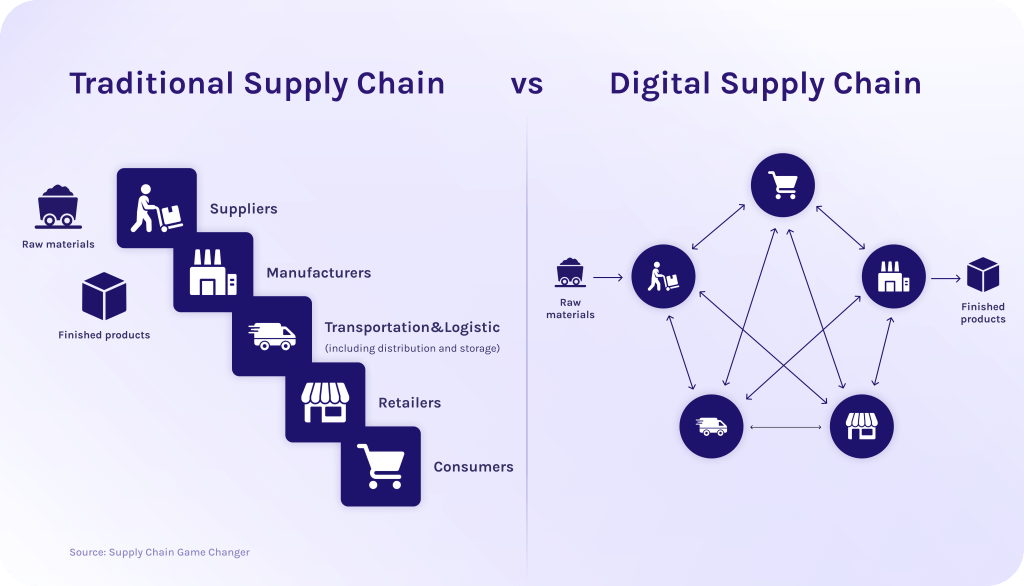
When it comes to supply chain digital transformation, we can’t avoid discussing differences between traditional supply chain and digital supply chain. As the research [2] says, the main distinguishing feature is that traditional supply chain processes are linear and follow one another in a strict sequence, whereas in the digital supply chain they are connected with each other.
Why is it so important?
Because when disruption occurs in a strict order of processes, a delay or problem in one step can quickly cascade throughout the entire supply chain. As a result, traditional supply chains are far less flexible, and one small problem will take days or even months to detect and solve.
Meanwhile, in digital supply chains, processes are connected and integrated. Thanks to the real-time information sharing and analytics, companies can quickly identify where the disruption has happened and take immediate actions to lower damaging impact and losses.
Let’s take a closer look at differences.
| Traditional supply chain | Digital supply chain | |
| Process structure | Linear and sequential – one step follows another in a strict order | Interconnected and integrated – processes communicate and operate in a coordinated network |
| Data management | Often legacy systems that rely on human entry | Unified platforms with real-time data sharing across the entire chain |
| Visibility | Limited visibility | End-to-end visibility |
| Collaboration | Limited collaboration due to fragmented systems | Seamless integration with partners through integrated platforms |
| Responsiveness to disruptions | Small issues can escalate over time due to often delayed detection | Disruptions detected early with automated responses |
Read More: AI and the Future of Modern Logistics
Key Drivers of Supply Chain Digital Transformation
As we entered an era of “logistics 4.0” [3], supply chain digital transformation becomes unavoidable. As traditional supply chains can’t handle today’s market volatility, businesses are forced to adopt some of the newest technologies to stay competitive and efficiently address rising customer expectations. So, what technologies now are the key drivers of digital transformation in supply chain?
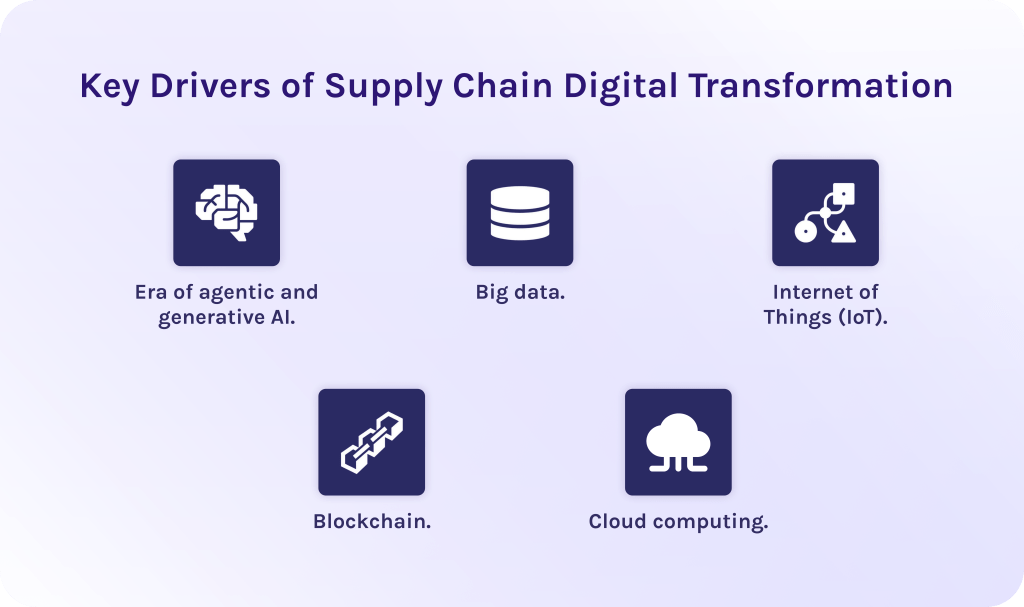
According to the article [4], there are five digital technologies in supply chain management:
Not just simple AI: era of agentic and generative AI.
The move from traditional AI to agentic and generative AI can be easily explained.
- Traditional AI can execute one specific task based on predefined rules and data.
- However, agentic AI [13] is far more independent and can take autonomous actions on its own.
- In turn, generative AI goes even further, as it can generate content, turning supply chains into self-optimizing platforms.
Read More: The Transformative Role of Generative AI in IoT
Big data.
Over decades, people were collecting and analyzing huge amounts of data on their own, which wasn’t fast and sometimes accurate enough. Human beings can make mistakes in calculations, while the cost of such mistakes sometimes may be very high, especially in such complex environments as supply chains.
But now companies can process large datasets in seconds, instead of weeks, as well as get more accurate results. More so, it supports demand forecasting and faster responses to market changes, making supply chains more efficient.
Internet of Things (IoT).
There isn’t one particular definition of IoT, but I’ll try to explain it. According to the research [5], it is an evolving concept in the world of information technologies, where “Things” refers to a device or sensor with the ability to collect data and transfer it across the network without manual intervention. These devices can share data across the other devices in real time, improving visibility and data accuracy.
Blockchain.
Blockchain plays a critical role in digital transformation supply chain management. It creates multiple records of transactions and product movements, thereby helping to address issues related to fraud or ethical sourcing. Moreover, it ensures that every transaction and product journey is verifiable and traceable.
Cloud computing.
Access to real-time data from any point of the globe in supply chain management digital transformation is as necessary as breathing. It enables companies to quickly detect disruptions and take immediate actions to mitigate their consequences. Moreover, all the data and services are stored in the cloud, not on the particular server, which, in turn, ensures that if one server fails, your services will still be available. It is far more secure than running your services on a local server.
Read More: Adopting Cloud Computing: Discovering the Top Programming Languages for Microsoft Azure
Benefits of Supply Chain Digital Transformation
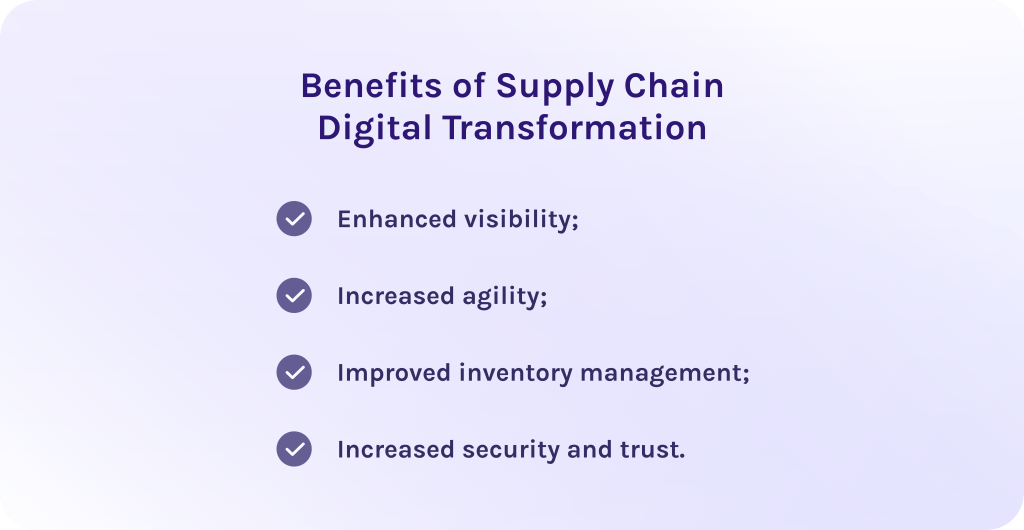
Among general benefits like improved efficiency or higher ROI, we wanted to highlight more particular advantages related specifically to supply chains. The research [6] highlights the following benefits of digital transformation in the supply chain:
- Enhanced visibility: IoT devices in combination with big data analytics contribute to greater supply chain visibility. They provide real-time tracking needed for taking timely actions to prevent or minimize disruptions.
- Increased agility: Digital transformation in supply chain management always aims to address the issue of uncertainty. Thus, it facilitates greater agility within all processes related to supply chains. Companies now can respond faster to market shifts and adapt logistics processes to customer demand.
- Improved inventory management: Predictive analytics help companies estimate future demand based on historical data and current market tendencies. This, in turn, makes it possible for organizations to optimize their inventory, thereby reducing excess inventory and minimizing shortages.
- Increased security and trust: According to the article [14], the implementation of blockchain technology has increased the security of data sharing and transactions . As a result, companies now collaborate more confidently with many vendors and suppliers, building stronger partnerships.
Ultimately, all the benefits described above collectively contribute to one main advantage of supply chain digital transformation – enhancing overall competitiveness and ensuring that the business can meet increasing customer expectations in times of high uncertainty and instability.
But why are some companies still waiting to adopt these technologies and approaches? The next section about the most popular challenges and adoption barriers will give you the answer to this question.
Read More: Empowering Your Workflow: Unveiling the Surprisingly Diverse Uses of Large Language Models
Common Challenges in Supply Chain Digitization
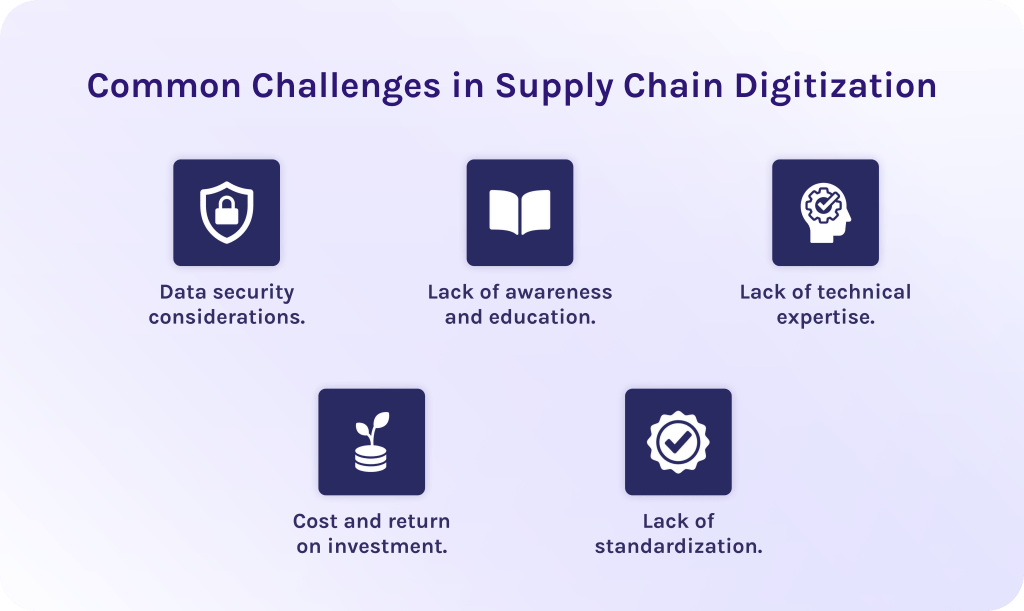
Even with all the benefits we’ve discussed above, implementation of new technologies was never easy. There can be several barriers to digital supply chain transformation that we now will pay our attention to. The recent report [7] indicates the following challenges of digital transformation for supply chain:
Data security considerations.
As supply chain processes involve huge amounts of sensitive data, many companies are worried about data breaches connected to Shadow AI and cyberattacks. According to statistics [8], cyberattacks happen every 39 seconds worldwide, affecting millions of businesses each year with the need to come up with new security measures as well as the threat of reputational damage.
Moreover, it was reported by Aqintelligence [9] that 20% of their responders said they experienced a breach because of security incidents involving shadow AI. The Cybermedics report [10] highlights that sensitive data exposed via shadow AI includes source code (12.7%), R&D materials (10.8%), and customer support info (16.3%).
Lack of awareness and education.
People often are afraid of anything that suddenly comes into their lives. Especially the older generation, as they don’t understand the benefits and use cases of new technologies. That is why they fear losing their job and can sabotage digital supply chain transformation.
Lack of technical expertise.
As well, even if people are aware of the value of the latest technologies and their advantages, they can simply lack the technical expertise to use or maintain them. Moreover, the human brain likes predictive things and might gravitate towards common working methods, denying new, more effective approaches.
Cost and return on investment.
Quite often, costs related to implementing new technologies are considered to be too high. In fact, they indeed are. Also, if we talk about ROI, it may take some time to recoup initial investments in supply chain digitization. These are some of the most popular reasons why companies may hesitate with digital supply chain transformation.
Lack of standardization.
New technologies emerge almost every day, providing absolutely new approaches to old processes that seemed to be effective enough in the past. However, now, when agentic AI and other innovations have reshaped our old views, it is obvious that their uncontrolled usage isn’t secure or always reliable. Without proper oversight, these technologies can also make supply chains more vulnerable.
For instance, AI-driven decisions may be based on incomplete or inaccurate data, leading to errors and mistakes. Therefore, companies should implement strict governance about AI usage to maximize outcomes while simultaneously minimizing risks.
Read More: IBM Cloud or Microsoft Azure: A Comparative Analysis of Two Tech Titans
How HYS Enterprise Helps Companies in Supply Chain Digital Transformation
HYS Enterprise is a Dutch software development company and technology consultancy with 10+ years of experience in such highly regulated industries as logistics, telecom, energy, finance, and retail.

One of our clients, Netherlands-based transport management system (TMS) provider FiLogic, wanted to develop a flexible cloud-based SaaS platform for transport and logistics businesses, affordable even for small businesses and startups. That’s why they looked for a reliable and stable partner.
Our team developed this solution from scratch and helped FiLogic launch a competitive, cloud-native logistics solution that empowers transport companies with real-time control, operational efficiency, and cost-effective scalability – key elements of digital transformation in modern supply chain management.
If you struggle to find your partner for supply chain digital transformation, HYS Enterprise can provide the expertise and resources you need. Contact us today to explore how we can help you address the industry challenges and reach your business goals.
Best Practices for Successful Digital Transformation in Supply Chain
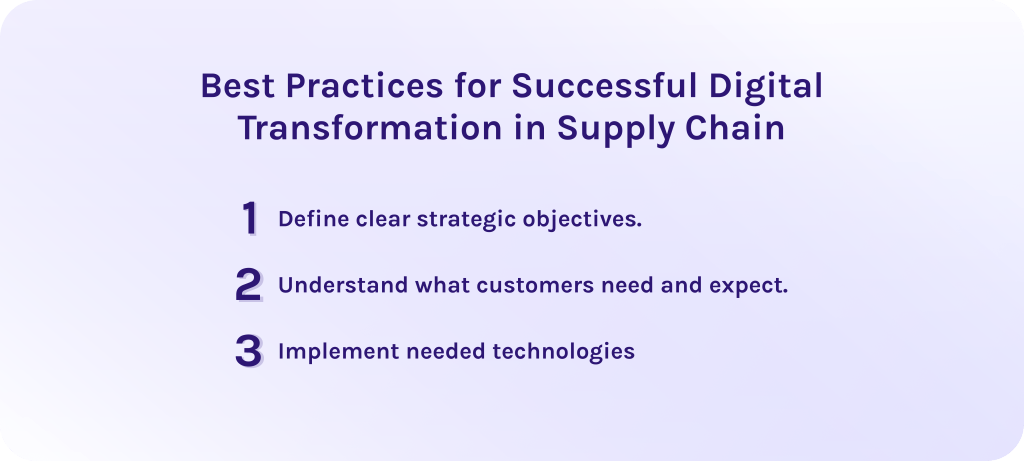
1. Define clear strategic objectives.
To begin with, identify your main pain points that a supply chain digital transformation should solve and align it with the broader organization’s mission. When you have a clear vision of the goals, it is more likely that all your activities will be focused on achieving them, without taking extra, unnecessary actions.
2. Understand what customers need and expect.
Supply chain planning and digitalization is not only about improving internal processes. Often its main goal is to address increasing customer demand to stay competitive.
According to statistics [11], 93% of customers want to stay informed about delivery updates, while 56% want full visibility into their order status from the moment of purchase to delivery. Thus, if you put the needs of your customer as a top priority, you’re more likely to gain a competitive advantage.
3. Implement needed technologies.
When customer needs are clear, the next step is to implement technologies. Use artificial intelligence and machine learning, implement blockchain for security and traceability, use IoT devices to track conditions, and bring all data together in the cloud. In fact, many companies are already increasing their investments in digitalization of supply chain processes. The statistics [12] say that:
- 65% of supply chain organizations raised investments in digital transformation.
- 60% use AI tools for forecasting, which help improve planning accuracy and responsiveness, as well.
- Furthermore, 7% plan to implement predictive analytics soon.
- 42% have implemented robotic process automation (RPA) in their operations.
Read More: A Journey Through the Cloud Maze: Comparing Azure, AWS, and GCP
Final Words
Supply chain digital transformation is extremely important for every business that not only wants to stay competitive but is also eager to deliver more value to end customers. Well, to make it possible, companies should rethink their approaches to supply chain management and switch from traditional ones to digital, powered by the latest technologies such as:
- artificial intelligence (AI);
- Internet of Things (IoT);
- cloud computing;
- automation;
- blockchain;
- big data.
In short, these technologies make supply chain operations more reliable and transparent, while the supply chain itself becomes more resilient. Thus, if you want to start a digital transformation of your supply chain processes, don’t hesitate to contact HYS Enterprise experts and make technologies work for your business success.
FAQs
What is a supply chain definition?
Supply chain is a sequence of activities that companies take to convert raw materials into ready-to-use goods and ship them to the end customers.
What is digital transformation in supply chain?
It is an integration of the latest technologies, such as artificial intelligence (AI), machine learning (ML), cloud computing, blockchain, and others, into supply chains to make them more resilient and efficient.
What is an example of supply chain digital transformation?
The perfect example of the supply chain and digital transformation is Amazon. It uses robotics, AI, big data, IoT, and other technologies to run one of the most advanced supply chains in the world. They analyze customer behavior and make predictions about demand with the help of AI. Robots move shelves to employees, while all suppliers and delivery partners are connected through cloud platforms.
How are digital technologies transforming the supply chain?
Digital transformation supply chain is possible thanks to some modern technologies like:
- Artificial intelligence.
- Machine learning.
- Cloud computing.
- Internet of Things (IoT) devices.
- Big data analytics.
- Automation.
How to build a digital supply chain?
To build a digital supply chain that will be aligned with your requirements, consider the following steps:
- Define clear business objectives.
- Access current supply chain maturity.
- Establish a strong data foundation.
- Adopt enabling technologies.
- Ensure security and governance.
- Upskill workforce and manage change.
- Monitor and continuously improve.
What are the key pillars of a digital supply chain?
The key pillars of a digital supply chain that distinguish it from a traditional one are:
- Real-time visibility.
- Advanced analytics and artificial intelligence (AI).
- Cloud operations and unified system.
- Automation and IoT devices.
- Improved security, thanks to blockchain technology.
What are the benefits of supply chain digital transformation?
Digital transformation supply chain will benefit businesses with:
- Full visibility of all ongoing processes across the supply chain.
- Gives flexibility to quickly adapt to problems or changes.
- Reduces costs.
- Improves efficiency.
- Provides advanced features for analytics.
- Helps to optimize processes.
What is the difference between logistics and supply chain?
Logistics is one of many supply chain activities. Whereas the supply chain itself includes a wide range of different activities for end-to-end value creation, from sourcing raw materials to delivering finished products to the final customer.
What are the 4 main areas of digital transformation in supply chain?
When we talk about four main areas of digitalization of supply chain processes, we often mean:
- More accurate data and analytics.
- Improved customer experience.
- Business model transformation.
- And, finally, improvement of digital operations.
Why is digital transformation essential for supply chains?
Digital transformation is indeed essential for supply chains because it makes them more resilient. With real-time tracking, companies are able to detect disruptions early and mitigate their consequences with minimum losses, simultaneously making the processes more efficient.
References
- https://cardiffuniversitypress.org/reader/chapters/pdf/10.18573/book8.g
- https://www.researchgate.net/publication/381617842_Traditional_vs_Digital_Supply_Chains
- https://www.researchgate.net/publication/380484636_Logistics_40_A_Comprehensive_Literature_Review_of_Technological_Integration_Challenges_and_Future_Prospects_of_Implementation_of_Industry_40_Technologies
- https://www.researchgate.net/publication/396177970_Digital_Transformation_in_Supply_Chain_Management_A_Commerce_and_Management_Perspective
- https://www.researchgate.net/publication/351003790_Internet_of_Things_IoT
- https://www.researchgate.net/publication/385933200_Digital_Transformation_and_Its_Role_in_Enhancing_Supply_Chain_Efficiency
- https://www.researchgate.net/publication/385877888_Addressing_the_challenges_towards_the_adoption_of_digital_technologies_in_construction_supply_chain_management
- https://dataglobehub.com/cybersecurity-statistics-and-insights/
- https://www.aqintelligence.net/post/sha
- https://www.cybermedics.com/post/how-unauthorized-shadow-ai-creates-enterprise-security-holes/
- https://gitnux.org/customer-experience-in-the-supply-chain-industry-statistics/
- https://zipdo.co/digital-transformation-in-the-supply-chain-industry-statistics/
- https://www.researchgate.net/publication/393393189_Agentic_AI_A_Comprehensive_Survey_of_Technologies_Applications_and_Societal_Implications
- https://www.researchgate.net/publication/381284016_AI_-_Powered_Blockchain_Technology_in_Industry_40_Exploring_the_Transformative_Synergy_of_AI_and_Blockchain_Technologies