
What Are OSS and BSS? A Foundational Overview
First things first, to understand what the OSS BSS architecture is, we need to define what the OSS and BSS are.
What Is OSS?
According to the article [2], OSS or Operational Support Systems, are the combination of computing software and hardware that makes a single platform, which, in turn, helps network engineers and operators to manage the work of telco infrastructure.
If you think of telecommunications, you will imagine enormous infrastructure with lots of 5G network towers and rollouts – it is the engine of any telco company. However, you need to manage all of this somehow. Therefore, the OSS systems in OSS/BSS architecture in telecom are the backbone that controls this engine.
Read More: An In-Depth Guide to Telecom Software Development
Key Functions of OSS in Telecom OSS BSS Architecture
As we mentioned before, OSS solutions are responsible for managing network-facing activities. Moreover, as we have learned from multiple researches [3], key functions of OSS typically include:
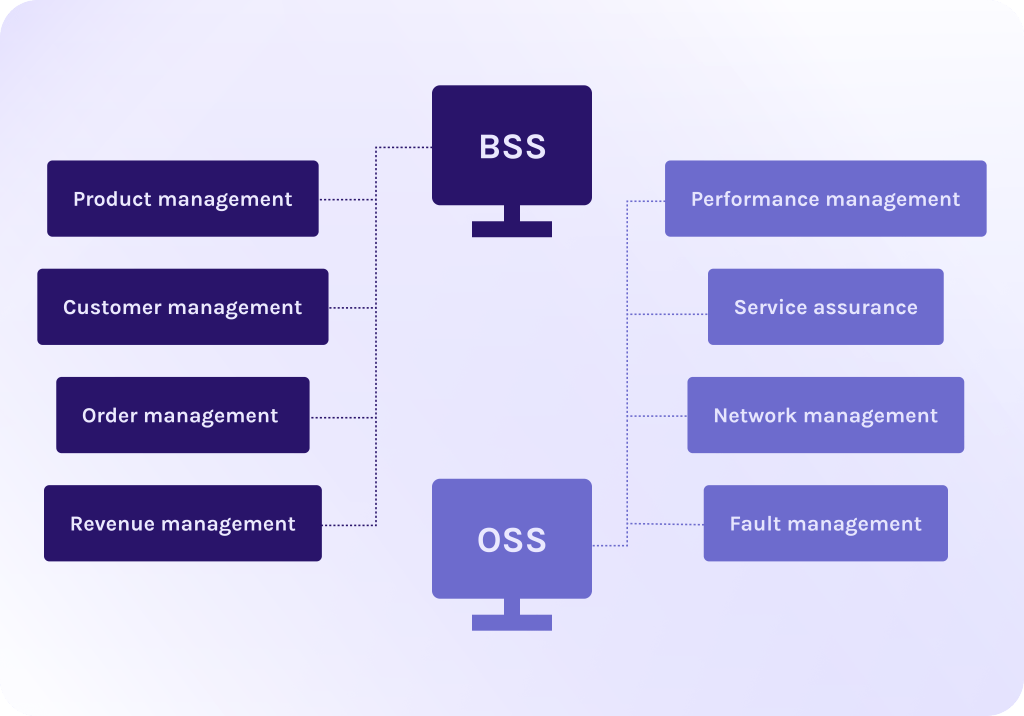
- Performance management: Obviously, the primary goal of any OSS solution is to monitor and analyze various performance metrics such as service quality or traffic load, improving the efficiency of all processes at the same time.
- Service assurance: These systems ensure that telecom services are delivered with proper quality of service (QoS). In turn, this involves continuous monitoring and identifying potential issues to be sure that services are reliable and stable enough.
- Network management: To be more precise, network management systems enable telecom operators to monitor and control their network resources and their performance. Thus, on the one hand, it makes telecom companies more confident, while making services more secure and reliable on the other.
- Fault management: In turn, these systems are used to detect and diagnose anomalies, thereby helping to resolve problems that might have a damaging impact on OSS BSS architecture overall as well as on the service delivery.
Well, we have now explored the importance of OSS architecture. So, what about BSS solutions?
Read More: The Current State of AI in Telecom Software Development Industry
What Is BSS?
According to the article [4], BSS or Business Support Systems, are an important part of telecom OSS BSS architecture. It is a set of functions that are designed to manage a telecom operator’s daily business activities and provide a comprehensive view of the performance of various business processes. In simple terms, BSS solutions handle everything related to customer-facing operations. For instance:
- Managing subscriptions.
- Processing orders.
- Billing and payments.
- Tracking customer interactions.
Thus, BSS systems are more oriented towards end customers, not engineers. Their main goal in OSS BSS telecom architecture is to deliver high-quality services and improve customer experience so that more people will want to become clients of your particular company.
Now, let’s move to the key functions of BSS systems.
Read More: Your Roadmap to Starting a Successful MVNO Business
Key Functions of BSS in Telecom OSS BSS Architecture
As was defined in the eTOM framework [5], BSS solutions support four core functions, which we will now take a closer look at.
- Product management: This part of BSS architecture handles all activities related to sales, product development, and administration, as well as offers bundles for both business and individual customers. Additionally, it often includes discounts, pricing, and managing relationships between projects.
- Customer management: Provides a single view of a customer and is responsible for customer relationship management (CRM) with 24/7 customer support available.
- Order management: It is all about managing customer orders from start to finish.
- Revenue management: As the name suggests, it is focused on everything connected to finances, including billing, charging, and settlement.
Well, now, as we covered the essentials, let’s proceed to the main part of the article – explanation of the OSS BSS architecture.
Read More: How Generative AI in Telecom is Revolutionizing Industry
How to Build Your OSS/BSS Architecture
We’ve developed our own framework to help you understand what steps you need to take to successfully transition to modern OSS BSS architecture.
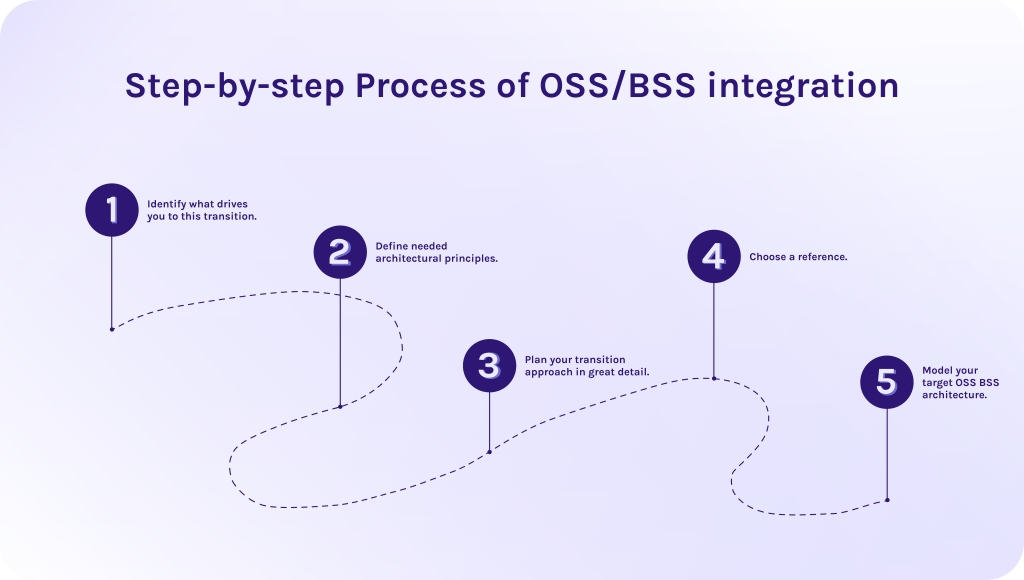
Step №1: Identify what drives you to this transition.
First things first, define what reasons make you think about this transition. It may be the need to support the 5G ecosystem or, for instance, reduce operational costs – your drivers [6]. In particular, they can be:
- Business drivers: the need to establish new services.
- Market drivers: the need to address market trends or regulatory changes.
- Technological drivers: the need to implement new technologies such as AI or cloud computing.
Step №2: Define needed architectural principles.
After having defined your pain points, the next step is to establish the core principles that will guide the design of your OSS BSS architecture in telecom. Some principles that we can mention as the examples are:
- API-first design.
- Scalability.
- Cloud-native design.
- Security by design.
- Flexibility.
Step №3: Plan your transition approach in great detail.
Develop a detailed transition roadmap that outlines all aspects necessary to go through the transition to a new OSS BSS architecture as smoothly as possible. Choose the vendor, testing and data migration strategies, and select which systems might be modernized first as well.
Step №4: Choose a reference.
Look for examples. Perhaps, consider exploring what your competitors do and what best practices you can tailor to your needs. This might be, for example, eTOM, SID, or Open API architecture, as they have proven their reliability in practice.
Step №5: Model your target OSS BSS architecture.
At the last step you can, finally, add finishing touches to the design and document your preferable OSS BSS architecture.
Read More: What is a Mobile Virtual Network Operator (MVNO)? Benefits and Challenges
How Does HYS Enterprise Help Telecom Companies to Succeed?
If you’re worried about a reliable team that can develop a robust software solution for your business, we are here to help you. HYS Enterprise is a stable and reliable player within the telecom market with many success cases within the portfolio. With over 10 years of experience, our experts know how to deliver quality telecom services and ensure their stable work even under pressure of strict regulations and uncertainty.

For example, one of our clients wanted to design a modern VoIP telephony system because their existing system wasn’t scalable enough to handle many users simultaneously. As well, they lacked control over server processes, which limited server performance and future functionality.
What did we do to solve the problem?
In turn, collaboration with HYS Enterprise’s experts redesigned the system completely using microservices architecture with controlled Asterisk services and automated load testing, which ensures reliability and scalability.
The result was a scalable and fault-tolerant VoIP platform capable of handling high call volumes reliably, with improved performance and flexibility for future growth.
If you want to delegate development of your OSS BSS architecture to a team of experienced professionals and get robust, secure services, don’t hesitate to book a call with our experts.
As well, you can read another of our success cases within the telecom industry.
Read More: Automated Billing Solution to Cut Down the Process from Two Weeks to Two Days
How Synergy of OSS and BSS Systems Benefits Telecom Companies
Although OSS and BSS systems are designed to serve different functions, their synergy has a huge impact on the efficiency and performance of telecom companies. The company’s processes not only become more reliable, but also customer experience becomes better, while network performance becomes more optimized as well, driving business to success. In particular, benefits of integration of OSS and BSS architecture in telecom are the following ones:
- Resource management becomes more optimal.
- Customer satisfaction improves increasingly because their orders are processed faster and more efficiently.
- Operational costs are reduced due to automation of processes and faster data flows.
- Ultimately, the system experiences fewer errors and failures thanks to robust architecture and seamless connection of services.
Challenges of Implementing OSS BSS Architecture
A poor integration between OSS and BSS solutions leads to several inefficiencies that, in the long-term perspective, can even cause costly delays or affect customer satisfaction. But what challenges make OSS BSS architecture difficult to implement effectively?
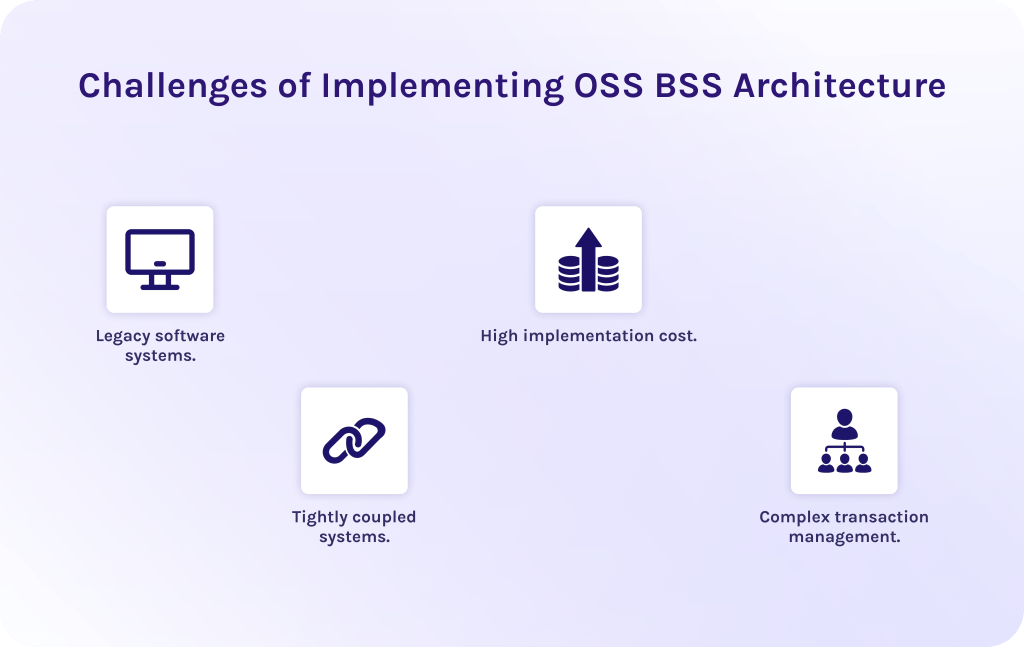
Legacy software systems.
One research indicates [7] that outdated legacy systems consume up to 80% of IT budgets in telecommunications. However, many companies still rely on old solutions for many reasons. On the one hand, they don’t need to develop new systems with modern BSS and OSS architecture, but on the other hand, their processes become more and more inefficient each day of waiting, which results in even higher expenses and lower system performance.
High implementation cost.
Such transitions are often considered as high-cost ones, and they indeed are. However, think about one thing: what if your competitors adopt modern OSS BSS architecture first and gain all competitive advantages? The initial cost of integration or modernization is always high, but the long-term benefits often outweigh the upfront expense.
Tightly coupled systems.
Traditionally, the BSS and OSS architecture in telecom is developed in a way that makes them dependent on each other. Consequently, it means that changes or issues in one of the systems cause problems in the other. It makes them less flexible and adaptable. As a result, companies in some cases don’t even know how to start this integration and not ruin the entire system.
Complex transaction management.
In some cases, simple user action may require updates across multiple systems within the OSS and BSS architecture. For example, activating a new service can involve user profile changes, order management, and billing activation. If not managed properly, it can cause a lot of problems and increase the risk of errors.
Read More: Top Telecom Project Management Challenges and How to Overcome Them
Conclusion
Let’s briefly sum everything up:
- OSS systems in telecom are the combination of software and hardware that makes a single platform and helps network engineers and operators to manage the work of telco infrastructure.
- Core functions of a robust OSS system typically involve performance management, service assurance, network management, fault management.
- BSS systems are a set of functions that are designed to manage telecom operator’s daily business activities and provide a comprehensive view of the performance of various business processes.
- Main functions of a reliable BSS system often include product management, customer management, order management, revenue management.
- To build your own OSS BSS architecture, first of all, you need to identify what drives you to this transition. Then, define needed architectural principles and plan your transition approach in great detail. Also, an important step is to choose a reference. Finally, you can model your target OSS BSS architecture.
- The synergy of OSS and BSS systems not only helps to make the company’s processes more reliable but also enhance customer experience, while optimizing the network performance as well, driving business to success.
If you’re looking for a reliable partner to design or modernize your systems architecture in telecom, specialists from HYS Enterprise, with deep industry expertise, know how to develop reliable solutions and achieve measurable results, fitting in the tight deadlines. Book a consultation to start a partnership today.
FAQs
What is OSS BSS architecture?
The OSS BSS architecture in telecom refers to the framework of how the Operational Support Systems and Business Support Systems would work together to support end-to-end telecom operations and services. It forms the backbone of any telco company because their specialists can see how network metrics affect business performance and vice versa.
How is OSS different from BSS?
OSS (Operations Support Systems) and BSS (Business Support Systems) are indeed distinct, though they are closely connected within the telecom environment. OSS primary goal is to support technical and operational aspects of telecom work. Meanwhile, BSS is focused on the business and customer-facing side of telecom operations.
What is OSS used for?
In telecom, OSS (Operational Support Systems) are software and hardware solutions that allow telecom operators to continuously manage network performance and the condition of infrastructure in real time throughout its entire lifecycle. Such systems provide all needed functions to ensure the system works properly and efficiently.
What are the 5 layers of network architecture?
Often, the 5 layers of network architecture are described as the following ones:
- Physical layer – physical infrastructure such as cables and routers.
- Data link layer – data transfer between directly connected devices.
- Network layer – routing and logical addressing across networks.
- Transport layer – end-to-end data delivery and error handling.
- Application layer – services and applications used by end users.
How do OSS and BSS systems integrate with each other?
OSS (Operations Support Systems) and BSS (Business Support Systems) are polar opposites, as they serve completely different business functions. However, when they work together, they share data through APIs, microservices, and other ways to connect and synchronize billing, order management, service activation, resources, and analytics.
What is an OSS architect?
OSS architect is a telecom IT specialist who is responsible for designing, developing, and managing the OSS system. In other words, it’s a person who develops OSS architecture and ensures the system’s efficiency and reliability at scale.
What is a BSS architect?
A BSS architect is a telecom IT professional whose main responsibility is the development and maintenance of the telecommunication Business Support System – software that manages customer-facing activities like billing and customer relationship management (CRM).
Why do we need OSS?
Because OSS (Operational Support Systems) serves as a bridge between the physical telecom 5G network and the services delivered to customers. Furthermore, it gives operators visibility and control needed to manage complex telco infrastructure with features like virtualization, predictive analytics, scenario planning, etc.
What are the biggest challenges in OSS/BSS integration?
When it comes to the biggest challenges of integration of OSS and BSS systems, they are often described as the following ones:
- Integration with legacy systems.
- High cost of the implementation.
- Tightly couples systems.
- Complex transaction management.
How is AI/ML being used in modern OSS/BSS?
Although artificial intelligence (AI) and machine learning (ML) are frequently considered costly and complex solutions, they give companies the ability to automate various processes as well as predict risks in advance. Therefore, in modern OSS/BSS systems, AI and ML become a backbone of high quality and efficiency.
References
- https://www.researchgate.net/publication/360154608_A_Review_on_5G_Technology_Evolution_Features_and_Challenges
- https://www.researchgate.net/publication/2504788_Systems_Management_of_Operational_Support_Systems_Applications
- https://www.researchgate.net/publication/283787165_Evolution_towards_a_Cloud_Deployed_Business_Support_System
- https://www.academia.edu/43098013/Business_Process_Framework_eTOM
- https://www.researchgate.net/publication/389206519_BSSOSS_as_a_Service_Cloud_Solutions_for_MVNOs
- https://www.researchgate.net/publication/370793249_Drivers_of_Digital_Transformation_and_their_Impact_on_Organizational_Management
- https://www.researchgate.net/publication/397253780_Cognitive_BSSOSS_Integration_and_Legacy_System_Modernization_The_Age_of_Intelligent_Middleware
