What Is Generative AI in Telecom
Generative AI in telecom refers to using artificial intelligence models that can generate text, images, code, and other content to improve telecommunications companies’ workflows. Moreover, it can not only analyze data but also make data-driven suggestions to enhance productivity. Have you ever spoken to ChatGPT? If yes, well, you know what GenAI is.
Read More: Empowering Your Workflow: Unveiling the Surprisingly Diverse Uses of Large Language Models
Difference between Generative AI and Traditional AI in Telecom
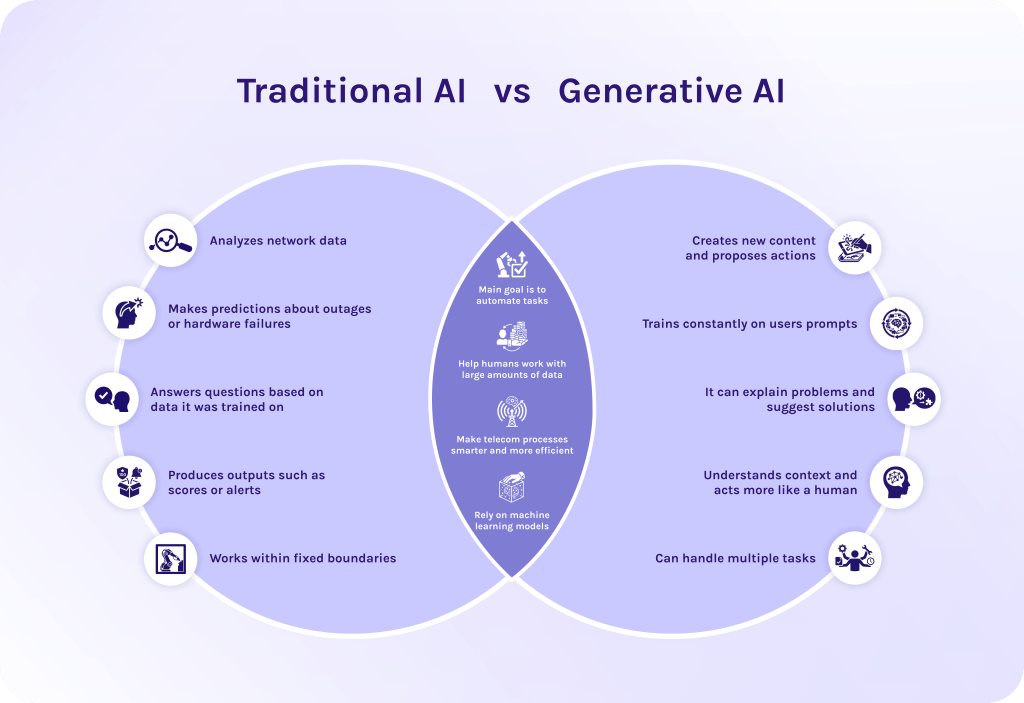
When it comes to differences between traditional and generative AI solutions, they differ mainly in what they are capable of doing within telecom environments.
In common, they both are forms of artificial intelligence whose main goal is to automate tasks and help humans work with large amounts of data, such as network performance metrics or operational logs. Thus, the main purpose of both approaches is making telecom processes smarter and more efficient. Additionally, they both rely on machine learning models that learn patterns from data and are not manually programmed step-by-step.
But what are distinctions?
Traditional AI, also known as ‘weak AI’, is designed to perform specific tasks within the clearly defined scope. Moreover, these systems operate based on a predetermined set of rules and instructions. As a result, it enables them not only to respond to data but also learn from it. In particular, traditional AI is designed to:
- Analyze network data and make predictions about outages or hardware failures.
- Answer questions based on data it was trained on.
- Typically, it produces outputs such as scores or alerts.
- Usually works within fixed boundaries and is designed for one specific task.
- Common use cases include fraud or anomaly detection.
On the other hand, generative AI, as we discussed earlier, is capable of generating new content, also based on data it was trained on. Additionally, it uses large language models (LLMs) and more advanced algorithms to create this new content. To be more precise, Gen AI:
- Focuses primarily on creating new content and proposing actions.
- Constant training on user prompts to give more personalized answers.
- It can explain problems and suggest solutions, not just give a final score.
- Understands context and acts more like a human.
- Is more adaptable, as it can handle multiple tasks.
In simple English, traditional AI helps telecom providers detect and predict problems, whereas Gen AI helps them understand and address these obstacles in the most efficient possible way.
Why Generative AI in Telecom Industry Matters
The telecommunications industry has reached a level of complexity and scale that traditional tools and human-only operations can no longer handle efficienty. More so, the telecom industry is one of the most regulated ones. That is why, if adopted well, you get a significant competitive advantage over the competitors.
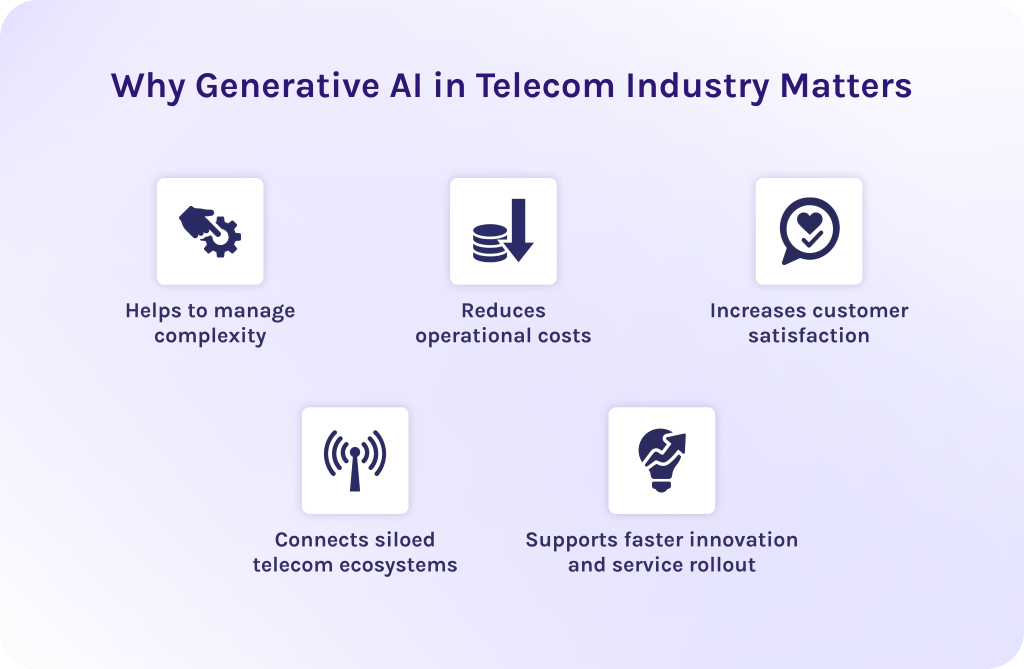
Telecom networks are too complex to manage manually.
Generative AI brings absolutely new approaches to managing modern telecom projects. Although managing large 5G rollouts and millions of connected endpoints was always extremely complex, with the rise of generative AI in telecom market, everything has changed. Gen AI in telecom can understand data coming from many systems at once and turn it into clear explanations, thus helping engineers manage complexity instead of being overwhelmed by it.
It reduces operational costs.
Telecom operations are extremely expensive, especially mobile networks management and customer support. However, in this case, generative AI in telecom OSS systems and also in BSS platforms significantly lowers operational expenses. How exactly? The answer is quite simple: by automating reporting, troubleshooting, documentation, and support. This allows telecom providers not only to save costs but also to eliminate time-consuming repetitive work, thereby increasing efficiency.
It increases customer satisfaction.
Customer satisfaction has always been one of the biggest challenges in the telecom industry, as customers always want fast issue resolution as well as clear communication. When implemented well, generative AI in telecom industry efficiently addresses this problem by powering intelligent assistants and chatbots that can understand natural language and respond to customer queries in real time, even at night, as AI doesn’t need to sleep.
It connects siloed telecom ecosystems.
As you know, telecom includes lots of services such as OSS, BSS, CRM, billing, and network platforms, often owned by different teams and using different data formats. As a result, when an issue appears, it requires manual coordination across multiple departments. Here generative AI in telecom starts to act as a cognitive layer that can reason across these systems simultaneously and give teams a full picture of what is happening. Thus, teams don’t need to search through all systems to get a detailed report with root causes of failure and suggestions on improvements.
It supports faster innovation and service rollout.
The telecom industry is a highly competitive field where the speed of launching new services can determine market leadership. In turn, Gen AI uses various large language models to assist teams throughout the entire lifecycle. Moreover, there is a huge variety of successful examples of generative AI use cases in telecom. It might help to design network architectures or even simulate “what-if” scenarios to evaluate potential risks.
To make a brief summary, a generative AI solution can help companies to:
- Manage the industry complexity.
- Reduce operational costs.
- Increase customer satisfaction.
- Connect systems and automate processes.
- Upgrade faster and stay competitive.
Now, let’s move to the next section and take a look at the main challenges of adopting generative AI solutions in telecom.
Read More: Automation as a Secret to Telecom Success
Current Challenges of Adopting Gen AI in Telecom Industry
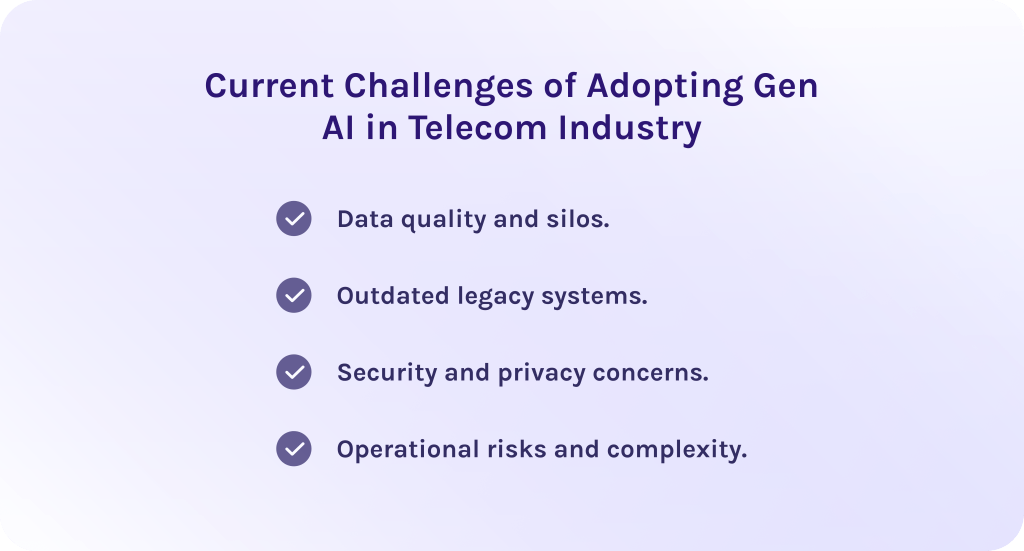
With all the advantages described above, generative AI in telecom looks extremely promising, doesn’t it? However, like with any other innovative technologies, specialists have many concerns about Gen AI implementation in the telecom sector. Let’s dive deeper into those concerns.
1. Data quality and silos.
When we talk about generative AI use cases in telecom industry, one of the biggest problems is data silos. Telecom mobile networks generate massive amounts of data, which is often fragmented across OSS, BSS, CRM, billing, and other systems. Data may become inconsistent or incomplete, making it hard for specialists to gather everything together and analyze it. Since AI models rely heavily on high-quality data, poor data quality can lead to inaccurate insights, resulting in limited trust in AI outputs.
2. Outdated legacy systems.
Usually, creating a new system can cost you a pretty penny; thus, it might be the main reason why many telecom companies rely heavily on old legacy systems that were not designed to support modern generative AI solutions. As a result, in many cases attempts to integrate artificial intelligence with old OSS and BSS systems end up being complex and inefficient. It slows down AI deployment and limits the ability to scale solutions across the entire network.
As statistics from McKinsey’s report show, about 70% of digital transformation initiatives fail because of problems related to legacy system integration.
3. Security and privacy concerns.
Generative AI in telecom constantly deals with huge amounts of sensitive data, which must be protected from cyberattacks and data leaks. Additionally, telecommunications is a strictly regulated industry that has to be compliant with global data security and protection regulations such as GDPR in Europe.
In this case, non-compliance can cost you not only fines but also reputational damage. According to a CNIL report, FREE MOBILE and FREE mobile operators were fined €27 million and €15 million, respectively, after a huge data breach in 2024. Then, the attacker got access to over 24 million subscriber contracts, which included sensitive customer data like IBANs. Consequently, it led to a reduction of customers’ trust so that fewer people now would consider being clients of these operators.
This situation should be a reminder for every Telco company – data protection and safety measures aren’t nice to have anymore – they are obligatory.
4. Operational risks and complexity.
Even though generative AI in telecom brings lots of opportunities for modernization and competitiveness, you should deploy it carefully. The proper implementation of generative AI models into modern OSS and BSS systems requires significant effort: you should set it up precisely, monitor continuously as well as constantly upgrade and train to get more accurate and actual answers. Even one small mistake or inaccuracy in Gen AI in telecom can disrupt a perfectly built chain of processes and cause financial losses related to low network performance.
HYS Enterprise has a significant experience in building reliable software systems, especially generative AI-based, that help companies from various industries, even highly regulated ones, to reach the best outcomes. One of its latest projects, EpicStaff, which allows its users to create a virtual team of autonomous AI agents to perform different tasks, has proved its efficiency in practice.
In 2024, EpicStaff partnered with Dutch logistics company Move Your Machine (MYM) to solve several inefficiencies. In turn, EpicStaff transformed MYM’s logistics:
- Autonomous agents handle pricing, orders, and marketing.
- 80–90% of the workload shifted to digital employees.
- Price quotes cut from days to seconds, saving ~40% delivery time.
- The entire business cycle runs autonomously with full transparency.
- MYM now operates with 2 people instead of 20, achieving record efficiency and 24/7 client control.
Want to achieve similar results and boost your business? Contact our experts to get a detailed consultation and build your AI system today.
Now, when you are aware of the main complexities, let’s proceed to the main section of the article – key generative AI use cases in telecom industry.
Read More: Top Telecom Project Management Challenges and How to Overcome Them
Key Generative AI Use Cases in Telecom
Generative AI is rapidly reshaping the telecom industry. The McKinsey report says that companies are implementing Gen AI mostly in such business functions like:
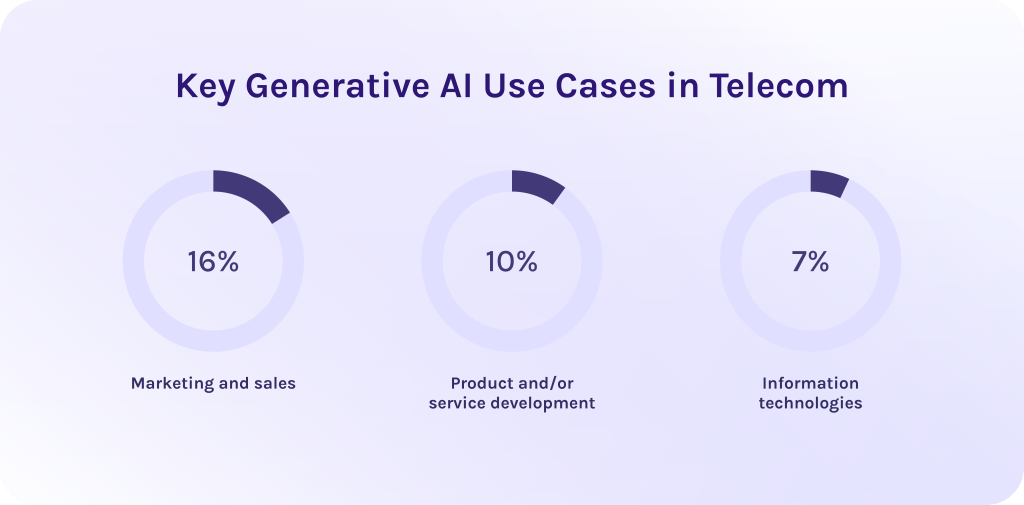
Here Gen AI delivers the most value. Thus, let’s take a closer look at how telecom companies can adopt generative AI solutions to increase outcomes and address common challenges. The most efficient generative AI use cases in telecom are the following ones:
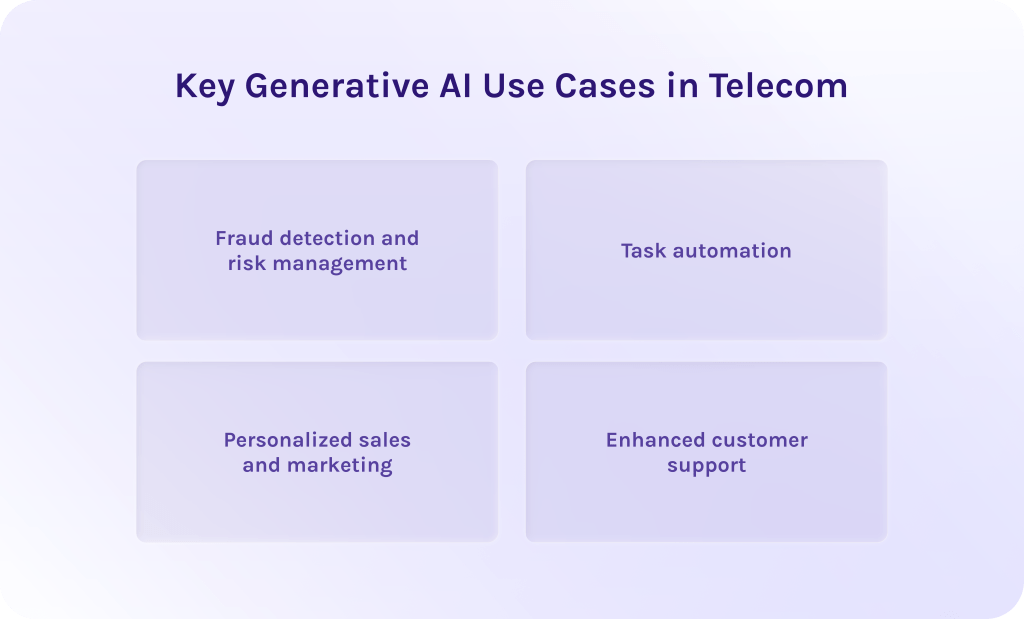
1. Fraud detection and risk management.
When we talk about risk management and fraud detection, it is one of the most popular generative AI use cases in telecom industry. Security and data protection here are top concerns, as telco companies constantly deal with huge amounts of sensitive user data. Generative AI in telecom can spot unusual activity or anomalies in network traffic in real time, thus enabling companies to detect possible cyberattacks, SIM card cloning, call rerouting, and other dangers.
As it can continuously learn, Gen AI can explore new fraud techniques and detect such threats more effectively.
2. Task automation.
It might be the most obvious point of AI use cases in telecom, but it still remains one of the most effective ones. You can delegate various tasks to such systems and don’t rely on human input anymore. For instance, network monitoring can be fully automated: the system can continuously monitor the network for anomalies, predict potential outages, or even, in some cases, trigger self-healing protocols on their own without relying on human interruption.
3. Personalized sales and marketing.
Generative AI use cases in telecom go far beyond network optimization – it comes in handy in various business processes, especially in marketing and sales. Here, it helps to analyze market trends and create advertising campaigns, generating pictures, text for emails, or ads for different segments of the audience. Furthermore, it can suggest marketing strategies or enhance the already existing ones, suggesting improvements and areas you should pay your attention to.
4. Enhanced customer support.
This list of the most efficient generative AI use cases in telecom can’t be complete without mentioning its influence on customer support. It can automatically process customer requests and offer flexible solutions. For instance, the user has problems with internet connection. So, he or she types the request to the system’s chatbot or virtual assistant that, in turn, analyzes all possible causes and then creates a step-by-step guide to help customers resolve the issue independently, or, if needed, passes this particular case to the human operator with full context and diagnostics already attached.
It benefits both operators that can lower operational costs, as well as customers that have 24/7 access to support.
Read More: A Modern VoIP Telephony System with a Scalable and Fault-Tolerant Network Structure
Future of Generative AI in the Telecom Industry
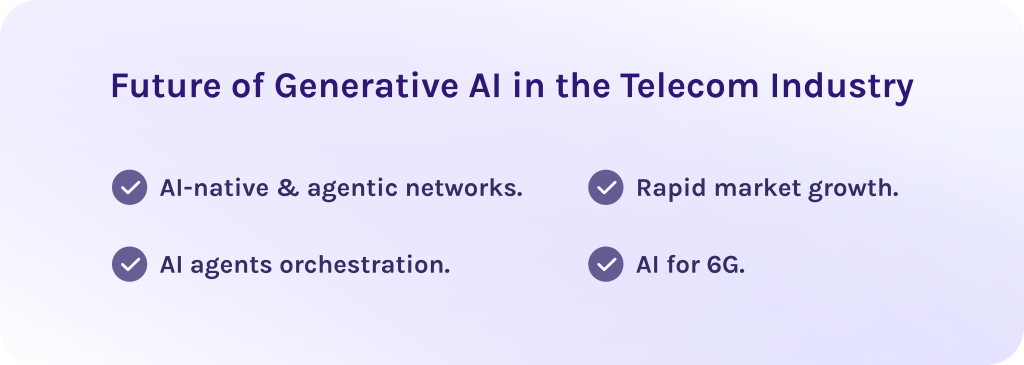
1. AI-native & agentic networks.
Telecom operators are now moving beyond simple automation toward AI-native and agentic systems that not only analyze data but can act autonomously to optimize networks. In fact, they can configure and heal themselves autonomously, with minimum human intervention. Moreover, they are using generative or agentic AI to orchestrate tasks across RAN (radio access network) and other infrastructure.
Thus, it results in:
- Detecting issues before outages.
- Real-time load balancing.
- Automated resource allocation.
This evolution helps reduce operating costs (OPEX) up to 25-30%, according to Rakuten Symphony research, and improves resilience as well as customer experience.
2. AI agent orchestration.
The telecom sector, like many others, now tends to shift towards agentic AI systems that can carry out tasks end-to-end. To give you more details, AI agents are autonomous software systems that can perform predefined tasks on their own, “speaking” to each other like a real business team and searching for the best solution.
Sounds promising, right?
The perfect illustration of this trend is EpicStaff, developed by HYS Enterprise. It is a hybrid visual+code AI agent system that gives businesses an opportunity to create their virtual ‘staff’ to automate various business processes. It is oriented towards a dual audience (technical specialists and no-code users), allowing different business teams, from marketing to engineering, to collaborate with each other and simplify their work. As a result, you can eliminate time-consuming activities, which in turn results in significant cost reduction.
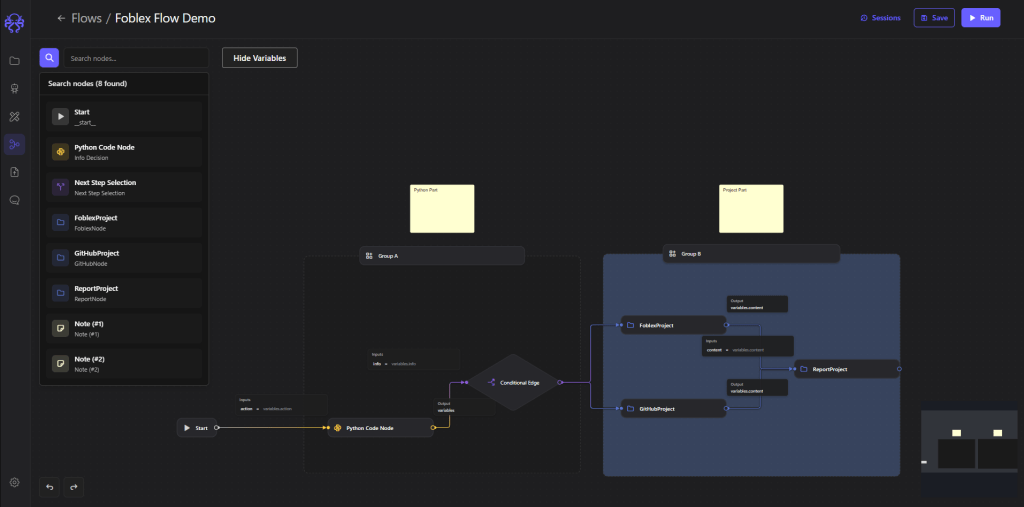
Moreover, EpicStaff is an open-source platform which means many users have already tested it and made sure of its safety. To learn all capabilities of EpicStaff, visit its GitHub repository and start building your virtual AI workforce today.
3. Rapid market growth.
The popularity of generative AI in telecom OSS systems as well as BSS platforms is growing faster than one could imagine. It is expected that from 2024 to 2034, the market of generative AI solutions in the telco industry will experience significant growth at a CAGR of 50.8%.
In turn, new revenue streams will arise from:
- AI-as-a-Service platforms for enterprise customers.
- API ecosystems and partner marketplaces.
- AI-powered IoT and private network solutions for specific industries.
4. AI for 6G.
We have only just managed to adapt to 5G, while companies are already working on the development of 6G networks. Generative AI in telecom will be not just a fancy feature there but a core part of network design, offering semantic networking and autonomous service orchestration. Some early researches even propose the concept of “Sovereign AI” models that balance performance with security and policy compliance.
Read More: Automated Billing Solution to Cut Down the Process from Two Weeks to Two Days
Final Words
Generative AI is no longer a future concept for the telecom industry – it is already transforming how networks are operated, secured, and monetized. AI use cases in telecom vary from autonomous network management and fraud detection to AI-driven customer support; it enables telecom operators to move faster and deliver better customer experiences.
As telecom evolves toward AI-native 5G and future 6G networks, companies that adopt agentic and generative AI today will gain a decisive competitive advantage. Those who embrace this shift will move beyond connectivity and become intelligent digital service providers, ready to scale and innovate. While others, unfortunately, are most likely to fall behind.
Develop your own generative AI solution for telecom today to gain a significant competitive advantage. Contact HYS Enterprise experts to embrace digital transformation.
FAQs
What is generative AI in telecom?
Generative AI in telecom are advanced large language models that can:
- Create new content.
- Make predictions about possible network issues.
- Constantly learn from not only predefined data but also through users inputs and new telecom data.
- Automate telecom operations and optimize work and data flows.
What are the most common generative AI use cases in telecom?
In fact, usually, AI in telecom is used for:
- Fraud and anomalies detection.
- Task automation.
- Personalization, sales, and marketing.
- Customer support.
How is traditional AI different from generative AI in the telecom industry?
Traditional AI are models that were trained on exact data so that they operate based on it. Whereas generative AI is designed to generate new content in various formats: text, images, videos, gifs, etc. Moreover, generative AI models can continuously learn from vast telecom data to be more flexible than traditional AI.
How do telecom companies benefit from generative AI solutions?
If implemented well, usage of generative AI models help Telco companies to:
- Manage the complexity of telecom environments.
- Reduce operational costs.
- Bring together interconnected parts of telecom systems.
- Increase customer satisfaction.
- Adopt new technologies faster with less stress.
Can generative AI improve network performance in telecom?
Definitely. Generative AI in telecom can significantly improve network performance. To be more precise, it can automate some repetitive routine tasks such as generating reports or analyzing market trends. Furthermore, generative artificial intelligence can be used for more advanced tasks like predictive analytics or intelligent resource allocation. Even though generative AI use cases in telecom industry vary significantly, in most cases it leads to cost reduction while optimizing mobile networks.
How is generative AI used for fraud detection in telecom?
Indeed, the generative AI solution can learn how real people behave, consequently, being able to detect anomalies in network traffic in real time. Moreover, it can identify new fraud patterns and automatically trigger preventive protocols to protect the whole system.
Is generative AI suitable for highly regulated telecom environments?
Absolutely, generative AI models can be appropriate in the telecom industry, but only under strict conditions. It requires strong security measures and compliance to deal with large amounts of sensitive user data. However, if fully automated and poorly managed, a generative AI solution can increase risks of data leaks or inaccurate outputs.
What challenges should telecom providers consider before adopting generative AI?
The main challenges of adopting a generative AI solution involve:
- Considering data quality and silos.
- Issues while integrating it with outdated legacy systems.
- Security and privacy concerns.
- Problems related to operational complexity.
References
- https://www.globenewswire.com/news-release/2025/07/21/3118534/0/en/Generative-Artificial-Intelligence-AI-in-Telecom-Market-Opportunities-and-Strategies-Report-2025-2034-Voice-Based-Generative-AI-in-Telecom-Set-for-Explosive-Growth-at-58-50-CAGR.html
- https://www.mckinsey.com/capabilities/transformation/our-insights/common-pitfalls-in-transformations-a-conversation-with-jon-garcia
- https://www.cnil.fr/en/sanction-free-2026
- https://www.mckinsey.com/capabilities/quantumblack/our-insights/the-state-of-ai-2024
- https://symphony.rakuten.com/blog/ai-first-delivery-rethinking-large-scale-rollouts-in-telecom#:~:text=25-30%25%20reduction%20in%20operational%20costs%2C
- https://arxiv.org/pdf/2509.06700
