
What Is Business Process Automation?
Business process automation (BPA) is an approach to manage the company’s daily operations by delegating repetitive and the most time-consuming tasks to the specialized software.
At its core, business process automation services are not just about replacing a human with a bot; it is about architecting a digital ecosystem where data flows seamlessly between disparate systems, such as your CRM, ERP, and communication tools, without human intervention.
Types of business process automation
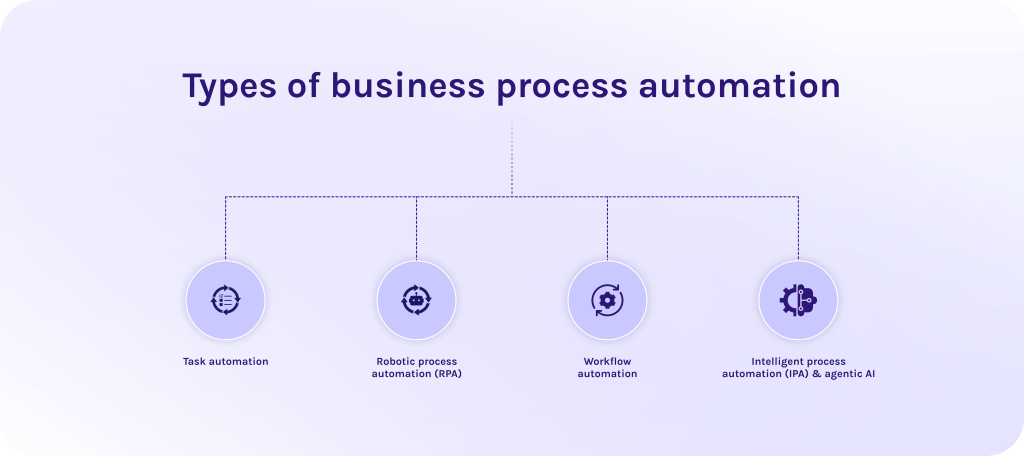
There are four primary types of business process workflow automation:
- Task automation. This is the simplest form, designed to handle individual, repetitive actions. It is often event-driven: when some event happens, it triggers action.
- Robotic process automation (RPA). RPA uses software “bots” to mimic human interactions with digital systems. It is the go-to solution for legacy systems that lack modern APIs.
- Workflow automation. While RPA handles tasks, workflow automation manages the flow of work between people and systems across an entire process. It routes data, sends notifications, and gathers approvals based on business logic [1].
- Intelligent process automation (IPA) & agentic AI. It combines traditional automation with AI (machine learning and LLMs) to handle unstructured data and make decisions. Unlike RPA, which breaks if a button moves, IPA can understand context and adapt. Agentic AI goes a step further by having a goal and choosing its own path to achieve it [2].
Read More: Best Scenario Planning Tools to Consider in 2026
Why Business Process Automation Is Now a Strategic Priority
Well, the answer is quite simple – because business process workflow automation brings several advantages, extremely valuable for the long-term strategic growth and success.
- Allows companies to execute more with the same resources. Traditionally, as capacity increases, the companies have to hire more specialists to handle it. However, with business process automation solutions it won’t be that necessary because some processes are already handled by the software.
- Execution becomes more consistent. Human beings need some rest while the software does not. It can manage requests and bottlenecks even at night so that in the morning you’ll have ready reports or execution summaries.
- Companies become more competitive and get higher ROI. As you now can handle more with the same resources, consequently, your growth opportunities while operational costs remain under control. Tasks get done faster while the number of errors reduces significantly which allows companies to deliver more quality services and quickly respond to market changes.
Read More: Best Free ERP Software: Open Source and Free ERP Systems Compared
Core Components of a Business Process Automation Platform
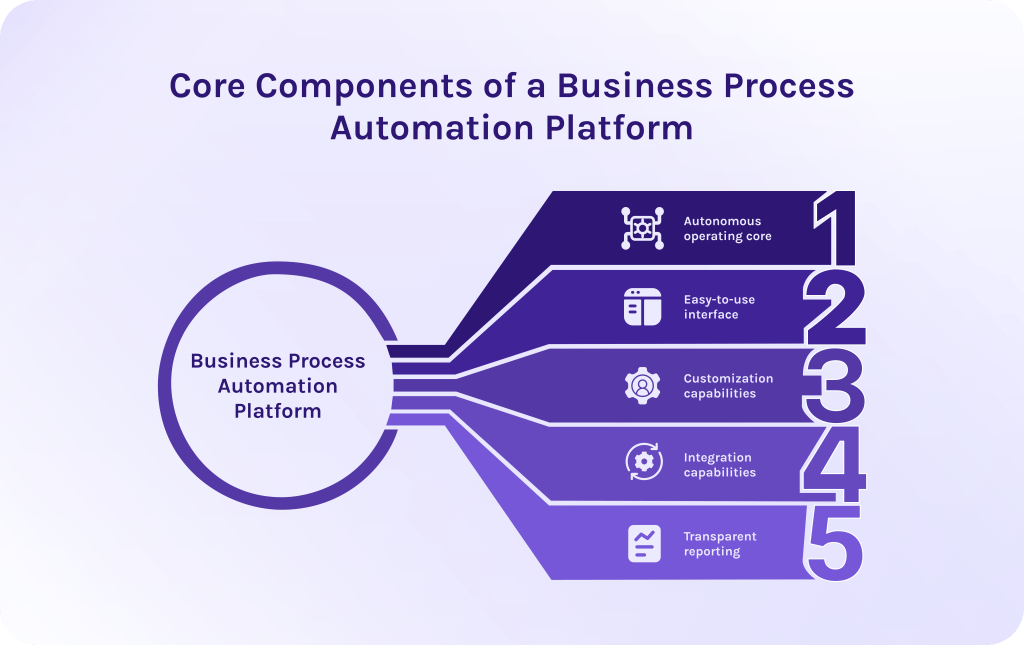
What features to look for in an automation business process tool? Below we’ve prepared a short list of must-haves that are indispensable for efficient workflow optimization:
- Autonomous operating core. The main purpose of the business process automation software is to execute tasks autonomously, with minimal human intervention. Thus, the platform must utilize a system of specialized AI agents that collaborate to automate the entire business cycle
- Easy-to-use interface. The interface must be intuitive enough so that even non-technical team members can easily use it without extensive training [3].
- Customization capabilities. Ability to add custom code to adjust the system to your specific needs or add new functions and expand your opportunities.
- Integration capabilities. The business process automation platform must simplify your workflow and not ruin them entirely. Thus, it has to have opportunities of seamless integrations with the tools you’re currently using.
- Transparent reporting. The business process automation tools must track key business success metrics to control efficiency of execution.
Read More: The Best Backlog Management Tools
Business Process Automation Examples in Enterprise Operations
To be more precise, let’s take a closer look at particular business process automation software real world use cases.
EpicStaff is the business process automation AI-powered tool that allows its users to automate completely different workflows – from complex logistics operations to marketing content creation.
Case Study: EpicStaff + MYM (Move Your Machine)
In 2024, The Netherlands based logistics company Move Your Machine (MYM) asked HYS Enterprise for help in building their own fully autonomous, AI-driven logistics platform. They struggled with industry inefficiencies such as long waits for quotes, opaque costs, and manual coordination. In this case:
- EpicStaff provided a multi-agent system that automates the entire business cycle, from lead generation and marketing to invoicing and logistics.
- The platform bridged the gap between developers and business leaders, ensuring a transparent architecture and preventing dependency on individual developers.
As the result of collaboration, MYM got the business process automation tool capable of:
- MYM successfully transferred 80-90% of manual work to digital employees, allowing the company to scale with a minimal two-person team.
- Price calculation times were reduced from several days to just seconds, contributing to a 40% saving in delivery time.
- The complex, autonomous architecture was built in only a matter of weeks using EpicStaff’s hybrid approach.
- The AI-augmented team recently broke its weekly turnover record, proving it could outperform traditional, large departments.
If you want to achieve the same levels of efficiency and performance, contact HYS Enterprise experts to learn more about our business process automation services and how intelligent business process automation can boost your business.
Read More: Top 10 AI Software Development Companies
The Rise of AI Business Process Automation
In recent years, one of the biggest business process automation trends in many industries has become the use of AI. And there are a few reasons for it. :
1. Significant ROI and cost optimization.
Enterprises are seeing rapid financial returns that justify large-scale business process automation AI tools adoption.
- Organizations report an average ROI of 200-300% within just 12 months of implementing AI-driven workflows [4].
- Companies typically achieve a 30-35% reduction in operational costs by automating routine tasks and optimizing resource allocation [5].
- AI integration has been shown to boost employee productivity by an average of 40% [4].
2. The shift towards fully autonomous systems.
The most notable change in 2026 is the emergence of agentic AI – autonomous systems capable of planning and executing multi-step tasks independently [13].
- Unlike traditional RPA that follows “if-then” scripts, AI can recognize patterns in unstructured text and adapt to variations [14].
- As well, AI-driven business process automation tools continuously learn from historical data and feedback loops, improving their accuracy and performance over time without manual reprogramming [6].
3. Higher operational resilience.
AI allows businesses to grow their output without a linear increase in headcount.
- Automated systems can manage sharp increases in transaction volumes and massive datasets during demand peaks without additional staffing.
- Predictive analytics enable companies to anticipate supply chain disruptions or market shifts, allowing systems to recommend or even execute corrective actions in seconds [7].
- Low-code and no-code platforms have democratized automation, reducing development time by 50–90% and allowing business teams to build their own tools [8].
Read More: AI-Driven Automation as the Foundation of Next-Gen SaaS Models
How to Build a Successful Business Process Automation Strategy
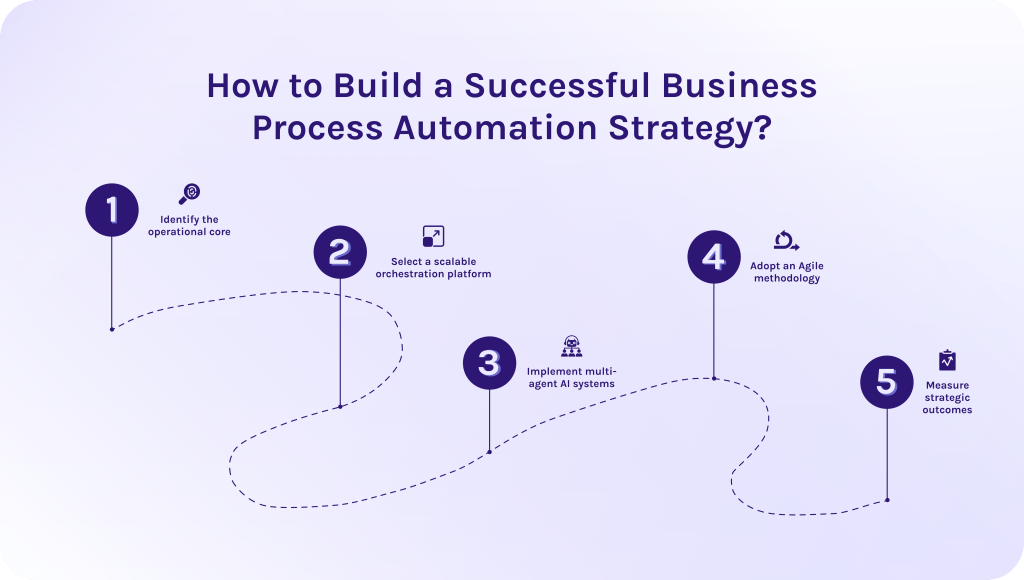
- Identify the operational core. The first step is identifying high-impact processes that suffer from long wait times and extra costs. Look for areas characterized by complex coordination between multiple parties [9].
- Select a scalable orchestration platform. Note that as your business grows, the software should handle growing capacity as well. Our suggestion here is to avoid completely no-code solutions and pay your attention to hybrid ones.
- Implement multi-agent AI systems. Use AI agents to take over specific roles, such as an “AI marketer” that can autonomously create content and redesign websites in minutes. As well, ensure agents work in a containerized environment to keep the architecture transparent and easy to maintain [11].
- Adopt an Agile methodology. Building complex autonomous architecture should be done iteratively to ensure rapid growth [10].
- Measure strategic outcomes. Success should be measured by the ability to scale without increasing headcount.
Read More: A Guide to the Best Risk Management Software
Conclusion
Over time, business process automation (BPA) has evolved into a strategic necessity for any organization looking to thrive in 2026. By delegating repetitive tasks to specialized software, companies can transform their daily operations into a seamless digital ecosystem where data flows without disruptions [15].
As one of the leading business process automation companies, HYS Enterprise specializes in architecting digital ecosystems where data flows seamlessly between your CRM, ERP, and communication tools. Contact our experts to help you identify high-impact bottlenecks and implement scalable solutions that decouple your growth from headcount and boost performance of your business.
FAQs
1. What is business process automation?
It is a process of implementing particular software solutions to automate repetitive or time-consuming tasks such as billing, reporting, or approvals. At the same time, it helps to simplify complex business processes and delegate some work to software to increase accuracy and avoid human error.
2. How does business process automation work?
Generally speaking, the business process automation solution manages the sequence of events between connected departments to optimize the entire business workflow. It uses predefined rules and logic to automatically handle routine tasks and address occurring bottlenecks on its own to keep performance stable and consistent.
3. What is low code business process automation?
Low-code business process automation is a way to build automation using drag-and-drop visual interfaces without writing code itself. It is especially valuable for no-code specialists like HR or marketers who can now create their own workflows without any coding experience needed.
4. What are the best business process automation tools?
The best tool will be different for every specific company or industry, as they all cover different business needs and are suitable for different situations. The business process automation tool that covers the needs of almost any industry and can be suitable for businesses of any scale is EpicStaff – AI agent orchestration platform that is already widely used by marketing teams and logistics companies.
5. What are the main business process automation benefits?
Automation of business process helps companies to:
- Significantly reduce operational costs replacing human labor in some moments and giving specialists the opportunity to perform more valuable tasks.
- Increases speed of execution, helping businesses to scale faster and more confidently.
- Quality of operations overall gets better as accuracy and efficiency increase.
- Compliance and auditability are enhanced.
6. What is the difference between workflow automation and business process automation?
The main difference lies in that simple workflow automation typically covers processes of one specific department or one specific task. Whereas business process automation solutions often connect multiple workflows across the entire enterprise.
7. What are some common business process automation examples?
- In finance, such systems can automatically process invoices to reduce cycle times.
- In HR, business process automation tools can automatically create an IT profile for the new employee, order hardware, send the welcome kit, and schedule 30-60-90 day reviews.
- In customer support, such systems can analyse sentiment, identifying if its urgent and serious issue or not.
8. What industries benefit most from business process automation?
We can confidently say that every industry can get benefits from business process automation software as such tools allow us to simplify processes and reduce errors. However, the most beneficial it will be for complex, multi-department companies within finance, healthcare, telecom, manufacturing to streamline their messy processes and free highly-qualified specialists for more valuable tasks.
9. What role does AI play in business process automation?
In the modern, intelligent business process automation, AI transforms simple task complexion into self-managing process. Such software now can identify bottlenecks by itself and deal with them immediately, without any human intervention needed. As well, such systems can analyse current and historical data about performance to predict future tendencies and needs.
10. How do companies implement business process automation?
To ensure that the business process automation solution won’t ruin the existing workflows and implement it smoothly, companies should take the following steps:
- They must identify where processes get stuck and why they actually need the software.
- After that, define indispensable functions and nice-to-have ones.
- While searching for the appropriate tool, evaluate the full cost of ownership.
- Request for the demo version or free trial to test the software in real-world conditions.
- Ultimately, choose the vendor.
References:
- https://www.researchgate.net/publication/400921685_Intelligent_Workflow_Automation
- https://www.researchgate.net/publication/398820912_Workflow_Automation_with_LLMs_Practical_Guide_for_2025
- https://www.researchgate.net/publication/383578205_User_Interface_Design_and_Usability_in_Information_Systems
- https://gitnux.org/workflow-automation-statistics/
- https://wifitalents.com/ai-workflow-automation-statistics/
- https://www.researchgate.net/publication/387151672_AI_Agents
- https://www.researchgate.net/publication/380399051_Predictive_Analytics_An_Overview_of_Evolving_Trends_and_Methodologies
- https://www.researchgate.net/publication/385782580_Low-CodeNo-Code_Platforms_and_Their_Impact_on_Traditional_Software_Development_A_Literature_Review
- https://www.researchgate.net/publication/381103871_How_to_conduct_successful_business_process_automation_projects_An_analysis_of_key_factors_in_the_context_of_robotic_process_automation
- https://www.researchgate.net/publication/368661694_Business_Process_Automation
- https://www.researchgate.net/publication/389350729_Multi-Agent_Systems
- https://www.researchgate.net/publication/369166448_Business_process_automation_New_challenges_to_increasing_the_efficiency_and_competitiveness_of_companies
- https://www.researchgate.net/post/What_is_Agentic_AI_Agentic_Artificial_Intelligence_Explained_The_Future_of_Autonomous_Intelligence
- https://www.researchgate.net/publication/396212502_Agentic_AI_Systems_A_Review_of_Architectures_Autonomy_and_Ethical_Implications
- https://www.researchgate.net/publication/392892294_BUSINESS_PROCESS_AUTOMATION_IN_BUSINESS_ANALYTICS
