
What is a Value Management Office (VMO)?
First of all, I want to start with the term “value” itself. What is the business value?
“A business is a value creation and distribution process. Before you can sell value to your customers, you have to first create it.”
– Pooja Agnihotri, 17 Reasons Why Businesses Fail :Unscrew Yourself From Business Failure [2].
A value management office in project management (also called value delivery office sometimes) is a strategic portfolio management team within an organization. In a nutshell, the responsibility of a value management office is to ensure that all projects and resources generate measurable business outcomes. It can be higher revenue, reduced costs, or improved customer satisfaction – anything that is valuable specifically for your organization.
Read More: Best Critical Path Software and Modern CPM Tools for Project Management
What Are the Key Aspects of a Successful Value Management Office?
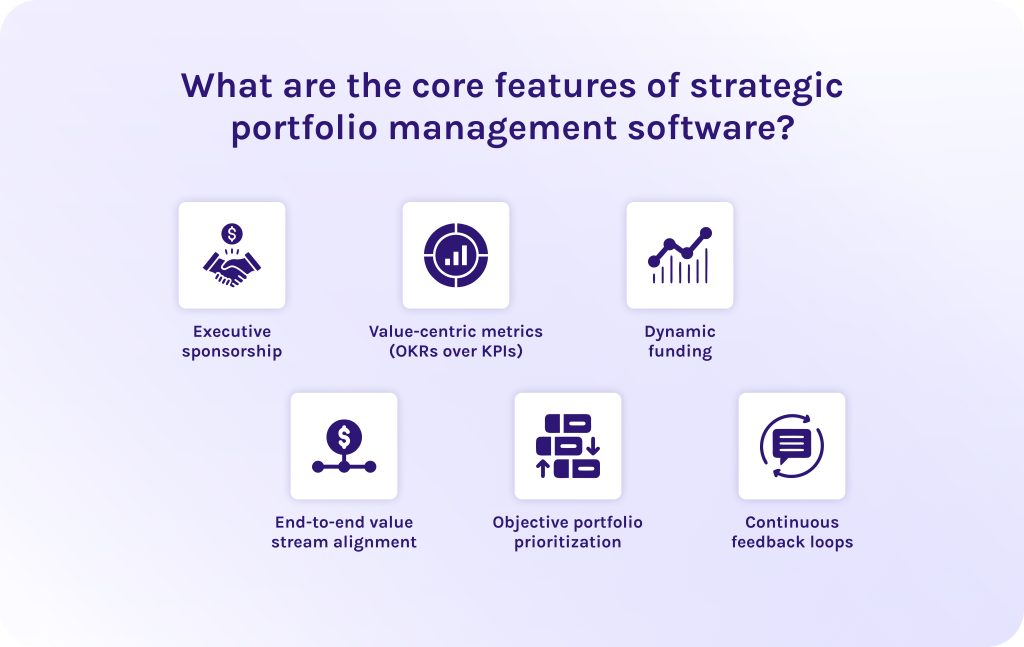
While writing this article, I’ve discovered five aspects that describe a truly successful value management office:
- Executive sponsorship. It ensures the value delivery office has the authority to reallocate resources and drive culture shifts across the enterprise.
- Value-centric metrics (OKRs over KPIs). Here, success of projects and initiatives is measured directly by actual business outcomes and customer impact.
- Dynamic funding. Value management office replaces annual budgeting with incremental funding. It allows organizations to shift capital quickly toward more valuable initiatives.
- End-to-end value stream alignment. In VMO businesses, teams are structured around the complete lifecycle of customer value delivery. This project management model eliminates delays and optimizes flow.
- Objective portfolio prioritization. When you use objective decision-making frameworks like WSJF (weighted shortest job first) or Eisenhower’s matrix, you ensure investments are prioritized based on real strategic value.
- Continuous feedback loops. Value management enables teams to test hypotheses early and pivot fast when assumptions prove wrong.
VMO vs. PMO: What Is the Difference?
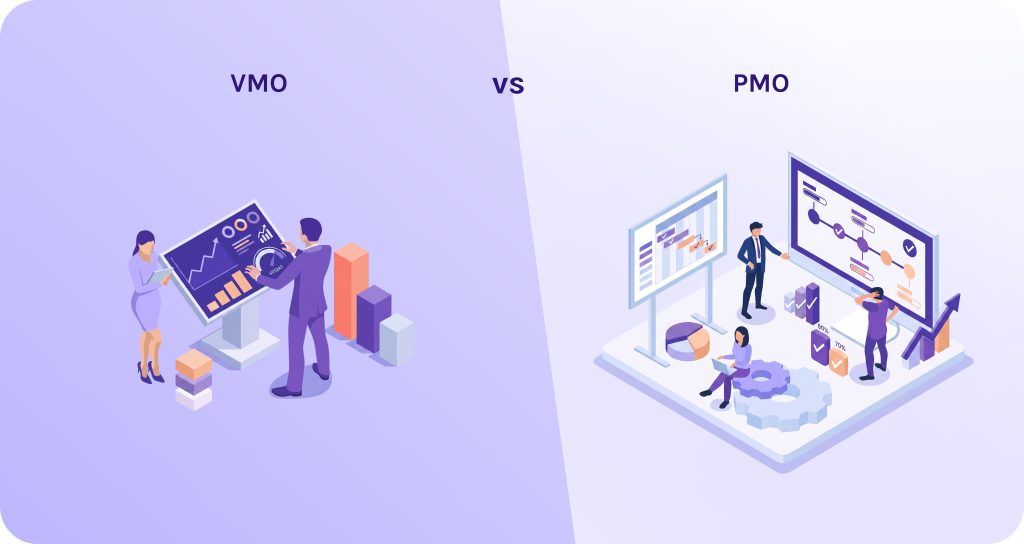
To understand the core difference, let’s, first of all, take a quick look at the definitions.
- VMO definition says that a value management office is a strategic oversight body focused on optimizing, funding, and measuring business outcomes across value streams.
- PMO definition highlights a project management office as an operational body focused on driving project execution and enforcing unified standards across the entire organization.
Which is better: Value Management Office vs PMO?
If we’re talking about which project management approach, VMO or PMO, is better globally, the answer is quite simple – neither. Because they serve fundamentally different purposes. But, in your personal case, look at what you need to improve:
- If you need to improve project management standards, operational execution, and discipline, PMO suits you the best.
- If you need to focus on strategic goals and outcomes-based governance, VMO will be a decent choice for you.
Modern high-performing enterprises often integrate both, using a value delivery office in project management to direct investments where they yield the highest ROI and leveraging PMO discipline to ensure smooth execution.
Read More: Best Engineering Project Management Tools: Complete Guide & Comparison
Core Value Management Office Responsibilities
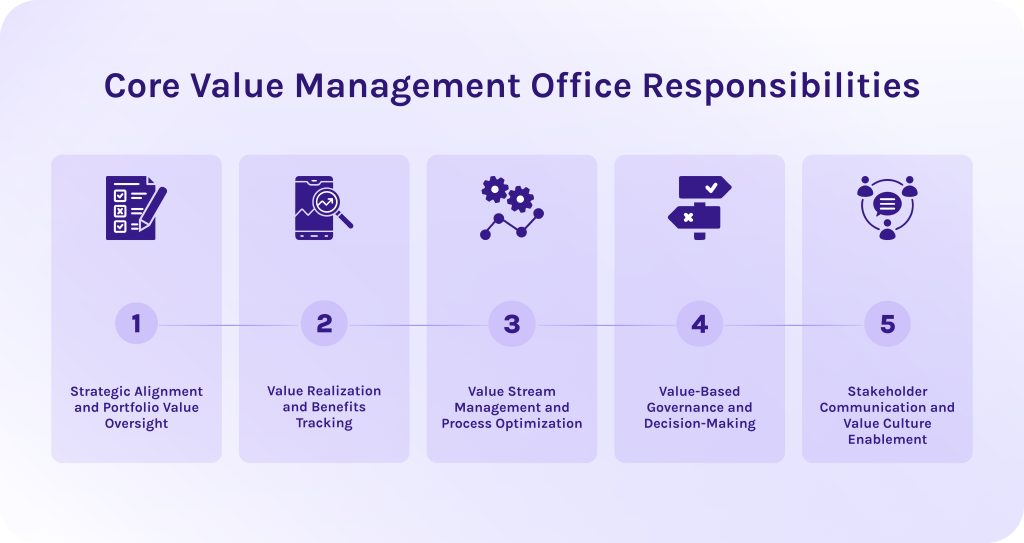
#1 Strategic Alignment and Portfolio Value Oversight
The main goal of an efficient value management office is to connect everyday teamwork to the high-level strategic goals. Here, initiatives are funded only if they directly map to active OKRs or strategic priorities. Moreover, work is continuously re-evaluated so teams stop building features that no longer align with market shifts.
#2 Value Realization and Benefits Tracking
Companies shift their focus from just project delivery to thinking about value delivered and strategic impact. Implementing value management office is all about measuring business metrics like growing revenue or percentage of customer retention and continuously tracking performance.
#3 Value Stream Management and Process Optimization
Now, organizations view the entire flow of work as a way to optimize delivery from initial concept to the final customer. With value management office companies:
- Eliminate waste like delays or unnecessary processes between departments.
- Accelerate time-to-market, improving velocity across the entire system.
#4 Value-Based Governance and Decision-Making
Companies also change their approaches to overseeing projects and initiatives to more flexible ones. In the value management office, all funding is released incrementally based on progress, not all at once. As well, enterprises prioritize their projects objectively, relying on scoring methodologies like WSJF (Weighted Shortest Job First). It removes gut feeling and subjectivity from decision-making.
#5 Stakeholder Communication and Value Culture Enablement
The need to foster a culture of continuous value delivery can be explained by the reality that even the best strategies fail if teams remain siloed. It makes it essential to build an environment where transparent communication and shared strategic goals replace traditional task-oriented mindsets. That is why department leaders in modern enterprises usually unite around shared value streams rather than isolated budgets or tasks.
Read More: 10 AI Project Management Tools to Pay Your Attention to in 2026
The Benefits of a Value Management Office
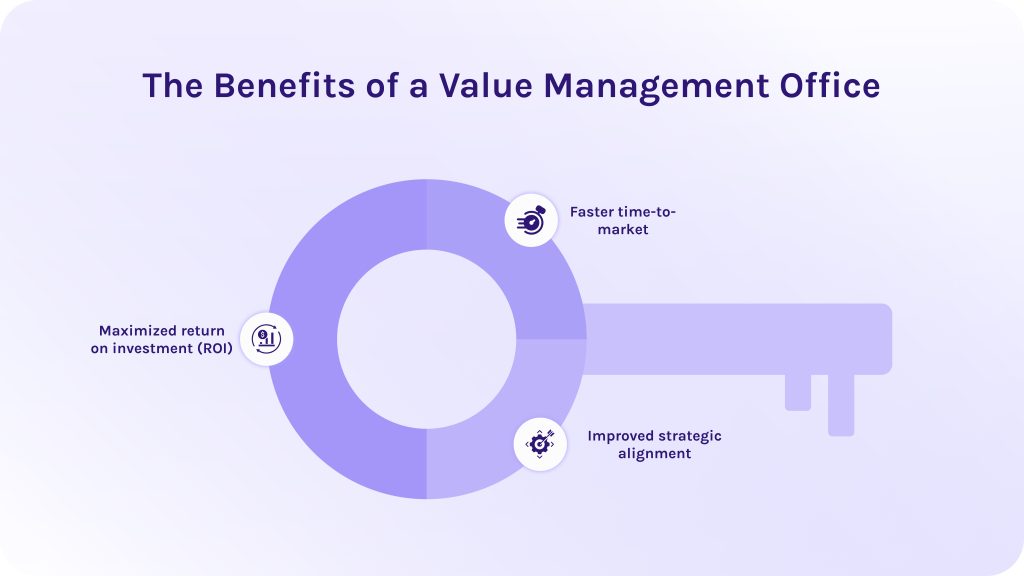
1. Maximized return on investment (ROI).
The value management office replaces static annual budgets with dynamic funding. It, in turn, allows organizations to rapidly defund underperforming initiatives and reallocate capital toward high-ROI opportunities. Recent research says that implementing a structured value management framework directly accounts for up to 60% of project success variance, delivering typical cost savings of 10% to 40% without reducing quality or scope [1].
2. Faster time-to-market.
Secondly, the value management office eliminates bureaucratic handoffs and approval delays. Thanks to it, workflows become more streamlined and efficient, which drastically reduces lead times, enabling agile teams to deliver features and updates to customers far quicker.
3. Improved strategic alignment.
A value management office grounds the entire portfolio in measurable OKRs to ensure that execution remains tied to high-level strategy.
Read More: Enterprise Workflow Automation: The Key to Scalable Operations
Conclusion
Let’s quickly summarize the main points of the article:
- Value management office is a project management model used to measure project success based on strategic value and business outcomes.
- Traditional project management falls short because it focuses on project delivery itself, not taking into account business value.
- VMO differs from PMO in a way that it focuses on bringing more flexibility to find new ways to deliver strategic value. In turn, PMO is focused on project management standards and unified processes.
- To choose which approach, VMO or PMO, you personally need more, look at your pain points: if it’s discipline and unstandardized processes, choose PMO; if it’s a focus on strategic value, choose VMO.
- VMO brings strategic alignment, helps you invest wisely (incrementally, depending on the progress) to avoid overspending in low-value projects. Moreover, it maximizes ROI and accelerates time-to-market.
FAQs
1. What does VMO stand for?
VMO stands for value management office. It is a department within the organization responsible for implementing Lean methodology principles across the agile teams.
2. What is a value management office?
A value management office (VMO) meaning is a strategic team within the organization that ensures every initiative and investment directly delivers measurable business outcomes and strategic value.
3. What is the focus of the value management office?
The primary focus of a VMO is to ensure that resources you use and projects you execute directly drive measurable business outcomes. This strategic portfolio management model helps to accelerate business growth and achieve strategic goals faster.
4. How does a VMO differ from a traditional PMO?
VMO (value management office) focuses mainly on delivering measurable business value. In turn, PMO’s (project management office) main goal is to standardize project management workflows across the entire company and improve discipline.
5. Why are companies switching from PMOs to VMOs?
Companies are now transitioning to value management offices because delivering projects on time doesn’t guarantee business success. Instead, you need to deliver strategic value. Value management offices align spending with real-time market needs, reducing wasted capital on low-value initiatives.
6. What are the responsibilities of a VMO?
7. How does a VMO define value?
There is no just one value. Within the VMO, we can define different values connected to different business processes:
8. How does a VMO prioritize projects?
Agile value management office uses different scoring models to measure the value of each ongoing or upcoming initiative:
9. What role does Agile play in a VMO?
Agile provides the operational backbone for a VMO. Traditional PMOs suit “Waterfall” delivery, while a VMO relies on Agile principles, like incremental delivery or short feedback loops.
10. What is “Value Stream Mapping” in a VMO?
Value stream mapping (VSM) is a lean management tool that companies use to visualize and optimize every step required to deliver a product or service to a customer.
References
1. “Evaluating the Impact of Value Management Phases on Project Success in Construction Projects: An Empirical Study Using PLS-SEM and IPMA”
https://www.researchgate.net/publication/397373123_Evaluating_the_Impact_of_Value_Management_Phases_on_Project_Success_in_Construction_Projects_An_Empirical_Study_Using_PLS-SEM_and_IPMA
2. “17 Reasons Why Businesses Fail :Unscrew Yourself From Business Failure”
https://www.goodreads.com/book/show/56990341-17-reasons-why-businesses-fail
3. “What Is a Value Management Office? An Implementation Experience in Latin America”
https://www.researchgate.net/publication/325034601_What_Is_a_Value_Management_Office_An_Implementation_Experience_in_Latin_America
4. “Value Management as an Organizational Capability Full Paper”
https://www.researchgate.net/publication/344467792_Value_Management_as_an_Organizational_Capability_Full_Paper
5. “Quantifying Outcomes for Project Management in a Value Management Office”
https://www.researchgate.net/publication/344599258_Quantifying_Outcomes_for_Project_Management_in_a_Value_Management_Office
6. “Value Management in Healthcare: How to Establish a Value Management Office to Support Value-Based Outcomes in Healthcare”
https://www.researchgate.net/publication/387237464_Value_Management_in_Healthcare_How_to_Establish_a_Value_Management_Office_to_Support_Value-Based_Outcomes_in_Healthcare
7. https://framework.scaledagile.com/value-management-office
8. “Value management”
https://www.researchgate.net/publication/395531919_Value_management