
What Is Digital Transformation in Logistics?
To begin with, let’s talk about digital transformation definition.
Digital transformation in transportation and logistics refers to the process of integration of modern technologies into logistics and transportation operations to meet increasing market demand and ever-changing customer expectations. Furthermore, it helps to improve efficiency and visibility across activities related to supply chains, which, in turn, helps to manage shipments, warehouses, and transportation networks more accurately.
Read More: AI and the Future of Modern Logistics
Traditional logistics vs. Digital logistics
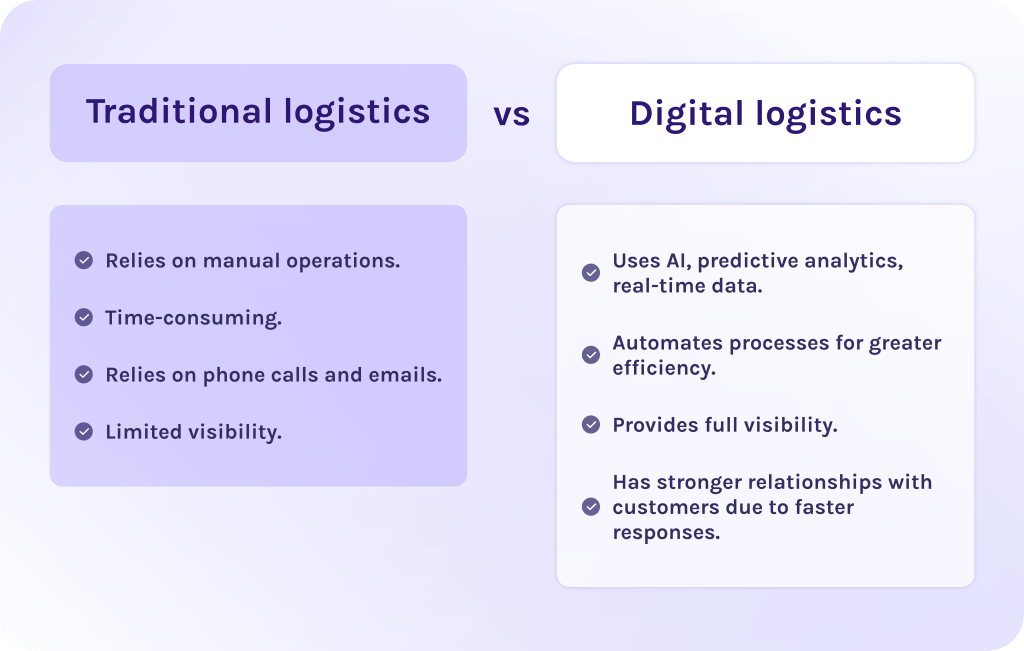
In simple terms, in traditional logistics companies ship goods from a warehouse to a customer using periodic status updates that are entered manually from the carrier. As well, they contact clients through phone calls or emails, without any automation. If the delay occurs due to traffic or weather, the company often finds it out hours or even days later, usually when the customer has already complained.
It leads to the escalation of the following issues:
- Decreasing customer loyalty.
- Higher costs in order to make monetary compensations and cover expenses caused by delays.
- Repetition of problems and delays due to lack of visibility and transparency.
However, digital solutions for logistics allow companies to track the shipments in real time using connected systems and sensors. If disruption occurs, the system immediately:
- Flags the issue.
- Suggests the alternative route.
- Updates delivery time automatically.
Moreover, both the logistics team and the customer receive real-time updates and are aware of changes. It, in turn, helps to solve problems faster as well as communicate proactively to find the best solution for both sides.
Historically, the strength of a logistics provider was measured by the size of their fleet or the square footage of their warehouses. Today, the competitive advantage has significantly changed – if you have successfully adopted IoT services, artificial intelligence, machine learning, blockchain, and automation, be sure that you did the right thing. Why? Because all these changes and innovations will pay off a hundredfold in several advantages, which we’ll discuss in the following section.
Read More: How to Efficiently Allocate Resources for High-Priority Projects and Initiatives
The Benefits of Digital Transformation in Logistics
Why does every logistics company need to enable digital transformation? Well, the answer lies in the following points:
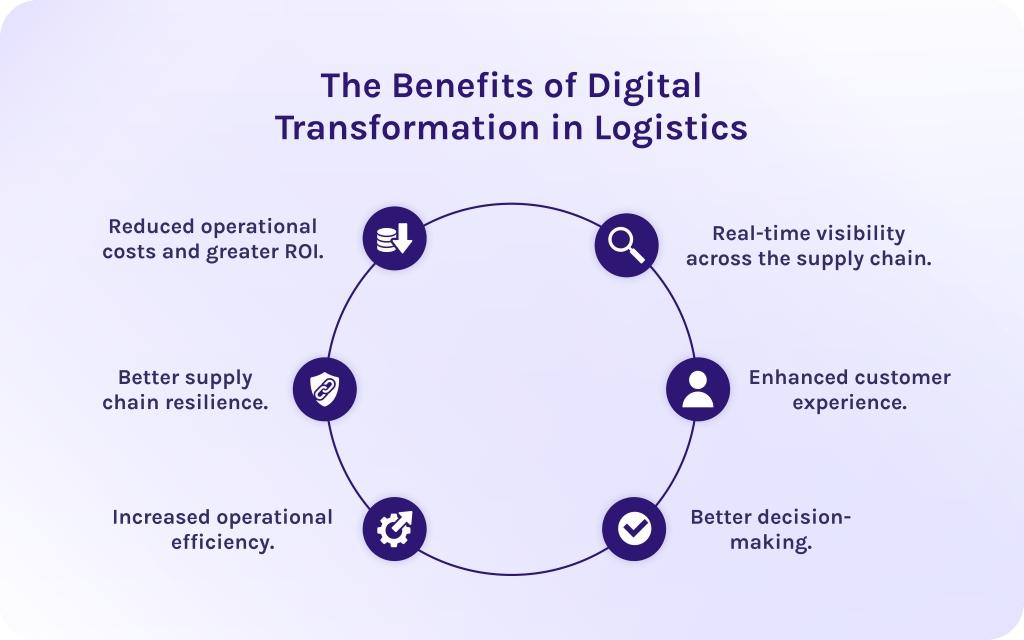
1. Reduced operational costs and greater ROI.
Digital transformation in transportation industry reduces costs while increasing profitability. Logistics companies now are able to automate repetitive tasks, which results in saving employees time for more important tasks. Moreover, it also pays off in:
- Reducing fuel costs.
- Optimizing routes.
- Improving warehouse utilization.
- Minimizing waste.
2. Better supply chain resilience.
Digitalization of logistics often results in greater adaptability to disruptions that can possibly occur. In fact, real-time data and advanced predictive analytics help companies to identify and be prepared for risks as early as possible and take full control over the supply chain. Thanks to these digital technologies in logistics, operations become more reliable.
3. Increased operational efficiency.
As you might know, logistics companies struggle with inefficiencies caused by poor risk management and lack of real-time data pretty often. In this case, digital logistics solutions help to make delivery faster and reduce delays, which raises overall efficiency.
4. Real-time visibility across the supply chain.
Without real-time visibility, it takes a lot of time and human effort to manage sometimes complex supply chains as well as pay greater attention to every part of the process. In turn, digital transformation in logistics gives companies a real-time picture of their operations, resulting in:
- Faster responses to disruptions.
- Better coordination across supply chains.
5. Enhanced customer experience.
Digital transformation in logistics allows companies to deliver more quality services like transparent tracking or accurate delivery estimates. For instance, AI-powered chatbots can quickly answer customer questions and suggest taking some actions in order to solve the problem. These chatbots are available even at night, thus helping customers to address even the most sudden situations.
6. Better decision-making.
Access to real-time data in modern logistics is as necessary as breathing. With a constantly changing political situation across plenty of countries, you need to manage geopolitical shifts and deal with uncertainty. Access to the relevant and accurate data helps logistics companies not only forecast the demand but also manage risks and improve overall supply chain performance due to current obstacles.
Read More: The Transformative Role of Generative AI in IoT
Real-World Examples of Digital Transformation in Logistics
One of the most illustrative examples of digital transformation in logistics is HYS Enterprise’s agentic AI platform called EpicStaff. It is purpose-built to create fully autonomous AI teams that can handle complex operational tasks, acting as highly effective digital employees.
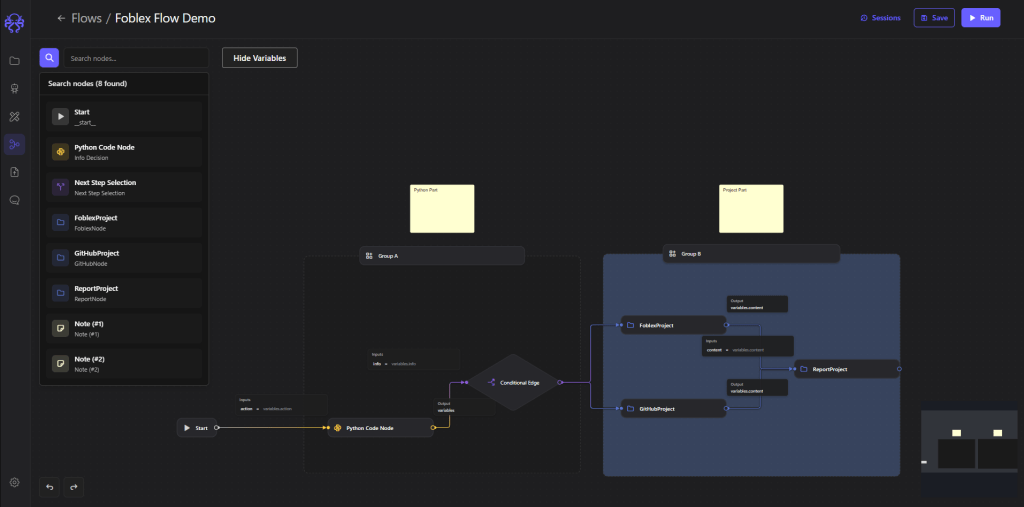
EpicStaff has proven in practice its reliability in helping companies from the logistics industry reduce manual workloads and achieve desired outcomes at the same time. For example, in collaboration with Dutch logistics company Move Your Machine (MYM), EpicStaff enabled:
- The entire business cycle runs autonomously with full transparency.
- 80–90% of the workload shifted to digital employees.
- Price quotes cut from days to seconds, saving ~40% delivery time.
- Autonomous agents handle pricing, orders, and marketing.
- MYM now operates with 2 people instead of 20, achieving record efficiency and 24/7 client control.
If you’re looking for the same level of quality and efficiency, you can leverage EpicStaff to build your unique virtual team. Contact HYS Enterprise today to explore how your logistics operations can achieve similar results.
Read More: FiLogic: An All-in-One Cloud-Based Transportation Management System
Challenges of Digital Transformation in Logistics
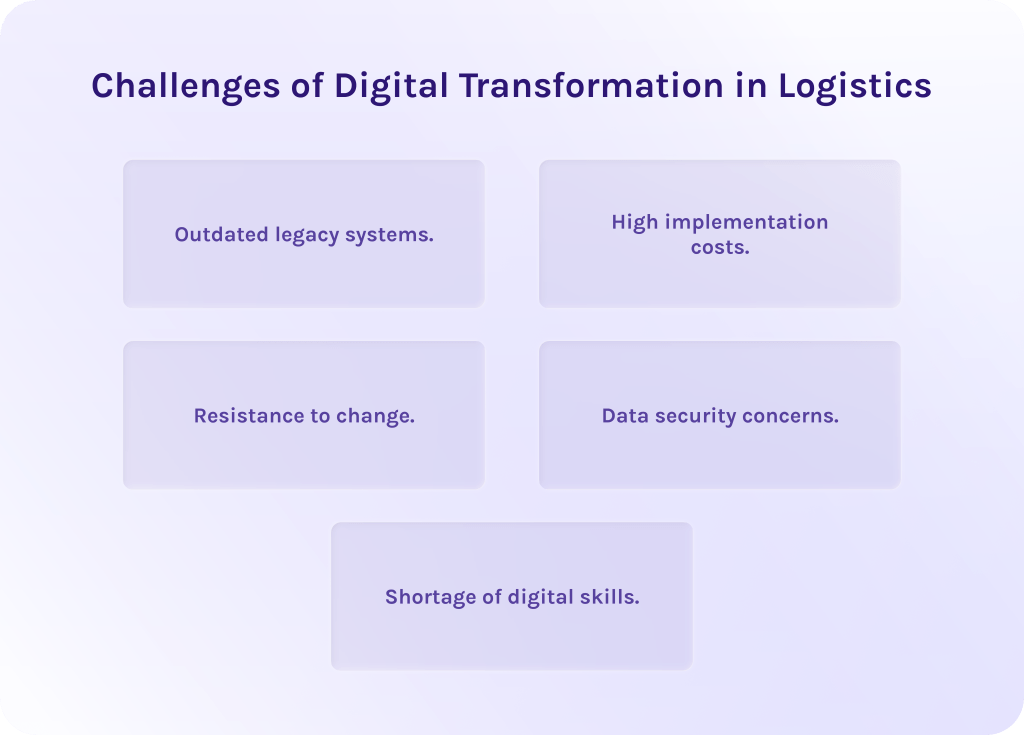
1. Outdated legacy systems.
Many businesses want to start the digitalization of logistics in 2026, but, unfortunately, they still rely on infrastructure built in the early 2010s. Modern technologies require powerful and high-speed 5G data flows, while many existing warehouse management systems (WMS) cannot process data at that velocity.
As a solution, many organizations within the logistics industry are trying to develop so-called “middleware” that would help to connect the latest technologies with legacy systems; thus, old ERP and BSS platforms can understand AI-native data without huge investments or building everything from scratch.
In fact, companies know that they need to go through this shift. As statistics say:
- 67% of logistics and transportation organizations say they have a strategy to digitize their business processes.
- As well, 31% say they are considering such a plan.
- And only 3% of responders say they don’t have any digital transformation strategy.
2. High implementation costs.
This barrier remains a major challenge to transportation digital transformation, particularly for small and mid-sized companies. In fact, upfront costs for autonomous mobile robots (AMRs) and 5G-enabled IoT sensor networks can reach millions for a single distribution center. Additionally, beyond the hardware, companies face “silent” expenses in cloud egress fees, specialized AI talent (which remains in short supply), and the temporary dip in productivity that occurs during the “teething” phase of new systems.
3. Resistance to change.
Technology only works if there are people who will use it. In 2026, in many logistics companies, people perceive artificial intelligence as a threat rather than a helping hand. They fear losing their job and that is why they often sabotage digital transformation in logistics and supply chain and constantly find workarounds to avoid using new digital tools.
The main reason for it is usually a poor digital literacy – a situation when people do not clearly understand how exactly this transformation will work.
4. Data security concerns.
Did you know that cyberattacks happen every 39 seconds all over the world? This moment is extremely important for logistics companies as they operate huge amounts of sensitive data, like shipment details or customer personal information. Consequently, it makes it extremely vulnerable to cyber threats and data breaches.
5. Shortage of digital skills.
Here the statistics sound a bit terrifying:
- The demand for AI and machine learning specialists in the transportation industry is expected to grow by 40% over the next five years.
- 43% of transport and logistics businesses indicate that skill gaps in local labor markets are the leading barrier to the adoption of new technologies.
- Research indicates that 40% of the global logistics workforce will need to be reskilled by 2027 to work alongside AI agents and robots.
Thus, it’s time for companies to rethink their approaches to digital transformation in logistics industry if they want to stay competitive and move ahead.
Read More: Top Telecom Project Management Challenges and How to Overcome Them
Current Trends in Digital Transformation Logistics Solutions
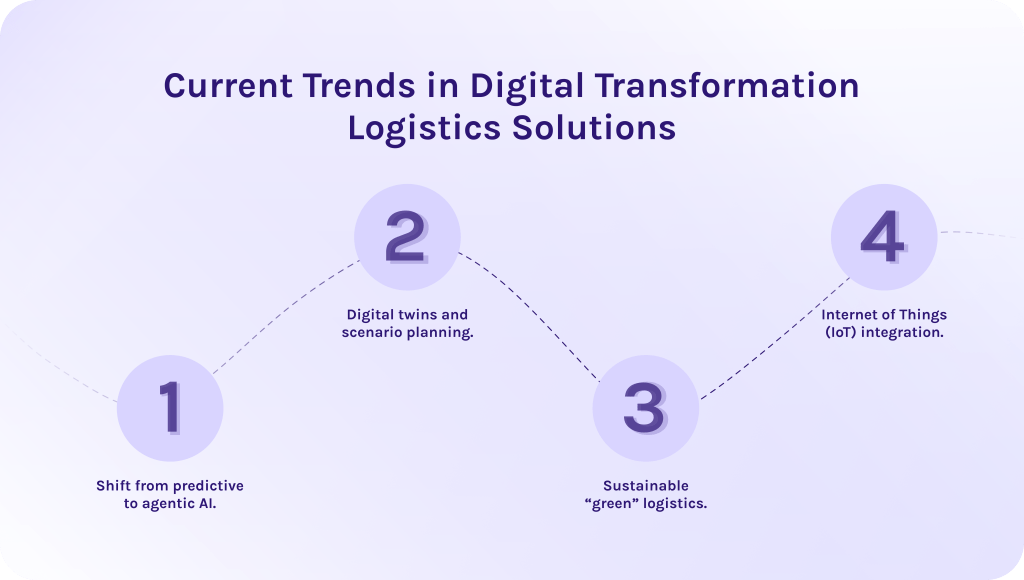
Shift from predictive to agentic AI.
While 2024 was the year of the “Copilot”, 2026 is considered to be the year of agentic AI. Instead of just flagging a delay (predictive), AI systems now have the autonomy to rebook a freight carrier or negotiate a spot rate on their own, acting like a human being.
According to a Capgemini report:
- 67% of executives believe agentic AI will boost productivity.
- 58% say it will transform supply chain frameworks.
If you want to learn how agentic AI can benefit exactly your business, don’t hesitate to explore all capabilities of EpicStaff on its GitHub repository today.
Digital twins and scenario planning.
In simple English, logistics and transportation companies are no longer guessing how to handle disruptions; they simulate them.
The use of Digital Twins (virtual replicas of warehouses and global shipping networks) allows managers to run thousands of “what-if” scenarios and generate possible outcomes, thus resulting in much better preparation for risks. It is reported that this allows for 40% faster order processing in AI-driven warehouses because the optimal layout and workflow have already been perfected in the virtual world.
Sustainable “green” logistics.
In recent years, ecological regulations have become stricter and that is the main reason why sustainability has evolved from a marketing trigger into a compliance-driven requirement. Many companies respond to this trend proactively. For example, DHL is using AI-driven carbon dashboards to track the footprint of every single shipment in real time. Additionally, some logistics companies are adopting electric and low-emission vehicles or paperless documentation to cut down on emissions and waste.
Internet of Things (IoT) integration.
In a nutshell, Internet of Things (IoT) devices as a part of digital transformation in logistics can continuously gather and monitor real-time data on the location, condition, and performance of various assets across the supply chain.
Additionally, sensors are able to monitor vehicle health and fuel consumption with such precision that AI can optimize routes specifically to hit carbon-reduction targets, turning “Green Logistics” into a measurable KPI.
Read More: AI-Driven Automation as the Foundation of Next-Gen SaaS Models
Conclusion
Key Takeaways:
- Digital transformation in logistics refers to the process of integration of modern technologies into transportation operations to meet increasing market demand and helps to improve efficiency and visibility across activities related to supply chains.
- Digital logistics slightly differs from the traditional one. While traditional heavily relies on manual operations and accepts limited visibility, digital logistics seeks to automate as many processes as possible, reducing cost spending and improving overall efficiency.
- With digital transformation in logistics, companies get significant competitive advantages: reduced costs, increased profitability, better decision-making, enhanced customer experience, real-time visibility across the supply chain, increased efficiency, better supply chain resilience.
- The biggest threats in logistics transformation now are shortage of digital skills, data security concerns, resistance to change, outdated legacy systems, and ultimately high implementation costs.
- The tendencies that gain popularity in the digitalization of logistics are Internet of Things (IoT) integration, sustainable “green” logistics, digital twins and scenario planning, shift from predictive to agentic AI.
FAQs
What is digital transformation in logistics?
Digital transformation in logistics is the process of modernizing logistics processes in a way that would improve the efficiency of transportation operations. It involves the ability to:
- Monitor supply chains in real time.
- Automate several processes like gathering data and making detailed reports.
- Analyze large volumes of data to optimize routes, reduce costs, and prevent disruptions.
- Enhance flexibility for faster decision-making.
What are the digital technologies used in logistics?
For digital transformation in transportation companies use IoT sensors, the newest AI models and approaches, robotics, cloud services, data analytics, and automation as well.
What are the latest trends in logistics?
From our perspective, the trends in the logistics industry that deserve the most attention are:
- Shift from predictive to agentic AI.
- Digital twins and scenario planning.
- Sustainable “green” logistics.
- Internet of Things (IoT) integration.
How does technology improve logistics?
Modern technologies such as artificial intelligence or IoT in transportation and logistics automate routine processes, thereby increasing accuracy and reducing costs. Overall, their main goal is to simplify processes and reduce human effort, and they are succeeding in it.
What are the four types of digital transformation?
The four main types of digital transformation include the following ones:
- Process transformation – automating and optimizing workflows.
- Business model transformation – developing new ways of delivering value and finding new revenue streams.
- Domain transformation – entering new markets.
- Organization transformation – new mindset, values, and ways of working.
What are the challenges of adopting digital logistics?
Logistics companies face several challenges that reflect on overall efficiency and transportation performance. We can highlight the following ones:
- Relying on outdated legacy systems.
- High implementation cost.
- Resistance to change.
- Data security concerns.
- Integration complexity.
- Shortage of skilled workers.
What is the difference between traditional logistics and digital logistics?
Traditional logistics relies on manual processes and limited visibility, while digital logistics uses real-time data, connected systems, and automation to manage supply chains in the most efficient possible way.
Why is real-time visibility important in modern logistics?
Real-time visibility is critical in terms of digital transformation efforts, as it allows logistics companies to:
- Track shipments.
- Identify disruptions early.
- Make decisions faster.
- Provide accurate updates to customers.
In general, it results in higher efficiency and reliability.
References
- https://wifitalents.com/digital-transformation-in-the-logistics-industry-statistics/
- https://www.spglobal.com/market-intelligence/en/news-insights/research/logistics-sector-prioritizes-digital-transformation-but-needs-technology-leadership-skills
- https://dataglobehub.com/cybersecurity-statistics-and-insights/
- https://www.ibm.com/thought-leadership/institute-business-value/report/augmented-workforce
- https://www.capgemini.com/news/press-releases/agentic-ai-integration-set-to-accelerate-this-year-among-gen-ai-early-adopters/
- https://www.mynoa.com/en/post/how-ai-is-rewiring-global-logistics-from-warehouse-to-last-mile
- https://www.dhl.com/discover/en-global/logistics-advice/essential-guides/logistics-industry-trends