What Is Logistics and Supply Chain Management?
Supply chain management and logistics represent the strategic and operational framework used to move products from their initial state to the final consumer. While pretty similar, the terms supply chain management and logistics management have significant differences that we’ll discuss in a great detail further.
What Is Logistics Management?
As some researches admit [1], logistics management is the specific discipline within the supply chain that plans, implements, and controls the efficient flow of goods and services and their storage.
The Core Components of Logistics Management
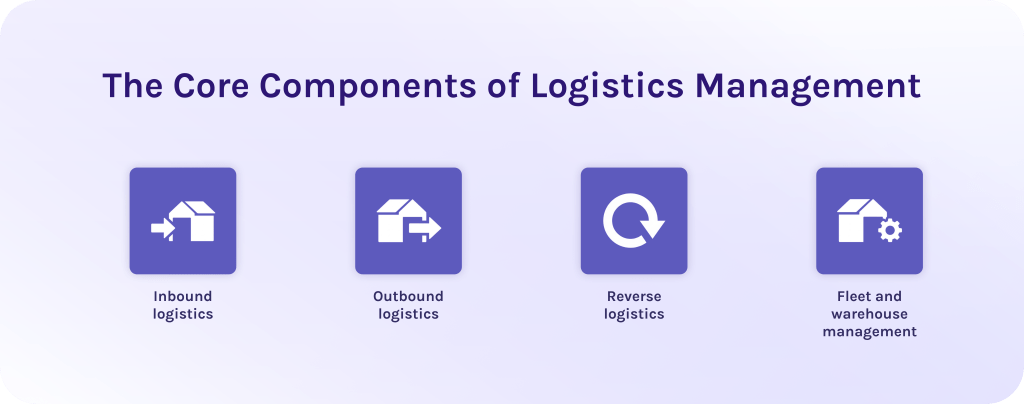
To manage this flow effectively, logistics professionals focus on four primary areas:
- Inbound logistics. It is about managing the relationship with suppliers and the movement of raw materials or semi-finished goods into a manufacturing plant or warehouse.
- Outbound logistics. This component is more physical. It deals with storing ready-to-use products and moving them from the factory to the end-customer.
- Reverse logistics. Handling the backward flow – managing returns, repairs, recycling, and the disposal of packaging.
- Fleet and warehouse management. The last point is about warehouse and route optimization. The main goal here is to understand how to optimize processes to decrease fuel and time consumption.
The “7 R’s” of Logistics
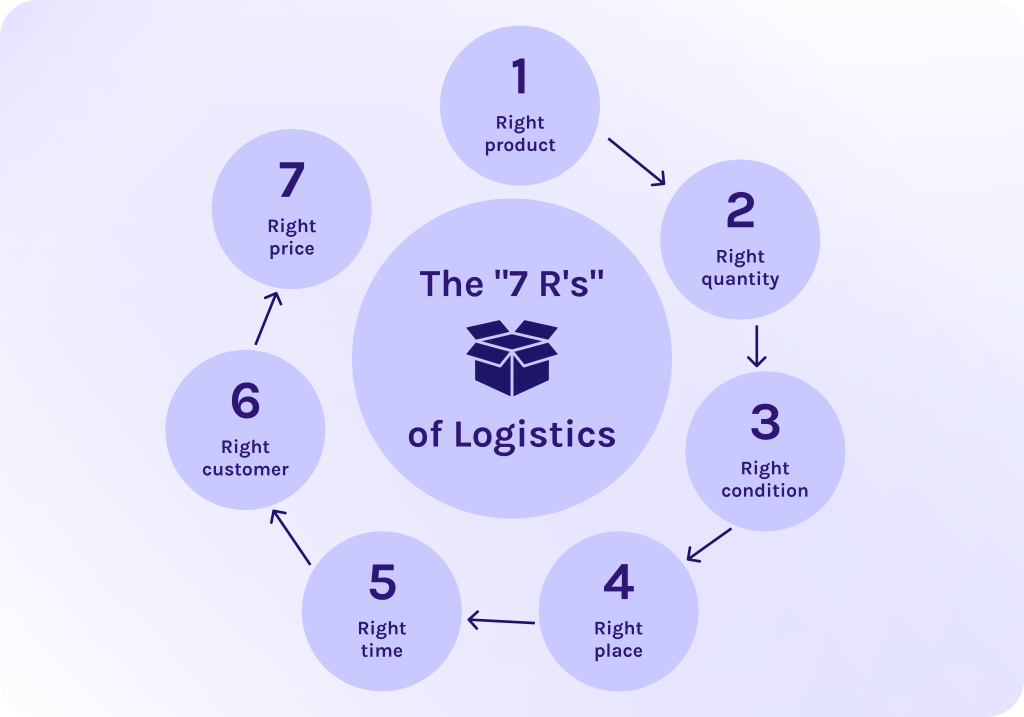
But how exactly would you know if the logistics operations work efficiently and successfully? To measure the success of your logistics operations you can use popular “7 R’s of logistics” framework that describes seven core characteristics of successful logistical operation [2]:
- Right product. Ensuring the correct item is picked.
- Right quantity. Sending the exact amount ordered (no more, no less).
- Right condition. Delivering goods without damage.
- Right place. Getting it to the specific destination.
- Right time. Meeting the delivery deadline.
- Right customer. Delivering to the person who actually bought it.
- Right price. Keeping the entire process cost-effective.
Read More: Digital Transformation in Logistics: From Traditional Operations to Real-Time Supply Chains
What Is Supply Chain Management?
While logistics is about movement, supply chain management (SCM) is about strategy. It is the oversight of the entire lifecycle of a product – from the raw ore in the ground to the recycling bin after the consumer is done with it [9]. It involves managing relationships with suppliers, manufacturers, retailers, and customers to maximize value and gain a competitive advantage [3].
The Key Components of Supply Chain Management
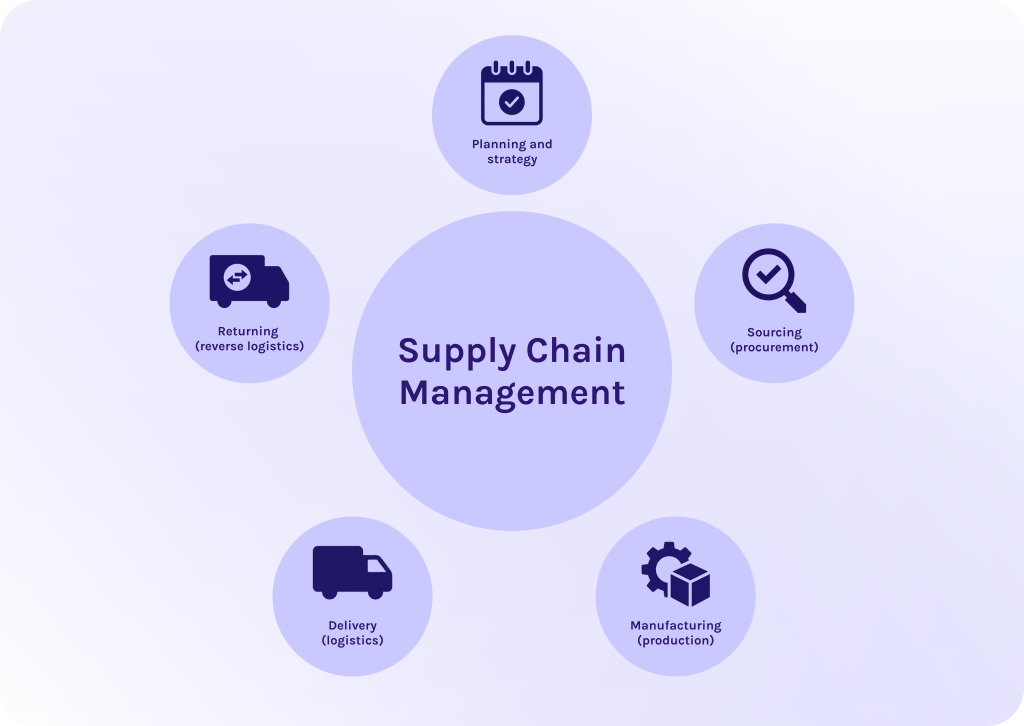
To understand how a product moves from a raw idea to a customer’s doorstep, we look at the five core components of supply chain management (SCM):
- Planning and strategy. At this step, companies must use historical data and predictive analytics to forecast demand. The goal is to balance the cost of holding inventory against the risk of running out of stock [10].
- Sourcing (procurement). The next component involves identifying and managing the vendors who provide the raw materials or components. SCM focuses on building resilient relationships to ensure quality and avoid disruptions.
- Manufacturing (production). This stage turns raw materials into finished goods. It involves scheduling production, testing for quality, and packaging for shipping. Modern SCM focuses on lean manufacturing to reduce waste and improve speed [11].
- Delivery (logistics). This component covers the coordination of customer orders, scheduled deliveries, dispatching loads, and invoicing. It includes the entire last mile process of getting the product to the end user.
- Returning (reverse logistics). It handles the backward flow of defective, unwanted, or excess products. A smooth return process is now a major factor in customer loyalty.
Read More: Supply Chain Digital Transformation: Everything You Need to Know
Supply Chain Management vs Logistics: Key Differences
While the terms logistics management and supply chain management are often used interchangeably in casual conversation, in fact, they represent two different scales of operation [4].
In simple English, the difference is:
- Logistics is a specialized puzzle piece.
- Supply chain management (SCM) is the entire puzzle.
Logistics vs Supply Chain Management Table of Comparison
| Logistics management | Supply chain management | |
| Definition | The integration and maintenance of goods and services. | The coordination of all entities in a product’s lifecycle. |
| Main focus | More about internal operations – movement of goods from point A to point B. | More about external operations – management of customer satisfaction and relationships with vendors. |
| Purpose | Enhanced efficiency and customer satisfaction. | Competitive advantage and long-term business value. |
Innovation in Logistics and Supply Chain Management
The main question today is “What should we expect from supply chain management and logistics in 2026 and the upcoming years?” Well, innovation shifts are significant:
1. Agentic AI and autonomous systems.
The latest and the most promising trend in supply chain management and logistics is the transition from predictive AI to agentic AI, which can make decisions on its own. For instance, AI agents can reroute shipments in real-time to avoid delivery delays and adjust inventory levels across warehouses without human intervention [8].
Do you want to see how it works in practice?
The perfect example for this is collaboration of HYS Enterprise with the Netherlands based logistics company Move Your Machine (further MYM). The founders needed a single logistics and supply chain management software capable of providing price calculations in seconds and full chain automation without creating an unmanageable technical architecture.
What solution did we provide?
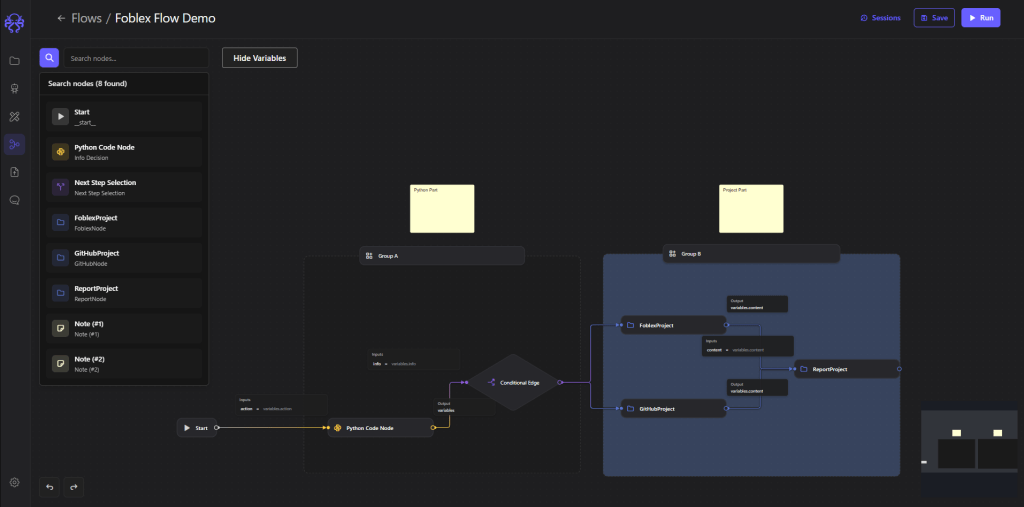
EpicStaff – AI agent-based platform, built on “visual+code” principle. It means that the platform can be used by completely different users – technical specialists with significant coding background on the one hand, and non-technical specialists from the marketing or HR departments on the other. Its strength lies in its complete autonomy and ability to operate independently, with minimum human oversight.
It helped our partners to:
- Manage the entire business supply chain transportation and logistics management cycle, including lead generation, marketing, invoicing, and order transfers.
- Customers can receive real-time price calculations and manage transport directly via WhatsApp.
- 80-90% of the workload was transferred to digital employees, allowing the company to scale with a team of only two people.
- Price calculation time was reduced from days to seconds, saving up to 40% of total delivery time.
Contact HYS Enterprise experts today to discover how our EpicStaff orchestration platform can automate your entire business cycle and empower your team to scale without limits.
Read More: Logistics Management Software: Complete Guide for Modern Supply Chains
2. Digital twins and predictive simulation.
Companies now manage their flow of goods through digital twins – virtual, real-time replicas of their entire physical network. The most common use case for them is to simulate different scenarios of what might happen if you apply some changes to your current processes. For instance, you can test the influence of extreme weather or geopolitical chokepoints on supply chain logistics to deploy contingency plans in a virtual environment before making exact actions or taking a decision.
3. Sustainability and circular logistics.
You’ve certainly heard about three sustainable R’s – reuse, reduce, and recycle, core pillars of sustainable logistics and supply chain management. Over the years, sustainability has transformed from a marketing buzzword to a strategic regulatory necessity without which companies risk losing their competitive position and customer trust.
Key drivers for this transition are:
- Global logistics and supply chain management companies are moving beyond simple carbon offsets toward circular flows that prioritize the repair, reuse, and recycling of materials from the initial design phase.
- New global regulations in supply chain logistics are mandating the use of digital product passports and blockchain to provide real-time data on the environmental impact of every shipment [14].
- Logistics is increasingly integrating renewable energy while transitioning from single-use packaging to durable and reusable assets [15].
Read More: Logistics Trends Shaping the Transportation and Logistics Industry
Conclusion
Even though it seems like supply chain management and logistics are indistinguishable, they are definitely two sides of the same coin, closely connected, yet different in scope and purpose.
- Logistics is a part of supply chain operations that is responsible for movement of goods across warehouses and for delivering them to the end user [12].
- Whereas, supply chain management is a much broader concept that includes logistics but more focused on the business strategy and relationships with clients and customers [13].
Ultimately, the most competitive companies are those that no longer view logistics as a mere cost center but as a high-tech extension of their broader supply chain strategy. By harmonizing these two activities, businesses can achieve a level of agility and efficiency that was previously impossible, transforming global volatility into a sustainable competitive advantage [5].
FAQs
1. What is logistics and supply chain management?
It is typically described as a combined process of the product’s path from its raw state to the end customer. Moreover, being often grouped together, they actually two different sides of the one process:
- Logistics management. Is considered to be a part of the supply chain. Its primary goal is to execute tasks like moving goods, storing them in warehouses, and getting them to a destination as efficiently and cheaply as possible.
- Supply chain management (SCM). In turn, it is a more general process that includes logistics. It links lots of vendors and retailers together to make sure the company has the right partnerships and resources to beat out competitors in the long run.
2. What is the difference between logistics and supply chain management?
The main difference can be understood from the definitions. Supply chain management is a more broad process that includes logistics as one of its key components. Logistics, in turn, is a more specific process of handling goods paths, their storage and distribution.
3. How do supply chain management and logistics work together?
Supply chain handles more strategic moments like relationships between suppliers and vendors and even handling reverse flows like returns or recycling after customers are finished with products. While logistics is responsible for physical operations such as movement of goods to the end customer or warehousing.
4. Why is supply chain management vs logistics often confused?
People confuse these terms because their functions are pretty much the same: both aim to get a product to a customer efficiently – and in smaller businesses, one person typically handles both roles.
5. What role does logistics management play in the supply chain?
Logistics management acts as the operational engine of the supply chain, specifically responsible for the physical movement and storage of goods. It ensures that the overarching supply chain strategy succeeds by getting the right products to the correct location at the precise time promised to the customer [17].
6. What is the difference between a 3PL and a 4PL provider?
3PL stands for third-party logistics, where a hands-on provider owns or manages the physical assets like trucks and warehouses to ship your goods. In turn, 4PL providers, consequently, stand for fourth-party logistics that manages your entire supply chain, including coordinating multiple 3PLs on your behalf [18] [19].
7. What are the main goals of supply chain management and logistics?
- The primary goal of supply chain management is to create a long-term competitive advantage by optimizing relationships and processes from raw materials to the final customer [20].
- Logistics focuses on the immediate operational goal of geographical movement, ensuring products are delivered at the lowest possible cost with the highest speed and accuracy [1].
- Ultimately, both work together to maximize customer satisfaction while minimizing total operational waste.
8. Is supply chain and logistics management a good career?
Yes, it is an excellent career because global trade is essentially recession-proof – goods always need to move, regardless of the economy. The field offers high demand, competitive salaries, and diverse roles ranging from data-driven AI analysts to hands-on operations managers [21].
9. How does sustainable logistics and supply chain management reduce environmental impact
Sustainable logistics and SCM aims to reduce carbon footprint reduction Using AI for route optimization to optimize routes and switching to electric or alternative-fuel vehicles. As well, implementation of circular logistics plays a critical role because products are designed for repair, reuse, or recycling from the start [16].
10. What challenges do companies face in logistics management?
Logistics was always extremely susceptible to geopolitical shifts or weather conditions, but today its complexity has risen significantly. Usually, logistics struggle with:
- High levels of geopolitical uncertainty and occurring crises.
- Increased need in environmental protection and compliance to ESG standards.
- Rising number of cyberattacks and rapid technological shifts.
- Talented labour shortages.
- Ultimately, all those challenges lead to one general – escalating operational costs.
References
- https://www.researchgate.net/publication/389004217_Evaluating_the_Role_of_Logistics_in_Supply_Chain_Management
- https://ciltuk.org.uk/Knowledge/Knowledge-Bank/Resources/Other-Resources/Useful-glossaries
- https://www.researchgate.net/publication/304194361_Supply_Chain_Management
- https://www.researchgate.net/publication/350499583_Logistics
- https://www.researchgate.net/publication/395368791_Trends_in_Logistics_-_Future_Plans
- https://www.researchgate.net/publication/348975753_A_Study_of_Inbound_Logistics_Mode_Based_on_JIT_Production_in_Cruise_Ship_Construction
- https://www.researchgate.net/publication/373123386_Research_on_integrated_inventory_transportation_optimization_of_inbound_logistics_via_a_VMI-TPL_model_of_an_existing_enterprise
- https://www.researchgate.net/publication/391373257_AI_Agents
- https://www.researchgate.net/publication/375792325_WHY_SUPPLY_CHAIN_MANAGEMENT_IS_SO_RELEVANT_IN_THIS_ERA_OF_GLOBALIZATION
- https://www.researchgate.net/publication/290430721_Supply_Chain_Management_Components_Competitiveness_and_Organisational_Performance_Causal_Study_of_Manufacturing_Firms
- https://www.researchgate.net/publication/386106344_Key_Elements_and_Concepts_in_Supply_Chain_Management_A_Primer_for_New_Entrepreneurs
- https://www.researchgate.net/publication/339534742_LOGISTICS_MANAGEMENT_FEATURES_AND_PRINCIPLES
- https://www.researchgate.net/publication/396699744_supply_chain_management
- https://www.researchgate.net/publication/359736841_Principles_of_Sustainable_Logistics
- https://www.researchgate.net/publication/377384699_Sustainable_logistic
- https://www.researchgate.net/publication/398777788_Sustainable_logistics_in_2025_a_review_of_key_trends_and_strategic_challenges
- https://www.researchgate.net/publication/395650121_Exploring_the_Role_of_Logistics_in_Enhancing_Supply_Chain_Management_Value
- https://www.researchgate.net/publication/384334813_Third-Party_Logistics_3PL_and_Supply_Chain_Efficiency
- https://www.researchgate.net/publication/390626643_IMPACT_OF_FOURTH-PARTY_LOGISTICS_4PL_ON_ENHANCING_SUPPLY_CHAIN_STABILITY_IN_PORT_LOGISTICS_SERVICES
- https://www.researchgate.net/publication/374210996_Supply_Chain_Management_and_Logistics_How_Important_Interconnection_Is_for_Business_Success
- https://www.researchgate.net/publication/228313333_Skills_Management_Knowledge_or_Logistics_Expertise_-_What_Do_Logistics_Managers_in_Clothing_Companies_Really_Need
