What Is Enterprise Workflow Automation?
Generally, workflow automation is a delegation of tedious, repetitive, time-consuming tasks to the specialized programs that will execute these tasks based on predefined rules and algorithms. If we are talking about simple process automation, typically, it can be automated emails or, for instance, data synchronization between different applications.
However, in terms of enterprise workflow automation, the scale of these operations is much bigger. Here algorithms handle operations across multiple departments or even geographical locations simultaneously, ensuring a smooth flow of processes of different complexity without losing performance efficiency.
Read More: Empowering Your Workflow: Unveiling the Surprisingly Diverse Uses of Large Language Models
Why Enterprise Operations Break at Scale
There is no company that starts immediately with a team of 5,000 people. And while growing, the resources and tools that were helpful at the beginning may not only slow processes but create much more complex challenges.
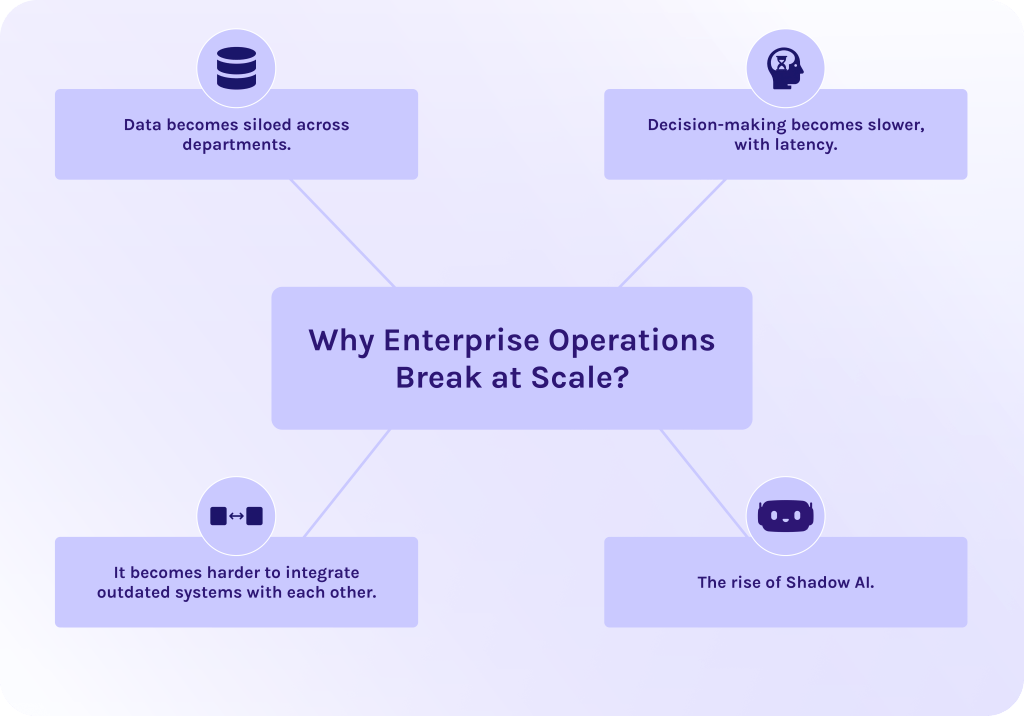
1. Data becomes siloed across departments.
When you operate a small team where everyone knows what everyone else is doing, process automation isn’t that difficult yet. However, with time, while scaling, your operations may become more complex and isolated from each other. Important information isn’t shared across departments, so teams make decisions without knowing what others are doing. That is why if a minor problem occurs, it can stay invisible until it eventually spreads across teams, causing a chain reaction of disruptions [1].
2. Decision-making becomes slower, with latency.
When a company scales, leadership often struggles to delegate. Too many decisions are centralized at the top, so everyday operations slow down because employees must wait for leadership approval. Tasks pile up while waiting for decisions, creating delays that make the company slow to react and less competitive [2].
3. It becomes harder to integrate outdated systems with each other.
When the company needs a new tool to cover extended business functions, it often patches together different software for different needs instead of creating one combined solution.
Thus, employees end up manually moving information between systems because the software cannot exchange data automatically. Consequently, mistakes become more common, and employees waste large amounts of time on routine administrative work instead of really valuable tasks.
4. The rise of Shadow AI.
Shadow AI is a new threat for companies that occurs because of a lack of AI governance. Employees use unapproved AI and can even feed it with confidential information, which, consequently, leads to data leaks and breaches.
For example, a marketing team might buy their own project management tool or use unsanctioned AI tools because the IT department’s approval process takes six months. This creates massive security holes and compliance nightmares (like GDPR or HIPAA violations) that the company doesn’t even know it’s committing [3].
Read More: How to Efficiently Allocate Resources for High-Priority Projects and Initiatives
Key Business Benefits of Enterprise-Grade Workflow Automation Solutions for Enterprise Leaders
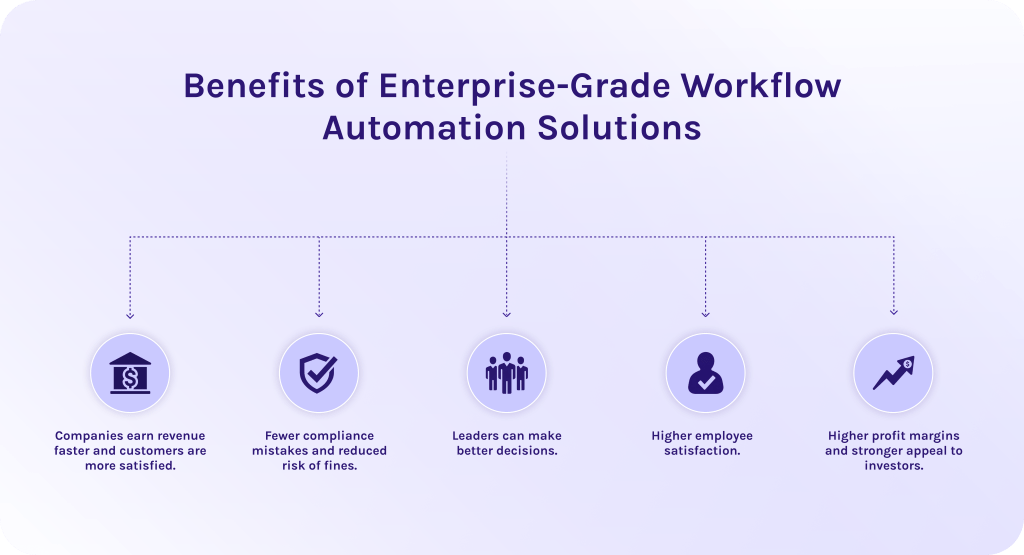
1. Companies earn revenue faster and customers are more satisfied.
It won’t be a surprise for you if I say that companies that complete processes faster gain a competitive advantage. Intelligent workflows remove delays between teams, which, in turn, makes workflows move forward instantly instead of waiting for human intervention.
2. Fewer compliance mistakes and reduced risk of fines.
This problem is especially common in regulated industries because manual processes there increase the risk of mistakes and violations. Thus, here automated workflows ensure that required rules and procedures are always followed because the system enforces them automatically.
3. Leaders can make better decisions.
Enterprise workflow tools create a so-called “single source of truth” for large companies that often struggle with inconsistent data across departments. So workflow solutions help them to avoid data silos and connect different systems so that all teams work with the same accurate, real-time data.
4. Higher employee satisfaction.
It may be obvious that highly skilled employees should not waste their time on repetitive tasks that can instead be spent on more valuable strategic activities. In this case, automated workflows remove routine work so talented employees can focus on strategic and high-value activities [4].
5. Higher profit margins and stronger appeal to investors.
Traditionally, business growth required hiring more staff, but enterprise automation workflow software allows companies to handle more work without increasing the number of employees at the same rate. In other words, you can achieve greater results with the same amount of resources [5].
Read More: How to Maximize Enterprise Productivity with the Power of Microsoft 365
Key Features of Enterprise Workflow Automation Software
The key features in AI workflow automation tools for enterprise are those ones that deliver the most business value and simplify your company’s workflows. These features can be the following ones:
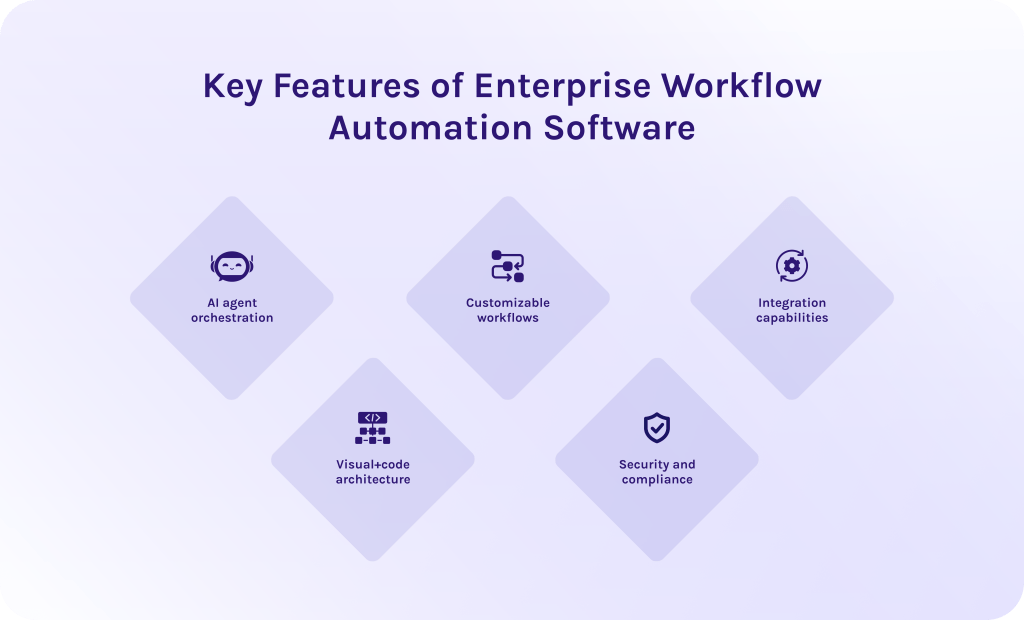
- AI agent orchestration. The ability to create your own AI agents for different tasks and adjust them to any specific activity. The strength of this approach lies in the agent’s autonomy and independence from humans. For instance, you can define the outcome, and the agent plans the steps, selects the tools, and executes across systems.
- Customizable workflows. It is the ability to reconfigure your business logic in minutes to optimize processes and quickly adjust to occurring challenges.
- Integration capabilities. The system must communicate seamlessly with the other software you’re already using to create your own corporate software environment without data silos or duplicate work, ensuring that information flows smoothly across departments in real time [6].
- Visual+code architecture. This feature allows users with different technical backgrounds to collaborate on creating workflows and optimize them without any coding experience needed.
- Security and compliance. To ensure protection from unauthorized access or data breaches, look for enterprise AI workflow automation software that offers features like role-based access control, end-to-end encryption, audit logs, and compliance with industry standards such as GDPR, HIPAA, or SOC 2 [7].
Read More: The Expert’s Eye: The Value of Architects
Top 5 Best Enterprise Workflow Automation Tools
1. EpicStaff
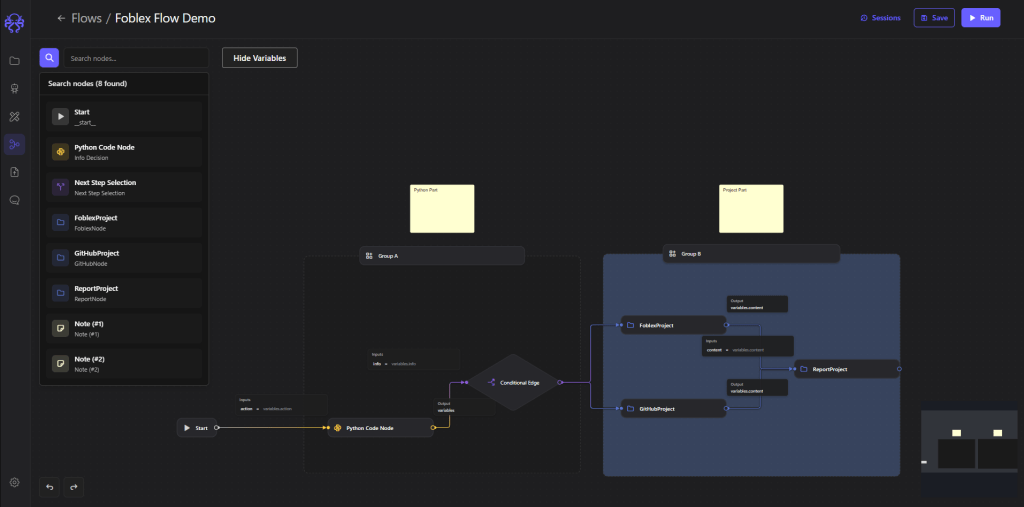
The leader of our list is EpicStaff – modern open-source AI-driven enterprise workflow automation platform with the help of which companies can create and manage complex workflows using an intuitive interface and custom code nodes.
Best for:
- Process AI agent orchestration.
- Enterprise-grade automation.
- Custom workflow design.
- Integration with existing systems.
- Operational visibility.
Explore the capabilities of EpicStaff – join our community on GitHub and start building your own autonomous enterprise AI workflow automation platforms today.
Read More: Top 10 AI Software Development Companies
2. Activepieces
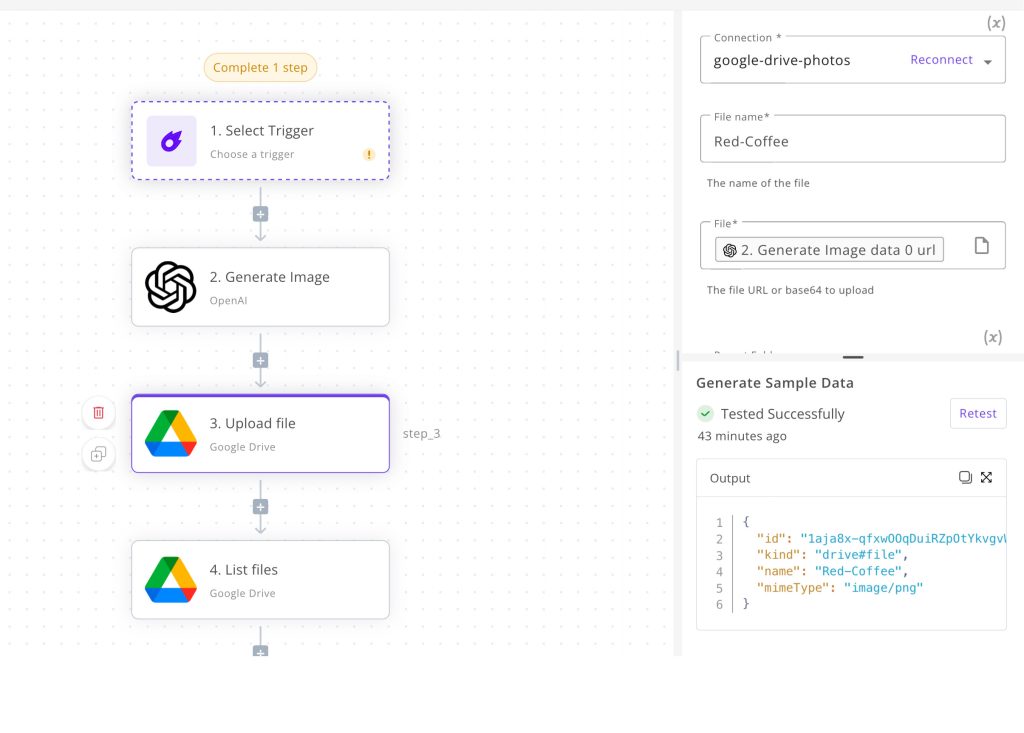
The next software for automated workflows is Activepieces. It is an open-source tool designed to connect apps and automate tasks across systems.
Best for:
- Open-source origin.
- Self-hosting deployment.
- Customizable workflows.
- Integrations with other SaaS tools.
3. Workato
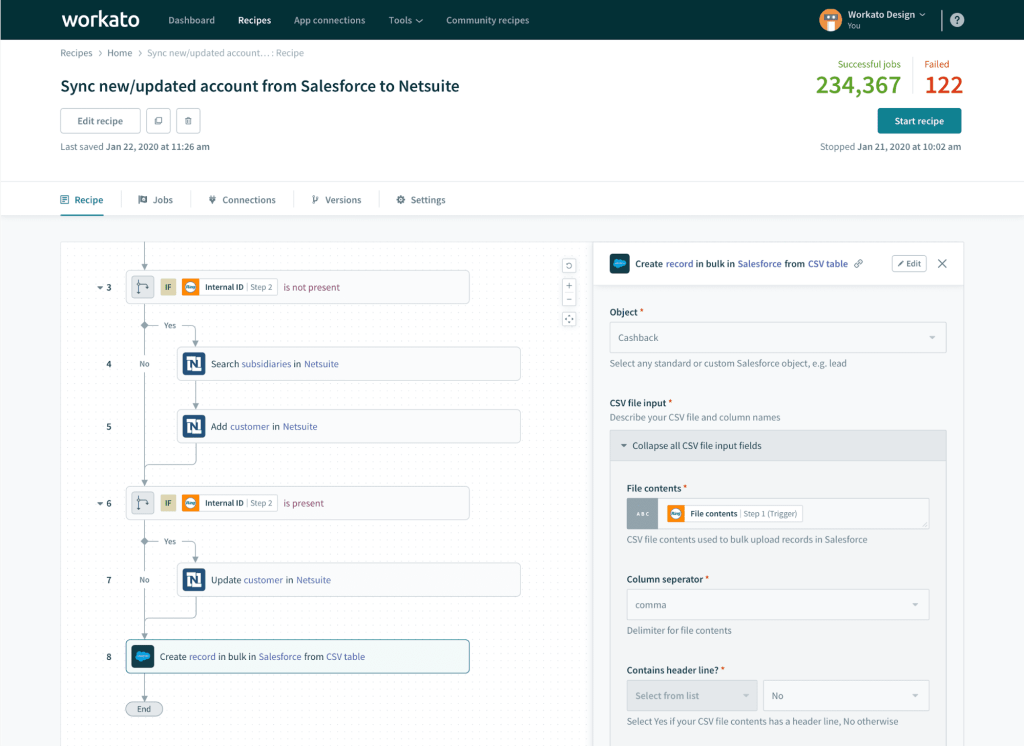
Workato is an enterprise-grade automation and integration platform (iPaaS) that helps organizations automate business processes across departments such as HR, finance, and IT.
Best for:
- Large enterprise integrations.
- Compliance-heavy industries.
- Complex multi-system workflows.
4. UiPath
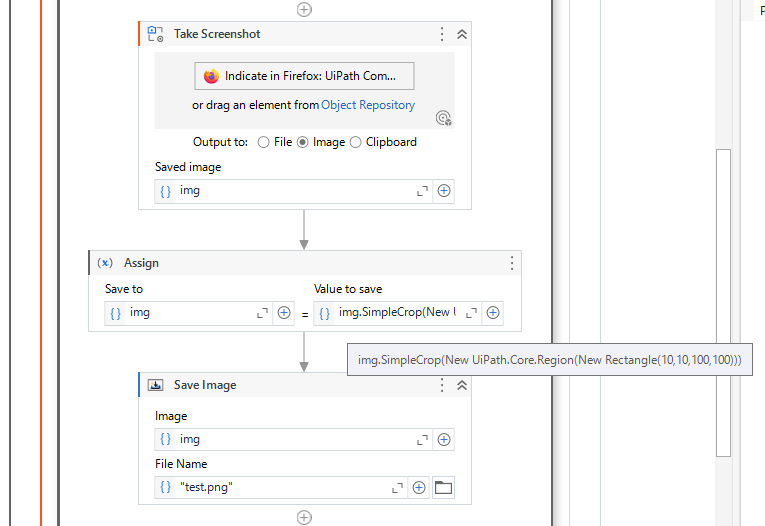
UiPath is one of the leading Robotic Process Automation (RPA) platforms. It automates repetitive tasks such as invoice processing and data entry using software bots that interact with applications like a human would.
Best for:
- Back-office automation.
- Legacy system integration.
- Document and data processing.
5. Make
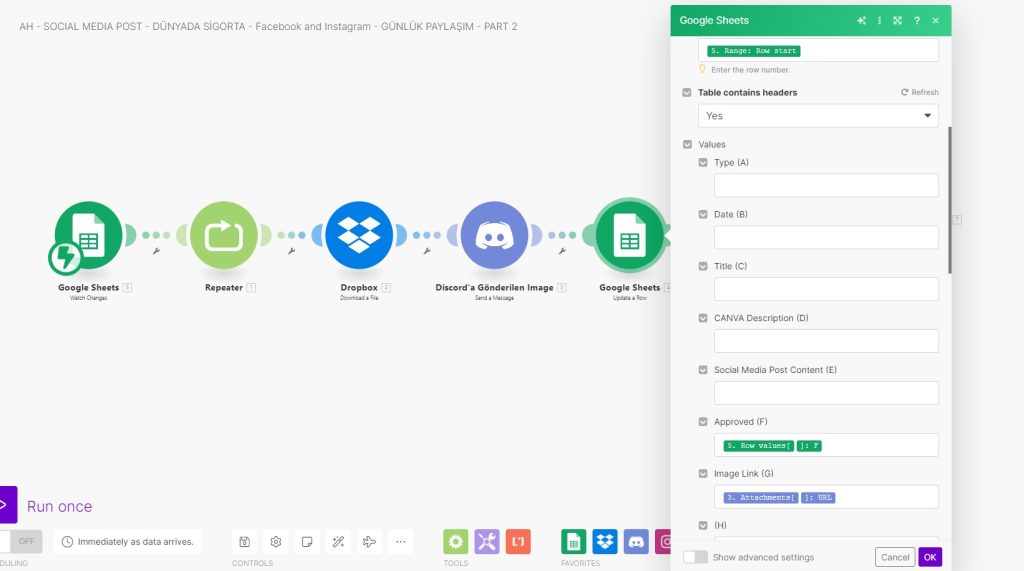
Make is a visual workflow automation platform that allows users to design complex automations using a flowchart-style interface.
Best for:
- Multi-step SaaS integrations.
- Marketing and operations automation.
- Visual workflow design.
Read More: Software Development Outsourcing Companies in the Netherlands: A Complete Guide
Conclusion
In conclusion, let’s briefly remember what we were talking about above:
- Enterprise automation breaks the linear growth trap, allowing you to multiply output and revenue without a proportional increase in headcount or operational complexity.
- The focus has shifted from rigid RPA to AI agent orchestration, where autonomous agents plan and execute complex processes across fragmented systems.
- Modern platforms act as the connectors for the enterprise, eliminating decision latency.
- A “visual+code” architecture enables non-technical teams to design workflows visually while allowing IT to inject custom logic, accelerating time-to-value.
Don’t forget to contact HYS Enterprise experts to explore all capabilities of EpicStaff and how it can benefit your organization.
FAQs
1. What is enterprise workflow automation?
Enterprise workflow automation is the strategic use of software to orchestrate complex processes across an entire organization’s departments and legacy systems using AI agents or other innovative technologies that can sync data between tools like ERPs and CRMs without manual intervention.
2. What is an enterprise workflow system?
An enterprise automation workflow software is a high-scale software infrastructure designed to coordinate, execute, and monitor complex business processes across multiple departments and disparate software platforms.
3. What is workflow automation?
Workflow automation is the use of software to execute repetitive tasks and move data between systems without manual intervention. This approach pays off a hundredfold in reduced number of human factor errors and significantly improved operational efficiency.
4. What are the best enterprise workflow automation platforms?
One of the best enterprise AI workflow automation tools is EpicStaff – AI agent orchestration platform that allows its users to create a team of digital employees and assign them to different tasks. Thus, they can execute multiple processes simultaneously, helping teams free their specialists for the more valuable activities.
5. What are the key features of enterprise workflow software?
The most important features you should look for in the perfect enterprise workflow automation software are:
- The ability to create multiple AI agents and assign them to specific tasks to reduce pressure on human specialists and reduce the number of manual errors as well.
- Integration capabilities with your current software to avoid siloed data and messy workflows.
- Hybrid (visual+code) architecture to make sure that specialists with different technical experience can work with the intelligent workflows and optimize them.
- Ability to customize workflows to adjust them to your specific needs and current corporate situation.
- Compliance with security standards to avoid data leaks and unauthorized access.
6. What are the benefits of enterprise workflow automation?
Thanks to automated enterprise workflow management, companies now can:
- Earn revenue faster.
- Make customers more satisfied with fast and quality service.
- Reduce compliance mistakes and risk of fines.
- Leaders can make better decisions.
- Make employees more satisfied.
- Increase profit margins.
- Strengthen appeal to investors.
7. How does AI improve enterprise workflow automation?
Artificial intelligence brings lots of benefits to enterprise workflow solutions, including:
- It reduces human intervention, making processes more independent and accurate.
- AI agents can navigate between applications and solve problems on their own.
- It is capable of predicting future trends or outcomes based on historical and real-time data.
- Can streamline messy data and turn it into a structured, readable format.
8. How do companies choose enterprise workflow automation software?
To choose a proper tool for enterprise AI workflow automation, take the following steps:
- Before looking at features, you must determine why exactly you need this tool. Which pain points must it cover?
- Then, evaluate must-have features and nice-to-have ones.
- Ask vendors for proven results or success cases where the tool delivered measurable business value.
- Look for security and compliance.
- Evaluate the total cost of ownership.
9. Why is workflow automation important for enterprise operations?
Because intelligent workflow automation combines business aspects with technical ones:
- Such software eliminates inefficient steps, bringing more strategic value to the execution.
- Ensures security of data and workflows.
- Allows companies to execute more with the same resources.
- Make decision-making more efficient.
10. What industries benefit most from enterprise workflow automation?
Automated workflows bring significant competitive advantage to the companies from industries where workflows consist of lots of repetitive manual tasks and are susceptible to human factor errors. These industries include:
- Financial services.
- Healthcare.
- Supply chain and logistics management.
- Manufacturing.
- Legal services.
References:
- https://www.researchgate.net/publication/376392595_Data_Silos_-A_Roadblock_for_AIOps
- https://www.researchgate.net/publication/230197558_Problems_in_delegation
- https://www.researchgate.net/publication/389889142_Shadow_AI_Cyber_Security_Implications_Opportunities_and_Challenges_in_the_Unseen_Frontier
- https://www.researchgate.net/publication/385257778_A_Study_of_Employee_Satisfaction_at_Workplace
- https://www.researchgate.net/publication/398820912_Workflow_Automation_with_LLMs_Practical_Guide_for_2025
- https://www.researchgate.net/publication/376581266_Advanced_Third-Party_Integrations
- https://www.researchgate.net/publication/388056494_Information_security_of_the_enterprise_as_a_technology_for_ensuring_information_protection
