
Traditional AI vs. Agentic AI in Telecom
Let’s, first things first, define, what is the difference between traditional and agentic AI.
What is traditional AI?
The term “Artificial intelligence” refers to an area of information technologies that replicate the work of the human brain, thereby analyzing huge amounts of information from OSS and BSS systems to automate particular business processes [1].
Such type of software is trained on predefined datasets and operates within fixed rules, which makes it impossible to take autonomous actions. As well, AI in telecom can be used for:
- It can detect fraud. Artificial intelligence allows telecom operators to detect anomalies in the network performance, thereby sending automatic alerts. It, in turn, helps telecom companies address fraud and unauthorized access.
- It can assist in customer service support. AI-powered chatbots can handle customer requests and help users solve some problems, analyzing historical data and best practices.
- It can predict future demand or bottlenecks. AI-powered systems can continuously monitor the environment, analyzing various performance metrics. In the future, it comes in handy in forecasting potential errors and bottlenecks as well as developing mitigation strategies before the exact problem will occur.
However, these systems still need human oversight to give accurate results and process data efficiently.
Read More: The Current State of AI in Telecom Software Development Industry
What is agentic AI in telecommunications?
By the definition, agentic AI is another emerging type of artificial intelligence whose distinguishing feature is full autonomy [2]. Thus, such systems can handle various difficult tasks with minimal human intervention and can continuously learn. It makes them stand out from other approaches and highly adaptable to new challenges.
Moreover, if we combine this concept with another emerging one called “generative AI” [3], we’ll get a far more interesting thing – AI agents. These, let’s call them, “team members” can communicate with each other and autonomously decide which actions to take to achieve predefined goals, thereby generating content on their own.
To see the differences, let’s compare traditional AI and agentic AI in telecom industry.
| Agentic AI | Traditional AI |
| Can act autonomously | Requires user input |
| Highly adaptable to the changes | Has limitations in adaptability |
| Can learn | Acts only according to predefined rules |
Agentic AI Use Cases in Telecom
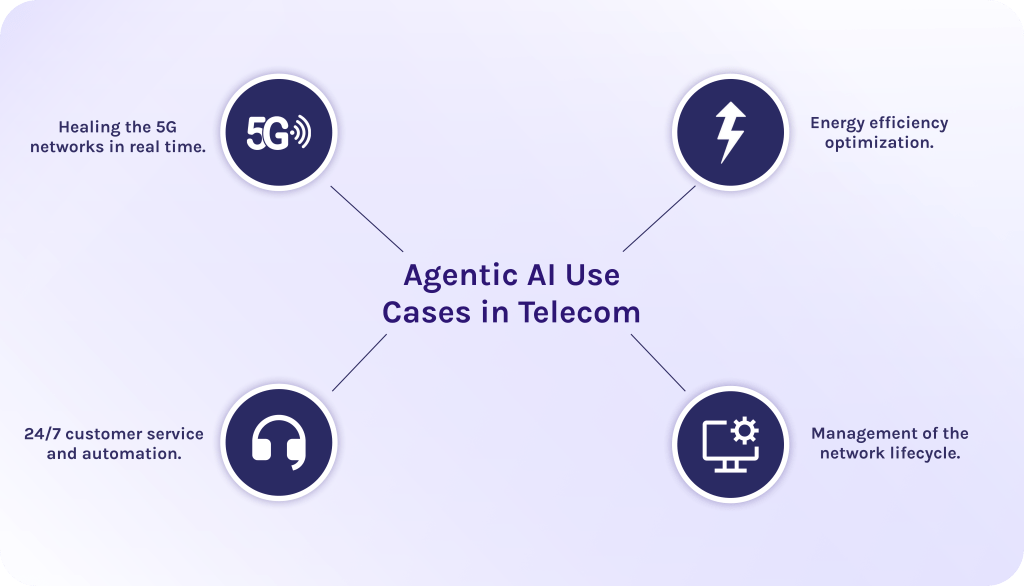
1. Healing the 5G networks in real time.
According to the research, healing in the context of 5G defines the set of automated processes whose main purpose is to maintain service quality and stable work. AI agents can detect network issues and fix them on their own.
This process has different types, listed below:
- Self-detection. The main purpose is monitoring various metrics like performance PKIs to detect unusual activity.
- Self-diagnosis. Isolating the problematic part and understanding causes of fault.
- Self-recovery. Taking actions to fix the problem.
- Self-optimization. Proactively improving network configurations to prevent future faults.
2. 24/7 customer service and automation.
AI agents become advanced virtual assistants that gather specific knowledge and can quickly analyze a user’s request and give the most relevant response, not predefined. As well, these virtual helpers don’t need to rest and cannot get sick, which makes them available at any time, providing fast and quality service to the customers. Among other agentic AI use cases in telecom, this might be the most widely used.
3. Management of the network lifecycle.
As well, from the other agentic AI use cases in telecom industry, stands out using these systems while planning and bringing the network changes into the life.
- AI-powered network planning. AI agent systems can evaluate geographical and business aspects of network rollouts and suggest the most suitable place and time to build infrastructure. As well, engineers can model various scenarios to see possible outcomes and evaluate perfect location and conditions as well as align all parts of the network together.
- AI virtual assistants. During project execution, AI agents can help experts in configurational validation or, for instance, in analysing efficiency metrics of already installed parts of infrastructure.
4. Energy efficiency optimization.
The last from the benefits of agentic AI that should be mentioned, is its broad capabilities in optimizing the energy consumption. For example, the system detects that some network parts don’t consume all the energy they receive; thus, the system can automatically power them down. This is especially important in terms of reducing a carbon footprint and reducing environmental pollution.
Read More: The Synergy of AI and IoT in Building the Ideal Healthcare System
Benefits of Agentic AI for Telecom Companies
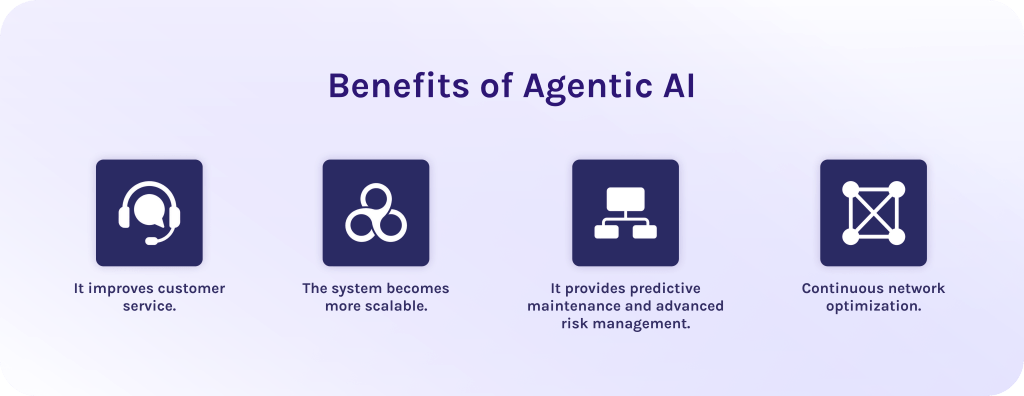
1. It improves customer service.
As traditional telecom systems depend on human beings, they cannot be managed properly while people are on vacation, sick, or sleeping. However, AI agent systems remove this barrier and provide always-on assistance, thereby instantly handling customer queries and increasing quality of customer service. Clients become more loyal and can even act like ambassadors of your company, suggesting your services to other people.
2. The system becomes more scalable.
Unlike traditional AI, AI agent systems are highly scalable, because you can create as many agents as you like. Each agent can be assigned to the specific role or domain like RAN optimization, customer experience management, security management, or, for instance, core network monitoring. You can cover almost any business pain point by creating specialized AI agents.
3. It provides predictive maintenance and advanced risk management.
Thanks to advanced algorithms, AI agent platforms can predict risks early and mitigate them autonomously. They can adjust on the fly to occurring problems by reconfiguring network elements, isolating faulty components, or triggering preventive maintenance before failures impact services [6].
4. Continuous network optimization.
Adoption of AI agents pays off a hundredfold, because the companies now can dynamically manage 5G slices and optimize traffic flows according to current demand. AI agents monitor performance metrics across RAN, core, and edge layers, to prevent congestion and service degradation to make your networks more resilient and stable.
Read More: An In-Depth Guide to Telecom Software Development
How EpicStaff’s AI Agents Impact Telecom Operations
EpicStaff is an AI agent orchestration platform, designed by HYS Enterprise to help companies create their own agentic AI systems. It has already gained traction among highly-regulated industries, like logistics, thanks to its open-source code and focus on security and transparency.
In terms of the telecom industry, it helps operators develop their own domain-specific autonomous OSS and BSS systems with:
- Advanced customer support functionality.
- Ability to manage network stability.
- Orchestrating multiple agents to automate almost any specific operation.
- Reducing operational costs and time previously spent on managing everything manually.
As well, it can be used by both no-code and technical users due to its hybrid Visual+Code structure. No-code users can create workflows in a visual builder, while technical specialists can insert custom Python code directly where needed.
What results can you expect from collaboration?
As an example, I will tell you about the collaboration of EpicStaff with Move Your Machine (MYM), a Dutch logistics company. MYM wanted to create a fully automated logistics platform, where the entire lifecycle would have been managed by AI agents instead of people to avoid inefficiencies.
As the result, with the help of EpicStaff, they’ve developed an AI-driven transportation system, results of which can be described by the following quote:
“MYM successfully transferred 80-90% of its work load to EpicStaff digital employees. This allowed the company to operate and scale with just two people, Wilbert and Arnо, instead of a team of twenty.”
Investor and co-founder of EpicStaff and HYS Enterprise, Yuri Warczynski.
To be more precise, now price calculation takes seconds instead of a few days, which saves up to 40% of delivery time. As well, the entire lifecycle is now fully automated and needs minimal human oversight.
If you want to empower your telecom operations with a fully autonomous agentic AI system and transform your approach to managing telecom services to achieve maximum efficiency and desired outcomes – contact HYS Enterprise specialists today.
Read More: What is a Mobile Virtual Network Operator (MVNO)? Benefits and Challenges
Conclusion
Agentic AI earns more and more popularity with each coming day and without any doubt it will become a new must-have in the next few years. Let’s quickly remember the main points of this article:
- Manual approach is no longer efficient in terms of managing complex and rapidly growing telecom services and infrastructure.
- As well, traditional AI systems also fall behind in providing needed scale of automation and autonomy.
- In turn, agentic AI fills these gaps due to its ability to act autonomously and automate as many processes as needed to minimize the level of human intervention.
- Specifically in telecom, agentic AI is used for network self-healing, improving customer service, continuous optimization, and predictive risk management.
- Adoption of AI agent systems like EpicStaff enable telecom companies to develop domain-specific, secure agentic AI systems for proactive OSS and BSS digital transformation.
Contact HYS Enterprise specialists to develop your own telecom agentic AI solution.
FAQs
What is agentic AI in telecom?
Agentic AI in telecom is an emerging AI type, which can autonomously perform tasks, make decisions, and continuously learn. Most often, it is used for self-healing and process optimization across the entire network.
What are examples of agentic AI in telecom?
Specifically in the telecom industry, AI agents can analyze the network performance to detect anomalies and fix them autonomously, with no human effort needed.
How is agentic AI different than AI?
Common AI tools act according to predefined instructions and cannot act autonomously. However, agentic AI in telecommunications is capable of making its own decisions and expanding its knowledge via continuous learning.
What is the difference between LLM and agentic AI in telecom?
The abbreviation LLM refers to “large language models” that can understand and interpret human language to process human requests, but cannot act on their own. In turn, agentic AI can take autonomous actions and make decisions to optimize networks or resolve outages, requiring minimal human effort.
What is the difference between GenAI and agentic AI in telecom?
GenAI, also known as generative AI is a type of artificial intelligence, which can generate various types of content like images, videos, text, and so on. It is mostly used in, for example, marketing where companies create telecom ad campaigns to promote their services.
Whereas agentic AI for telecom is a type of AI platform that can take autonomous actions and make decisions on its own, requiring minimal human intervention. It is used to perform multiple network operations and optimize them automatically in real time.
Can agentic AI reduce telecom operational expenses (OPEX)?
Indeed, agentic AI solutions help telecom companies to reduce OPEX thanks to early risk detection and automation of processes across the network. When workflows are streamlined and risks are mitigated, companies save money and can reinvest them into other strategic initiatives.
How does agentic AI improve the customer experience (CX)?
AI agents in telecom [5] can improve customer experience because they offer 24/7 customer support so that your clients don’t need to wait for the operator to solve their problem. As well, specialized AI agents address one of the biggest user pain points – personalization, by analyzing user behavior, preferences, and usage patterns to deliver tailored recommendations and customized service offers in real time.
What are the primary use cases for agentic AI in 5G and 6G networks?
Mostly, agentic AI is used in 5G and 6G networks for self-healing and self-optimization. To be more precise, the system detects fraud or issue and autonomously decides how to fix it and what actions it needs to take to achieve desired results.
What are the security risks of deploying agentic AI in telecom?
In some cases, malicious AI agents can imitate trusted systems to bypass security controls, which may result in data breaches. The other risk lies in lack of oversight of how agents work, leading to uncontrolled data exchange and, also, data leaks. Ultimately, if you feed agents with low quality data, it definitely will lower the reliability and accuracy of responses [4].
References:
- https://www.researchgate.net/publication/361023979_ARTIFICIAL_INTELLIGENCE_WHAT_IS_IT
- https://www.researchgate.net/publication/388313991_Agentic_AI_Autonomous_Intelligence_for_Complex_Goals_-_A_Comprehensive_Survey
- https://www.researchgate.net/publication/370965310_Generative_AI
- https://www.mckinsey.com/capabilities/risk-and-resilience/our-insights/deploying-agentic-ai-with-safety-and-security-a-playbook-for-technology-leaders
- https://uxmag.medium.com/how-agentic-ai-is-reshaping-customer-experience-from-response-time-to-personalization-c8588291b7fa
- https://www.researchgate.net/publication/395203067_The_Role_of_Agentic_AI_Toward_Autonomous_Secure_and_Resilient_Next-Generation_Networks
- https://www.researchgate.net/publication/391566323_Role_of_Agentic_AI_in_5G_Network#:~:text=Once%20a%20fault%20is%20identified,power%20or%20beamforming%20angles.
