
What is agentic AI?
First things first, we need to refresh our memory on what agentic AI is.
Agentic AI is artificial intelligence systems that have the ability to act autonomously and pursue specific goals. At the same time, they don’t need constant human oversight. You can create multiple AI agents and give them different tasks. They will decide how to act on their own, thereby learning new information and communicating with each other.
We can compare this dynamic with a real project team where you have a team leader and multiple team members, each of whom has their specific responsibilities and tasks to do.
Read More: A Practical Guide to Agentic AI Governance for Scale
How does agentic AI differ from traditional and generative AI?
To understand how exactly agentic AI systems have reshaped the vision of efficiency, we should take a quick look at the most common types of artificial intelligence.
What is traditional AI?
This type of artificial intelligence relies on strict linear rules to process inputs and deliver predictable outputs. It uses “if/then” conditional logic where all steps are foreseen: if something happens, then you have multiple options for what should happen next.
What is machine learning?
Here, everything becomes more dynamic and data-driven. Machine learning discovers its own rules from massive historical datasets and can recognize patterns. It excels at making mathematical predictions and classifications, though it remains highly specialized to its specific training data.
What are large language models?
These are a language-focused branch of machine learning designed to comprehend context, grammar, and user intent. They can interpret natural language and answer questions by predicting the most statistically probable next words.
Read More: Empowering Your Workflow: Unveiling the Surprisingly Diverse Uses of Large Language Models
What is generative AI?
Generative AI, in turn, uses LLMs to actively produce original content, such as text, images, or code, based directly on user prompts. It operates primarily as a reactive creative assistant, keeping its execution confined to a closed chat window.
Agentic AI compared to other types of artificial intelligence.
AI agents use different LLMs to break down major goals into small, consequent tasks. It can independently use software tools, connect to APIs, self-correct errors, and execute entire workflows without needing continuous human prompting.
| Traditional AI & ML | Generative AI | Agentic AI | |
| Core intent and output | Processes historic data to forecast numbers or detect anomalies. | Generates content or summaries based on its training patterns. | Achieves high-level goals by independently running end-to-end operational workflows. |
| Operational loop | Executes pre-programmed “if/then” parameters in a single pass. | Does nothing until a human provides a specific prompt, answering once and stopping. | Decomposes an objective into a plan, reflects on errors, and self-corrects until done. |
| Interaction with tools | Highly restricted to the specific data pipelines or telemetry databases it was custom-built to watch. | Sandboxed inside a chat interface. | Connects directly to APIs, web browsers, databases, CRMs, and internal enterprise software. |
Read More: Low Code Platform: Complete Guide to Low-Code Development Platforms in 2026
Why does agentic AI matter for enterprises?
Large market players are moving toward AI agents because they solve the ultimate limitation of generative AI: the requirement for constant human prompting. But what are the other reasons you should implement agentic enterprise systems into your daily business routine?
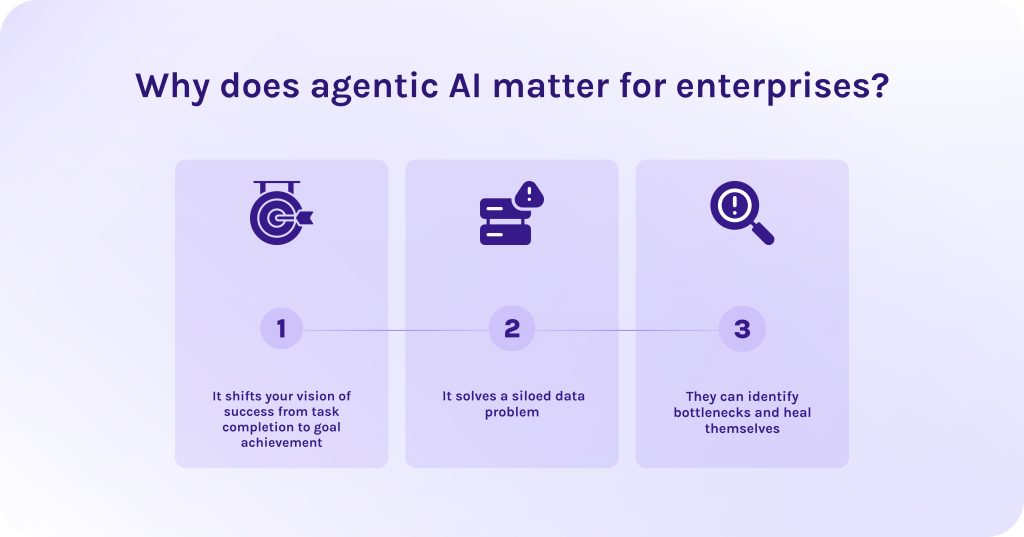
1. It shifts your vision of success from task completion to goal achievement.
Traditional enterprise systems and basic chatbots require constant human intervention—you have to give them step-by-step instructions. In turn, agentic AI systems allow you to input a single, big corporate objective. The system itself will break the goal into smaller, sectional tasks and assign each task to a specific AI agent with needed skills. As well, it can navigate across separate internal software platforms (like your ERP and CRM) to gather relevant data or update required fields without a human having to hand off files between silos.
2. It solves a siloed data problem.
Data from leading firms confirms that the major bottleneck in corporate efficiency isn’t employee speed; it’s the operational coordination between fragmented tools. Can you imagine that on average a corporate worker toggles between different applications and websites roughly 1,200 times per day? This unrelenting cycle of “app toggling” equates to context switching every 24 seconds, imposing a massive cognitive tax [4].
Another research demonstrates that chronic multitasking and juggling fragmented software tools consume up to 40% of an employee’s daily productive time purely in reorientation overhead. The broader economic ripple effect of this fragmented focus costs the U.S. economy an estimated $450 billion annually [5].
In this case, AI agent systems are shifting user experiences away from manual app-clicking to solutions that handle complex processes 24/7 on their own. This transition allows enterprises to scale their operational capacity exponentially during seasonal spikes without a linear increase in headcount or overhead.
3. They can identify bottlenecks and heal themselves.
Legacy automation (like Robotic Process Automation, or RPA) breaks the moment a web page changes or a data format shifts even slightly. Because agentic AI solutions relies on a core reasoning framework, it possesses an iterative loop: plan, act, evaluate, and reflect. If an API returns an error or a document is missing context, the agent doesn’t crash; it analyzes what went wrong and self-corrects mid-workflow.
Read More: AI Agent Orchestration in 2026: A Guide to Building Scalable Multi-Agent Systems
How does agentic AI work in enterprises?
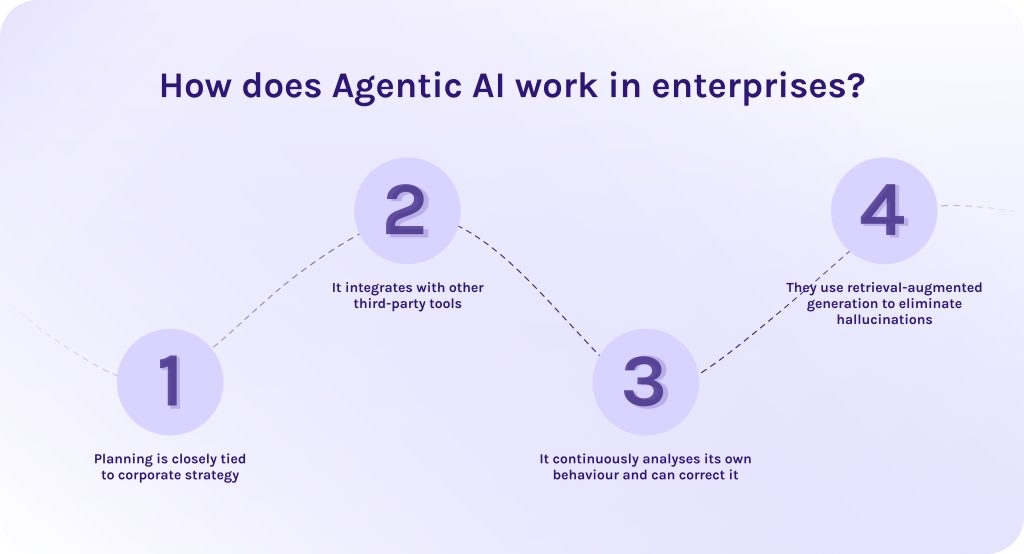
- Planning is closely tied to corporate strategy. Instead of requiring step-by-step instructions, the core AI agents take a large corporate objective and independently decomposes it into smaller tasks
- It integrates with other third-party tools: AI agents can connect to other applications via secure APIs to interact directly with existing software stacks. It allows them to autonomously browse webs, query SQL databases, update CRMs, and modify ERP systems.
- It continuously analyses its own behaviour and can correct it: The enterprise agentic AI system uses an iterative loop to evaluate its own execution path in real time.
- They use retrieval-augmented generation to eliminate hallucinations: This framework restricts reasoning of AI agents and answers strictly to verified, internal corporate knowledge bases.
Now, when we’re aware of the basics of enterprise agentic AI, you may come up with the question, “Is our organization actually ready to deploy this kind of autonomy?” Well, for this reason, we’ll further talk about AI maturity.
Read More: AI Agent Management Platform: A Guide to Enterprise AI Agent Orchestration and Governance
What is AI maturity?
AI maturity is the ability of the organization to deploy, measure, manage, and scale artificial intelligence to drive continuous business value. We can use it as a specific metric to determine whether a company is merely experimenting with AI solutions or truly aligns agentic enterprise with the corporate strategy, data infrastructure, corporate culture, talent, and governance frameworks.
Read More: Enterprise Workflow Automation: The Key to Scalable Operations
What are levels of AI maturity?
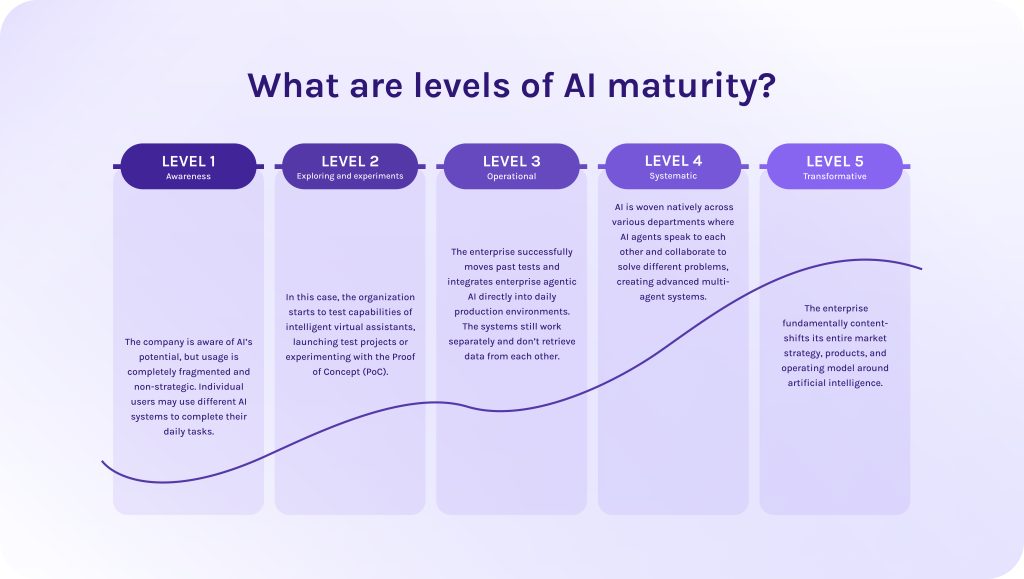
There are five levels of AI maturity:
- Awareness: The company is aware of AI’s potential, but usage is completely fragmented and non-strategic. Individual users may use different AI systems to complete their daily tasks.
- Exploring and experiments: In this case, the organization starts to test capabilities of intelligent virtual assistants, launching test projects or experimenting with the Proof of Concept (PoC).
- Operational: The enterprise successfully moves past tests and integrates enterprise agentic AI directly into daily production environments. The systems still work separately and don’t retrieve data from each other.
- Systematic: AI is woven natively across various departments where AI agents speak to each other and collaborate to solve different problems, creating advanced multi-agent systems.
- Transformative: The enterprise fundamentally content-shifts its entire market strategy, products, and operating model around artificial intelligence.
Read More: What Is Business Process Automation? Strategy, Tools, Benefits, and Enterprise Use Cases
What are use cases of enterprise agentic AI?
I want to show you how you can build efficient workflows using enterprise agentic AI software.
As an example, I’ll take EpicStaff – an open-source, self-hosted orchestration platform featuring a node-based visual UI built over a Django backend. It allows software engineers to build integrations using Python or Model Context Protocol (MCP), while giving operations teams and auditors the ability to inspect, modify, and visually audit every single decision the agent makes through visual interface.
The collaboration between EpicStaff and Move Your Machine (MYM), the Dutch transportation company, is one of the most prominent real-world case studies of an “AI-first” enterprise in action.
MYM didn’t want to rely on one massive, slow AI model. Instead, they used EpicStaff to deploy a modular network of 43 specialized AI agents. These digital workers collaborate seamlessly, using EpicStaff’s persistent context layer to pass data back and forth.
While using EpicStaff, MYM achieved:
- MYM successfully managed its rapid operational growth and scale with a core team of just 2 human operators instead of the traditional 20 required by a legacy freight forwarder.
- Now, humans in this system are strategic managers who handle exceptions.
- Roughly 80% to 90% of all administrative tasks associated with customer order handling and back-office invoicing were completely offloaded to the virtual enterprise AI team.
- Automating the instant coordination loop cut out the time-consuming human handoffs, resulting in up to a 40% reduction in end-to-end delivery cycle times.
The massive success achieved by Move Your Machine proves that Agentic AI is no longer a futuristic concept. It is rather a production-ready strategy for scaling enterprise capacity without a linear increase in overhead or headcount. If you want to know how EpicStaff can improve your productivity – contact HYS Enterprise experts.
Read More: AI-Driven Automation as the Foundation of Next-Gen SaaS Models
What are the risks of agentic AI implementation in enterprises?
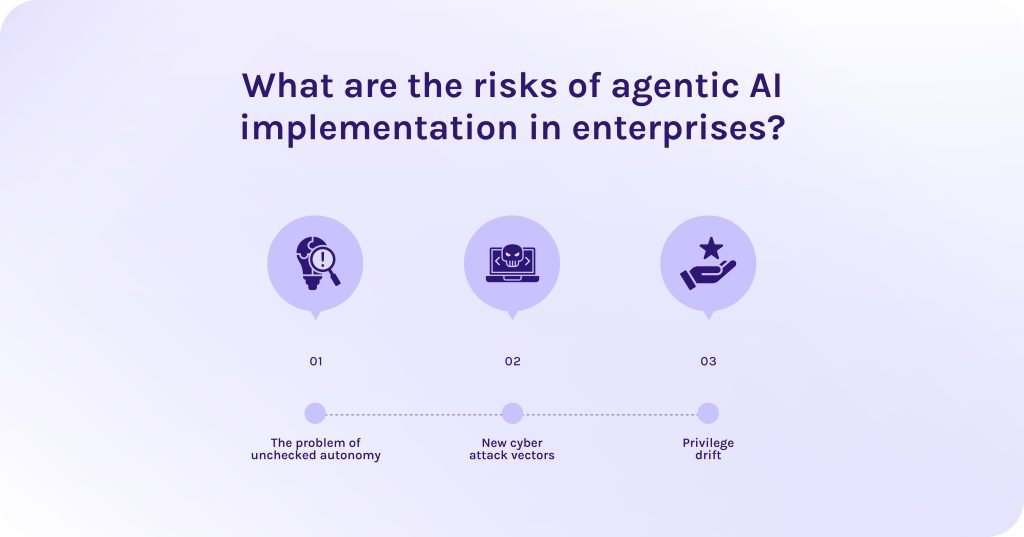
Alongside all advantages and efficiency boost, enterprise agentic AI also brings several risks. The primary risks of agentic AI implementation include:
- The problem of unchecked autonomy: AI uses independent decision loops. If an enterprise AI agent processes a flawed data point or experiences a subtle reasoning hallucination, it can propagate bad decisions across multiple software solutions it is connected to.
- New cyber attack vectors: Enterprise agentic AI is highly susceptible to prompt injection via external documents or incoming emails. When an autonomous agent scans that data, the injected text can overwrite its core programming.
- Privilege drift: Because enterprise agentic AI requires wide access to independently navigate between software applications, they are frequently over-permissioned. This creates a situation where a single compromised agent account provides a malicious actor with unchecked administrative authority to modify security configurations or exfiltrate core corporate records.
Read More: AI Outsourcing: Complete Guide to Benefits, Vendor Selection, and Implementation Success
Conclusion
A few years ago, enterprise agentic AI sounded like something from the “Detroit: Become Human” video game. We just learned how to efficiently generate content with AI, and now, in 2026, it’s already capable of making strategic decisions without humans. Let’s quickly recap the main points of the article:
- Enterprise agentic AI are the systems that can take autonomous actions and communicate with each other to decide which way of solving this particular problem is the best.
- Enterprises have successfully evolved from basic generative AI prompts to deploying fully autonomous agentic networks that can independently execute multi-step workflows and self-correct when system parameters change.
- However, with all benefits, AI agents are highly susceptible to prompt injection. Moreover, if it hallucinates, the consequences can spread across the other connected third-party software, leading to inaccurate outputs and wrong decisions. Ultimately, they are often over-permissioned.
If you want to develop your own enterprise agentic AI system or try to set up workflows in the existing one – contact HYS Enterprise experts for help.
FAQs
1. How agentic AI drives enterprise software growth?
Agentic AI solutions drive enterprise growth by shifting applications from passive tools that require constant human prompting into systems that can execute end-to-end workflows on their own.
2. What is enterprise agentic AI?
Enterprise agentic AI is autonomous AI systems that can independently break down high-level corporate goals into smaller tasks and execute them. Their capabilities go far beyond just answering prompts or generating text. These systems utilize secure enterprise data and APIs to operate as a self-directed digital workforce capable of running end-to-end business operations.
3. How is agentic AI reshaping enterprise software?
- With AI agents, enterprise software becomes more independent and needs less human oversight.
- Consequently, with less human intervention you’ll get a decreased number of human errors and more accuracy.
- Enterprise AI agents can decompose complex workflows into multi-agent systems that can dynamically reason and delegate sub-tasks to other entities.
- This software can correct itself when an API error or operational roadblock occurs, leading to increased autonomy.
4. How do we implement agentic AI in our enterprise?
To successfully implement enterprise agentic AI in your organization, consider the following points:
- Identify workflows you want to automate. Find what workflows take most of your time but have high strategic impact. It can be marketing research or, for instance, creating technical tasks for SEO articles.
- Access your data pull. Evaluate your data pipeline and build a secure Retrieval-Augmented Generation (RAG) to ensure that your agents pull strictly from accurate corporate knowledge bases to prevent hallucinations.
- Choose the tech stack. Select an enterprise-grade agent orchestration framework, like EpicStaff.
- Create and test your first agent. Build a prototype to monitor how effectively the AI agent makes decisions.
- Don’t forget about human-in-the-loop (HITL). Design mandatory human review checkpoints directly into your workflows for high-risk decisions. These decisions must wait for manual approval.
- Ensure safety and compliance. Implement strict role-based access controls (RBAC) so the AI agent inherits the exact data permissions of its user.
- Deploy your agent and monitor its work. Roll out the system in controlled phases while closely tracking production metrics.
5. How is agentic AI used in enterprise workflows?
- They not only process users’ queries and answer questions, agents independently execute multi-step workflows across disjointed systems. Such AI solutions can make API calls simultaneously to CRM, ERP, databases, and, ultimately, financial systems to process all that data at the same time.
- Agentic workflows use reasoning loops to correct themselves if something went wrong or safely escalate to a human manager when hitting an operational roadblock.
- Complex enterprise processes are broken down and handed to a network of specialized agents that share context and pass tasks between each other to complete large-scale business objectives.
6. How to measure ROI from enterprise agentic AI?
To measure ROI from AI agents for enterprises, you can use the following metrics:
- Calculate ACCT (agent cost per completed task): (Total run cost + human cost + overhead + amortized build cost) / number of successful tasks.
- Full autonomy rate: (Number of tasks fully resolved by AI / total number of tasks) × 100.
- Error reduction rate: (Pre-AI error rate – post-agent error rate) \ сost to аix an error.
7. Who offers the leading enterprise agentic AI?
EpicStaff, developed by HYS Enterprise, is an open-source AI agent orchestration platform. Here, multiple AI agents work together to solve complex problems by delegating different tasks to separate agents. They are capable of autonomous decision making which they make on their own, requiring minimal human intervention to autoname complex business processes.
8. How does agentic AI differ from traditional AI assistants and chatbots?
Agentic AI systems can independently decompose a complex objective into a multi-step action plan. They authenticate to external APIs and self-correct its own errors to change states and execute workflows across enterprise software without needing constant human intervention.
9. What business problems can enterprise agentic AI solve?
- It operates seamlessly across disconnected systems like CRMs and ERPs, updating records and extracting data via APIs.
- It can prevent supply chain disruptions by monitoring inventory anomalies and shipping delays in real time.
- It can autonomously identify and resolve system bottlenecks.
- If we are talking about more specific use cases, for instance, HR agents streamline onboarding by coordinating data cross-checks across multiple departments.
10. How can agentic AI automate complex business workflows?
AI agents for enterprises use a reasoning engine to decompose large goals into consequent sub-tasks. It then uses native API integrations to autonomously navigate software systems and apply self-correction loops to resolve bottlenecks without requiring continuous human prompting.
References
- https://www.mordorintelligence.com/industry-reports/agentic-ai-market#:~:text=Study%20Period,sorted%20in%20no%20particular%20order
- https://paul-okhrem.com/enterprise-ai-agents-statistics-2026/#executive-summary
- https://finance.yahoo.com/markets/crypto/articles/europe-building-foundations-trusted-agentic-195802993.html?guccounter=1&guce_referrer=aHR0cHM6Ly93d3cuZ29vZ2xlLmNvbS8&guce_referrer_sig=AQAAAHQH8hPT6N9wHPKOL2USjmcpFhXP9JqnaJIHKj-NQHfNo-AB1D4EzunNuudDNJJY8bGrDbq5VPhIL7PZOVuEd2ssMxBIxHQXjQsfAtJWeXWmsHCQAhmg0gxt5_6EnoEy_HPAIZU6H2yya5DA_u_L1sC96x0sklZVrnSa2yCl8JIX
- https://conclude.io/blog/context-switching-is-killing-your-productivity/
- https://speakwiseapp.com/blog/context-switching-statistics
- https://www.researchgate.net/publication/394937970_Artificial_intelligence_AI_agents_and_the_future_of_customer_loyalty
- https://www.researchgate.net/publication/394539994_A_Comprehensive_Review_of_AI_Agents_Transforming_Possibilities_in_Technology_and_Beyond
- https://www.researchgate.net/publication/393620165_The_Rise_of_Autonomous_AI_Agents_Automating_Complex_Tasks
- https://www.researchgate.net/publication/389562150_AI_Agents_A_Systematic_Review_of_Architectures_Components_and_Evolutionary_Trajectories_in_Autonomous_Digital_Systems